Internal Credit Rating Model in Banks: Scorecards, Grades and Validation
Every bank sanctioning a term loan or a working capital limit above a threshold runs the borrower through an internal credit rating model in banks before the file ever reaches the sanctioning authority. For a Certified Credit Professional candidate, this is not a side topic — it is the engine behind pricing, provisioning and portfolio limits. This article walks through how scorecards are built, how rating grades are assigned and validated, and where these models sit alongside capital and appraisal norms, with direct links into the CCP study chapters you will need for the exam.
📊 What an Internal Credit Rating Model Actually Does
An internal credit rating model in banks is a structured tool that converts scattered borrower information — balance sheet ratios, conduct of account, industry outlook, management quality — into a single grade on a bank-defined master scale, typically running from AAA-equivalent (lowest risk) down to a default grade. Unlike an external rating from a credit rating agency, this grade is generated and owned entirely inside the bank, using data the credit officer and the relationship team gather during appraisal. The output feeds three downstream decisions: whether to sanction the facility, at what spread over the benchmark rate, and how much provision to carry against expected loss.
Rating models differ by borrower segment because a corporate with audited financials cannot be scored the same way as a small trader with informal records. Large corporate and mid-corporate models lean heavily on financial ratios pulled from the same appraisal exercise covered under Credit Appraisal, while retail and small-business scorecards rely more on bureau scores, banking behaviour and demographic filters. Both streams, however, share the same governance backbone — a rating policy approved by the board, a defined periodicity for review, and an independent function that challenges the score before it is finalised.
Because the rating drives pricing, credit officers are trained to treat every input field as an audit trail item, not a formality. A rating that is padded to clear an internal hurdle rate is one of the most common findings in credit audits, and CCP candidates should expect at least one scenario-based question built around this exact failure mode.
🏗️ Building the Scorecard: Financial and Non-Financial Parameters
A typical scorecard splits its weight between two buckets. The financial bucket — usually 50 to 60 percent of total weight for corporate models — scores ratios such as the current ratio, debt-equity, interest coverage, and operating margin trend over the last three audited years. The non-financial bucket covers management track record, industry risk, regulatory exposure, account conduct, and the strength of the security package. Each parameter is scored on a fixed sub-scale, and the sub-scores are aggregated using bank-specific weights into a composite score, which is then mapped to a grade on the master scale.
The weighting itself is not arbitrary; it is calibrated using historical default data so that parameters with genuine predictive power for that portfolio carry more weight than cosmetic ones. This is exactly where the model overlaps with the borrower-classification logic taught under Types of Borrowers & Types of Credit Facilities, since a scorecard built for a manufacturing SME cannot simply be reused for an NBFC borrower or a real-estate developer without re-calibrating the parameter set.
💡 Exam Tip: If a question asks why banks use separate scorecards for corporate, SME and retail segments, the correct answer is always about parameter and data availability differences, not about regulatory mandate.
Most banks also build in override provisions, where a relationship manager or credit committee can move the model-generated grade by one or two notches with documented justification — for instance, an unusually strong promoter net worth not fully captured by the ratio set. Every override is logged and reviewed separately during the annual validation exercise, because a pattern of upward overrides without justification is itself a red flag for the rating desk's independence.
🎯 Grade Masters, Notching and What Each Grade Means for Pricing
The master scale is the reference table every rating ultimately lands on. A typical scale runs ten to twelve notches, with the top grades reserved for borrowers whose probability of default is negligible over a one-year horizon and the bottom grades flagging accounts headed toward the watch-list or NPA classification. Each notch is anchored to an indicative probability-of-default (PD) band, and the bank's pricing committee maps a risk premium to that band so that a lower grade automatically attracts a higher spread over the base rate or MCLR.
This is also the point where the internal credit rating model in banks connects directly to capital planning. A portfolio skewed toward lower grades consumes more risk-weighted assets and pushes up the capital charge the bank must hold, which is why the rating desk and the capital-planning team under Capital Adequacy track grade migration every quarter. It is worth noting for exam purposes that Indian banks continue to compute regulatory capital for credit risk under the Standardised Approach; internal rating grades drive pricing, provisioning and limit-setting, not the regulatory capital formula itself, since RBI has not operationalised the Internal Ratings-Based approach for domestic banks as of 2026. The portfolio-level view built from these grades also feeds the bank's own internal capital adequacy assessment process, which candidates preparing for risk-management papers should study as a companion topic.
⚠️ Common Mistake: Candidates often assume a bank's internal AAA grade is equivalent to an external agency's AAA rating. The scales are not calibrated to each other and the two should never be equated in an answer.
Grade-linked pricing also ties into risk-adjusted return, an area candidates should revise alongside Importance & Application of RAROC, since a relationship-level RAROC calculation uses the same PD band that the rating model assigns.
🔍 Validation, Back-testing and Rating Migration
A rating model is only as good as its last validation cycle. Banks are expected to validate models at least annually through three checks: discriminatory power (does the model actually separate good accounts from bad ones), calibration accuracy (do the PD bands match the realised default rate), and stability (are borrowers migrating grades in a pattern consistent with genuine credit-quality change rather than model noise). Back-testing compares the grade assigned twelve months earlier against the account's actual performance today, and a migration matrix tracks how many accounts moved up, stayed flat, or slipped down a grade over the period.
A rising share of downgrades relative to upgrades in the migration matrix is an early portfolio-health signal, often visible well before slippage shows up in the standard stressed asset resolution pipeline. Independent validation is usually housed in risk management or an internal audit function separate from the credit-sanctioning chain, precisely so that a desk under pressure to keep grades favourable cannot mark its own homework.
📌 Remember: Discrimination, calibration and stability are the three pillars of rating-model validation — examiners frequently ask candidates to match a described symptom to the pillar it violates.
Where validation exposes a systematic bias — say, the model consistently under-rates risk for a particular industry after a sector downturn — the fix is a re-calibration of weights, not a one-off manual override of individual accounts. Banks document these re-calibrations and place them before the board-level risk committee, since the rating model is treated as a material risk-management tool under the bank's own credit policy framework.
🔄 Internal Rating in the Wider Credit Cycle
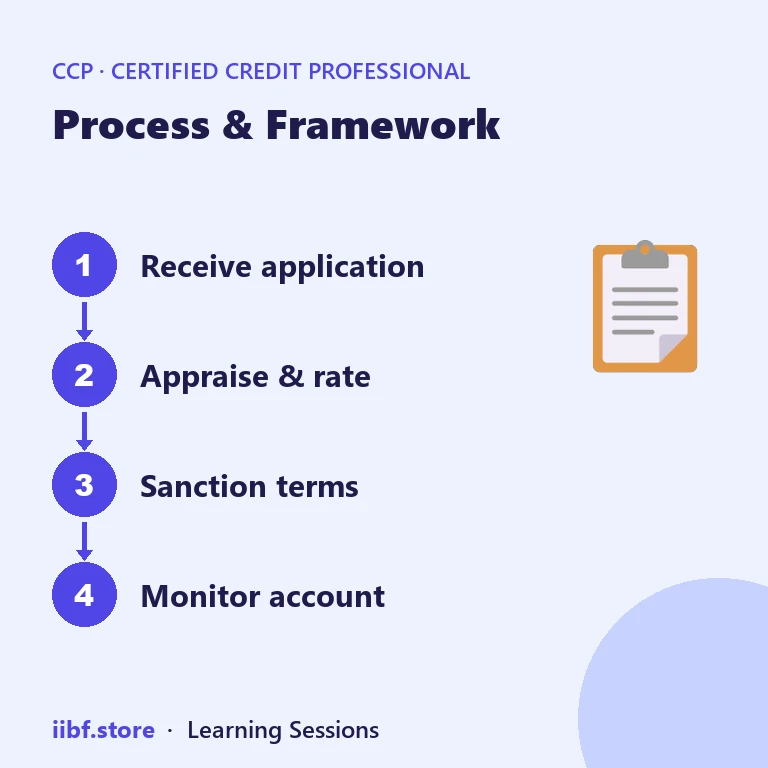
The rating grade does not stand alone; it is one output of a chain that starts at policy and ends at monitoring. The bank's overarching approach to who gets financed and on what terms is set out first under A Credit Policy, which in turn draws on the foundational lending principles in Principles of Lending. The rating model operationalises those principles into a repeatable, documented score rather than leaving each sanctioning officer to apply judgement inconsistently across files.
Once a facility is sanctioned, the rating grade also shapes how it is delivered and monitored, an area explored under credit delivery mechanisms and the periodic review cycle that every rated account goes through. A grade is never treated as permanent: a fresh rating exercise is triggered at each renewal, after a covenant breach, or when materially adverse information comes in outside the normal review cycle, such as a return of cheques or a delay flagged during account conduct monitoring.
For CCP candidates, the practical exam angle is almost always scenario-based: given a set of financial ratios and a conduct note, identify which grade band the borrower likely falls into, or identify which validation pillar has been breached. Reading the model mechanics once is rarely enough — working through the sibling article on second method of lending alongside this one helps connect assessment methodology to the rating output that the assessment ultimately feeds.
| Feature | Internal Credit Rating Model | External Agency Rating |
|---|---|---|
| Who assigns it | Bank's own credit/risk function | SEBI-registered rating agency |
| Used for regulatory capital (India, 2026) | ✗ Not under Standardised Approach | ✓ Yes, for eligible exposures |
| Drives internal pricing/spread | ✓ Directly | ✗ Indirectly, if at all |
| Review frequency | Annual, plus trigger-based | Annual, plus surveillance |
| Scale comparability across issuers | ✗ Bank-specific | ✓ Broadly comparable |
| Validated by | Independent risk/audit function | Agency's internal committee + regulator |
For broader context on how India's credit-risk capital framework interacts with these models, RBI's Master Directions on Basel III capital regulations remain the primary source candidates should cite rather than any secondary summary.
🧠 Practice MCQs: Internal Credit Rating Models in Banks
Q1. The primary purpose of an internal credit rating model in a bank is to (a) replace the need for external audit (b) generate a bank-specific risk grade that drives pricing and provisioning (c) satisfy only statutory audit requirements (d) calculate GST liability of the borrower
Answer: (b) — The model converts borrower data into a grade used internally for pricing, provisioning and sanction decisions.
Q2. Under the current regulatory framework applicable to Indian banks in 2026, internal rating grades are used for (a) computing regulatory capital under the IRB approach (b) internal pricing and provisioning, with regulatory capital still under the Standardised Approach (c) replacing the credit appraisal process entirely (d) fixing statutory liquidity ratio
Answer: (b) — RBI has not operationalised the IRB approach for Indian banks; capital charge for credit risk continues under the Standardised Approach.
Q3. In rating-model validation, "calibration accuracy" specifically checks whether (a) the model runs without software errors (b) the assigned PD bands match the realised default rate (c) the borrower's audited financials are error-free (d) the master scale has enough grades
Answer: (b) — Calibration compares the predicted probability of default for each grade against actual observed defaults.
Q4. A rating migration matrix is used to track (a) branch-wise loan disbursement (b) movement of borrower accounts between rating grades over a period (c) changes in the repo rate (d) staff transfers within the credit department
Answer: (b) — It shows how many accounts upgraded, stayed stable, or downgraded across a defined review period.
Q5. When a credit officer overrides a model-generated grade upward without adequate documented justification, this is best described as a (a) normal and encouraged practice (b) breach of rating-model governance requiring review (c) statutory violation of the Banking Regulation Act (d) technical rejection reason for the loan
Answer: (b) — Undocumented or unjustified overrides undermine the independence of the rating process and are flagged in validation and audit reviews.
Want chapter-wise mock tests with 100+ MCQs? Start practising free →
❓ Frequently Asked Questions
Is an internal credit rating the same as a CIBIL or bureau score?
No. A bureau score reflects an individual's or entity's repayment history across lenders, while an internal credit rating model in banks combines financials, conduct of account and qualitative factors specific to that bank's own portfolio and policy.
How often is a borrower's internal rating reviewed?
Typically at least once a year at renewal, and additionally whenever a trigger event occurs, such as a covenant breach, a sharp fall in turnover, or adverse conduct in the account.
Does a lower internal rating grade always mean higher loan pricing?
In almost all banks, yes — the master scale is linked to a pricing grid, so a lower grade typically attracts a higher spread over the benchmark rate, reflecting the higher assessed probability of default.
Who validates a bank's internal rating models?
Validation is carried out by a function independent of the credit-sanctioning chain, usually risk management or internal audit, to ensure the model's discriminatory power, calibration and stability are not compromised by sanctioning pressures.
Internal credit rating models sit at the intersection of appraisal, pricing and capital planning, which is exactly why CCP examiners test them from multiple angles rather than as an isolated topic. Revisit the linked chapters above, work through the tag archive of Certified Credit Professional articles, and once the mechanics feel solid, take a full-length paper on iibf.store/tests to see how rating-model questions actually get framed under exam pressure.
Quick quiz on this topic
5 exam-style questions from our free test bank — check yourself before you move on.
Practice this topic
Take a free mock test, download chapter PDFs, or watch a video class — all included on iibf.store.