Internal Capital Adequacy Assessment Process for IIBF Exams
The internal capital adequacy assessment process is a bank's own, Board-owned answer to one question: how much capital does this balance sheet actually need, given every risk it runs — not merely the three that Pillar 1 puts a formula on? Regulatory minimums are a floor, not an opinion about your bank. ICAAP is where a bank forms that opinion, documents it, defends it to the supervisor, and then holds capital accordingly. For IIBF Risk Management candidates this is one of the highest-yield chapters in the syllabus, because examiners can test it as concept, as arithmetic, and as regulatory process.
This guide walks through what ICAAP demands, which risks it must capture, how capital planning and stress testing feed into it, and exactly where it stops and supervisory review begins.
🧭 What the Internal Capital Adequacy Assessment Process Actually Requires
ICAAP is not a document you produce once a year to satisfy an inspection. It is a continuous process, and the document is only its output. Under the Basel framework as implemented by the Reserve Bank of India in its Basel III capital regulations, every bank must have a Board-approved process to assess its overall capital adequacy in relation to its risk profile, plus a strategy for maintaining capital at that level.
Four features define a defensible ICAAP:
- Board and senior management oversight. The Board owns the risk appetite and signs off the capital plan; management cannot outsource this to the risk department.
- Comprehensive risk assessment. All material risks — not just those with a Pillar 1 charge — are identified, measured where measurable, and mitigated or capitalised where not.
- Sound capital assessment. A method that links measured risk to a capital number, with the assumptions written down.
- Monitoring, reporting and independent review. Internal audit or an equivalent independent function must challenge the process.
Proportionality is the practical rule. A large, complex bank with a trading book is expected to run economic-capital models; a small bank may run simpler, more conservative buffers. What is never proportionate is skipping a material risk. ICAAP is applied at the solo level and again at the consolidated level, so subsidiaries and group exposures cannot be quietly left out of the arithmetic.
💡 Exam Tip: ICAAP is a bank-run process; SREP is the supervisor-run review of it. Any option that says the supervisor prepares the ICAAP is wrong, however plausibly it is worded.
🏛️ Where ICAAP Sits Among the Three Pillars
Pillar 1 prescribes minimum capital for credit, market and operational risk using regulator-specified approaches. Pillar 2 is the supervisory review process, and it has two halves — the bank's ICAAP and the supervisor's evaluation. Pillar 3 is market discipline through disclosure. Candidates lose marks by treating Pillar 2 as one activity; it is deliberately two-sided.
Indian minimums under RBI's Basel III rules are worth memorising as a block: Common Equity Tier 1 at 5.5% of risk-weighted assets, Tier 1 at 7%, and total CRAR at 9%, with a capital conservation buffer of 2.5% that must be met with CET1. That takes an Indian bank to 8% CET1 and 11.5% total capital including the buffer — already above the Basel global minimum. Domestic systemically important banks carry an additional CET1 surcharge depending on the bucket into which RBI places them under its D-SIB framework.
The table below is the distinction examiners test most often — which risks carry an explicit Pillar 1 charge, and which must be handled inside the internal capital adequacy assessment process instead.
| Risk type | Explicit Pillar 1 capital charge? | How ICAAP treats it |
|---|---|---|
| Credit risk | ✅ Yes | Tests whether the standardised charge under-states the actual portfolio |
| Market risk | ✅ Yes | Adds capital for illiquid or concentrated trading positions |
| Operational risk | ✅ Yes | Supplements the formula with loss data, RCSA and scenario outputs |
| Credit concentration risk | ❌ No | Add-on for single-borrower, group, sector and geographic concentration |
| Interest rate risk in the banking book | ❌ No | Measured by earnings and economic-value approaches; capitalised if material |
| Liquidity risk | ❌ No | Managed through LCR, NSFR and buffers; capital is not the primary tool |
| Reputational and strategic risk | ❌ No | Qualitative assessment feeding stress scenarios and buffer sizing |
📉 The Pillar 2 Risks You Must Be Able to List
Credit concentration risk is the flagship Pillar 2 risk and the one most likely to appear in a case-style question. Pillar 1 risk weights assume a well-diversified portfolio; a bank with a third of its book in one sector is not that bank, so it must add capital for the gap. Sound practice measures concentration by single borrower, connected group, industry, geography and collateral type — the logic developed in the portfolio credit risk chapter.
The other names that belong on your list:
- Interest rate risk in the banking book (IRRBB) — measured through earnings-at-risk and economic-value-of-equity approaches.
- Residual risk from credit risk mitigation — the documentation, legal or timing failure that stops collateral or a guarantee from working as assumed.
- Settlement and counterparty risk not otherwise captured, including exposures where a trade fails after value has been given.
- Model risk — the risk that the PD, LGD or EAD estimates behind your capital number are simply wrong. The parameter mechanics are covered in the credit risk models chapter.
- Reputational, strategic, compliance and pension obligation risk, plus securitisation risk where the bank retains exposure.
Operational risk deserves special mention because it appears in both pillars. It carries a Pillar 1 charge, yet the internal capital adequacy assessment process still asks whether the formula-driven number matches the bank's own loss experience and control weaknesses — evidence that comes from the operational risk management framework and from technology and cyber assessments. Where internal loss data or a risk-and-control self-assessment shows exposure the formula ignores, ICAAP is the place to add capital.
🧮 Capital Planning: Turning Risk Numbers Into a Capital Budget
The capital plan is where ICAAP becomes a business document rather than a risk memo. It should be forward-looking and multi-year, aligned to the Board-approved business plan, and it must reconcile three things: projected growth in risk-weighted assets, projected internal capital generation from retained profits, and the buffer the Board wants above the regulatory minimum.
A workable sequence for the exam:
- Project the balance sheet and RWA growth over the planning horizon under a base case.
- Compute the capital required for Pillar 1 risks under that projection.
- Add the Pillar 2 assessment — concentration, IRRBB, residual and other material risks.
- Add the buffers: capital conservation buffer, any D-SIB surcharge, and the countercyclical buffer if activated.
- Compare the total against projected available capital, and identify the shortfall.
- Specify the actions that close it — retained earnings, capital raising, RWA optimisation, or slower growth.
Two disciplines separate a credible plan from a wish list. First, the internal target ratio must sit visibly above the regulatory minimum, because operating at the floor leaves no room for a bad quarter and triggers restrictions on discretionary distributions once the conservation buffer is eroded. Second, pricing must be consistent with the plan: if capital is scarce, loans have to earn it, which is why capital planning and RAROC based loan pricing are two views of the same constraint. Where the plan depends on assumptions about policy rates, check current levels on the RBI rates reference rather than a figure remembered from last year.
⚠️ Common Mistake: Treating the capital conservation buffer as optional headroom. It is a hard constraint — breach it and dividend, bonus and buy-back distributions are restricted, even though the bank is still above the 9% minimum CRAR.
🔥 Stress Testing, Risk Appetite and the Board's Role
Stress testing is the engine of a serious ICAAP. The base case tells you what capital you need if the plan works; the stressed case tells you what you need if it does not. A bank runs sensitivity analysis on single factors, scenario analysis on coherent combinations of factors, and reverse stress tests that start from failure and work backwards to the conditions that would cause it.
Scenarios must be severe but plausible, and they must be linked. A slowdown scenario that raises slippages should simultaneously raise provisions, compress net interest margin, shrink internal capital generation and inflate risk weights on downgraded exposures. Modelling only one leg is the classic weakness supervisors flag.
Trading-book stress deserves its own treatment because normal-market measures under-report tail losses. That is why stressed calibrations sit alongside the standard Value at Risk calculation methods, and why off-balance-sheet exposures must be converted before they can be stressed — the mechanics behind the credit conversion factor in Basel norms.
All of this reports upward into the risk appetite statement: the Board's written limits on how much risk the bank will accept, expressed in measurable terms — a minimum CET1 ratio under stress, a maximum sector exposure, a tolerance for operational loss. ICAAP without a risk appetite statement has no benchmark to judge results against. Recovery planning follows the same chain of logic: if stress pushes capital toward the point of non-viability, the bank needs pre-agreed options, and the extreme end of that spectrum — the legal machinery that applies when an entity winds itself up — is explained in our note on voluntary liquidation under IBC.

🔍 ICAAP Versus SREP: Drawing the Line Cleanly
The supervisory review process rests on four principles that are frequently examined verbatim. Principle 1: banks should have a process for assessing overall capital adequacy relative to their risk profile and a strategy for maintaining capital levels. Principle 2: supervisors should review and evaluate that internal assessment and take action if they are not satisfied. Principle 3: supervisors should expect banks to operate above the minimum regulatory ratios and should be able to require capital in excess of the minimum. Principle 4: supervisors should intervene early to prevent capital falling below prudent levels and require rapid remedial action.
Read the split carefully. Principle 1 is the bank's obligation — the ICAAP. Principles 2 to 4 are the supervisor's — the review, the power to require additional capital, and the duty to act early. The bank submits its ICAAP document to the Reserve Bank on the prescribed periodicity; the supervisor then evaluates it as part of risk-based supervision, tests the assumptions, and may impose a bank-specific capital add-on above Pillar 1 where the assessment falls short.
The practical consequence is that ICAAP quality is itself supervised. Weak documentation, stale data, unchallenged models, or a capital number that arrives at a conveniently comfortable answer will attract an add-on. This is also why technology and cyber exposures now feature so prominently — a bank that cannot evidence control over its systems, as set out in the technology risk chapter, cannot credibly claim its operational risk capital is sufficient. For more on how these threads connect across the syllabus, browse our full risk management article library.
🧠 Practice MCQs: Internal Capital Adequacy Assessment Process
Q1. Under the Basel framework, the ICAAP is an element of which pillar? (a) Pillar 1 (b) Pillar 2 (c) Pillar 3 (d) It sits outside the pillar structure
Answer: (b) — Pillar 2, the supervisory review process, comprises the bank's ICAAP and the supervisor's review of it.
Q2. Which of the following carries an explicit minimum capital charge under Pillar 1? (a) Credit concentration risk (b) Interest rate risk in the banking book (c) Operational risk (d) Reputational risk
Answer: (c) — Pillar 1 prescribes charges for credit, market and operational risk only; the other three are Pillar 2 risks.
Q3. For an Indian bank under RBI's Basel III rules, minimum CET1 plus the capital conservation buffer equals: (a) 8.00% of RWA (b) 5.50% of RWA (c) 7.00% of RWA (d) 11.50% of RWA
Answer: (a) — CET1 of 5.5% plus a 2.5% conservation buffer met with CET1 gives 8.0%; 11.5% is total capital including the buffer.
Q4. Which statement reflects Principle 3 of the supervisory review process? (a) Banks need only maintain the exact regulatory minimum (b) Supervisors may act only after a breach has occurred (c) ICAAP applies at the solo level alone (d) Supervisors should expect banks to operate above the minimum ratios and may require capital in excess of it
Answer: (d) — Principle 3 establishes both the expectation of a buffer above the minimum and the supervisor's power to require more capital.
Q5. The capital planning horizon within a bank's ICAAP should be: (a) Backward-looking over the previous financial year (b) Forward-looking and multi-year, aligned with the Board-approved business plan (c) Restricted to the current quarter (d) Determined solely by the statutory auditor
Answer: (b) — Capital planning must project RWA growth, internal capital generation and buffers across the business-plan horizon.
Want chapter-wise mock tests with 100+ MCQs? Start practising free →
❓ Frequently Asked Questions
Is ICAAP mandatory for all banks in India?
Yes. RBI's Basel III capital regulations require every bank to have a Board-approved internal capital adequacy assessment process, applied at both solo and consolidated levels. The depth of the process is proportionate to the bank's size, complexity and risk profile, but no bank is exempt from having one.
What is the difference between regulatory capital and economic capital in ICAAP?
Regulatory capital is what the rules require under Pillar 1 formulas. Economic capital is the bank's own estimate of capital needed to absorb unexpected losses at a chosen confidence level over a chosen horizon. ICAAP compares the two and explains any gap, adding capital where the internal estimate is higher.
Can RBI require a bank to hold capital above 9% CRAR?
Yes. Under Principle 3 of the supervisory review process, the supervisor can impose a bank-specific capital requirement above the Pillar 1 minimum where the ICAAP or the risk profile justifies it — for example, for excessive concentration, weak controls or unreliable internal models.
How is stress testing linked to the ICAAP capital number?
Stress results define the buffer. The bank projects capital ratios under severe but plausible scenarios; if the stressed ratio falls below the Board's risk appetite floor, the capital plan must be revised through higher retention, capital raising, or reduced risk-weighted asset growth.
🎯 Key Takeaways Before Your Exam
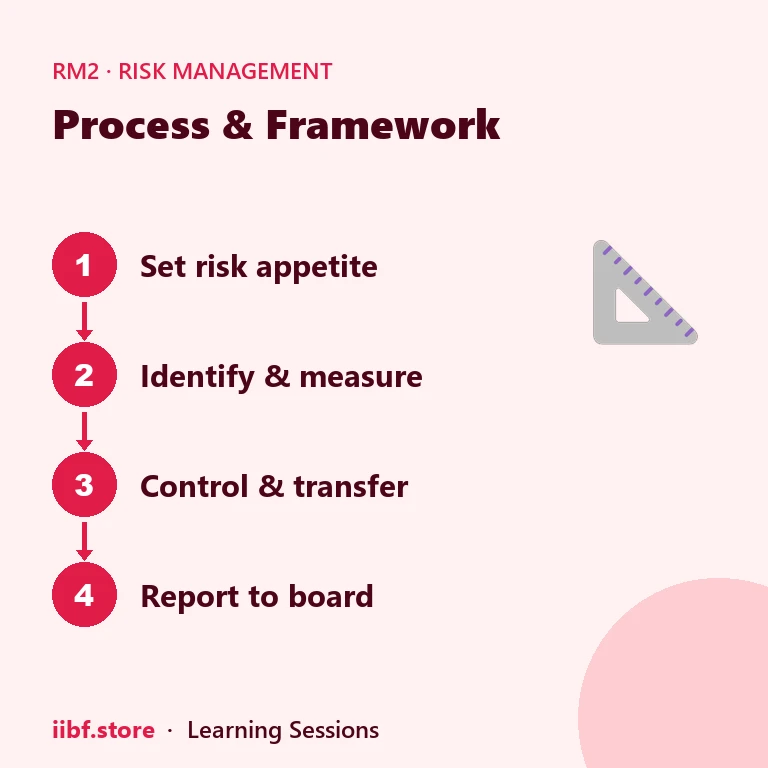
Remember the sequence: identify all material risks, measure them, translate them into capital, add the buffers, project forward, stress the projection, and let the Board's risk appetite decide whether the answer is acceptable. ICAAP is the bank's assessment; SREP is the supervisor's verdict on it. Keep the Pillar 1 versus Pillar 2 risk split at your fingertips and most questions on this chapter answer themselves.
Test how well it has landed with a timed mock — attempt a free Risk Management practice test and review every explanation before your next study session.
Prefer revising from a printed book?
Chapter-wise books with MCQs after every chapter — minimal pages, complete coverage, delivered anywhere in India. Every book has a free sample to read first.
Learning Sessions · Ashish Sir
132 pages · 225 MCQs
Learning Sessions · Ashish Sir
188 pages · 435 MCQs
Learning Sessions · Ashish Sir
117 pages · 236 MCQs
Learning Sessions · Ashish Sir
Learning Sessions · Ashish Sir
118 pages · 299 MCQs
Learning Sessions · Ashish Sir
Learning Sessions · Ashish Sir
Learning Sessions · Ashish Sir
Learning Sessions · Ashish Sir
115 pages · 255 MCQs
Learning Sessions · Ashish Sir
Learning Sessions · Ashish Sir
334 pages · 936 MCQs
Learning Sessions · Ashish Sir
115 pages · 344 MCQs
Learning Sessions · Ashish Sir
107 pages · 240 MCQs
Learning Sessions · Ashish Sir
90 pages · 150 MCQs
Learning Sessions · Ashish Sir
Learning Sessions · Ashish Sir
131 pages · 672 MCQs
Learning Sessions · Ashish Sir
221 pages · 831 MCQs
Learning Sessions · Ashish Sir
128 pages · 524 MCQs
Learning Sessions · Ashish Sir
107 pages · 445 MCQs
Learning Sessions · Ashish Sir
148 pages · 478 MCQs
Learning Sessions · Ashish Sir
151 pages · 465 MCQs
Learning Sessions · Ashish Sir
148 pages · 375 MCQs
Learning Sessions · Ashish Sir
216 pages · 895 MCQs
Learning Sessions · Ashish Sir
109 pages · 300 MCQs
Learning Sessions · Ashish Sir
104 pages · 360 MCQs
Learning Sessions · Ashish Sir
82 pages · 297 MCQs
Learning Sessions · Ashish Sir
151 pages · 600 MCQs
Learning Sessions · Ashish Sir
98 pages · 282 MCQs
Learning Sessions · Ashish Sir
Practice this topic
Take a free mock test, download chapter PDFs, or watch a video class — all included on iibf.store.
Keep reading