
Is the CAIIB Rural Banking Book Right for You? An Honest Guide
It is 10:40 at night. The branch closed late, the day-end figures took longer than usual, and you have just opened your CAIIB elective notes only to find a syllabus that seems to stretch from rural demographics to self help groups. If you chose Rural Banking as your elective, you already know the feeling: the subject is not hard, it is wide. Our job in this guide is simple. We want to help you decide, honestly, whether the CAIIB Rural Banking book is the right tool for you, or whether you should spend your money and your scarce evenings differently.
We will not call it a miracle. A book is a tool, and tools suit some people better than others. So below you will find four reader profiles, a comparison table, and a plain list of what a printed book cannot do. Even if you never buy anything from us, the planning ideas here should save you a few weeks.
Why Rural Banking feels endless for working bankers
Most candidates who pick this elective do so because they have seen rural or agriculture lending at their branch. That helps, but it also creates a trap: you feel you already know the subject, so you postpone serious reading. Then the exam cycle comes closer and you discover that the paper covers far more than your branch experience.
The paper moves across four broad areas. First, the rural economy itself: demography, society, infrastructure, agriculture and development policy. Second, how rural development is financed: regulation, credit institutions, agriculture and allied activities, the non-farm sector, SME finance and project appraisal. Third, priority sector lending and government initiatives. Fourth, the problems and prospects, including technology, financial inclusion and micro credit. That is a lot of ground for someone who studies after a full working day.
What tired candidates usually get wrong
- They read everything once, slowly, and never get to a second revision.
- They memorise scheme names without understanding which institution does what.
- They skip practice questions until the last week, then panic.
- They collect five sets of notes and finish none of them.
If any of these sound familiar, the problem is rarely intelligence. It is usually a lack of one single, structured source and a fixed routine. That is the gap a good printed book can fill.
What is inside the CAIIB Rural Banking book
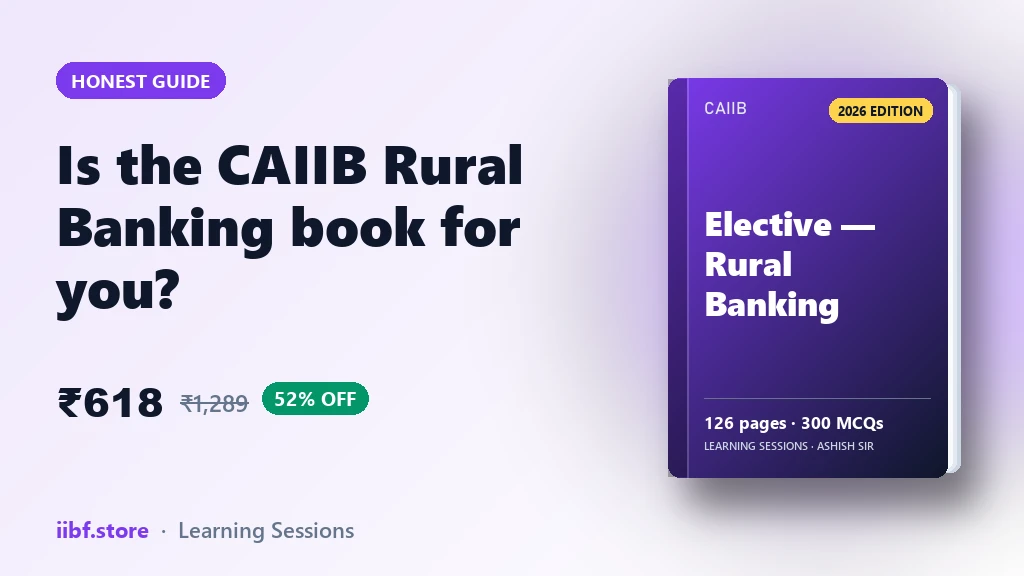
Let us describe it by facts, so you can judge for yourself. The CAIIB Rural Banking book is the 2026 edition of the printed Rural Banking elective. It runs to 126 pages across 20 chapters, arranged in four modules, and carries 300 questions. The extras listed for the book include 60 case studies (240 questions).
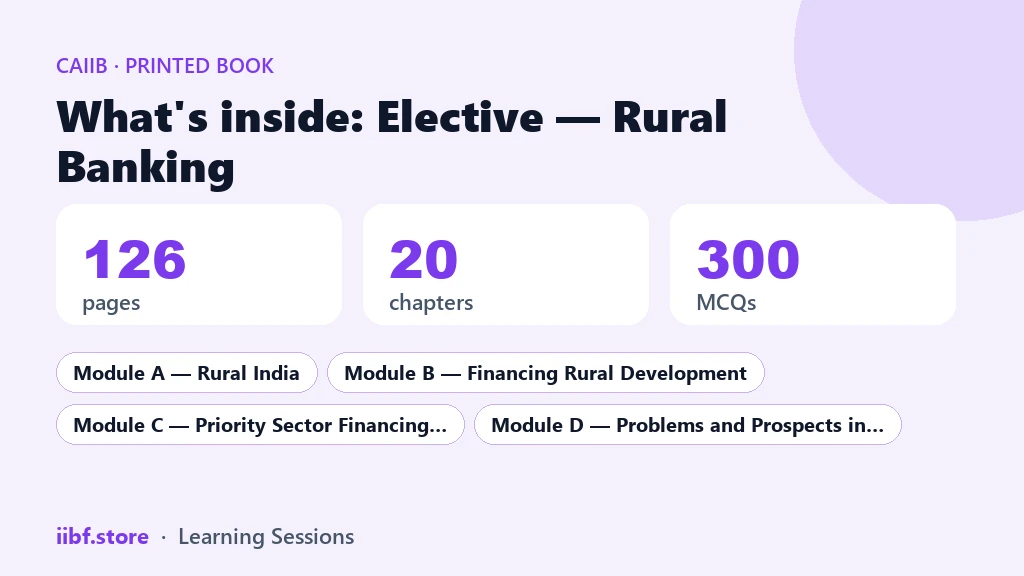
| Module | Chapters | What it covers |
|---|---|---|
| A - Rural India | 7 | Demographic features, rural society, economic features, infrastructure, agriculture economy, development policies, issues |
| B - Financing Rural Development | 6 | Regulation, rural credit institutions, agriculture and allied finance, non-farm sector, SME finance, project appraisal |
| C - Priority Sector Financing and Government Initiatives | 4 | Priority sector lending, poverty alleviation programs, housing and education loans, RBI financial inclusion initiatives |
| D - Problems and Prospects in Rural Banking | 3 | Emerging trends, technology in financial inclusion, micro credit and self help groups |
At 126 pages, this is a compact book. That is its strength for a busy banker and also its limit, which we will come back to. The current price shown on the book page is ₹618 against an MRP of ₹1,289, but prices can change, so treat the book page as the final word.
Four reader profiles: which one are you?
Instead of telling everyone the same thing, here is how we would honestly advise four different kinds of candidates.
1. The first-attempt candidate
You are new to CAIIB, you have cleared JAIIB or are about to attempt the first CAIIB cycle, and you want one clean path through the elective. For you, a compact book is useful because it shows the whole shape of the paper early. Read module by module, in order. Module A gives you the vocabulary; Modules B and C are where most of the lending logic sits; Module D ties it to current trends.
Where it is not enough: a first-timer needs exam-style practice early. Reading 20 chapters and then attempting your first mock a week before the exam is a common mistake. Attempt the free mock tests after each module, even if you score badly at first. The score matters less than learning how the questions are framed.
2. The repeat-attempt candidate
You have been through this paper before and it did not go your way. The last thing you need is another heavy stack of material. What you need is diagnosis. Before opening any book, write down which modules cost you marks last time. Then use the CAIIB Rural Banking book selectively: go straight to those modules, read them again with a pen, and attempt the questions for them first.
Where it is not enough: a repeat attempt usually fails on exam-hall behaviour, not on missing knowledge. Time management, reading long case-style questions and not second-guessing are skills you build only by timed practice. Pair your revision with full-length timed mocks and review every wrong answer.
3. The candidate short on time
Some of you have only a few weeks, a transfer, a busy quarter-end, or a family situation. A short book helps because you can plan around its size. With 20 chapters, you can allot a realistic number of evenings and see the finish line. Cover the chapters in order of weightage as you perceive it, but do not skip an entire module; this paper rewards breadth.
Where it is not enough: if you have very little time, no single book can compensate for zero practice. Spend about half of whatever time you have on questions. The 300 questions and 60 case studies in the book are there for this purpose, so use them rather than only reading.
4. The reader who prefers paper over screens
After a full day at a computer screen, many bankers simply cannot read a PDF at night. If that is you, a printed book is not a luxury, it is the only format you will actually open. You can underline, fold a page, carry it in your bag, and read in a queue or on a train without a battery worry.
Where it is not enough: paper cannot update itself. Rural policy, priority sector norms and scheme details change from time to time, so always cross-check anything that looks time-sensitive against the latest circulars on the official IIBF website and the RBI site. Treat the book as your base layer and verify the moving parts.
A simple plan to use the CAIIB Rural Banking book
Whichever profile fits you, the method is the same. Do not read the book like a novel. Use it like a workbook.
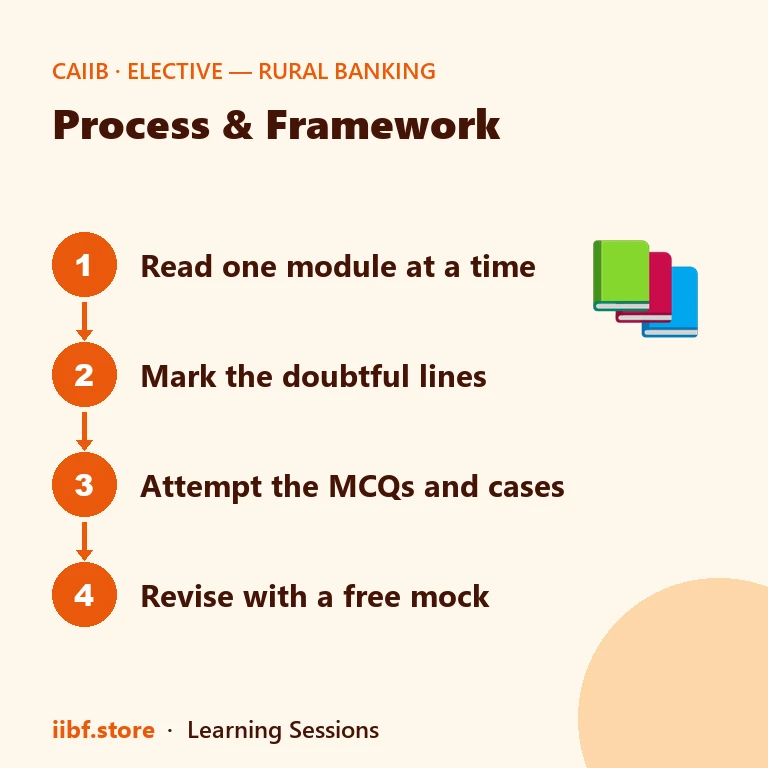
- Read one module at a time. Finish a whole module before you judge it. Modules are small enough to complete in a week of evenings.
- Mark the doubtful lines. Use a pencil. Anything you could not explain aloud in your own words gets a mark.
- Attempt the questions and cases. Do the MCQs for that module immediately, while it is fresh. Then revisit your marks.
- Revise with a free mock. At the end of each module, take a short test and note your weak chapters for the next revision round.
This loop is more important than the book itself. A candidate who follows it with any decent material will do better than one who owns three books and a vague intention.
What to pair it with
- Free mock tests for timed practice and for getting used to the question style.
- Free PDFs and study material for extra reading on topics you find thin.
- The CAIIB course page if you want a wider view of what is available for your other papers.
- The official IIBF website for the exam schedule and syllabus notices of the upcoming exam cycle.
Who should probably not buy it
Honesty works both ways, so here is the other side. You may not need this book if you already work daily in a rural or agriculture-lending role and have your own detailed notes that you trust and have revised more than once. You may also prefer something else if you want a very long, reference-style text with extensive background on every scheme; a 126-page book is built for focused exam preparation, not for deep academic study.
And if you expect any book to guarantee a pass, please do not buy this one. Nothing we publish can promise that. What a book can do is reduce the confusion about what to read and give you structured questions to test yourself. The rest, the daily discipline and the practice, remains yours.
Our recommendation, in one paragraph
If you are a working banker who wants a compact, printed, module-wise base for the Rural Banking elective, with questions built in, the CAIIB Rural Banking book is a reasonable choice, especially if you read better on paper. Look at the book page and read the free sample first, then decide. You can also browse the full range at iibf.store/books and more exam help on the blog. Whatever you pick, fix your evenings, practise under time, and keep the official schedule in view.
Frequently asked questions
Is the CAIIB Rural Banking book enough to clear the paper on its own?
For most candidates, no single book is enough. Use it as your base for reading and self-testing, then add timed mock tests and a check of recent circulars. The combination matters more than any one resource.
How many pages and questions does it have?
The 2026 edition has 126 pages, 20 chapters in four modules, and 300 questions. The extras listed include 60 case studies (240 questions). Check the book page for the latest details.
Can I see a sample before ordering?
Yes, a free sample is available on the book page. Read it first and see whether the style suits the way you study.
Where do I find the exam dates and official syllabus?
Always refer to the official IIBF website at iibf.org.in for the schedule and notices for the upcoming exam cycle. We do not quote dates here because they can change.
Prefer revising from a printed book?
Chapter-wise books with MCQs after every chapter — minimal pages, complete coverage, delivered anywhere in India. Every book has a free sample to read first.












Quick quiz on this topic
5 exam-style questions from our free test bank — check yourself before you move on.
Practice this topic
Take a free mock test, download chapter PDFs, or watch a video class — all included on iibf.store.


