Inside the CAIIB Rural Banking Book: Modules, Chapters, MCQs
It is 10 pm. You have finished a full day at the counter, in the loan section or in front of a stack of files, and you finally sit down with the CAIIB elective you chose. Rural Banking looks friendly on paper because you meet farmers, SHGs and priority sector targets at work. Then you open the syllabus and it feels endless: demography, infrastructure, project appraisal, microfinance, technology. Where do you even begin?
This article is a guided tour of the CAIIB Rural Banking book. You will see how it is organised, what a single chapter looks like, and how to use it if you only have an hour a day. Even if you never buy it, the study method here will work with any material you pick.
Why Rural Banking feels bigger than it is
Most candidates do not struggle with Rural Banking because it is hard. They struggle because it is wide. One paper moves from census-style facts about villages to credit institutions, from project appraisal to self help groups. When the topics are scattered across many sources, you waste your best study hours just deciding what to read next.
The fix is not more hours. It is a map. Before you read a single page, you should know the four big blocks of the paper and roughly how many chapters sit in each. Once you can see the whole paper on one page, it stops being a fog and becomes a checklist you can tick off.
What a tired reader actually needs
- Short notes that you can finish in one sitting, not a 40-page chapter you abandon halfway.
- Key points you can revise on a bus or in a lunch break.
- Questions straight after the notes, so you know immediately whether it stuck.
Keep this list in mind. We will use it to judge the book honestly in the sections below.
The map: four modules, twenty chapters
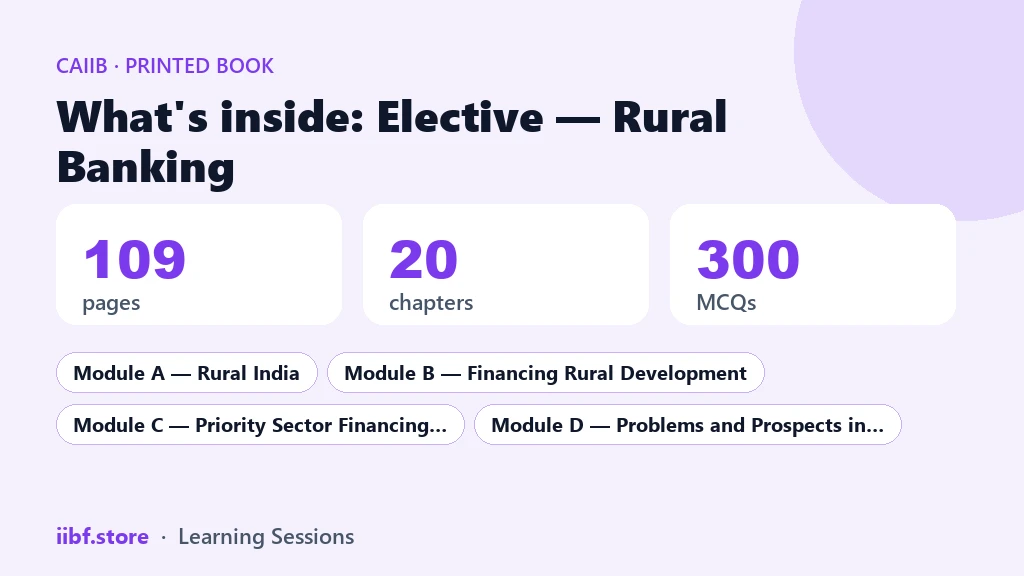
The book follows the paper in four modules. Here is the full layout, taken straight from the contents, so you can picture the journey before you start.
| Module | Chapters | What it covers |
|---|---|---|
| Module A: Rural India | 7 | Demographic features, rural society, economic features, infrastructure, agriculture economy, development policies, issues in rural areas |
| Module B: Financing Rural Development | 6 | Regulation of rural financial services, rural credit institutions, financing agriculture and allied activities, non-farm sector, SME finance, project formulation and appraisal |
| Module C: Priority Sector Financing and Government Initiatives | 4 | Priority sector lending, poverty alleviation programs, rural housing and education loans, RBI initiatives on financial inclusion and financial education |
| Module D: Problems and Prospects in Rural Banking | 3 | Emerging trends in rural banking, technology in financial inclusion, micro credit and self help groups |
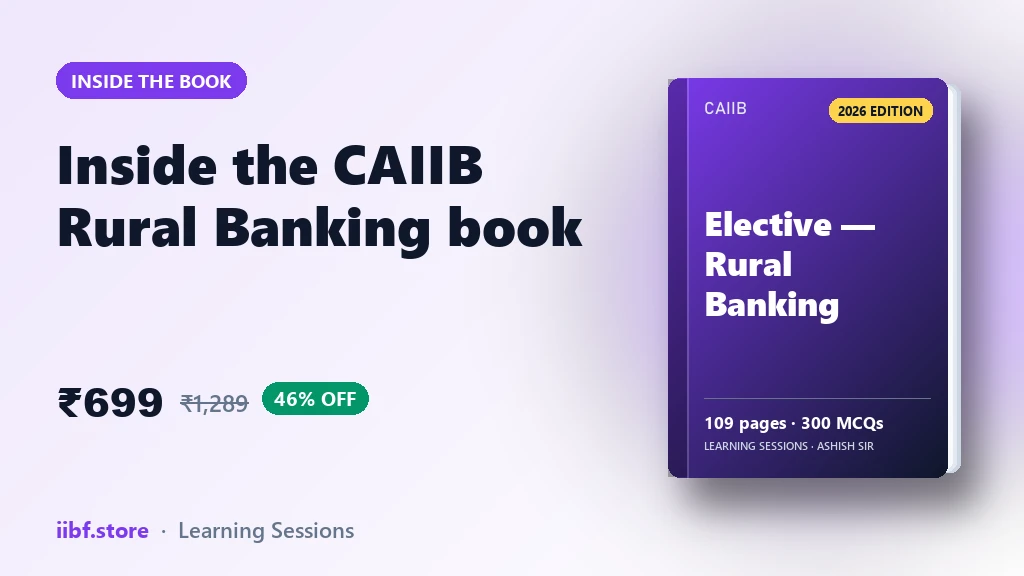
That is 20 chapters in 109 pages, which works out to a little over five pages per chapter on average. That is the point of a compact book: you can finish a chapter in a single tired evening and still feel you made progress.
How to read the four modules
Module A is the background. It is mostly descriptive, so read it quickly and focus on the numbers and terms you can be asked to recall. Module B is the heart of the paper for a banker: who lends, who regulates, how agriculture and the non-farm sector are financed, and how a project is appraised. Module C connects the paper to your daily work with priority sector lending, poverty alleviation programs and housing and education loans. Module D looks ahead at technology, microfinance and SHGs.
If you are short of time, give Module B and Module C your freshest hours. Read Module A and D in the lighter slots.
One chapter, start to finish
A book is easier to trust when you can picture one session with it. Take a chapter such as Rural Credit Institutions from Module B. The rhythm is the same in every chapter of the book.
- Concise notes. The topic is explained in a few pages, in plain language, without the padding of a long reference text.
- Key points. The facts you must be able to recall quickly are pulled out so that revision does not mean re-reading the whole chapter.
- MCQs. You test yourself on the same chapter immediately, while the material is still fresh.
The book carries 300 questions in all, so on average you get around 15 questions per chapter. That is enough to expose what you only thought you knew, and not so many that the chapter becomes a chore.
The extra layer: case studies
Beyond the chapter questions, the book lists 60 case studies carrying 240 questions. Case-style questions reward the candidate who has understood how a rule applies in a situation, not just the one who memorised the rule. For a working banker this is the most natural kind of question, because it looks like a real borrower sitting in front of you.
A four-step plan for your first pass
Here is a simple method that fits the structure of the Rural Banking book for CAIIB. It works with a busy schedule because every step is small.
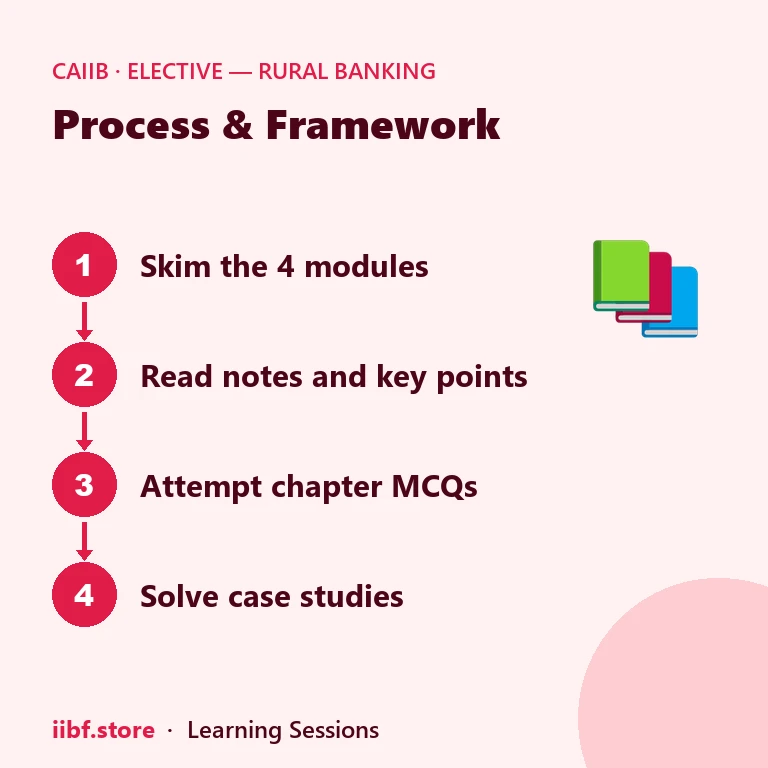
- Skim the module first (10 minutes). Read only the chapter titles of the module you are about to start. You are building the map in your head.
- Read notes and key points (30 to 40 minutes). One chapter per sitting. Underline only what surprises you.
- Attempt the chapter MCQs the same day. Do not peek. Mark every wrong answer and write one line on why you got it wrong.
- Return to the case studies after each module. Do a handful at a time instead of leaving all 60 for the last week.
At a pace of one chapter on weekdays and a revision block on Sunday, a first pass over 20 chapters fits comfortably into a few weeks. Adjust it to your own branch workload, and treat the weeks as a guide, not a promise.
A weekly rhythm that survives a bad week
- Monday to Thursday: one new chapter each night.
- Friday: redo only the questions you got wrong that week.
- Saturday: one full module revision from key points.
- Sunday: rest, or a light case study session if you feel fresh.
If you miss two evenings, do not try to make it up in one night. Slide the whole plan by two days and carry on. Consistency beats intensity every time.
Using the CAIIB Rural Banking book with free resources
No single book should be your only source. Pair it with the official syllabus and announcements on the IIBF website, which is where you should check the schedule and rules for the upcoming exam cycle. Fees, dates and attempt rules change, so always confirm them there and not from a blog.
On our side, you can practise with the free mock tests, download free PDFs, and browse the full books collection if you are also preparing other papers. The CAIIB course page lists everything for the exam in one place.
One honest limit: a book gives you understanding and a bank of practice questions, but it will not give you exam-hall speed by itself. Pair it with timed mocks in the final weeks so that reading time and answering time both improve.
Who gets the most out of this book
Based on its size and structure, this book suits some candidates more than others.
- The working banker with limited evenings. A 109-page, 20-chapter book is designed to be finished, not just owned.
- The candidate who already meets rural credit at work. If you handle agriculture or priority sector accounts, the notes connect to what you know and the MCQs fill the theory gaps.
- The reviser. If you have read the paper once, the key points and the 300 questions make a quick second and third pass.
- The candidate who learns by testing. Questions after every chapter and 60 case studies suit people who understand things better by answering than by reading.
It may be less ideal if you want a long, encyclopedic reference on every rural scheme. This is a focused exam companion, not a research text. If a printed copy appeals to you, the current price is ₹699 against an MRP of ₹1,289, but prices may change, so the book page always shows the latest figure. You can also read the free sample there before deciding.
Final thoughts before you open page one
Rural Banking rewards the candidate who stays calm and consistent. Start by learning the four modules, read one chapter at a time, test yourself the same day, and keep the case studies for the end of each module. Whether you use this CAIIB Rural Banking book or another source, that rhythm is what carries tired people to the finish line. For more study guides, visit the iibf.store blog.
Frequently asked questions
How many chapters and pages does the book have?
It has 20 chapters across four modules in 109 pages, in the 2026 edition.
How many practice questions are included?
The book carries 300 questions, and the extras list 60 case studies with 240 questions.
Is there a free sample I can read first?
Yes, a free sample is available on the book page, so you can judge the style before ordering.
Is this book enough to clear the paper on its own?
It is a focused companion with notes, key points and questions. Add timed mock tests and check the official syllabus on the IIBF website for the upcoming exam cycle.
Prefer revising from a printed book?
Chapter-wise books with MCQs after every chapter — minimal pages, complete coverage, delivered anywhere in India. Every book has a free sample to read first.
109 pages · 300 MCQs
Learning Sessions · Ashish Sir
148 pages · 478 MCQs
Learning Sessions · Ashish Sir
151 pages · 465 MCQs
Learning Sessions · Ashish Sir
148 pages · 375 MCQs
Learning Sessions · Ashish Sir
216 pages · 895 MCQs
Learning Sessions · Ashish Sir
104 pages · 360 MCQs
Learning Sessions · Ashish Sir
82 pages · 297 MCQs
Learning Sessions · Ashish Sir
151 pages · 600 MCQs
Learning Sessions · Ashish Sir
98 pages · 282 MCQs
Learning Sessions · Ashish Sir
131 pages · 672 MCQs
Learning Sessions · Ashish Sir
221 pages · 831 MCQs
Learning Sessions · Ashish Sir
128 pages · 524 MCQs
Learning Sessions · Ashish Sir
107 pages · 445 MCQs
Learning Sessions · Ashish Sir
132 pages · 225 MCQs
Learning Sessions · Ashish Sir
188 pages · 435 MCQs
Learning Sessions · Ashish Sir
117 pages · 236 MCQs
Learning Sessions · Ashish Sir
Learning Sessions · Ashish Sir
118 pages · 299 MCQs
Learning Sessions · Ashish Sir
Learning Sessions · Ashish Sir
Learning Sessions · Ashish Sir
Learning Sessions · Ashish Sir
115 pages · 255 MCQs
Learning Sessions · Ashish Sir
Learning Sessions · Ashish Sir
334 pages · 936 MCQs
Learning Sessions · Ashish Sir
Learning Sessions · Ashish Sir
115 pages · 344 MCQs
Learning Sessions · Ashish Sir
107 pages · 240 MCQs
Learning Sessions · Ashish Sir
90 pages · 150 MCQs
Learning Sessions · Ashish Sir
Learning Sessions · Ashish Sir
Quick quiz on this topic
5 exam-style questions from our free test bank — check yourself before you move on.
Practice this topic
Take a free mock test, download chapter PDFs, or watch a video class — all included on iibf.store.