IT Security Study Plan for Working Bankers: 21 Days, 20 Chapters
It is 9:40 pm. You have closed the branch, reconciled the day, answered one last call from the regional office and finally reached home. The exam is on your mind, and the syllabus feels like a wall. A sensible IT Security study plan is not about heroic six-hour sessions. It is about 60 to 90 focused minutes that you can actually repeat for three weeks.
This article gives you exactly that: a 21-day schedule, a way to read each chapter, and a simple rule for MCQs. It is written for the banker who works all day, studies at night, and cannot afford to waste a single evening.
Why an IT Security paper feels harder than it is
Most bankers come from branch operations, credit or accounts. Words like firewall, intrusion detection, hot site or access control feel like someone else's department. That unfamiliarity is the real difficulty, not the depth of the paper.
Three things make it manageable:
- The subject has a clear structure. It moves from overview, to controls, to threats, to audit and compliance. Once you see this order, each chapter has a place in your head.
- Most questions test understanding of concepts, not coding or hands-on technical skill. If you can explain why a control exists, you can usually pick the right option.
- Repetition beats volume. Reading a short chapter twice is better than skimming a long one once.
You do not need to become a security engineer. You need to become a banker who understands how the bank protects its information, and can say so under exam conditions.
How the book is organised, and why that helps your schedule
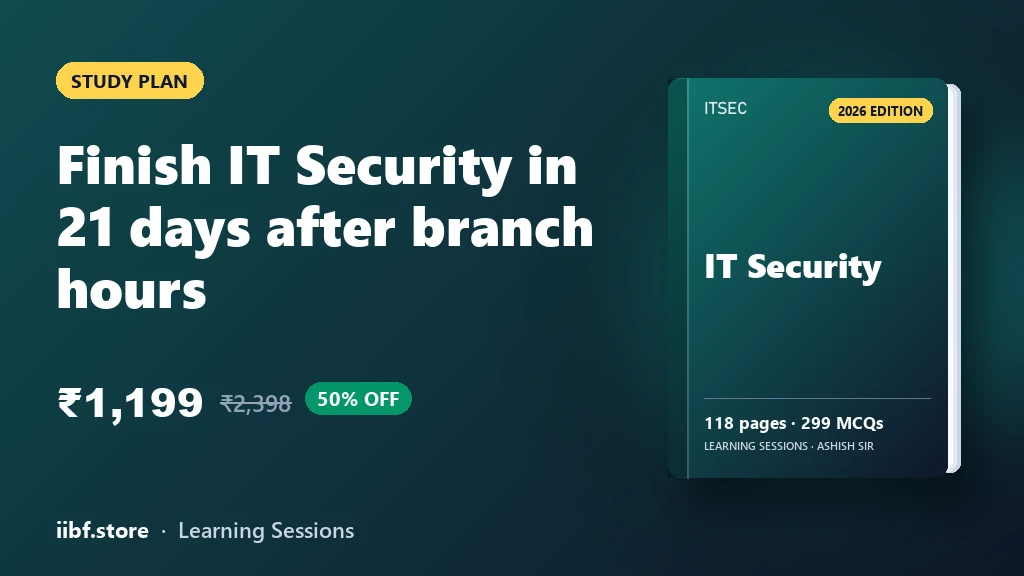
A good IT Security study plan follows the order of the material, so it helps to know how it is laid out. The IT Security printed book (2026 edition) runs to 118 pages across 20 chapters, grouped into four modules, with 299 MCQs.
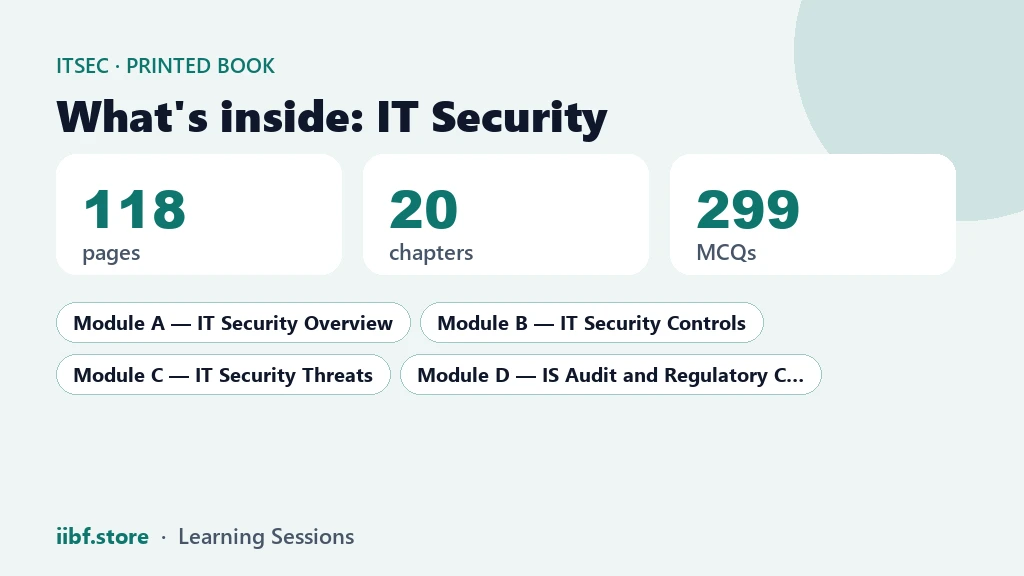
Module A: IT Security Overview (8 chapters)
Introduction to Information Security, Corporate IT Security, Organisational Security and Risk Management, Security Governance, Physical and Environmental Security, Hardware Security, Software and Operational Security, and Security Standards and Best Practices. This is your foundation. Read it slowly, because the vocabulary introduced here is used in every later chapter.
Module B: IT Security Controls (5 chapters)
Asset Classification and Controls, Physical and Environmental Security Controls, Software Security Controls, Network Controls, and Controls in Software Development and Maintenance. Think of this as the bank's toolkit: what protection exists, and where it is applied.
Module C: IT Security Threats (5 chapters)
IT Security Threats, Software Attacks (Virus and Malwares), Incident Management, Fault Tolerant System, and Business Continuity and Disaster Recovery Management. This module is the other side of Module B: what goes wrong, and how the bank recovers.
Module D: IS Audit and Regulatory Compliance (2 chapters)
Information Systems Audit and Regulatory Mechanism in Indian Banks. These two chapters are short but heavily bank-specific, so they reward careful revision.
The nightly routine: 20 minutes read, 20 minutes MCQs, 10 minutes recall
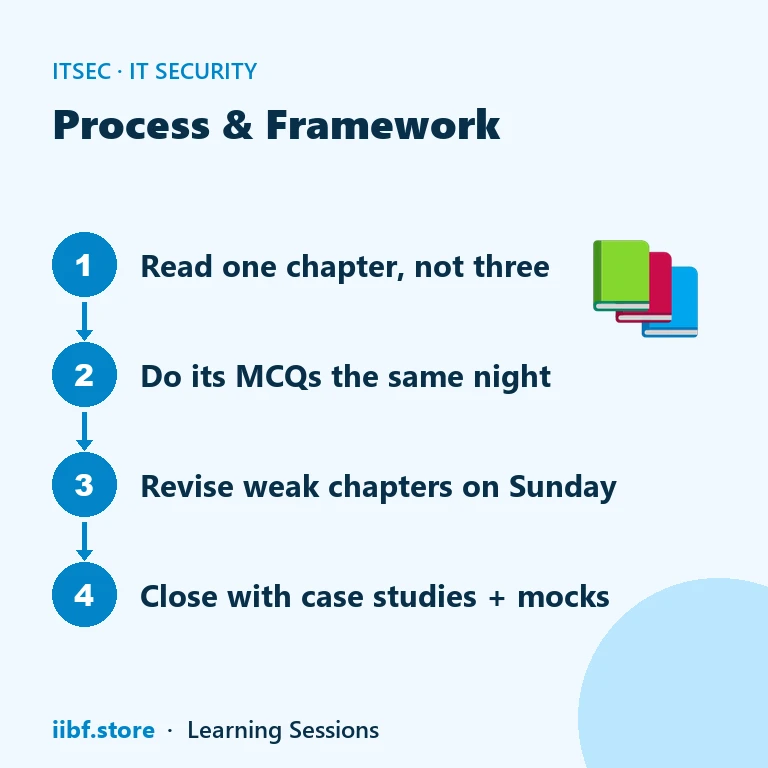
Before the day-wise table, fix the routine. Every evening session in this IT Security study plan has the same three parts, so you never waste energy deciding what to do.
- Read for 20 to 30 minutes. One chapter, or part of one. Underline definitions and lists. Do not copy notes by hand; it eats your time.
- Attempt that chapter's MCQs the same night. With 299 questions across 20 chapters, the average is roughly 15 per chapter, a quarter of an hour of work. Do them while the chapter is fresh.
- Close the book and recall for 10 minutes. Say aloud, or write in three lines, what the chapter was about. If you cannot, you have not learnt it yet.
Mark every wrong answer. These marks become your Sunday revision list, so you never have to guess what to revise.
The 21-day table
Here is the day-wise IT Security study plan, following the book's own chapter order. Chapter numbers refer to the sequence in which the chapters appear in the modules above.
| Days | What to read | MCQs that night |
|---|---|---|
| 1 to 3 | Module A: Introduction to Information Security, Corporate IT Security, Organisational Security and Risk Management | All end-of-chapter MCQs for chapters 1 to 3 |
| 4 to 6 | Module A: Security Governance, Physical and Environmental Security, Hardware Security | All MCQs for chapters 4 to 6 |
| 7 to 8 | Module A: Software and Operational Security, Security Standards and Best Practices | All MCQs for chapters 7 and 8, then redo Module A mistakes |
| 9 to 10 | Module B: Asset Classification and Controls, Physical and Environmental Security Controls | All MCQs for chapters 9 and 10 |
| 11 to 12 | Module B: Software Security Controls, Network Controls, Controls in Software Development and Maintenance | All MCQs for chapters 11 to 13 |
| 13 to 15 | Module C: IT Security Threats, Software Attacks (Virus and Malwares), Incident Management, Fault Tolerant System, Business Continuity and Disaster Recovery Management | All MCQs for chapters 14 to 18, about two chapters on the busier nights |
| 16 to 17 | Module D: Information Systems Audit, Regulatory Mechanism in Indian Banks | All MCQs for chapters 19 and 20 |
| 18 to 19 | Revision: your marked wrong answers from all four modules | Redo only the questions you got wrong |
| 20 to 21 | Case studies and mega tests (see below) | Timed practice, then review every miss |
If a night goes wrong, because a branch audit ran late or someone at home fell ill, do not try to make up two days in one. Shift the whole table by one day and drop nothing. A plan that survives bad days is better than a perfect plan that breaks on day four.
Weekends, revision and the case-study stage
Weekdays are for new chapters. Use one weekend morning to revisit the modules you finished that week, using only your marked wrong answers. Ninety minutes is enough.
The book also carries 40 case studies (160 questions) and 5 mega tests (500 questions). These are best kept for the last stretch, after all four modules are read. Case studies train you to apply a concept to a short scenario, which is how many bank-based questions are framed. Mega tests train stamina and timing.
A practical way to use them in days 20 and 21:
- Take one mega test seated, with a timer, and no phone.
- Review every wrong answer and note which module it came from.
- Go back to that module's chapter for twenty minutes, not the whole book.
- Repeat with a second mega test if time allows.
Free practice is available too. The free mock tests and the free study material on the site are a good way to check your speed before spending on anything.
Mistakes that quietly break a working banker's schedule
Reading two modules before touching a single MCQ
It feels productive and it is not. MCQs show you what you actually remember. Solve them the same night, every night.
Memorising lists without understanding them
Lists of controls, threats or standards are easy to forget. Ask what each item protects against, and the list becomes a story you can rebuild in the exam hall.
Leaving Module D for the last night
Information Systems Audit and Regulatory Mechanism in Indian Banks are only two chapters, but they connect directly to a banker's own work. Give them their own two days, as the table does.
Treating the book as the whole preparation
One honest limit: a book alone will not give you exam-hall speed. Pair your IT Security study plan with timed mocks, and check the official exam schedule and instructions for the upcoming cycle on the IIBF website.
Putting the IT Security study plan to work this week
Do not wait for a perfect Monday. Tonight, open the first chapter, read for twenty minutes, and solve its MCQs. That is day one of the IT Security study plan done, and the hardest step is behind you.
If you want the chapters, MCQs, case studies and mega tests in one place, the IT Security book is listed at ₹1,199 against an MRP of ₹2,398. Prices can change, so the book page is always the current reference. You can also browse the wider books catalogue and the blog for more plans like this one.
Frequently asked questions
Can I really finish IT Security in 21 days while working full time?
The schedule above asks for about an hour a night plus one weekend revision block. Many bankers can sustain that. If your branch hours are heavier, stretch the same table to 30 days rather than skipping the MCQs.
How many MCQs should I solve each night?
All the end-of-chapter MCQs for that night's chapter. With 299 questions across 20 chapters, that averages roughly 15 per chapter. Redo only your wrong answers during revision.
When should I use the case studies and mega tests?
After you have read all four modules. The book has 40 case studies (160 questions) and 5 mega tests (500 questions), and they work best as the final practice stage in days 20 and 21.
Is there a free sample before I buy?
Yes. The book page has a free sample you can read first, so you can judge the style and depth before ordering.
Prefer revising from a printed book?
Chapter-wise books with MCQs after every chapter — minimal pages, complete coverage, delivered anywhere in India. Every book has a free sample to read first.
118 pages · 299 MCQs
Learning Sessions · Ashish Sir
132 pages · 225 MCQs
Learning Sessions · Ashish Sir
188 pages · 435 MCQs
Learning Sessions · Ashish Sir
117 pages · 236 MCQs
Learning Sessions · Ashish Sir
Learning Sessions · Ashish Sir
Learning Sessions · Ashish Sir
Learning Sessions · Ashish Sir
Learning Sessions · Ashish Sir
115 pages · 255 MCQs
Learning Sessions · Ashish Sir
Learning Sessions · Ashish Sir
334 pages · 936 MCQs
Learning Sessions · Ashish Sir
Learning Sessions · Ashish Sir
115 pages · 344 MCQs
Learning Sessions · Ashish Sir
107 pages · 240 MCQs
Learning Sessions · Ashish Sir
90 pages · 150 MCQs
Learning Sessions · Ashish Sir
Learning Sessions · Ashish Sir
131 pages · 672 MCQs
Learning Sessions · Ashish Sir
221 pages · 831 MCQs
Learning Sessions · Ashish Sir
128 pages · 524 MCQs
Learning Sessions · Ashish Sir
107 pages · 445 MCQs
Learning Sessions · Ashish Sir
148 pages · 478 MCQs
Learning Sessions · Ashish Sir
151 pages · 465 MCQs
Learning Sessions · Ashish Sir
148 pages · 375 MCQs
Learning Sessions · Ashish Sir
216 pages · 895 MCQs
Learning Sessions · Ashish Sir
109 pages · 300 MCQs
Learning Sessions · Ashish Sir
104 pages · 360 MCQs
Learning Sessions · Ashish Sir
82 pages · 297 MCQs
Learning Sessions · Ashish Sir
151 pages · 600 MCQs
Learning Sessions · Ashish Sir
98 pages · 282 MCQs
Learning Sessions · Ashish Sir
Practice this topic
Take a free mock test, download chapter PDFs, or watch a video class — all included on iibf.store.