CCP Study Plan: Finish the Credit Syllabus in 28 Days, Part-Time
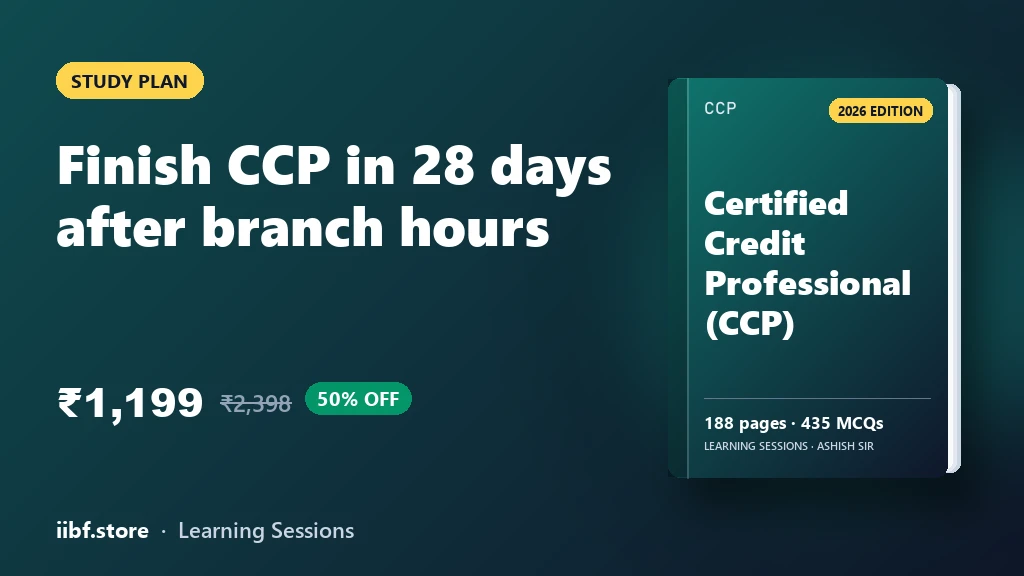
You reach home at 8 pm. The day had a sanction note due, a stock audit and a customer who would not leave your cabin. Now you open the credit syllabus and it looks endless: lending principles, appraisal, working capital, export finance, IBC, fraud. If this is you, a good CCP study plan matters more than extra motivation. Motivation runs out by Wednesday; a plan that fits a tired evening does not.
This article gives you that plan. It is a 28-day schedule for the Certified Credit Professional paper, built for someone studying 90 minutes on weekdays and a little longer on weekends. You can follow it with any material you trust. Where it helps, we also show how the Certified Credit Professional printed book fits in, because its chapter order is what the schedule follows.
Why a CCP study plan fails for most working bankers
Most plans fail for three plain reasons, and none of them is about intelligence.
- They assume free evenings. A plan that needs four hours daily collapses the first time branch work runs late.
- They start with the hardest topic. Ratio analysis and project appraisal on day one, after a long day, is a recipe for guilt.
- They never test. Reading feels like progress. Only questions tell you whether a chapter has actually stayed with you.
So the plan below does three things differently. It gives you one chapter-sized goal per night, it keeps the lighter chapters near the heavier ones, and it ties every reading block to a small set of MCQs the next day.
The rule of the small win
On a bad day, do only the MCQs of yesterday's chapter. That is 15 minutes, and the streak survives. A streak you protect is worth more than a perfect day you cannot repeat.
Know the paper before you plan it
The Certified Credit Professional syllabus runs across five modules. In the printed book they are laid out like this, with chapter counts that decide your daily load:
- Module A, Introduction and Overview of Credit: 8 chapters, from principles of lending and credit policy to credit rating, capital adequacy and RAROC.
- Module B, Credit Appraisal and Risk Assessment: 4 chapters, covering financial statement analysis, non-financial risk, project appraisal and credit scoring models.
- Module C, Working Capital and Non-Fund Based Facilities: 2 chapters.
- Module D, Specialised Areas of Credit: 8 chapters, including export finance, priority sector lending, retail loans, structured finance, digital finance and green finance.
- Module E, Documentation, Credit Monitoring and Stressed Assets: 7 chapters, including types of charges, resolution of stressed assets, the Fair Practices Code, the Insolvency and Bankruptcy Code and fraud risk management.
That is 29 chapters in all. Over 28 days it works out to roughly one chapter a day, with revision days mixed in. For the exact syllabus and the schedule of the upcoming exam cycle, always check the official site at www.iibf.org.in and do not rely on any third-party summary, including this one.
What the book gives you to work with
The CCP exam preparation book from iibf.store is a printed, 2026 edition with 188 pages across those 29 chapters, plus 435 MCQs placed at the end of the chapters. It also lists 60 case studies (240 questions) and 5 mega tests (500 questions) as extras. Those numbers matter for planning: 435 MCQs over 29 chapters is about 15 per chapter on average, which is a comfortable next-day quiz after a 90-minute reading session.
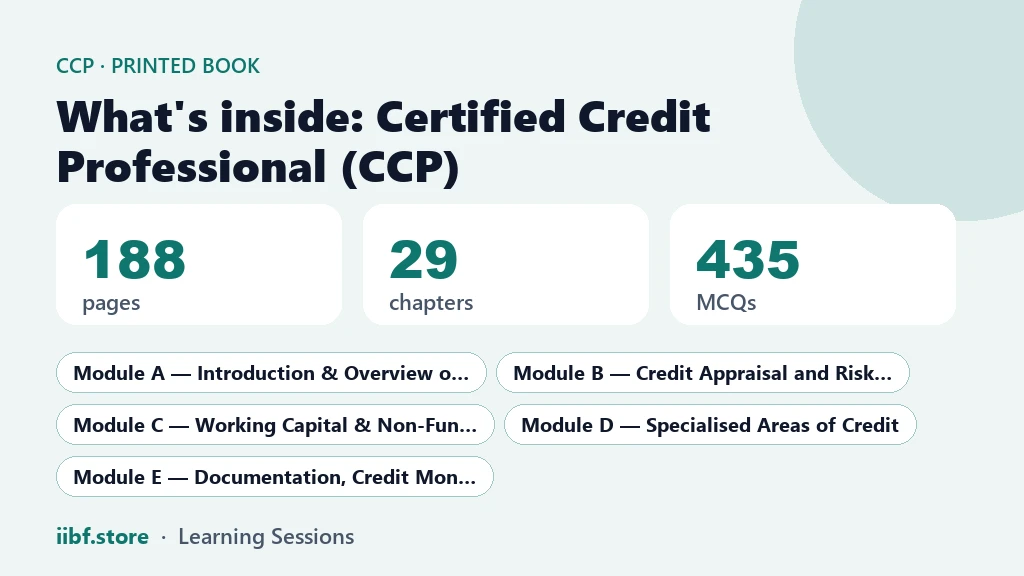
A short book has one real advantage for a busy person: you can see the finish line. A thick reference text makes it easy to quit in week two. Eight to ten pages a chapter is something you can read on a train or in a lunch break.
It is currently priced at ₹1,199 against an MRP of ₹2,398 (prices can change, so the book page is always the current word). If you want to judge the writing style before spending anything, there is a free sample on the book page. And one honest limit: a book alone will not give you exam-hall speed. Pair it with timed practice from the free mock tests.
The 28-day CCP study plan, module by module
Here is the schedule. MCQ counts are approximate, using the book's average of about 15 per chapter, so adjust to what your copy shows.
| Days | What to read | MCQs to attempt |
|---|---|---|
| 1 to 7 | Module A, 8 chapters: lending principles to RAROC (two short chapters on day 7) | About 15 per chapter, around 120 in all |
| 8 to 11 | Module B, 4 chapters: financial statements, non-financial risk, project appraisal, scoring models | About 15 per chapter, around 60 |
| 12 | Revision of Modules A and B, weak chapters only | Redo every MCQ you got wrong |
| 13 to 14 | Module C, 2 chapters: working capital assessment, non-fund based facilities | About 30, plus re-solve one working capital numerical |
| 15 to 20 | Module D, 8 chapters, paired lighter ones (digital finance with green finance) | About 15 per chapter, around 120 |
| 21 to 26 | Module E, 7 chapters: documentation to fraud risk management | About 15 per chapter, around 105 |
| 27 to 28 | Full revision, case studies and one mega test | One timed full-length test, then review every error |
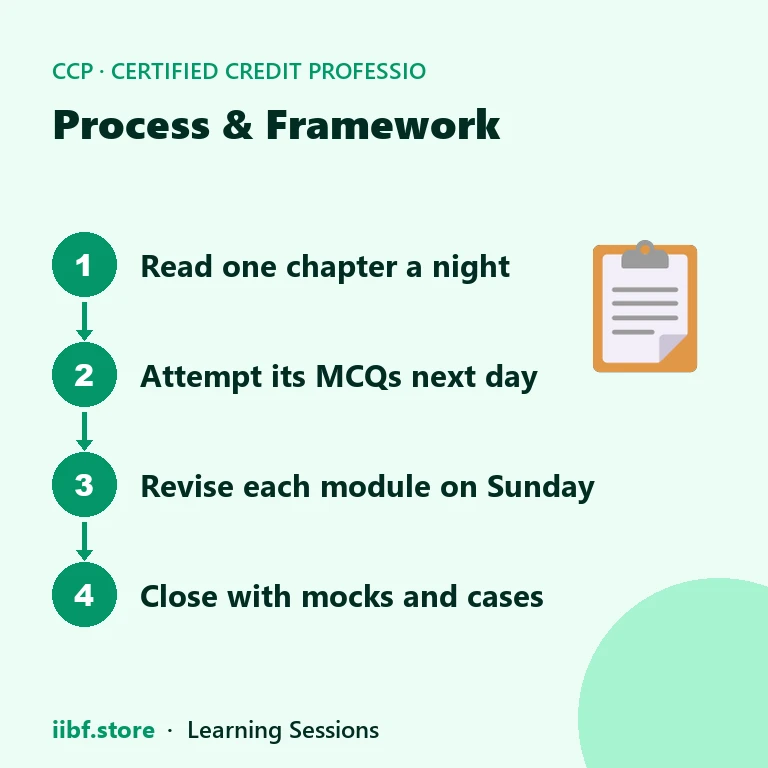
A weekday evening, minute by minute
- First 10 minutes: skim the chapter headings and the summary. Know where you are going.
- Next 55 minutes: read once, pencil in hand. Mark definitions, limits and lists. Do not copy notes.
- Last 15 minutes: write the chapter from memory in five lines. Whatever you cannot recall is tomorrow's first job.
- Next day, 15 minutes: attempt that chapter's MCQs, on the bus or in a quiet minute.
Where to go slow, and where to go fast
Not every chapter deserves the same time. A credit officer knows some of this already from daily work, and that is an advantage to use.
Go slow
- Analysis of financial statements and working capital assessment. These carry numerical thinking. Give them an extra half hour and redo the sums once.
- Insolvency and Bankruptcy Code and resolution of stressed assets. Terms and sequences get confused easily. Make a one-page flow of who does what.
- Capital adequacy and RAROC. They look short but trip people in questions.
Go faster
- Branch-familiar chapters: documentation, types of charges and credit monitoring will feel natural if you handle advances. Read quickly, spend the saved time on MCQs.
- Newer topics such as digital finance, P2P lending and green finance: mostly concept and definition. Read twice, quiz once.
Weekends, slippage and the Sunday check
Every plan slips. Build the slip in. Keep Sunday evening as a catch-up window of two hours: first redo the MCQs you got wrong during the week, then finish any chapter you missed. If you are more than two chapters behind, do not stretch the whole plan. Merge two light chapters on one day and move on.
For extra practice that costs nothing, the free study material section and the full books range are worth a look, and the blog carries chapter-wise revision notes for other papers too.
Keep this CCP study plan honest: measure, do not guess
After each module, note your MCQ accuracy on a sheet of paper. If a module is below roughly 60 percent, give it an extra evening before the next module starts. The goal is not to finish the book, it is to be able to answer questions on it, and those are different things.
Use the 60 case studies in the last week. Case-style questions test whether you can connect appraisal, documentation and monitoring, which is how real files behave. Finish with a mega test under a timer, in one sitting, at the hour you are likely to write the paper.
Final word
You do not need a perfect month. You need about 28 ordinary evenings, one chapter at a time, with questions after every chapter. Start tonight with Module A, Principles of Lending, and read just that. If you want the chapter-wise structure to follow, the Certified Credit Professional book page shows the full contents, and the same plan works with whatever material you already own.
FAQ
Is 28 days enough for the Certified Credit Professional paper?
For many working bankers who already handle credit, it is a workable target at 90 minutes a day, but it depends on your starting point. If your base is weak, stretch the same CCP study plan to six weeks and keep the sequence unchanged.
How many hours a day do I need?
Plan for about 90 minutes on weekdays and two to three hours on weekends. Consistency beats long sessions, so a short daily slot you actually keep is better than a heroic Sunday.
Should I read the whole book first and test later?
No. Attempt each chapter's MCQs the next day, while the memory is half-fresh. That gap is where recall is built.
Where do I get the official exam dates and syllabus?
From the Indian Institute of Banking and Finance at www.iibf.org.in. Check it for the upcoming exam cycle before fixing your start date.
Prefer revising from a printed book?
Chapter-wise books with MCQs after every chapter — minimal pages, complete coverage, delivered anywhere in India. Every book has a free sample to read first.
188 pages · 435 MCQs
Learning Sessions · Ashish Sir
132 pages · 225 MCQs
Learning Sessions · Ashish Sir
117 pages · 236 MCQs
Learning Sessions · Ashish Sir
Learning Sessions · Ashish Sir
118 pages · 299 MCQs
Learning Sessions · Ashish Sir
Learning Sessions · Ashish Sir
Learning Sessions · Ashish Sir
Learning Sessions · Ashish Sir
115 pages · 255 MCQs
Learning Sessions · Ashish Sir
Learning Sessions · Ashish Sir
334 pages · 936 MCQs
Learning Sessions · Ashish Sir
Learning Sessions · Ashish Sir
115 pages · 344 MCQs
Learning Sessions · Ashish Sir
107 pages · 240 MCQs
Learning Sessions · Ashish Sir
90 pages · 150 MCQs
Learning Sessions · Ashish Sir
Learning Sessions · Ashish Sir
131 pages · 672 MCQs
Learning Sessions · Ashish Sir
221 pages · 831 MCQs
Learning Sessions · Ashish Sir
128 pages · 524 MCQs
Learning Sessions · Ashish Sir
107 pages · 445 MCQs
Learning Sessions · Ashish Sir
148 pages · 478 MCQs
Learning Sessions · Ashish Sir
151 pages · 465 MCQs
Learning Sessions · Ashish Sir
148 pages · 375 MCQs
Learning Sessions · Ashish Sir
216 pages · 895 MCQs
Learning Sessions · Ashish Sir
109 pages · 300 MCQs
Learning Sessions · Ashish Sir
104 pages · 360 MCQs
Learning Sessions · Ashish Sir
82 pages · 297 MCQs
Learning Sessions · Ashish Sir
151 pages · 600 MCQs
Learning Sessions · Ashish Sir
98 pages · 282 MCQs
Learning Sessions · Ashish Sir
Quick quiz on this topic
5 exam-style questions from our free test bank — check yourself before you move on.
Practice this topic
Take a free mock test, download chapter PDFs, or watch a video class — all included on iibf.store.
Keep reading