KYC AML CFT Study Plan for Working Bankers: 21 Days
It is 9:30 pm. The branch closed two hours ago, the last reconciliation took longer than it should have, and the certificate exam you registered for feels very far from your desk. If that is you, this KYC AML CFT study plan is written for your evenings, not for a full-time student with six free hours a day.
The paper looks easy from the outside because you already handle account opening, CDD and STR alerts at work. But the exam does not ask how your branch does it. It asks about the framework behind it: how money laundering works, which international bodies set standards, what Indian law says, and how the organisation is structured. Daily work gives you part of that. It does not give you all of it. So the plan below treats the syllabus as 16 chapters in a fixed order and gives each one a slot.
Why this paper trips up people who already do KYC at work
Most candidates fail a regulatory paper for one of three reasons: they read in a random order and lose the thread, they never test themselves until the last week, or they memorise the branch-level procedure and ignore the global and legislative background. None of these is about intelligence. All of them are about planning.
The branch-experience trap
You may have verified thousands of customers. But a question on the layers of money laundering, on correspondent banking risk, or on how a country-risk rating is built will not be answered by branch routine. Plan to spend real time on the chapters that feel unfamiliar, especially the international ones.
The last-week trap
If your first MCQ attempt happens five days before the exam, you discover your weak chapters too late to fix them. Solve questions from day one, even if you score badly. A wrong answer on day three costs you nothing. The same wrong answer in the exam hall costs a mark.
You can check the official exam notice, eligibility and schedule for the upcoming exam cycle on the IIBF website. Fix your exam date first, then count backwards. Twenty-one days is a comfortable target if you can give 60 to 90 minutes on weekdays and a longer block on weekends.
The syllabus in two blocks: Module A and Module B
The paper splits naturally into two modules, and your KYC AML CFT study plan should follow the same split.
- Module A, Anti-Money Laundering (10 chapters): Money Laundering and Terrorism Financing; Money Laundering - Some Methods; Money Laundering - Global Measures; International Guidelines and Standards; AML/CFT Legislation in Major Countries and Regions; AML CFT Legislation in India; AML/CFT Organisation Structure in India; Money Laundering and Correspondent Banking; Country Risk; Transaction Monitoring and Reporting.
- Module B, Know Your Customer (6 chapters): KYC Policy and Customer Acceptance Policy; Customer Identification Procedure and Risk Management; KYC Specific Requirements; Organisational Set Up for KYC AML; Topical Issues Related to KYC AML; Training and Awareness.
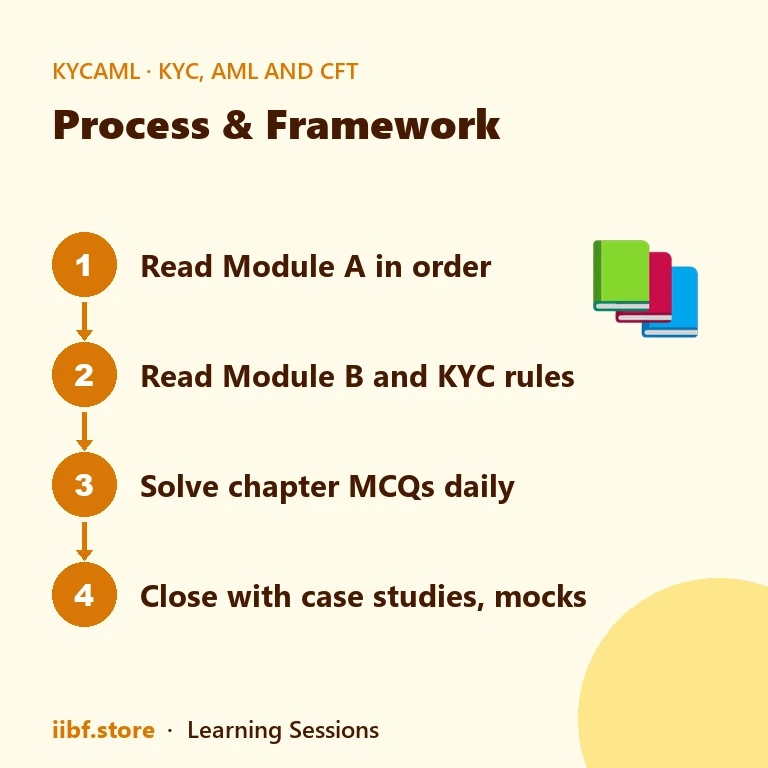
Module A is the heavier block: ten chapters that build from concepts to methods to global standards to Indian law. Module B is shorter and closer to your daily work, which makes it a good place to finish strong. Read Module A first, in order, because chapter 4 (international standards) makes much more sense after chapter 3 (global measures), and chapter 6 (Indian legislation) leans on both.
Do not skip the order
It is tempting to start with Module B because it feels familiar. Resist it. Once Module A is clear, Module B reads like a rulebook you already understand. If you read Module B first, every rule looks like an arbitrary instruction.
A book that fits the way you study at night
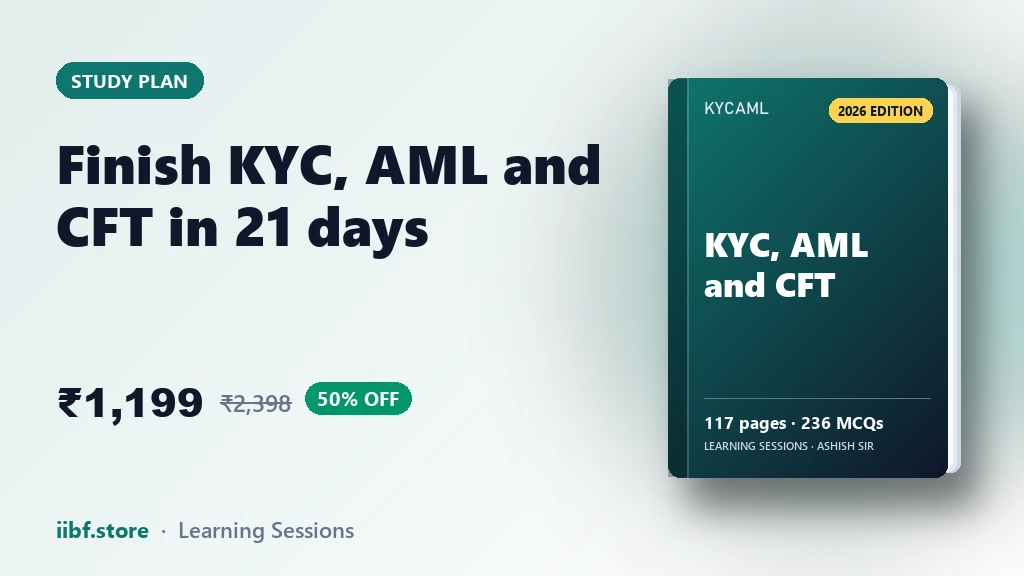
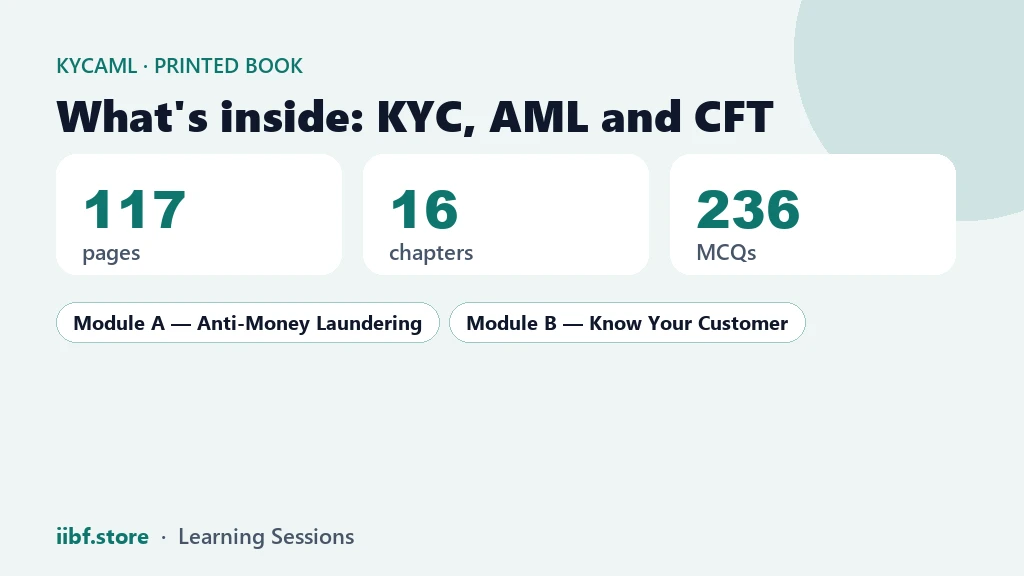
Many people stay away from a regulatory paper because they imagine a heavy, scattered syllabus. A compact, exam-oriented book changes that. The KYC, AML and CFT book from iibf.store is a 2026 edition printed in 117 pages across 16 chapters, with 236 MCQs placed along the chapters. That is short enough to finish a full read in the three weeks this KYC AML CFT study plan proposes, and still leave time for revision.
On top of the chapters, the book includes 40 case studies (160 questions) and 5 mega tests (500 questions). The case studies are what separate a pass from a comfortable pass in a paper like this, because they make you apply the concepts to a situation. The mega tests are what you use in the last week to check whether you can sit through a full paper without losing focus.
The 21-day KYC AML CFT study plan, day by day
This is the core of the article. It assumes about an hour on weekdays, a longer sitting on weekends, and one rest day you will almost certainly need. Move the days around to fit your branch calendar, but keep the order of chapters.
| Days | What to read | MCQs to solve |
|---|---|---|
| 1-3 | Chapters 1-3: Money Laundering and Terrorism Financing; Some Methods; Global Measures | MCQs of chapters 1-3, same evening |
| 4-6 | Chapters 4-5: International Guidelines and Standards; Legislation in Major Countries and Regions | MCQs of chapters 4-5, then redo chapters 1-3 wrong answers |
| 7-9 | Chapters 6-7: AML CFT Legislation in India; AML/CFT Organisation Structure in India | MCQs of chapters 6-7 |
| 10-12 | Chapters 8-10: Correspondent Banking; Country Risk; Transaction Monitoring and Reporting | MCQs of chapters 8-10; finish all of Module A |
| 13-15 | Chapters 11-13: KYC Policy and CAP; Customer Identification and Risk Management; KYC Specific Requirements | MCQs of chapters 11-13 |
| 16 | Chapters 14-16: Organisational Set Up; Topical Issues; Training and Awareness | MCQs of chapters 14-16; all 236 MCQs now attempted once |
| 17-18 | Revision of your weakest chapters only | Redo every wrong MCQ |
| 19 | 40 case studies: do a first batch | Case-study questions, timed |
| 20 | Rest or light skim of notes | None |
| 21 | Mega tests: start with the first, review every answer | One full mega test |
The case studies and the remaining mega tests will not fit in one day, and they should not. If your exam is more than a few days away, spread them: one mega test every second day, with the day in between spent only on reviewing mistakes.
How to use the evening hour
Split each weekday sitting into three parts. Spend about 35 minutes reading the day's chapter, 15 minutes on that chapter's MCQs, and 10 minutes writing down in a notebook the points you got wrong. That last ten minutes feels optional at 10 pm. It is not. Those notes become your final revision sheet.
What to do on a bad day
Some evenings the branch will eat everything. On those days, do only the MCQs for the chapter you last read. Fifteen minutes of questions keeps the habit alive and keeps the material warm. Do not try to double up the next day; just continue from where you stopped and shift the plan by a day.
Method: how to read a regulatory chapter without falling asleep
A regulatory paper is full of names, dates, institutions and thresholds. Reading them straight through works badly at the end of a working day. Try this instead.
- Read the headings first. Spend two minutes on the structure of the chapter before the detail. Your brain then has places to put the facts.
- Attempt the chapter's MCQs with the book closed. Then read the answers. Wrong answers teach more than right ones.
- Make a one-page sheet per module. Institutions and what each does, types of reports, risk categories. A single page you can scan in five minutes on the metro or during lunch.
- Say it aloud once. If you cannot explain correspondent banking risk to a colleague in thirty seconds, you have not learnt it yet.
Use free resources alongside the book. The free study material section and the free mock tests on iibf.store are useful for a second opinion on topics you find heavy. For related articles and exam tips, the iibf.store blog is worth a bookmark.
The last week: case studies and mega tests
Chapter MCQs test recall. Case studies test judgement, and judgement is where candidates lose marks they thought they had. In the final week, move from reading to application. Take the 40 case studies in sets, attempt the questions before reading the explanation, and mark the ones where your reasoning, not your memory, let you down.
Then take the 5 mega tests as dress rehearsals. Sit at a table, set a timer, switch off your phone, and take the test in one go. Do not pause to look things up. After each test, spend as much time reviewing as you spent attempting. A mega test that you attempt but do not review is a wasted evening.
Be honest about what a book cannot do
A book alone will not give you exam-hall speed or calm. It gives you structure and practice material. Pair it with timed mocks, and keep an eye on the official notices, because regulations in this area get updated and the exam reflects the position stated by the institute for your cycle. When the book and an official circular differ, trust the circular and check it on iibf.org.in.
What the book costs and how to decide
The printed book is listed at ₹1,199 against an MRP of ₹2,398 (50 percent off). Prices can change, so check the KYC, AML and CFT book page for the current price, and read the free sample there before you decide. If you prefer to compare options, all titles are listed at iibf.store/books.
Whether or not you buy, the plan above works with any good set of notes. Take the order of chapters, the evening split, the daily MCQs and the last-week mocks. They matter more than which book you hold.
Your next step tonight
Do not wait for a perfect Monday. Tonight, open chapter 1, read for 35 minutes, solve its MCQs, and write down what you missed. That single evening proves to you that the KYC AML CFT study plan is workable alongside a full-time posting. Three weeks from now you will have read 16 chapters, attempted 236 MCQs, worked through case studies and sat full-length tests, which is more preparation than most candidates manage before an exam.
Frequently asked questions
Can I finish this paper in 21 days while working full time?
Yes, if you can give roughly an hour on weekdays and a longer sitting on weekends. The book is 117 pages over 16 chapters, so the reading itself is modest. Most of your time goes into MCQs and revision, which is where the marks come from.
Should I read Module A or Module B first?
Module A first. The ten chapters on anti-money laundering build from concepts to global standards to Indian law, and the KYC rules in Module B make more sense once that background is clear.
When should I start the mega tests?
After you have read all 16 chapters and attempted every chapter MCQ once. In this plan that is around day 16. Starting earlier mostly shows you what you have not read yet.
Where do I find the official exam schedule and eligibility?
On the IIBF website at iibf.org.in. Check it for the upcoming exam cycle before fixing your plan dates, and also try the free mock tests for practice.
Prefer revising from a printed book?
Chapter-wise books with MCQs after every chapter — minimal pages, complete coverage, delivered anywhere in India. Every book has a free sample to read first.
117 pages · 236 MCQs
Learning Sessions · Ashish Sir
132 pages · 225 MCQs
Learning Sessions · Ashish Sir
188 pages · 435 MCQs
Learning Sessions · Ashish Sir
Learning Sessions · Ashish Sir
118 pages · 299 MCQs
Learning Sessions · Ashish Sir
Learning Sessions · Ashish Sir
Learning Sessions · Ashish Sir
Learning Sessions · Ashish Sir
115 pages · 255 MCQs
Learning Sessions · Ashish Sir
Learning Sessions · Ashish Sir
334 pages · 936 MCQs
Learning Sessions · Ashish Sir
Learning Sessions · Ashish Sir
115 pages · 344 MCQs
Learning Sessions · Ashish Sir
107 pages · 240 MCQs
Learning Sessions · Ashish Sir
90 pages · 150 MCQs
Learning Sessions · Ashish Sir
Learning Sessions · Ashish Sir
131 pages · 672 MCQs
Learning Sessions · Ashish Sir
221 pages · 831 MCQs
Learning Sessions · Ashish Sir
128 pages · 524 MCQs
Learning Sessions · Ashish Sir
107 pages · 445 MCQs
Learning Sessions · Ashish Sir
148 pages · 478 MCQs
Learning Sessions · Ashish Sir
151 pages · 465 MCQs
Learning Sessions · Ashish Sir
148 pages · 375 MCQs
Learning Sessions · Ashish Sir
216 pages · 895 MCQs
Learning Sessions · Ashish Sir
109 pages · 300 MCQs
Learning Sessions · Ashish Sir
104 pages · 360 MCQs
Learning Sessions · Ashish Sir
82 pages · 297 MCQs
Learning Sessions · Ashish Sir
151 pages · 600 MCQs
Learning Sessions · Ashish Sir
98 pages · 282 MCQs
Learning Sessions · Ashish Sir
Quick quiz on this topic
5 exam-style questions from our free test bank — check yourself before you move on.
Practice this topic
Take a free mock test, download chapter PDFs, or watch a video class — all included on iibf.store.
Keep reading