Cryptographic Key Management in Banks: IIBF IT Security Guide
Every bank that encrypts a database column, a card number, or a payment message is really only as safe as its cryptographic key management in banks practice. Encryption algorithms are public and well tested, so the entire security of encrypted data collapses to one question: who controls the key, and how well is that key protected across its life? This guide walks through the key lifecycle, storage controls, regulatory expectations, and the mistakes examiners love to test.
🔑 What Is Cryptographic Key Management
Cryptographic key management is the set of processes and controls a bank uses to generate, distribute, store, rotate, and eventually destroy the cryptographic keys that protect its data and transactions. It is a distinct discipline from encryption itself — encryption is the mathematics, key management is the operational and governance layer that keeps the mathematics trustworthy.
ISO 27001's Annex A cryptographic-controls domain treats key management as a first-class control area, separate from the general policy on use of cryptography. A bank can deploy strong AES or RSA algorithms and still fail an audit if keys are generated on a developer's laptop, copied into a configuration file, or never rotated after an employee with access leaves the organisation.
This is also why key management sits above individual technical measures. Even carefully implemented encryption in transit and at rest is worthless if the keys protecting that data are poorly controlled — a compromised key silently defeats every layer built on top of it, often without any visible sign of the breach.
Under a bank's information security governance structure, discussed in the Governance Security chapter, key management policy is typically owned jointly by the information security function and IT operations, with sign-off from the risk committee for any high-value key material such as HSM master keys.
🏦 The Key Lifecycle in a Bank's IT Environment
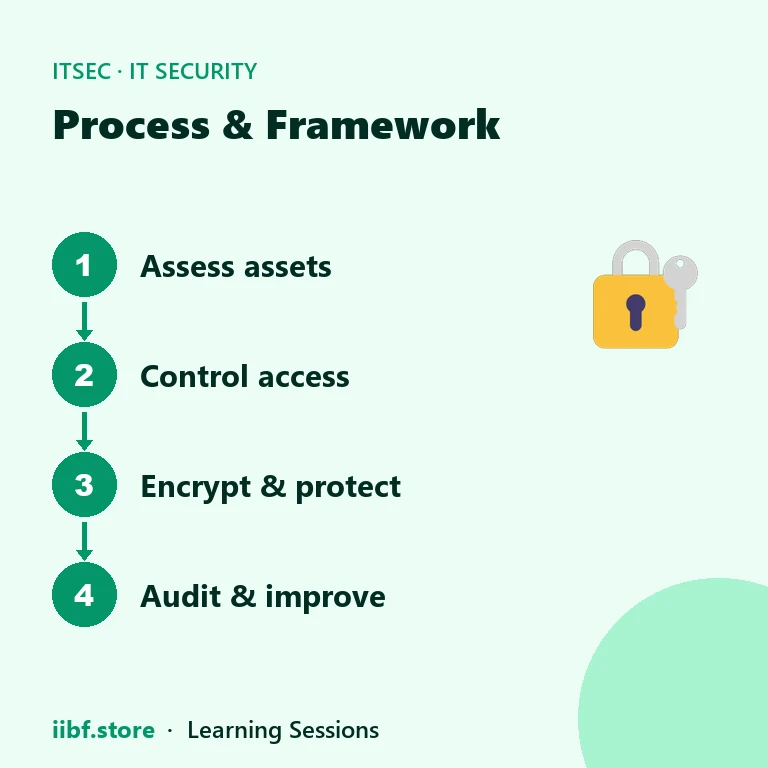
Exam questions on this topic almost always test the lifecycle stages, because each stage has a distinct failure mode. The standard stages are generation, distribution, storage, activation/use, rotation, archival, and destruction.
Generation must use a certified random-number source — a weak or predictable generator produces keys an attacker can guess or reconstruct. Banks generate high-value keys inside a hardware security module rather than in software, so the raw key material never exists in a form a system administrator can copy.
Distribution is the transfer of a key (or, more often, a key-encrypting key) from the point of generation to the systems that will use it. This step relies on secure channels and, for the most sensitive keys, a manual "dual control" process where two authorised custodians each hold a component and neither can reconstruct the full key alone.
Rotation, sometimes called re-keying, replaces a key before it has been in use long enough for cryptanalysis or accumulated exposure to become a realistic risk. A bank's key management policy sets a maximum validity period per key type and mandates emergency rotation whenever a key is suspected of compromise.
Destruction closes the lifecycle: once a key is retired, all copies — including backups — must be securely erased so that archived ciphertext protected by that key can never again be decrypted by anyone outside authorised recovery processes.
💡 Exam Tip: If a question describes "two custodians, each holding half a key, neither able to reconstruct it alone," the answer is dual control / split knowledge — a key management control, not an access control.
🔒 Hardware Security Modules and Key Storage Controls
A Hardware Security Module (HSM) is a tamper-resistant physical device purpose-built to generate, store, and use cryptographic keys without ever exposing the raw key material outside the device. Instead of loading a key into application memory, the application sends data to the HSM and receives back an encrypted or signed result — the key itself never leaves the hardened boundary.
Banks rely on HSMs for the keys protecting card PINs, payment switch traffic, digital signatures, and root certificate authorities, because software-only key storage is far easier to extract through a memory dump, a misconfigured backup, or an insider with database access. This directly extends the physical and logical protections covered in the Hardware Security chapter.
Key storage is not only about hardware — it is also about scope. Keys protecting a customer database, as covered under database security in banks, should never be reused for a tokenisation vault or a separate application; key reuse across systems multiplies the blast radius of a single compromise.
Tokenisation is a useful contrast here: schemes built around data masking and tokenisation replace sensitive values with surrogate tokens precisely so that fewer systems need direct access to the underlying key at all — reducing the number of places a key compromise can do damage.
⚠️ Common Mistake: Students often assume encryption strength alone answers a security question. If the option list includes "improve key management" versus "use a longer key," and the scenario describes operational weaknesses (shared keys, no rotation, keys in source code), key management is almost always the correct choice.
📋 Regulatory Expectations: RBI and ISO 27001
RBI's cybersecurity and IT governance expectations for banks require a documented cryptographic key management policy as part of the broader information security framework, covering key generation standards, custodian responsibilities, rotation schedules, and incident response for key compromise. Banks are expected to periodically review this policy alongside their overall risk assessment rather than treat it as a one-time setup task.
ISO 27001, which many banks adopt as their information security management system baseline, requires organisations to define rules for the effective use of cryptography, including key management, and to review those rules whenever the threat landscape or regulatory guidance changes. The Security Standards and Best Practices chapter maps how ISO 27001 clauses translate into bank-specific controls.
Just as a bank quantifies market exposure using structured approaches such as Value at Risk calculation methods, it must quantify and document cryptographic risk — which keys protect which data classes, what the impact of compromise would be, and how quickly a key can be rotated in an emergency.
Auditors verify this in practice by asking for the key inventory: a register of every active key, its owner, its algorithm and length, its creation date, and its scheduled rotation date. A bank that cannot produce this register in an audit is treated as having no effective key management control, regardless of how strong the underlying encryption is.
For primary-source reading on the supervisory expectations behind these controls, see RBI's official notifications on IT governance for banks and the IIBF's own examination resources at iibf.org.in.
⚠️ Common Key Management Failures and How Banks Fix Them
The most frequently cited failure in audit reports is a hardcoded key or credential embedded directly in application source code or a configuration file checked into version control. Once exposed this way, the key must be treated as compromised and rotated immediately, even if there is no evidence it was actually misused.
A second common failure is the "orphaned key" — a key still active in production long after the system, vendor contract, or employee associated with it has been decommissioned. Orphaned keys are dangerous precisely because no one is actively monitoring them, making them an attractive, low-visibility target.
A third failure is skipping rotation because it is operationally disruptive. Banks address this with automated key rotation built into the application deployment pipeline, so that rotating a key no longer requires a manual outage window, and secrets-management tooling that issues short-lived keys automatically rather than relying on staff discipline.
Related weaknesses show up at the network and infrastructure layers too — a bank with hardened perimeter controls but secrets injected as plain environment variables, or a bank that reuses the same TLS key across every branch tunnel, has not actually closed the underlying key management gap even though its other defences look strong.
The fix in every case is the same governance discipline: a central key inventory, defined ownership, enforced rotation schedules, and an incident-response runbook that treats any suspected key exposure as a security incident from the first minute, not after confirmation of misuse.
📌 Remember: Rotation policy, dual control, and the key inventory register are the three controls examiners test most often — memorise what each one prevents, not just its definition.
A comparison of how the main lifecycle stages differ in control intent is useful for quick revision:
| Lifecycle Stage | Primary Risk | Core Control | Automated in Modern Banks? |
|---|---|---|---|
| Generation | Weak or predictable randomness | Certified RNG inside HSM | ✅ |
| Distribution | Interception or single-person control | Dual control / split knowledge | ❌ (often manual) |
| Storage | Extraction from memory or backups | HSM-bound, non-exportable keys | ✅ |
| Rotation | Prolonged exposure window | Scheduled or event-triggered re-keying | ✅ |
| Destruction | Recoverable residual copies | Verified secure erase across all backups | ❌ (needs manual verification) |
🧠 Practice MCQs: Cryptographic Key Management in Banks
Q1. Two authorised custodians each hold one component of a master key, and neither can reconstruct the full key alone. This control is best described as: (a) Data masking (b) Dual control / split knowledge (c) Tokenisation (d) Key rotation
Answer: (b) — Splitting a key between two custodians so no single person holds it in full is the definition of dual control (split knowledge).
Q2. A bank finds an active cryptographic key still in production three years after the vendor contract it was created for ended. This is an example of: (a) Key rotation (b) A tokenisation vault (c) A key-encrypting key (d) An orphaned key
Answer: (d) — A key still active after its associated system or contract has ended, with no owner monitoring it, is classified as an orphaned key.
Q3. Why do banks prefer generating high-value keys inside a Hardware Security Module rather than in application software? (a) The raw key material never leaves the tamper-resistant boundary (b) It is cheaper (c) It removes the need for encryption (d) It eliminates the need for a key inventory
Answer: (a) — An HSM is designed so the plaintext key never exists outside its hardened boundary, protecting it from memory dumps or insider extraction.
Q4. During an ISO 27001 audit, which document is used to verify that a bank's key management control is operating effectively? (a) The network topology diagram (b) The key inventory register (c) The employee leave policy (d) The marketing calendar
Answer: (b) — Auditors check the key inventory register listing every active key, its owner, algorithm, creation date, and rotation schedule as evidence of effective control.
Q5. A key is discovered hardcoded in a configuration file that was checked into a shared code repository. What is the correct immediate action? (a) Leave it unless misuse is confirmed (b) Only rotate it at the next scheduled rotation date (c) Rotate the key immediately and treat it as compromised (d) Disable logging for that system
Answer: (c) — Any exposed key must be treated as compromised and rotated immediately, regardless of whether misuse has been confirmed, since exposure itself is the trigger.
Want chapter-wise mock tests with 100+ MCQs? Start practising free →
❓ Frequently Asked Questions
Is cryptographic key management the same as encryption?
No. Encryption is the mathematical process of converting data into ciphertext; key management is the surrounding discipline of generating, storing, rotating, and destroying the keys that make that encryption trustworthy over time.
Why do banks use HSMs instead of just storing keys in a database?
A Hardware Security Module keeps the raw key material inside a tamper-resistant boundary so it is never exposed to application memory, backups, or administrators, whereas a database-stored key can potentially be extracted by anyone with sufficient access.
What triggers an emergency key rotation outside the normal schedule?
Any suspected exposure — a hardcoded key found in code, a departing employee who had access, a compromised system, or a vendor breach — triggers immediate rotation rather than waiting for the scheduled rotation date.
How does key management relate to ISO 27001 for banks preparing for the IT Security paper?
ISO 27001's cryptographic-controls domain requires a documented policy covering key generation, distribution, storage, rotation, and destruction, and auditors specifically request the key inventory register as evidence that the policy is followed in practice, not just written.
Ready to test yourself further?
Cryptographic key management ties together governance, hardware controls, and audit evidence — exactly the kind of cross-topic scenario IIBF loves to test. Reinforce it with structured practice on IIBF's CAIIB IT Security paper, browse more topics on the IT Security tag hub, and check the latest regulatory notes at IIBF news updates before your next attempt.
Prefer revising from a printed book?
Chapter-wise books with MCQs after every chapter — minimal pages, complete coverage, delivered anywhere in India. Every book has a free sample to read first.
118 pages · 299 MCQs
Learning Sessions · Ashish Sir
132 pages · 225 MCQs
Learning Sessions · Ashish Sir
188 pages · 435 MCQs
Learning Sessions · Ashish Sir
117 pages · 236 MCQs
Learning Sessions · Ashish Sir
Learning Sessions · Ashish Sir
Learning Sessions · Ashish Sir
Learning Sessions · Ashish Sir
Learning Sessions · Ashish Sir
115 pages · 255 MCQs
Learning Sessions · Ashish Sir
Learning Sessions · Ashish Sir
334 pages · 936 MCQs
Learning Sessions · Ashish Sir
Learning Sessions · Ashish Sir
115 pages · 344 MCQs
Learning Sessions · Ashish Sir
107 pages · 240 MCQs
Learning Sessions · Ashish Sir
90 pages · 150 MCQs
Learning Sessions · Ashish Sir
Learning Sessions · Ashish Sir
131 pages · 672 MCQs
Learning Sessions · Ashish Sir
221 pages · 831 MCQs
Learning Sessions · Ashish Sir
128 pages · 524 MCQs
Learning Sessions · Ashish Sir
107 pages · 445 MCQs
Learning Sessions · Ashish Sir
148 pages · 478 MCQs
Learning Sessions · Ashish Sir
151 pages · 465 MCQs
Learning Sessions · Ashish Sir
148 pages · 375 MCQs
Learning Sessions · Ashish Sir
216 pages · 895 MCQs
Learning Sessions · Ashish Sir
109 pages · 300 MCQs
Learning Sessions · Ashish Sir
104 pages · 360 MCQs
Learning Sessions · Ashish Sir
82 pages · 297 MCQs
Learning Sessions · Ashish Sir
151 pages · 600 MCQs
Learning Sessions · Ashish Sir
98 pages · 282 MCQs
Learning Sessions · Ashish Sir
Practice this topic
Take a free mock test, download chapter PDFs, or watch a video class — all included on iibf.store.