JAIIB PPB MCQ Practice: A Method That Actually Works
There is a particular kind of frustration that shows up about six weeks into JAIIB prep. You have read the chapter. You understood the chapter. Then you open a question set and get four out of ten. The gap is not knowledge — it is that reading and answering are different skills, and only one of them is what the exam measures.
PPB 2026 question series with latest updates · Watch on YouTube
This session runs a JAIIB PPB MCQ series built around recently updated material, and the value is less in the individual answers than in watching how each question is dismantled. That method is what this article sets out, so you can apply it to any question set you pick up afterwards.
What the paper is, mechanically
Before technique, the format. IIBF states that the question paper will contain approximately 100 objective type multiple choice questions for 100 marks, that the examination is held in online mode only, that the duration is two hours, and — critically — that there is no negative marking for wrong answers. The Institute reserves the right to vary the number of questions for a subject.
Two hours for roughly a hundred questions is about seventy seconds each. That is generous for a definition question and tight for a scenario question, which is why pacing matters more than raw knowledge for most candidates who fail narrowly.
Where PPB questions come from
Principles & Practices of Banking has four modules, and the question style shifts noticeably between them. Knowing which module a question belongs to tells you what kind of answer it wants.
| Module | Coverage | Typical question style |
|---|---|---|
| A — General Banking Operations | Banker-customer relationship, KYC/AML, deposit accounts, cheques, FEMA and NRI, customer service, RTI, Consumer Protection Act 2019 | Rule recall and small operational scenarios |
| B — Functions of Banks | Principles of lending, types of facilities, appraisal, working capital and term loan assessment, loan operations | Applied scenarios and simple computations |
| C — Banking Technology | Bank computerisation, core banking, CBS operations, EOD/BOD, access control | Direct factual recall |
| D — Ethics | Business ethics, individual ethics, ethical dimensions for employees | Judgement and best-fit reasoning |
Module C is where the fastest marks live — the questions are direct and the content is finite. Module B is where the hardest marks live, because a lending scenario can hide the actual rule behind two lines of narrative.
The three habits worth building
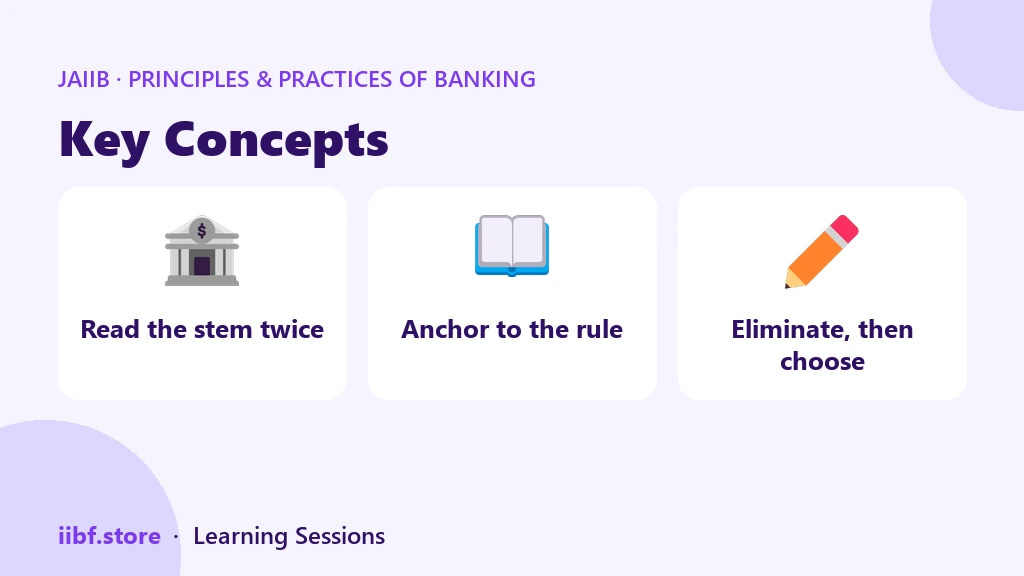
Read the stem twice before looking at the options. The options are designed to be attractive. If you read them first, one of them starts to feel right before you have decided what the question is asking. Read the stem, decide your answer in your head, then look down. If your answer is there, take it and move on.
Anchor every question to one rule. Behind a two-line scenario there is always a single proposition — who bears the liability, what relationship exists, which document governs. Name it before answering. "Bank acted as agent, not trustee" is a decision; "option C sounds right" is a guess.
Eliminate before choosing. Most four-option questions contain one obviously wrong option and two that differ on a single word: may versus shall, joint versus several, on demand versus on notice. Find the differing word and the question usually answers itself.
Two worked questions
"A customer hands the bank a sealed box for safe custody. What relationship is created?" Anchor first: this is banker-customer relationship in Module A. The bank receives goods for a purpose, with an obligation to return them — that is bailment, and the bank is the bailee. It is not trusteeship, because there is no trust property held for a beneficiary, and it is not agency, because the bank is not acting on the customer's behalf with third parties. Answer: bailee-bailor.
"A borrower has a sanctioned limit of Rs 50 lakh but drawing power of Rs 38 lakh. What can be drawn?" Anchor: working capital operations in Module B. Sanctioned limit is the ceiling; drawing power is what the current security position actually supports. The permissible drawal is the lower of the two, so Rs 38 lakh. The distractor is always the sanctioned limit, because that is the bigger and more memorable number.
Both questions are answerable in under thirty seconds once the rule is named — and both are close to unanswerable if you are hunting through a remembered paragraph instead.
Why "latest updates" questions deserve separate attention
PPB carries a lot of material that moves: KYC and AML instructions, customer service guidelines, grievance redressal and ombudsman arrangements, payment system rules. When a rule changes, question banks that were built a year ago quietly go stale, and practising a wrong answer repeatedly is worse than not practising at all.
So treat any figure, threshold or scheme name in a practice question as provisional. Where a question turns on a current number, verify it against the primary source — the Reserve Bank of India's master directions and circulars for operational rules, and IIBF's own syllabus document for what is examinable at all. That habit costs a few minutes and protects you from confidently writing a rule that was superseded.
Building the loop
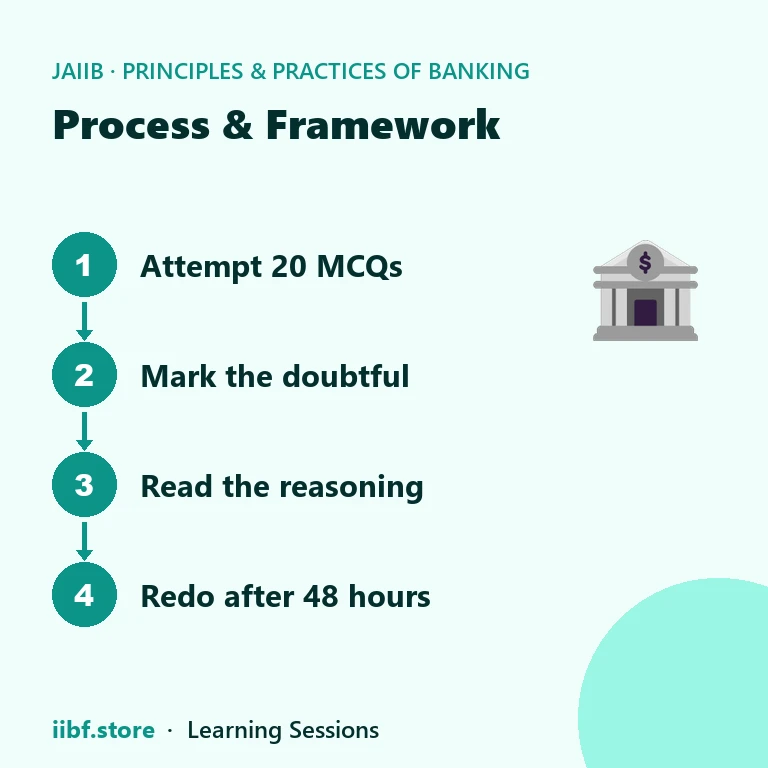
Attempt twenty questions in one sitting without checking answers. Mark the ones you were unsure about even if you got them right, because a lucky guess is a gap you have not found yet. Then read the reasoning for every question you missed or flagged — not just the correct option, the reason the others fail. Redo the same twenty after forty-eight hours. Anything you miss twice goes back to the chapter.
Because there is no negative marking, never leave a blank. Guess, flag it, and come back if time allows. A question you skipped to "come back to later" and never returned to is a mark you gave away for free.
Work through the module notes in the JAIIB course library, then run a JAIIB PPB MCQ set from the practice test bank the same day you read a topic. The study planner will schedule the forty-eight-hour repeats for you, and the current RBI rates page is worth a glance before any practice session that touches policy numbers.
How many questions are there in the JAIIB PPB paper?
Approximately 100 objective type multiple choice questions for 100 marks, held in online mode over two hours. IIBF notes it may vary the number of questions asked for a subject.
Should I guess if I do not know the answer?
Yes. There is no negative marking for wrong answers in the JAIIB examination, so a blank is strictly worse than a guess. Eliminate what you can, choose, and move on.
How many JAIIB PPB MCQ questions should I do per day?
Consistency beats volume. Twenty questions attempted properly, reviewed for reasoning and repeated after forty-eight hours will move your score more than a hundred questions skimmed once without correction.
How do I know a practice question is still current?
Check anything that involves a figure, threshold or scheme name against the primary source — RBI circulars and master directions for operational rules, and the IIBF syllabus document for scope. Question banks age faster than textbooks do.
Quick quiz on this topic
5 exam-style questions from our free test bank — check yourself before you move on.
Practice this topic
Take a free mock test, download chapter PDFs, or watch a video class — all included on iibf.store.
Keep reading