Is the SFB Exam Preparation Book Right for You? An Honest Guide
It is 9:40 pm. You have closed the branch, travelled home, eaten something, and now there is a syllabus waiting for you that feels endless. Every second person has a "complete package" to sell you. You have probably been burned by at least one of them already. So before you spend a rupee, let us ask a plain question: is the SFB exam preparation book actually right for someone in your situation?
This guide is written like a senior colleague would talk to you over tea. We will look at four kinds of readers, say honestly how the book helps each of them, and, just as important, say when a book alone will not be enough. If the answer for you is "buy something else" or "do the free stuff first", you will find that here too.
First, what exactly is in the book?
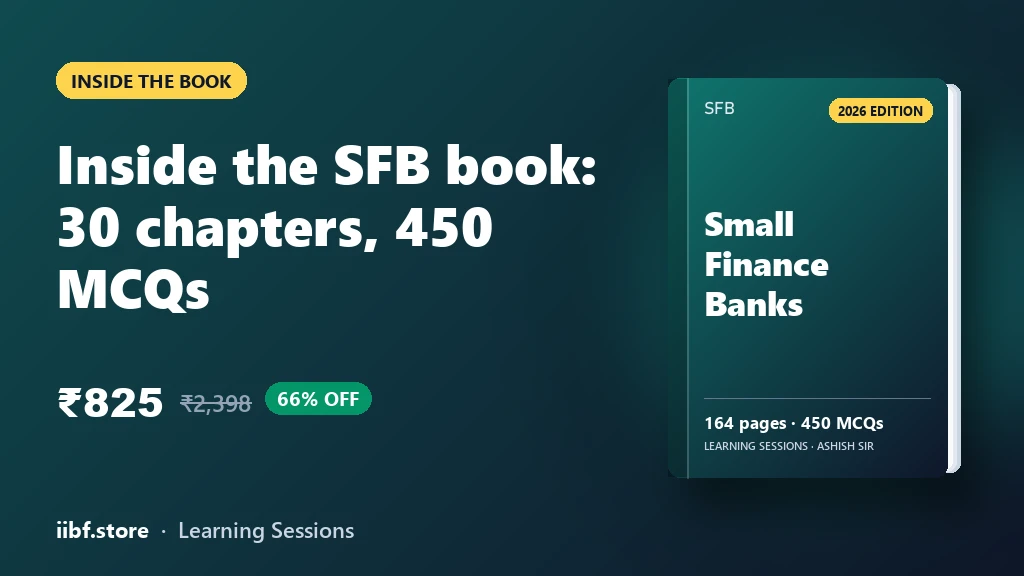
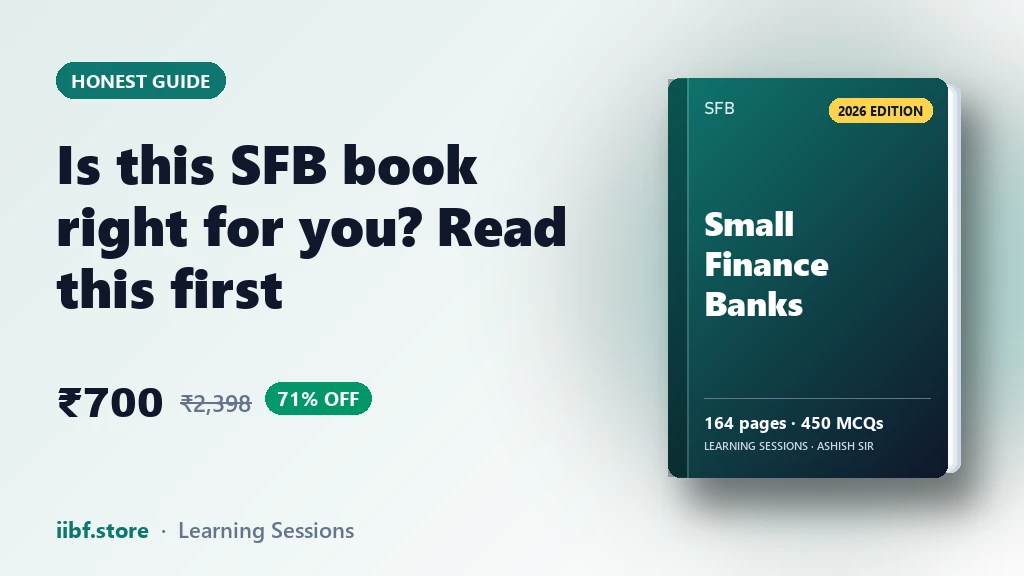
Let us start with facts, no adjectives. The Small Finance Banks printed book is the 2026 edition, with 164 pages, 30 chapters and 450 practice questions. The chapters are grouped into four modules:
- Module A, Financial System, Regulation and SFB Framework: Financial System, Banking Regulations, Setting Up of a Small Finance Bank, Financial Inclusion and Financial Literacy, Government Sponsored Credit-Linked Schemes, Risk Management.
- Module B, Operational Aspects of Banking: Operations of Banks, Maintenance of Accounts, KYC and AML, Banker Special Relationship, Negotiable Instrument.
- Module C, Credit Management: nine chapters from Principles of Lending to NPAs, Agricultural Advances, Recovery of Loans, Credit Guarantee Schemes and Foreign Exchange.
- Module D, Marketing and Customer Relationship Management: ten chapters from Marketing and Consumer Behaviour to Payment Systems, Consumer Protection and Soft Skills.
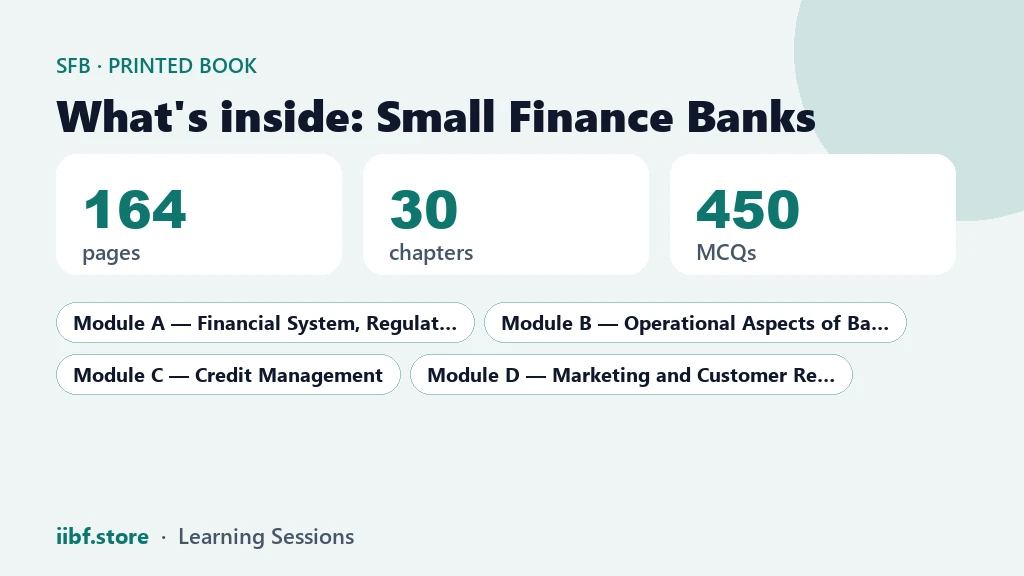
On top of the chapters, the book carries 30 case studies (120 questions) and 5 mega tests (500 questions). Two things stand out for a working banker. It is compact, 164 pages is a weekend-and-a-few-evenings read, not a semester. And it follows the same module logic you already know from branch work: regulation, operations, credit, customers.
Which reader are you? Four honest profiles
Most candidates who pick up an SFB exam preparation book fall into one of four groups. Find yourself below, and read the "not enough on its own" line carefully. That line is the one other sellers skip.
Profile 1: You are attempting for the first time
You know banking from the counter, but the exam language is new: regulatory frameworks, priority sector norms, credit-linked schemes. For you, the main risk is not difficulty, it is not knowing where to start and drowning in notes.
How to use the book: read it in module order, one module per week. Do not highlight everything. After each chapter, close the book and write three lines from memory. Then attempt that chapter's questions the same day.
When it is not enough: a first-timer often underestimates exam-hall speed. Reading builds understanding; it does not build the habit of answering under a clock. You need timed practice, and the free mock tests are the cheapest way to get it.
Profile 2: You have attempted before
You know the pain of coming out of the hall thinking "I knew this, why did I mark that?". Your problem is rarely the absence of content. It is usually patchy recall and a few weak modules that keep dragging the score down.
How to use the book: do not start from page one. Take the four module headings, rate yourself honestly out of five on each, and begin with your weakest. Read only that module, then take its questions cold. Wrong answers tell you which chapter to reopen.
When it is not enough: if your last attempt went wrong because of nerves or time management, a better book will not fix it. You need two or three full-length timed sittings before the exam, and a short written log of every mistake.
Profile 3: You are short on time
Perhaps your exam is close, or your branch is in audit season and your evenings belong to someone else. You have a few weeks, maybe less, and you cannot afford a plan that needs a month of free evenings.
How to use the book: triage. Skim the chapter list and pick the chapters closest to your daily work first: Operations of Banks, Maintenance of Accounts, KYC and AML, Negotiable Instrument. You already half-know them, so they are quick wins. Then spend your fresh hours on the ones you have never handled, such as Credit Guarantee Schemes or Para Banking Activities.
When it is not enough: a short runway means you cannot read everything. The book will not rescue a cramming plan that skips practice. Keep at least a third of your time for questions and the mega tests, and be realistic: if you can give only an hour a day, say so to yourself now rather than the night before.
Profile 4: You prefer paper over screens
After a full day at a terminal, the last thing your eyes want is another glowing screen. Many bankers say they remember better when they underline with a pencil and scribble in the margin. If that is you, a printed book is not a luxury, it is how you study.
How to use the book: make it yours. Fold the pages you keep forgetting, write the full form of every abbreviation in the margin, and keep a small flag on the chapters you will revisit the night before.
When it is not enough: paper cannot tell you the latest circular or notice. For anything regulatory, check the official source at iibf.org.in before the exam, and use the free PDFs and updates on the site for anything newer than the printed edition.
A simple way to use the book while working full time
Whichever profile you matched, the same four-step rhythm works with this SFB exam preparation book for most people with a job. It is not clever, which is exactly why it survives tired evenings.
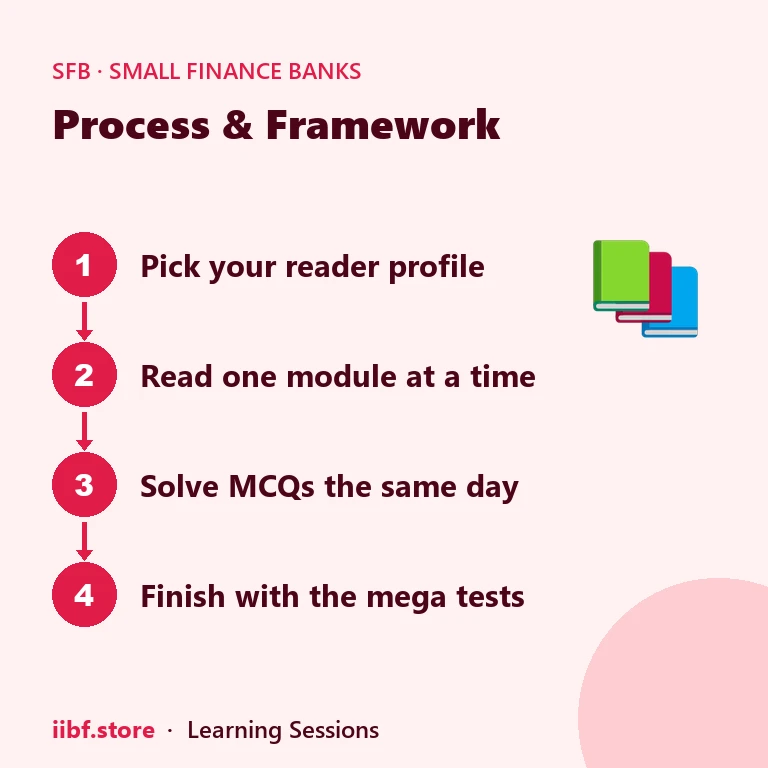
- Pick your starting point. First-timers begin with Module A; repeat candidates begin with their weakest module.
- Read one module at a time. Three or four chapters a week is enough. Stop at the end of a chapter, never in the middle.
- Solve questions the same day. Memory fades in a night. A wrong answer today costs nothing; a wrong answer in the hall costs a mark.
- Finish with the case studies and mega tests. These are where you practise applying a concept to a situation, which is how many bankers meet the paper.
If you can give 45 minutes on a weekday and two hours on a weekend, this rhythm fits inside a working life. If you cannot, shorten the weekly target, not the practice.
Where this SFB exam preparation book will not be enough
Here is the honest part. A book is a tool for understanding and revision. It is not a guarantee, and anyone who tells you otherwise is selling you something. Specifically, the Small Finance Banks book page describes a printed edition, so keep these limits in mind:
- Exam-hall speed. Reading does not train you to answer under time pressure. Pair the book with timed mocks from the free mock tests section.
- Recent changes. Regulations move. Treat the printed edition as your base and check official notices for anything recent.
- Self-discipline. The book cannot make you open it at 10 pm. A fixed slot, even 30 minutes, matters more than a perfect plan.
- Your own weak spots. Only you can see them, and only practice reveals them. Keep a notebook of errors.
What should you spend, and what can you do for free?
The book is listed at ₹700 against an MRP of ₹2,398, which is 71 percent off. Prices can change, so treat the book page as the current source. Before buying the SFB exam preparation book, do two free things. Open the free sample on the book page and read a chapter. If the style helps you, good. If it does not, you have lost nothing.
Also browse the free study material and the wider books catalogue. A candidate who already has solid notes might need only mock practice, and that is a perfectly sensible decision.
| Reader | Start with | Add alongside |
|---|---|---|
| First attempt | Module A, then in order | Free mock tests for timing |
| Repeat attempt | Your weakest module | Two or three full timed sittings |
| Short on time | Chapters near your daily work | Case studies and mega tests early |
| Prefers paper | Any module, with pencil in hand | Official notices for recent changes |
The bottom line
The SFB exam preparation book makes sense if you want one compact, module-wise source you can read on paper, with 450 questions, 30 case studies and 5 mega tests to practise on. It makes less sense if you only need timed practice, or if you expect a book to do the studying for you. Be honest about which reader you are, start from the right module, and keep practice in the plan from day one.
For the official schedule of the upcoming exam cycle, always check the IIBF website. And if you want to see exactly what you would be getting, the book page has the contents and the free sample.
Frequently asked questions
Can I clear the exam with only this book?
Many candidates use a book as their main source, but no book can promise a result. Pair it with timed mock tests so that the exam hall is not the first time you answer under a clock.
Is it suitable if I have never worked in a small finance bank?
Yes. The chapters start from the financial system and regulation, then move to operations, credit and marketing, so general banking experience is a good base. Read Module A first.
Is there a way to try it before buying?
Yes. The book page has a free sample you can read first. You can also use the free study material and free mock tests on the site while you decide.
Will the price stay the same?
Prices may change. The book page always shows the current price, which at the time of writing is ₹700 against an MRP of ₹2,398.
Prefer revising from a printed book?
Chapter-wise books with MCQs after every chapter — minimal pages, complete coverage, delivered anywhere in India. Every book has a free sample to read first.














Practice this topic
Take a free mock test, download chapter PDFs, or watch a video class — all included on iibf.store.