Is the Treasury Management Book Right for You? An Honest Guide
It is 10:40 at night. The branch closed late again, the day-end figures took longer than expected, and the Treasury paper is sitting on your to-do list like a guest who will not leave. Money markets, forex, derivatives, liquidity, front office and back office: the syllabus looks like six subjects pretending to be one. If you are choosing a Treasury Management book right now, you are probably tired and a little sceptical, and you should be. You have been sold "complete packages" before.
So this is not a sales pitch. This is a plain guide to who the printed book suits, who it does not, and what you must add to it. Read it, and if the answer is "not for me", you will still leave with a method you can use with any material.
Start with your situation, not the book
Before you compare any study material, answer three questions honestly. How many hours a week can you really give, not on paper but after a full branch day? Is this your first attempt or a repeat? And do you retain better from paper or from a screen?
Those answers matter more than any brochure. A candidate with four steady hours a week and a printed text will usually beat a candidate with fifteen "planned" hours and three open browser tabs. Treasury is a subject where steady, small, repeated contact with the same vocabulary wins, because the terminology repeats across chapters: yield, duration, forward premium, repo, CRR, SLR, mid office.
- Write down your real weekly hours, then take away one quarter of them for the weeks you will be too tired.
- Decide your attempt type: first, repeat, or a short-notice sit.
- Pick paper or screen as your main reading mode, and stay consistent.
Once you know these three things, the choice of material becomes simple. Let us look at what the book actually contains so you can judge the fit.
What the Treasury Management book actually contains
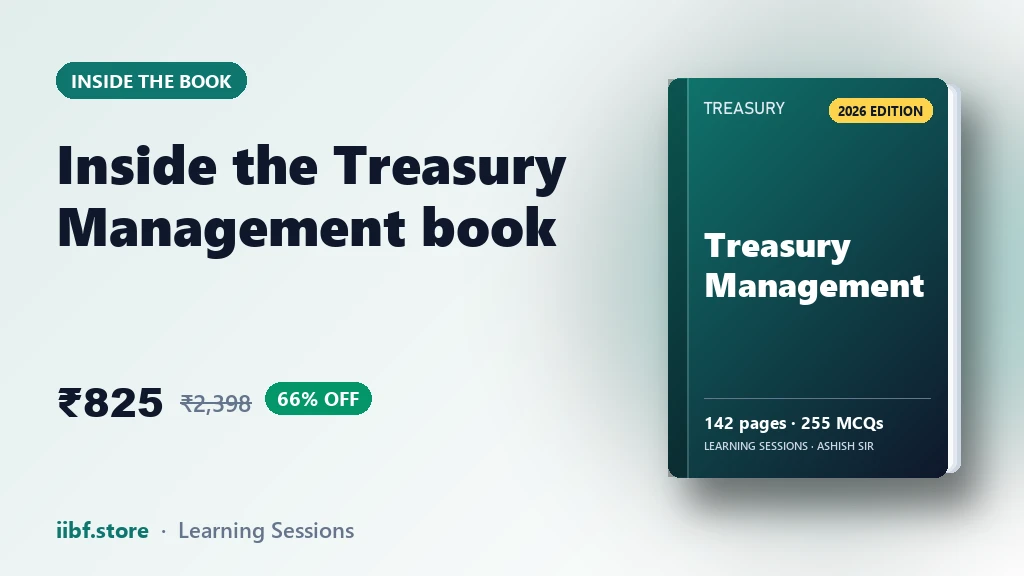
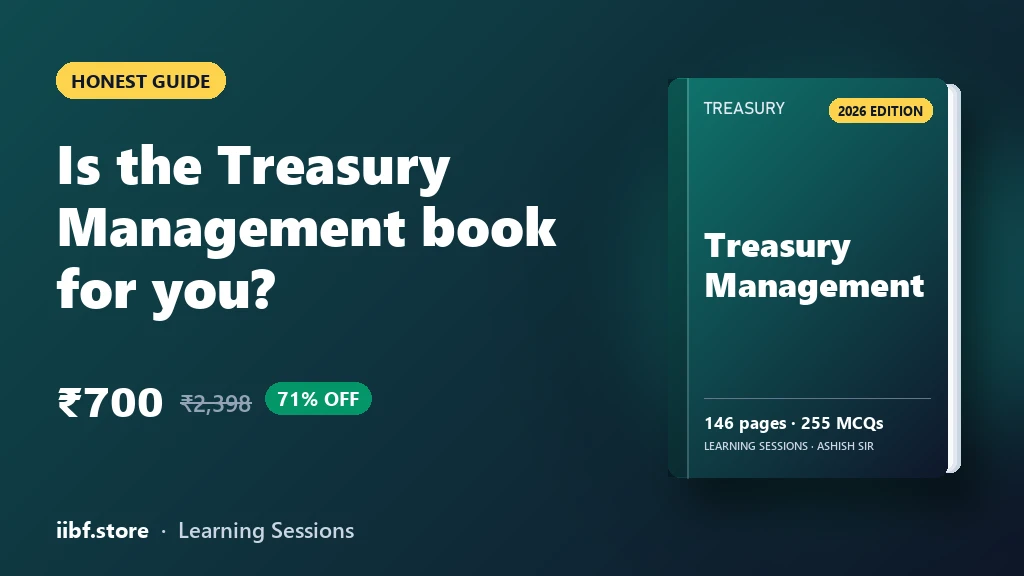
The Treasury Management book is a 2026 edition printed text of 146 pages. It has 12 chapters in a single module, Module T, and it carries 255 questions in total. The chapters run in a sensible order: Financial Markets, Money Market, Debt Markets and Fixed Income Securities, Capital Markets, Foreign Exchange Markets, Interest Rate Quotations and Market Terminology, Derivatives, Treasury Management, Liquidity Management, Front Office, Mid Office and Back Office, Regulations, Supervision and Compliance of Treasury Operations, and Role of Information Technology in Treasury Management.
Beyond the chapters there are 20 case studies carrying 80 questions, four annexures, and a supplementary section on risk analysis and control. There are also 5 mega tests with 500 questions. Pages and questions are facts you can check on the book page; nothing here is a promise about your result.
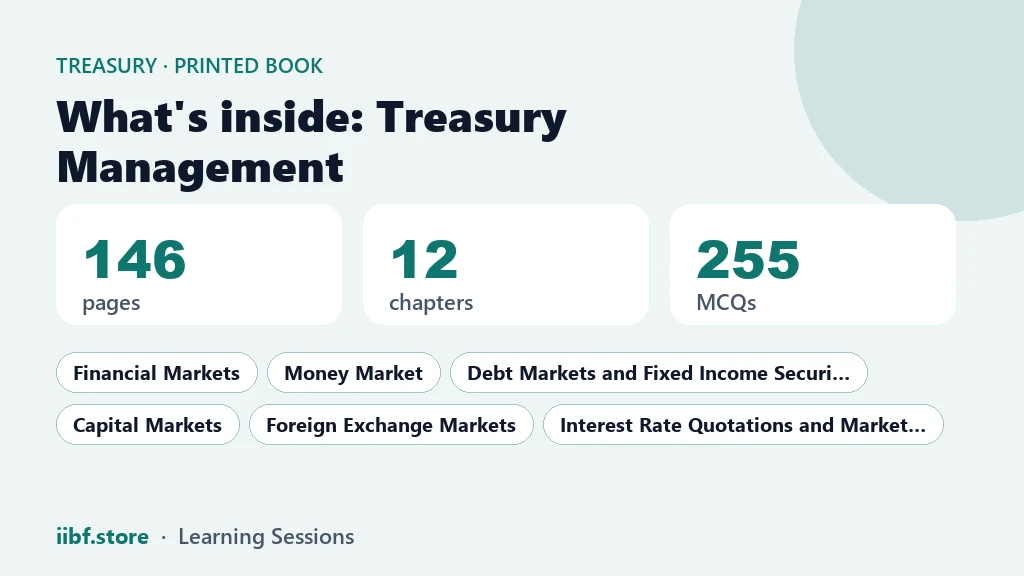
At 146 pages it is deliberately compact. That is a strength if you are short on time, and a limit if you want every nuance explained at length. Keep that trade-off in mind as we go through the reader profiles below.
Reader profile 1: the first-attempt candidate
How to use the book
If this is your first attempt, your biggest risk is not weakness in any one chapter. It is drifting. A compact printed text gives you a visible finish line: twelve chapters, one a night on weekdays, a recap on Sunday. Read the chapter first without a pen, then read it again and underline definitions. Solve that chapter's questions the next day, not the same night, because the delay is what shows you what you actually remember.
Do not skip the case studies. Treasury questions often test whether you can apply a concept to a short scenario, and the 20 case studies are practice for exactly that.
When it is not enough on its own
A book will not give you exam-hall speed. In your last two weeks you need timed practice, which means full-length mocks under a clock. Use the five mega tests in the book, and add the free mock tests at iibf.store/tests so you meet questions you have not already seen. If a chapter on derivatives or forex still feels foggy after two reads, that is a signal to look for a class or a video on that topic, not to read the same page a fifth time.
Here is the first honest filter for this guide.
Reader profile 2: the repeat-attempt candidate
How to use the book
If you have failed or postponed before, you do not need a fresh start from page one. You need a diagnosis. Take the questions in each chapter cold, before you read anything, and mark your score. The chapters where you score lowest are your real syllabus. Spend most of your hours there, and only skim the rest.
Repeat candidates also tend to over-read and under-test. Flip that ratio. Read for one hour, then test for two. The Treasury Management book is useful here because the questions sit inside the same covers as the explanation, so a wrong answer sends you straight back to the right paragraph.
When it is not enough on its own
If your earlier attempt went wrong because of time pressure in the hall rather than gaps in knowledge, more reading will not fix it. You need repeated timed mocks and a habit of leaving a question and returning to it. Also check the official updates on the IIBF website, because the format or scope of a paper can change between cycles and a printed edition cannot update itself.
Reader profile 3: the candidate who is short on time
How to use the book
Short on time usually means a few weeks, a demanding branch, and a lot of anxiety. This is where a 146-page text earns its place, but only if you respect the order. Do the regulation and risk chapters early, because they are the easiest to read on a commute, and keep the numerical and market chapters for your sharpest hours.
Use a simple rule: no chapter gets more than two sittings. Sitting one is reading with a pencil. Sitting two is questions only. Then move on and come back during revision.
When it is not enough on its own
Be realistic. If you have never worked with money markets or forex, a very short runway is risky no matter what you study. In that case consider whether the upcoming exam cycle is the right one, or whether the next cycle gives you a calmer run. The official schedule is on the IIBF site, and there is no shame in choosing the date that fits your life. A book cannot compress understanding that has not had time to form.
Reader profile 4: the candidate who prefers paper
How to use the book
Many bankers spend all day on screens and simply do not retain from them at night. If that is you, a printed Treasury Management book is not nostalgia; it is a sound study choice. Paper lets you annotate, fold, draw the yield curve in the margin, and carry one object instead of a device full of notifications.
Make the margins work. Write one line in your own words at the end of each chapter, and keep a separate page for formulas and abbreviations. By the end you will have your own revision sheet, which is worth more than any ready-made summary.
When it is not enough on its own
Paper cannot show you new questions. Pair it with online practice and, where you can, with the free PDFs at iibf.store/free-material for extra reading on topics you find thin. Paper also cannot be searched, so keep an index of your own for the topics you revisit often.
A simple four-step method for any of these profiles
Whatever your profile, the same loop works. It is boring, which is why it works.
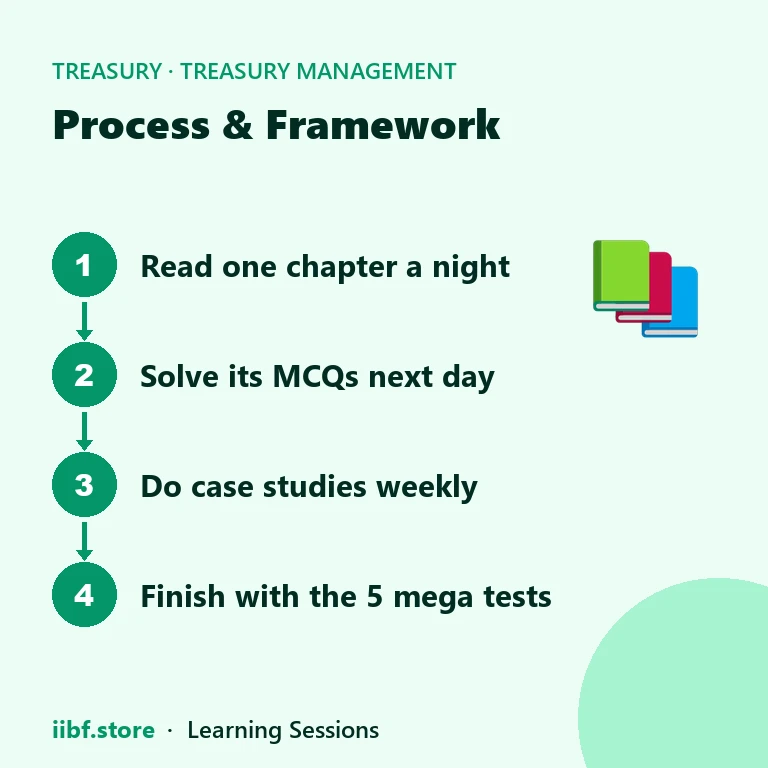
- Read one chapter at a sitting. Pencil in hand, no phone.
- Test it the next day. The gap shows what stuck.
- Do case studies weekly. Scenarios are where theory becomes marks.
- Finish with full tests. Treat them as dress rehearsals, timed and uninterrupted.
The quick comparison
| Your profile | Best use of the book | What to add |
|---|---|---|
| First attempt | One chapter a night, questions next day | Free mock tests in the last two weeks |
| Repeat attempt | Cold-test each chapter, study the weak ones | Timed mocks to fix hall speed |
| Short on time | Two sittings per chapter, hardest topics at your sharpest hours | A class or video for any chapter that stays unclear |
| Prefers paper | Annotate, build your own formula page | Online practice and free PDFs for fresh questions |
If you want to see how other certificates and papers are structured before you decide, the full range is on the books page, and the blog has more preparation guides written for working bankers.
The price, stated plainly
The listed price of the book is ₹700 against an MRP of ₹2,398, which the page shows as 71% off. Prices can change, so treat the book page as the current source. A free sample is available there, and you should read it before paying anything. If the writing style does not help you, no discount makes it a good purchase.
Final word
The Treasury Management book suits you if you want a compact, structured paper text with questions built in, and you are willing to add timed mocks. It does not suit you if you expect a single book to replace practice, or if you have no time at all before the paper. That honesty is the point: pick the tool that fits your hours and your habits, then keep showing up for twenty minutes on the nights when thirty feels impossible.
Frequently asked questions
Can I clear the paper with only this book?
The book gives you a structured text, 255 questions, 20 case studies and 5 mega tests. Whether that is enough depends on your background and practice habits. Most candidates should add timed mock tests, and no book can promise a result.
Is it suitable if I have no treasury or dealing room experience?
Yes, the chapters begin with financial markets and build up to derivatives and regulation. If you are new to the topic, give yourself more weeks and seek a video or class for any chapter that stays unclear.
Is there a way to check the style before buying?
Yes, there is a free sample on the book page. Read it first and decide whether the explanations suit you.
Where do I find the exam date and rules?
Always check the official site, www.iibf.org.in, for the schedule and current rules of the upcoming exam cycle.
Prefer revising from a printed book?
Chapter-wise books with MCQs after every chapter — minimal pages, complete coverage, delivered anywhere in India. Every book has a free sample to read first.
















Practice this topic
Take a free mock test, download chapter PDFs, or watch a video class — all included on iibf.store.