JAIIB PPB Syllabus 2026: Which Module to Study First
The question in this class is the one every first-timer asks: the paper is huge, so where do I actually begin? The instinct is to open the book at page one and grind forward. That is the slowest possible route, and it is why so many candidates arrive at the exam having read Module A four times and Module D never.
JAIIB PPB syllabus priority for 2026 · Watch on YouTube
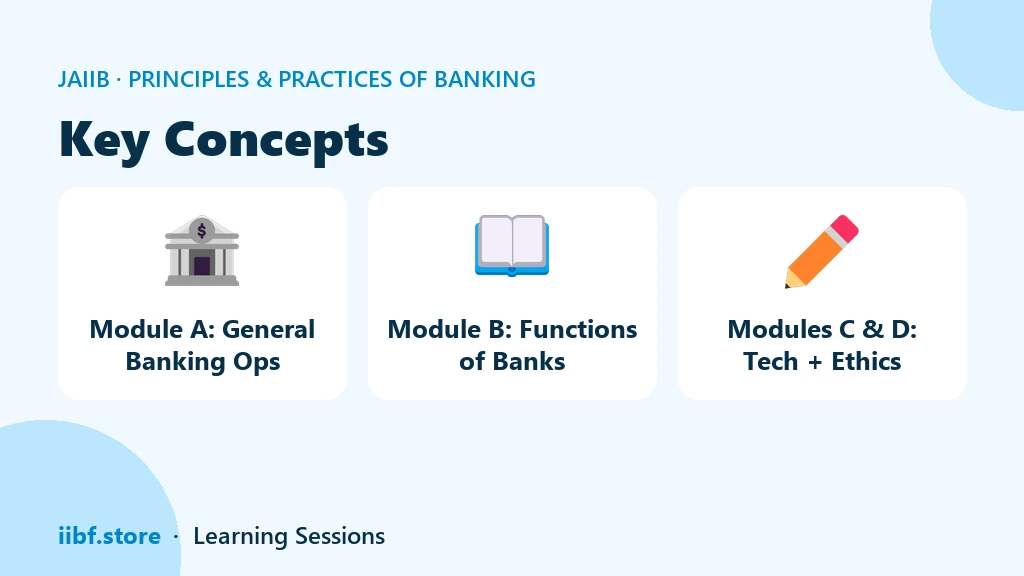
So let us settle the structure first. The JAIIB PPB syllabus published by IIBF splits Principles & Practices of Banking into four modules, and knowing what each one is for changes the order you should study them in.
The four modules, in the Institute's own words
Module A — General Banking Operations. The largest and most operational module. Banker-customer relationship, AML/KYC guidelines and the operational aspects of KYC, opening accounts of various types of customers, operational aspects of deposit accounts, clearing and collection and cash handling, the banker's special relationship (mandate, power of attorney, lien, set-off, appropriation), FEMA remittance facilities for individuals, NRI business, foreign currency accounts, cash management services, payment and collection of cheques, responsibilities of paying and collecting banks, ancillary services, financial inclusion and financial literacy, customer service guidelines, duties and rights of bankers and customers, grievance redressal and the RBI ombudsman framework, the Consumer Protection Act 2019 and the Right to Information Act 2005.
Module B — Functions of Banks. The lending module. Principles of lending, types of borrowers and credit facilities, fund-based working capital, term and demand loans, non-fund-based facilities, credit appraisal and assessment techniques, assessment of working capital and term loans, and the operational aspects of loan accounts — interest rates, credit management, credit monitoring and the accounting of loan products.
Module C — Banking Technology. Essentials of bank computerisation, networking, core banking, data warehousing and mining, and the operational aspects of a CBS environment: functions performed by CBS, flow and accounting of transactions, end-of-day and begin-of-day operations, password and logical access control, and security controls.
Module D — Ethics in Banks and Financial Institutions. Business ethics as an integrated perspective, ethics at the individual level, ethical dimensions for employees, and the case material the Institute uses to ground it.
Why "chapter 1 se start mat karo" is genuinely good advice
Module A is not a bad module. It is a bad starting module for most candidates, for a simple reason: it is enormous, it is detail-dense, and almost none of it builds on anything else. You can read forty pages of deposit account operational instructions and still not feel any closer to a pass, because there is no structure to hang the details on.
Module B behaves differently. Principles of lending, types of facilities, appraisal and monitoring form a chain — each topic explains the next. Studying B first gives you a working mental model of what a bank does with money, and that model then makes half of Module A make sense, because deposit rules, KYC and remittance facilities all become "the operational plumbing around the lending business" rather than a list.
| Order | Module | Why here | Rough share of your time |
|---|---|---|---|
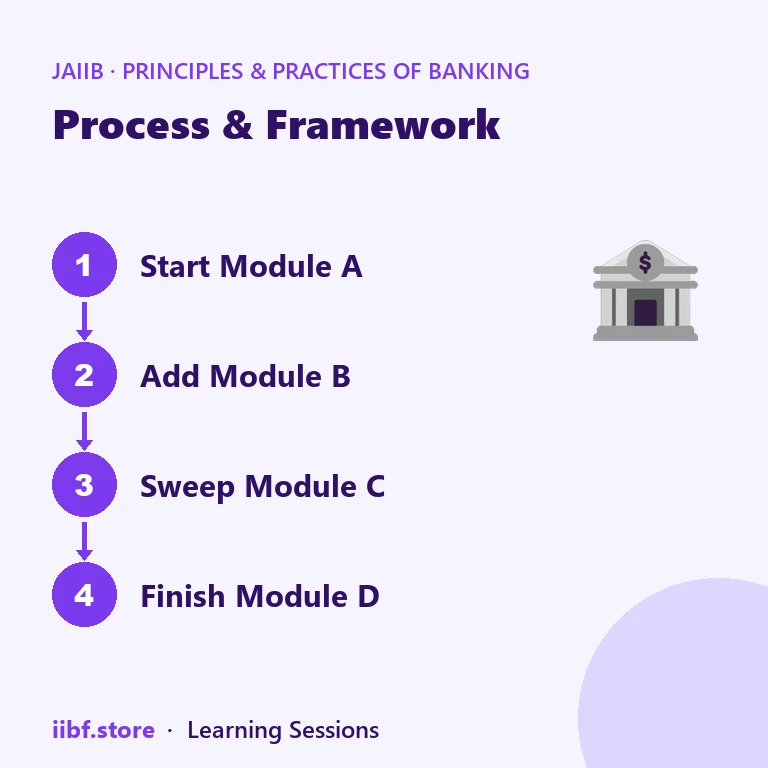
| 1 | B — Functions of Banks | Builds a model; topics reinforce each other | 30% |
| 2 | A — General Banking Operations | Largest module; far easier once B is in place | 40% |
| 3 | C — Banking Technology | Short, self-contained, high recall-per-page | 18% |
| 4 | D — Ethics | Readable, conceptual, low memorisation load | 12% |
Those percentages are a study-time recommendation, not an official weightage. IIBF does not publish module-wise marks for this paper, and anyone quoting exact per-module marks is guessing. What the Institute does publish is the paper shape: approximately 100 objective multiple-choice questions for 100 marks, online mode only, two hours, with no negative marking for wrong answers.
No negative marking changes your tactics
This is the single most under-used fact in JAIIB preparation. Because there is no penalty for a wrong answer, the correct strategy is to attempt every question. A blank is worth exactly zero; a guess on a four-option question is worth an expected 0.25 marks, and an educated guess after eliminating one option is worth more.
Practically, that means your last five minutes should be spent filling in everything you left blank, not re-checking answers you were already confident about. Candidates lose marks to unattempted questions far more often than to changed-but-wrong answers.
The numbers you should have memorised before you plan
JAIIB has four papers: Indian Economy & Indian Financial System, Principles & Practices of Banking, Accounting & Financial Management for Bankers, and Retail Banking & Wealth Management. The pass mark in a subject is 50 out of 100. The alternative route is at least 45 marks in each subject with an aggregate of 50% across all subjects in a single attempt. Credits for passed subjects are retained until the time limit expires.
And that time limit is the constraint that should shape your plan: five attempts within a maximum of three years, whichever comes first, counted from the date you register for your first attempt. An attempt is counted when you apply, whether or not you sit the exam. Registering "just to keep the option open" and then not appearing costs you a real attempt.
Fees are structured to reward finishing early too — the first attempt costs more than subsequent ones, but re-enrolling after exhausting your attempts wipes your retained credits entirely. There is no cheaper strategy than passing on schedule.
Turning this into a week
Pick one module, read one topic, then immediately answer questions on that topic before moving on. Reading three topics and then testing all three is measurably worse, because you never find out which one did not stick. Alternate: read, test, correct, next.
Our JAIIB course library follows the module order above with chapter notes and one-liners, the practice tests let you check a topic the same day you read it, and the study planner will lay the four modules across the weeks you actually have. Before you finalise anything, cross-check the current IIBF rules and syllabus for your exam cycle — the JAIIB PPB syllabus is revised periodically and your plan should follow the live document, not a screenshot from a study group.
How many modules are there in the JAIIB PPB syllabus?
Four. Module A is General Banking Operations, Module B is Functions of Banks, Module C is Banking Technology, and Module D is Ethics in Banks and Financial Institutions.
Which PPB module should I study first?
Module B works best as a starting point because its topics build on one another and give you a working model of bank lending. Module A is the largest module and becomes considerably easier once B is in place.
Is there negative marking in the JAIIB exam?
No. IIBF states there is no negative marking for wrong answers. The paper is approximately 100 objective multiple-choice questions for 100 marks, conducted online over two hours, so you should attempt every question.
How many attempts do I get for JAIIB?
Five attempts within a maximum period of three years, whichever comes first, counted from the date of registration for your first attempt. An attempt is counted when you apply, regardless of whether you appear for the exam.
Quick quiz on this topic
5 exam-style questions from our free test bank — check yourself before you move on.
Practice this topic
Take a free mock test, download chapter PDFs, or watch a video class — all included on iibf.store.
Keep reading