Letters of Credit UCPDC 600: Types, Parties and Documents (2026)
Letters of Credit UCPDC 600 form the backbone of documentary trade settlement in international commerce, and no candidate preparing for the IIBF International Trade Finance certificate can afford to treat the topic lightly. A letter of credit (LC) is a written undertaking by a bank, issued at the request of a buyer, to pay the seller a stated sum against presentation of stipulated documents that comply with the credit terms. The governing rulebook is the Uniform Customs and Practice for Documentary Credits, 2007 Revision — popularly called UCP 600 — published by the International Chamber of Commerce (ICC) and effective from 1 July 2007. This article walks through LC types, the parties involved, the document set, discrepancy handling, and how guarantees differ from credits.
What UCP 600 Governs and Why It Matters
UCP 600 is a set of 39 articles that codify the rights, duties, and standard practices of banks handling documentary credits. It applies only when the credit expressly states that it is subject to these rules, after which the articles bind all parties unless the credit modifies or excludes them. A cardinal principle is autonomy: the credit is a transaction separate from the underlying sale contract, and banks deal in documents alone, not in the goods, services, or performance to which the documents may relate. A second principle is strict compliance — documents must conform to the terms of the credit on their face, examined against the standard in Article 14. Banks are given a maximum of five banking days following presentation to determine whether a presentation is complying. UCP 600 also introduced clear definitions of key terms such as "honour," "negotiation," "complying presentation," and "nominated bank," reducing the ambiguity that plagued earlier versions. For IIBF aspirants, mastering these definitions and time limits is the single highest-yield area, because examination questions frequently test the five-day examination window and the documents-only rule. The Reserve Bank of India, which supervises authorised dealer banks handling trade transactions, expects these practices to be followed rigorously; its Master Direction on Import of Goods and Services is available at rbi.org.in.
Types of Letters of Credit
Letters of Credit come in several forms, and the exam expects you to distinguish them precisely. A sight LC pays the beneficiary immediately upon presentation of complying documents, whereas a usance (or deferred payment) LC permits payment at a future date, typically 30, 60, or 90 days after the shipment or acceptance date, giving the buyer credit. A confirmed LC carries a second undertaking from a confirming bank — usually in the seller's country — that adds its own guarantee to that of the issuing bank, protecting the exporter against country and issuing-bank risk. An unconfirmed LC relies solely on the issuing bank. A revolving LC reinstates automatically after each drawing up to an aggregate ceiling, which suits repeat shipments under a long-term contract and saves the cost of opening fresh credits. A standby LC functions like a guarantee: it is drawn upon only if the applicant defaults, and is common in performance and financial obligations. Other variants include transferable credits, which allow the first beneficiary to transfer rights to second beneficiaries, and back-to-back credits used by intermediary traders. Understanding when each type is appropriate demonstrates command over the subject and is heavily rewarded in the CAIIB and specialised certificate papers. Reinforce these distinctions with the mock papers on iibf.store/tests.
Parties and the Documentary Cycle
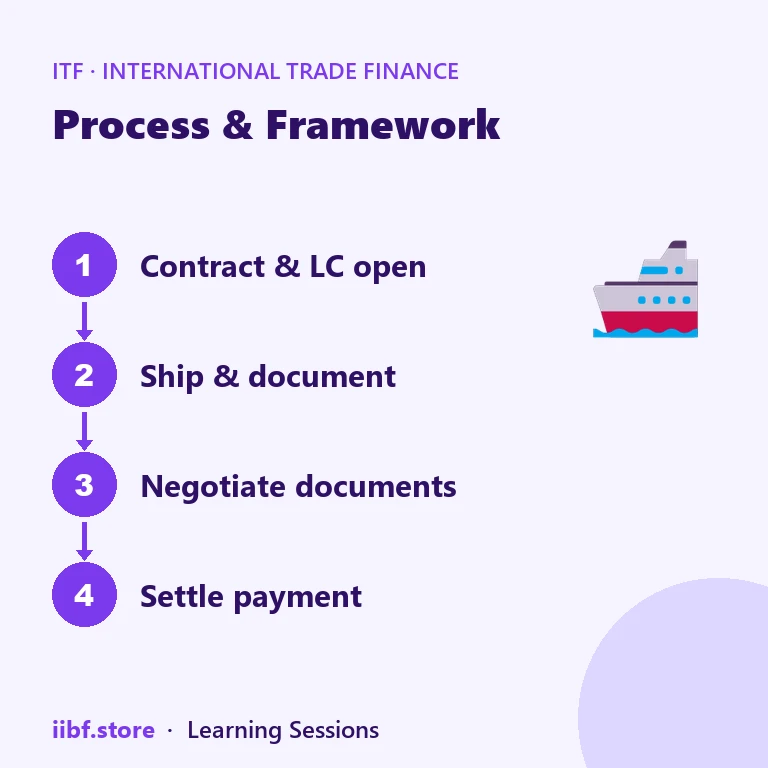
Every documentary credit involves a defined cast of parties whose roles you must memorise. The applicant is the buyer or importer who requests the credit. The issuing bank opens the LC and carries the primary payment obligation. The beneficiary is the seller or exporter in whose favour the credit is issued. An advising bank, usually in the beneficiary's country, authenticates and transmits the credit without adding any payment undertaking. A confirming bank, where appointed, adds its own definite undertaking. The nominated bank is the bank authorised to honour or negotiate, while a reimbursing bank settles claims on behalf of the issuing bank. The typical cycle runs as follows: buyer and seller agree on LC payment; the applicant applies to the issuing bank; the credit is transmitted through the advising bank to the beneficiary; the seller ships the goods and assembles the documents; the documents are presented to the nominated or issuing bank; the bank examines them within five banking days; and on a complying presentation, payment flows back to the beneficiary while documents pass to the applicant to claim the goods. This flow underpins secure cross-border trade and complements related instruments such as packing credit and export credit insurance. Deepen your grounding with the structured modules on iibf.store/course/caiib.
Documents, Discrepancies, and Standard Examination
The document set in a typical LC transaction includes the commercial invoice, transport document (bill of lading, airway bill, or multimodal document), insurance document, packing list, certificate of origin, and any inspection or analysis certificates the buyer requires. Under Article 14 of UCP 600, banks examine documents on their face to determine complying presentation, applying international standard banking practice. Common discrepancies that lead to rejection include late shipment, presentation after the expiry date, an LC amount exceeded, inconsistent description of goods, missing endorsements, and documents inconsistent with one another. When a bank finds discrepancies, it may refuse to honour, but must give a single notice stating each discrepancy no later than the close of the fifth banking day, and may return, hold, or seek a waiver from the applicant. A key exam point is that non-documentary conditions are to be disregarded, and that the commercial invoice need not be signed unless the credit requires it. The Incoterms 2020 rules published by the ICC govern the delivery, cost, and risk split between buyer and seller and interact closely with the documents an LC calls for. Trade-based money laundering (TBML) controls also require banks to watch for over- and under-invoicing. Keep current on regulatory changes through iibf.store/resources/iibf-news and the wider iibf.store/blog.
Bank Guarantees versus Letters of Credit
Candidates frequently confuse a bank guarantee with a letter of credit, so the distinction deserves clarity. A letter of credit is a primary payment mechanism: the issuing bank pays the beneficiary in the ordinary course once complying documents are presented, and payment is expected as part of normal trade settlement. A bank guarantee, by contrast, is a contingent instrument invoked only when the principal defaults on its obligation — the bank pays the beneficiary just if the applicant fails to perform or to pay. Guarantees are common domestically for bid bonds, performance bonds, and advance-payment security, and can be conditional or unconditional (payable on demand). A standby LC blurs this line because, although structured as a credit, it operates functionally like a guarantee and can be made subject to UCP 600 or to the ISP98 rules. Other trade-finance instruments in the IIBF syllabus include packing credit (pre-shipment finance), and cover from the Export Credit Guarantee Corporation (ECGC), which insures exporters against commercial and political risks of non-payment. Together, these tools manage the twin exposures of payment risk and performance risk that define international trade.
Conclusion and Next Steps
Mastering Letters of Credit UCPDC 600 means knowing the LC types, the parties, the document set, the five-day examination window, and how guarantees differ from credits. These fundamentals recur across IIBF certificate and CAIIB questions, so practise them until they are second nature. Put your knowledge to the test with full-length mock exams and topic quizzes at iibf.store/tests, and build a complete foundation through the advanced banking modules at iibf.store/course/caiib. Consistent, structured practice is what turns a passing candidate into a confident trade-finance professional.
What is the difference between a sight LC and a usance LC?
A sight LC pays the beneficiary immediately on presentation of complying documents, whereas a usance (deferred payment) LC pays at a future date — commonly 30, 60, or 90 days after shipment or acceptance — extending credit to the buyer.
How many banking days does a bank have to examine documents under UCP 600?
Under Article 14 of UCP 600, a nominated bank, confirming bank, or issuing bank has a maximum of five banking days following the day of presentation to determine whether a presentation is complying.
How does a confirmed LC protect the exporter?
A confirmed LC adds a second, independent payment undertaking from a confirming bank — usually in the exporter's country — on top of the issuing bank's obligation, protecting the exporter against issuing-bank and country risk.
What is the key difference between a bank guarantee and a letter of credit?
A letter of credit is a primary payment instrument that pays on presentation of complying documents in the normal course of trade, while a bank guarantee is contingent and is invoked only when the applicant defaults on its underlying obligation.
Practice this topic
Take a free mock test, download chapter PDFs, or watch a video class — all included on iibf.store.