NBFC Scale-Based Regulation: The RBI SBR Framework Explained
Scale-based regulation is the framework the Reserve Bank of India uses to supervise non-banking financial companies (NBFCs) according to their size. Activity and perceived riskiness. Introduced through an RBI circular in October 2021 and effective from October 2022.
This layered framework replaced the older one-size-fits-all approach with a layered pyramid. For IIBF NBFC certification candidates. Understanding scale-based regulation is essential.
Because it frames how every NBFC type is licensed. Capitalised and monitored across the financial system today.
The Scale-Based Regulation Pyramid
The scale-based regulation framework arranges NBFCs into four tiers shaped like a pyramid. The Base Layer (NBFC-BL) sits at the bottom and holds the least systemically important entities — non-deposit-taking NBFCs with asset size below the threshold the RBI fixes (currently 1,000 crore), peer-to-peer lending platforms, account aggregators and non-operative financial holding companies. The Middle Layer (NBFC-ML) covers all deposit-taking NBFCs regardless of size, plus larger non-deposit-taking NBFCs above the asset threshold, along with standalone primary dealers, infrastructure debt funds, core investment companies and housing finance companies. The Upper Layer (NBFC-UL) contains the handful of NBFCs that the RBI specifically identifies as systemically significant using a scoring methodology; these face bank-like norms including common equity tier-1 capital requirements and a mandatory listing timeline. At the apex sits the Top Layer, which is meant to remain empty unless the RBI judges that a particular Upper Layer NBFC poses an extreme, unacceptable rise in systemic risk, at which point it can be moved up and supervised even more intensively. The design principle is proportionality: the more an entity can disturb the wider financial system if it fails, the heavier the prudential, governance and disclosure obligations it must carry. Base Layer entities follow simplified norms, the Middle Layer attracts a fuller set of prudential rules, and the Upper Layer must comply with differential standard-asset provisioning, a leverage ceiling, internal capital adequacy assessment and a compulsory listing within three years of identification. Regulatory intensity therefore rises steadily as you climb the pyramid, so candidates should memorise which entity belongs where and why. You can practise these classifications on our mock tests.

NBFC Types and Activity-Based Classification
Beyond the layered pyramid, NBFCs are also classified by the activity they perform, and the layered RBI framework overlays its tiers on top of this older taxonomy. Common categories include the Investment and Credit Company (NBFC-ICC), which merged the earlier asset-finance, loan and investment company types into one; the Infrastructure Finance Company (IFC), which deploys most of its assets into infrastructure loans; the Microfinance Institution (NBFC-MFI), serving low-income borrowers under household-income and indebtedness limits; and the Core Investment Company (CIC), which mainly holds equity in group companies. Specialised players such as Infrastructure Debt Funds, Factors, Mortgage Guarantee Companies and Account Aggregators round out the list. Deposit-acceptance is a key dividing line: deposit-taking NBFCs (NBFC-D) face stricter prudential norms and are automatically placed at least in the Middle Layer, while non-deposit-taking companies (NBFC-ND) may sit in the Base Layer if small. The RBI has progressively reduced the number of deposit-taking NBFCs to limit retail risk, and most new licences are issued only to non-deposit-taking companies. It is also worth noting that some categories, such as Housing Finance Companies, moved under RBI supervision from the erstwhile National Housing Bank, while government-owned NBFCs were brought into the layered framework in a phased manner. An NBFC can thus carry two labels at once — for example, a large infrastructure finance company may be an IFC by activity and sit in the Middle Layer by scale, or even the Upper Layer if it is named systemically significant. Knowing both the activity label and the layer of a given NBFC helps you answer scenario questions accurately, and our match-the-pair game is a quick way to drill these pairings before the exam.
Co-Lending and NPA Norms
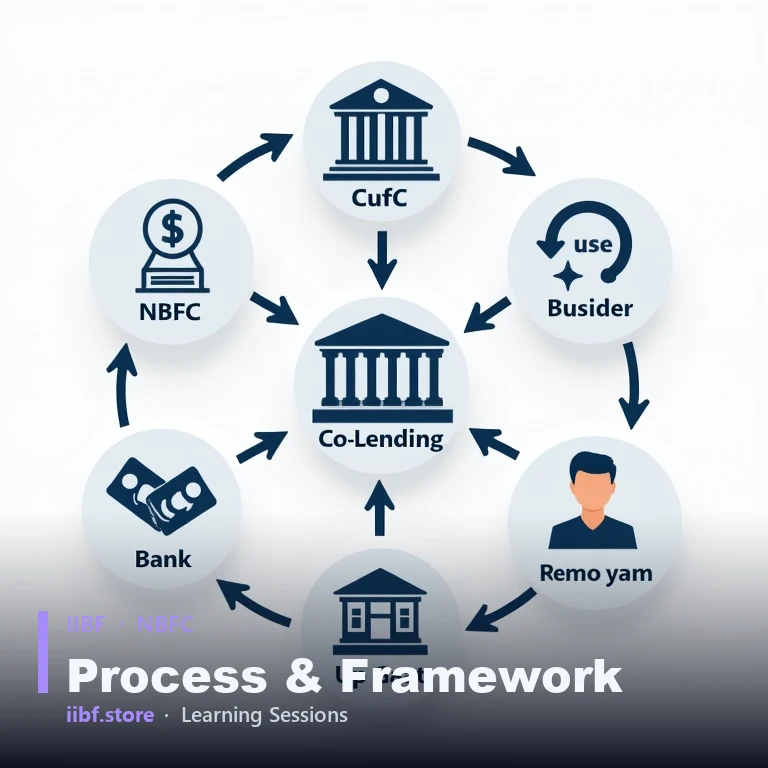
Two operational areas the NBFC certification tests heavily are co-lending and asset classification. Under the RBI co-lending model, banks and NBFCs jointly originate priority-sector loans: the NBFC sources and services the borrower while the bank funds the larger share, sharing risk and reward in an agreed ratio with each lender keeping its portion on its own books. This widens credit reach to underserved segments while letting banks tap NBFC distribution networks. On the prudential side, scale-based regulation tightened income-recognition and asset-classification (IRAC) norms so that NBFC non-performing asset (NPA) rules converge with bank standards. A key clarification requires NBFCs to classify an account as NPA when it is overdue beyond 90 days and to upgrade it to standard only after all arrears of interest and principal are cleared, not on partial payment. Provisioning requirements, large-exposure limits, and a board-approved policy on loans to directors and senior officers also apply more rigorously in the Middle and Upper Layers, and concentration norms cap how much a single borrower or group can absorb. The co-lending model has practical conditions too: the bank must comply with its own priority-sector and Know Your Customer obligations, interest rates and grievance redressal must be transparent to the borrower, and the arrangement is governed by a master agreement between the two lenders. Candidates often face numerical questions on the funding split — frequently 80 per cent bank and 20 per cent NBFC — so revise the mechanics carefully. Staying current with these evolving rules matters; track regulatory updates on our IIBF news page and the official Reserve Bank of India website.

Bank versus NBFC: Key Differences
A recurring exam theme is how NBFCs differ from banks despite both extending credit. NBFCs cannot accept demand deposits or issue cheques drawn on themselves, and they are not part of the payment and settlement system the way banks are. They are not required to maintain the cash reserve ratio (CRR) and statutory liquidity ratio (SLR) in the same manner as banks, though deposit-taking NBFCs do face liquidity requirements. Crucially, NBFC depositors are not covered by Deposit Insurance and Credit Guarantee Corporation (DICGC) insurance, unlike bank depositors. NBFCs often serve niches that banks underserve — used-vehicle finance, gold loans, microfinance and infrastructure — giving them faster turnaround and deeper local reach. However, this reliance on borrowed funds rather than low-cost deposits makes NBFCs more exposed to liquidity stress, which is precisely why the layered framework pushes the larger ones toward bank-like governance and capital buffers. There are similarities too: both are credit institutions, both must follow fair-practices codes, and both are ultimately answerable to the RBI for prudential conduct. The 2018 crisis at a major infrastructure-finance NBFC exposed how asset-liability mismatches in the sector can ripple into banks and mutual funds, and that episode was a key trigger for tighter rules. Exam questions frequently test these distinctions through one-line comparisons, so build a mental table of deposits, reserves, insurance cover and the payment system. For deeper conceptual coverage, the CAIIB course connects these NBFC themes to the wider banking syllabus.
Frequently Asked Questions
What is scale-based regulation for NBFCs?
Scale-based regulation is the RBI framework. Effective October 2022. That supervises NBFCs through four tiers — Base, Middle, Upper and Top Layers.
Regulatory intensity increases with an NBFC's size. Activity and systemic importance. Replacing the earlier uniform approach with proportionate, risk-aligned rules.
How many layers does the framework have?
There are four layers: the Base Layer for small. Non-deposit-taking NBFCs. The Middle Layer for deposit-taking and larger entities. The Upper Layer for systemically significant NBFCs facing bank-like norms. And the Top Layer, which stays empty unless extreme systemic risk arises.
How do NBFCs differ from banks?
NBFCs cannot accept demand deposits. Issue self-drawn cheques, or access the payment system as banks do. Their depositors lack DICGC insurance cover.
And CRR or SLR rules apply differently. NBFCs typically serve niche credit segments banks underserve. Relying more on borrowed funds.
What is the co-lending model?
Co-lending lets banks and NBFCs jointly originate priority-sector loans. The NBFC sources. Services borrowers while the bank funds the larger share.
With each lender keeping its portion on its own books. It expands credit reach. Sharing risk and reward in an agreed ratio.
Conclusion
Scale-based regulation reorganised NBFC supervision into a clear, proportionate pyramid, aligning the largest and riskiest entities with bank-like discipline while keeping smaller players lightly regulated. For the IIBF NBFC certification, anchor your revision to the four layers, the activity-based types, co-lending mechanics and the bank-versus-NBFC distinctions, and the rest of the syllabus falls into place. Ready to convert this into marks? Attempt a full-length NBFC mock test and explore more exam guides on our banking exam blog today.
Quick summary in plain words
In short: keep it simple.
Read each point slow.
Take notes as you go.
Use the free tests to check what you know.
Watch the video if a part feels hard.
Do a bit each day.
Ask us on WhatsApp if you get stuck.
You can pass this exam.
Stay calm and trust your prep.
Come back to this guide often.
Small steps add up fast.
Skim the box below first.
Quick summary in plain words
In short: keep it simple.
Read each point slow.
Take notes as you go.
Watch the video if a part feels hard.
Do a bit each day.
Ask us on WhatsApp if you get stuck.
You can pass this exam.
Stay calm and trust your prep.
Come back to this guide often.
Small steps add up fast.
Skim the box below first.
Quick summary in plain words
In short: keep it simple.
Read each point slow.
Take notes as you go.
Watch the video if a part feels hard.
Do a bit each day.
Ask us on WhatsApp if you get stuck.
You can pass this exam.
Stay calm and trust your prep.
Come back to this guide often.
Small steps add up fast.
Skim the box below first.
Quick summary in plain words
In short: keep it simple.
Read each point slow.
Take notes as you go.
Watch the video if a part feels hard.
Do a bit each day.
Ask us on WhatsApp if you get stuck.
You can pass this exam.
Stay calm and trust your prep.
Come back to this guide often.
Small steps add up fast.
Skim the box below first.
Practice this topic
Take a free mock test, download chapter PDFs, or watch a video class — all included on iibf.store.