Operational Risk Management in Financial Services: IIBF RISKINFINANC Guide
Operational risk is one of the most critical and evolving areas in modern banking, and for candidates preparing for the Risk in Financial Services (RISKINFINANC) certification from the Indian Institute of Banking and Finance, a thorough understanding of this subject can make a decisive difference in the examination. From the Basel definition to loss-event taxonomy, from RCSA frameworks to the new Standardised Approach under Basel III, this article covers the core concepts that IIBF aspirants must master. You can also explore related study material and practice tests at iibf.store/blog for a comprehensive preparation strategy.
The Basel Definition and Seven Loss-Event Types
The Basel Committee on Banking Supervision defines operational risk as "the risk of loss resulting from inadequate or failed internal processes. People and systems, or from external events." Crucially, this definition excludes strategic risk and reputational risk, which are governed by separate frameworks. The definition is intentionally broad so that it captures the full spectrum of failures that are not driven by credit or market movements.
Basel II and Basel III both identify seven loss-event categories that financial institutions must track and report. Understanding these categories is essential for the IIBF RISKINFINANC exam:
- Internal Fraud — Misappropriation of assets, tax evasion, intentional mismarking of positions, bribery by employees or insiders.
- External Fraud — Theft, forgery, hacking, and third-party cheque fraud.
- Employment Practices and Workplace Safety — Discrimination claims, employee health and safety violations, and organised labour disputes.
- Clients, Products and Business Practices — Mis-selling, fiduciary breaches, improper trade practices, and money laundering failures.
- Damage to Physical Assets — Natural disasters, terrorism, vandalism.
- Business Disruption and System Failures — Hardware/software failures, telecommunications outages, utility disruptions.
- Execution, Delivery and Process Management — Transaction capture errors, failed mandatory reporting, negligent vendor management, and data entry mistakes.
Indian banks. Under RBI guidance, are required to maintain an internal loss data database that maps every operational loss event to one of these seven categories. This data feeds directly into capital computation under the Standardised Approach and supports trend analysis by senior management.

Risk and Control Self-Assessment (RCSA) and Key Risk Indicators
Risk and Control Self-Assessment (RCSA) is the foundational tool through which banks identify, evaluate and prioritise their operational risks. In an RCSA exercise. Business units work through a structured process to list every material risk they face, assess the inherent risk (before controls), evaluate the effectiveness of existing controls, and arrive at a residual risk rating. The output — typically a heat map or risk register — is reviewed by the Operational Risk Management (ORM) function and escalated to the Board Risk Committee for significant residual risks.
Key Risk Indicators (KRIs) complement the RCSA by providing forward-looking, quantitative signals. A well-designed KRI does three things: it is measurable on a regular (often monthly or weekly) cycle. It has a predefined threshold or traffic-light boundary, and it is causally linked to a risk identified in the RCSA. Examples commonly tested in the IIBF RISKINFINANC syllabus include:
- Number of failed transactions per thousand as a proxy for process failure risk.
- Staff turnover rate in critical roles as a signal for key-person risk.
- System downtime hours per quarter as an indicator of IT resilience risk.
- Number of audit exceptions outstanding beyond 90 days as a governance risk signal.
- Volume of customer complaints relating to product mis-selling.
A robust KRI programme requires that each indicator be owned by a specific business line manager, reviewed regularly, and that breaches of amber or red thresholds trigger a documented management response. Banks that have developed mature KRI libraries often integrate them into dashboards reviewed at monthly operational risk committees. For practice questions on RCSA and KRIs, the mock tests at iibf.store/tests are an excellent resource for IIBF certification candidates.
Loss data collection is the third pillar alongside RCSA and KRIs. Banks maintain an internal loss database that records every operational loss event above a defined minimum threshold (often Rs. 10,000 or as stipulated by policy), capturing details such as business line, loss-event type, gross and net loss amount, date of discovery, and date of occurrence. This historical data validates RCSA judgements, calibrates scenario analysis, and is submitted to industry loss data consortia for benchmarking.
Business Continuity Management and Disaster Recovery
Business Continuity Management (BCM) and Disaster Recovery (DR) sit within the broader operational risk framework and are specifically addressed in the IIBF Risk in Financial Services curriculum. BCM is the overarching discipline: it covers how an organisation identifies its critical business functions. Determines the maximum tolerable period of disruption (MTPD) and the recovery time objective (RTO) for each, and maintains tested plans to resume operations within those timelines.
The Reserve Bank of India has issued guidelines requiring all scheduled commercial banks to maintain board-approved BCM policies. Conduct business impact analyses (BIA) at least annually, and test their business continuity plans through tabletop exercises and live failover drills. IIBF candidates should be comfortable with the following sequence:
- Business Impact Analysis (BIA) — Identify critical processes, dependencies (IT systems, third-party vendors, key staff) and quantify financial and operational impact of disruption.
- Risk Assessment — Identify threats (flood, fire, pandemic, cyber attack, power failure) and assess likelihood and impact.
- Strategy Selection — Choose between hot site (immediate failover), warm site (partial standby) and cold site (basic infrastructure) based on RTO requirements and cost.
- Plan Development — Document crisis management procedures, communication trees, and alternative processing arrangements.
- Testing and Maintenance — Conduct at least annual end-to-end tests; update plans after any significant change in business or IT environment.
Disaster Recovery specifically addresses IT systems and data. The recovery point objective (RPO) defines how much data a bank can afford to lose (measured in time), which drives the frequency of data backup and the choice of replication technology. Indian banks operating critical payment systems are required by RBI to maintain near-zero RPO for core banking and RTGS/NEFT connectivity. For current RBI operational guidelines, candidates should refer to iibf.store/resources/rbi-rates and stay updated via iibf.store/resources/iibf-news.
Three Lines of Defence and the Basel III Standardised Approach
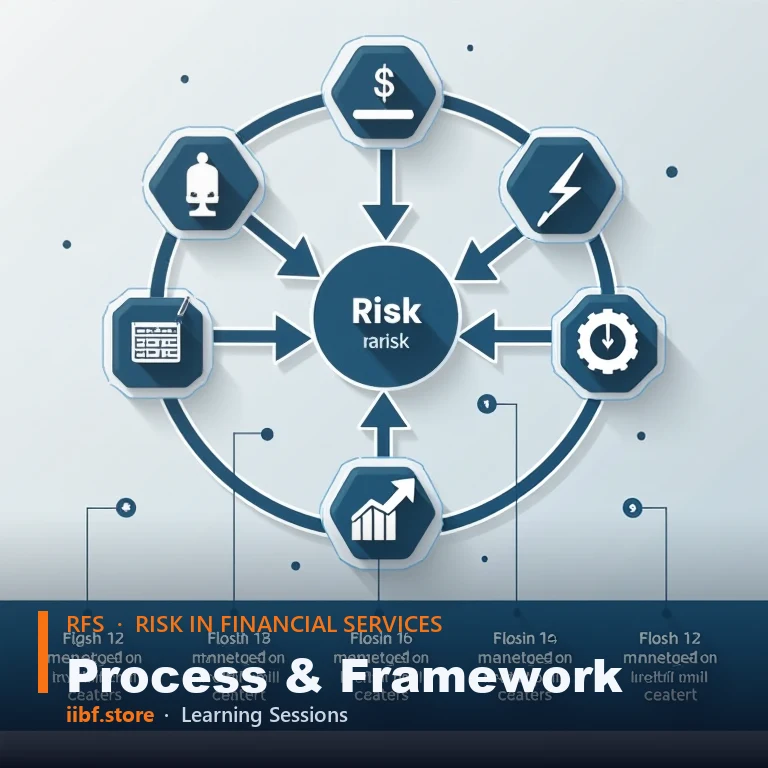
The Three Lines of Defence (3LoD) model is the globally accepted governance structure for managing operational risk and is central to the IIBF RISKINFINANC syllabus. Understanding where each line sits and what it is accountable for is frequently tested.
- First Line of Defence — Business Lines: Front-office and operations staff who own and manage risk in day-to-day activities. They implement controls, identify incidents, and maintain the RCSA for their unit. Responsibility cannot be outsourced to a risk department.
- Second Line of Defence — Risk and Compliance Functions: The Operational Risk Management department and the Compliance function set the framework, provide tools (RCSA templates, KRI libraries, loss data systems), challenge the first line's assessments, and report to senior management and the board.
- Third Line of Defence — Internal Audit: Provides independent assurance that the first and second lines are functioning as designed. Internal audit reviews the adequacy of the risk framework, tests whether controls actually work, and reports directly to the Audit Committee of the Board.
On the capital measurement side. The Basel III New Standardised Approach (NSA) — which replaces the earlier Basic Indicator Approach, Standardised Approach, and Advanced Measurement Approach — is a significant exam topic. Under the NSA, operational risk capital (ORC) is computed as:
ORC = Business Indicator Component (BIC) × Internal Loss Multiplier (ILM)
The Business Indicator (BI) is calculated from three financial statement components: the Interest. Leases and Dividends (ILDC) component, the Services (SC) component, and the Financial (FC) component. The BI is mapped to a marginal coefficient (alpha) that increases with bank size in three buckets. The Internal Loss Multiplier adjusts the BIC upward (or leaves it at 1.0 for small banks) based on the bank's own 10-year average annual operational loss history relative to the BI. This design rewards banks that have invested in loss reduction and strong controls — a philosophically important shift from the AMA era.
For India, the RBI has issued guidelines on the implementation timeline and domestic adjustments to the NSA framework. IIBF candidates preparing for CAIIB and the RISKINFINANC certificate should also understand how the NSA interacts with Pillar 2 supervisory review and Pillar 3 disclosure requirements. Aspirants pursuing JAIIB will find that the foundational concepts of operational risk discussed here underpin several JAIIB papers as well. You can also reinforce your learning through interactive tools at iibf.store/games/match.
For authoritative global standards on operational risk capital and the Basel framework, candidates are encouraged to consult the Bank for International Settlements directly at www.bis.org, which publishes all Basel Committee consultative papers, final standards, and frequently asked questions on the Standardised Approach.
What is the Basel definition of operational risk?
The Basel Committee defines operational risk as the risk of loss resulting from inadequate or failed internal processes, people and systems, or from external events. This definition deliberately excludes strategic risk and reputational risk, keeping the focus on process, people, systems, and external-event failures.
What are the seven Basel loss-event types that banks must track?
The seven categories are: (1) Internal Fraud, (2) External Fraud, (3) Employment Practices and Workplace Safety, (4) Clients. Products and Business Practices, (5) Damage to Physical Assets, (6) Business Disruption and System Failures, and (7) Execution, Delivery and Process Management. All internal loss data must be mapped to one of these categories for regulatory reporting and capital calculation.
How does the Basel III New Standardised Approach calculate operational risk capital?
Under the New Standardised Approach, Operational Risk Capital equals the Business Indicator Component (BIC) multiplied by the Internal Loss Multiplier (ILM). The Business Indicator is derived from three financial statement components (interest/leases/dividends. Services, and financial items), and the ILM adjusts the capital charge based on the bank's own 10-year average annual loss history relative to its Business Indicator. Banks with higher historical losses pay proportionally more capital.
What is the role of the Three Lines of Defence in operational risk governance?
The Three Lines of Defence model assigns clear accountability: the First Line (business units) owns and manages risk daily; the Second Line (ORM and Compliance) sets the framework. Provides tools, and independently challenges the first line; the Third Line (Internal Audit) provides independent assurance that both the first and second lines are functioning effectively. The Board Risk Committee and Audit Committee provide ultimate oversight above all three lines.
Mastering operational risk management — from the Basel loss-event taxonomy and RCSA methodology to BCM frameworks and the New Standardised Approach — is essential for the IIBF RISKINFINANC certification and will also strengthen your performance in CAIIB and advanced risk papers. Validate your understanding and identify gaps by taking full-length mock tests at iibf.store/tests today.
Free Revision PDFs — One-Liners & True/False
Printable last-minute revision sheets for Operational Risk Management in Financial Services: IIBF RISKINFINANC G: 20 quick-fire one-liners and 20 true/false questions, each with answers & explanations. Free to download and share.
Practice this topic
Take a free mock test, download chapter PDFs, or watch a video class — all included on iibf.store.
Keep reading