RBI scale based regulation for NBFCs: Layers, Norms, Timeline
RBI's scale based regulation for NBFCs (SBR) decides how heavily a non-banking financial company is supervised, and it rests on one simple idea: the larger and more interconnected the NBFC, the tighter the rulebook it must live with. Announced in October 2021 and operational from 1 October 2022, the framework replaced a patchwork of size-and-activity classifications with four clean layers — Base, Middle, Upper and Top. For the IIBF NBFC certification, this is high-yield territory, because examiners repeatedly test layer identification, the capital numbers attached to each layer, and the extra obligations that fall only on the biggest players.
🏛️ Why RBI Replaced the Old NBFC Rulebook
Before SBR, NBFCs were regulated mainly on two axes — whether they accepted public deposits, and whether they crossed the systemically important asset threshold of ₹500 crore. That binary approach worked when the sector was small. It stopped working once NBFC balance sheets grew into a meaningful share of total credit and became deeply plugged into banks, mutual funds and insurance companies through borrowings, securitisation and co-lending arrangements.
The failure of a few large housing and infrastructure finance entities in the 2018-19 period showed how quickly stress at one big NBFC could freeze funding for the whole sector. Depositors were not the only people at risk; wholesale lenders, debt mutual funds and ultimately bank balance sheets were exposed too. RBI's response was proportionality: instead of applying one uniform standard, calibrate the intensity of regulation to the scale, complexity and systemic footprint of each entity.
That is exactly what "scale based" means. A small loan company operating in three districts with no public funds does not need bank-grade governance, while an NBFC with a balance sheet comparable to a mid-sized bank clearly does. Candidates should read this alongside the classification basics in the chapter on NBFC types and roles, and the supervisory context in recent RBI initiatives, because SBR did not abolish the old activity-based categories — an NBFC-ICC, NBFC-MFI or NBFC-Factor still keeps its category label and simply sits inside one of the four layers.
💡 Exam Tip: SBR did not replace activity-based categories. Every NBFC now has two identities — its category (ICC, MFI, Factor, IFC, CIC, HFC) and its layer (BL, ML, UL, TL). Questions often mix the two deliberately.
📊 The Four Layers and How an NBFC Lands in Each
The Base Layer (NBFC-BL) holds non-deposit taking NBFCs with asset size below ₹1,000 crore, along with NBFC-P2P platforms, account aggregators, non-operative financial holding companies, and NBFCs that neither access public funds nor have any customer interface. This is the lightest-touch layer.
The Middle Layer (NBFC-ML) captures every deposit-taking NBFC irrespective of size, all non-deposit taking NBFCs with assets of ₹1,000 crore and above, and — regardless of asset size — standalone primary dealers, infrastructure finance companies, core investment companies, infrastructure debt funds and housing finance companies. Category alone can therefore push a small entity into the Middle Layer.
The Upper Layer (NBFC-UL) is not self-assessed. RBI identifies these entities using a scoring methodology that blends quantitative and qualitative parameters in roughly a 70:30 weight. The quantitative side looks at size and leverage, interconnectedness with the rest of the financial system, and complexity of operations. The qualitative side considers the nature and type of liabilities, group structure and segment penetration. The ten largest NBFCs by asset size are placed in the Upper Layer as a rule, whatever their score. Government-owned NBFCs are kept out of the Upper Layer and placed in the Base or Middle Layer as applicable.
The Top Layer (NBFC-TL) is designed to stay empty. RBI moves an Upper Layer NBFC into it only if supervisors judge that systemic risk from that entity has increased substantially, and such an NBFC then faces higher capital charges and bespoke supervisory action.
| Layer | Who falls here | Headline capital norm | Mandatory listing? |
|---|---|---|---|
| Base (BL) | Non-deposit NBFCs below ₹1,000 crore assets, P2P, AA, NOFHC | No CRAR; leverage ratio ceiling of 7 | ❌ |
| Middle (ML) | All deposit-taking NBFCs, non-deposit NBFCs of ₹1,000 crore and above, plus HFC, IFC, IDF, SPD, CIC | CRAR 15% with Tier I of at least 10% | ❌ |
| Upper (UL) | Identified by RBI on the scoring methodology; top 10 NBFCs by asset size always included | CRAR 15% plus CET1 of at least 9% of risk weighted assets | ✅ within 3 years of identification |
| Top (TL) | Normally empty; populated only on a supervisory call about systemic risk | Higher capital charge as specified by RBI | ✅ (carried over from UL) |
| All layers | Every NBFC, whatever its layer | IPO subscription funding capped at ₹1 crore per borrower | ❌ |
💰 Capital Norms Layer by Layer: NOF, CRAR and CET1
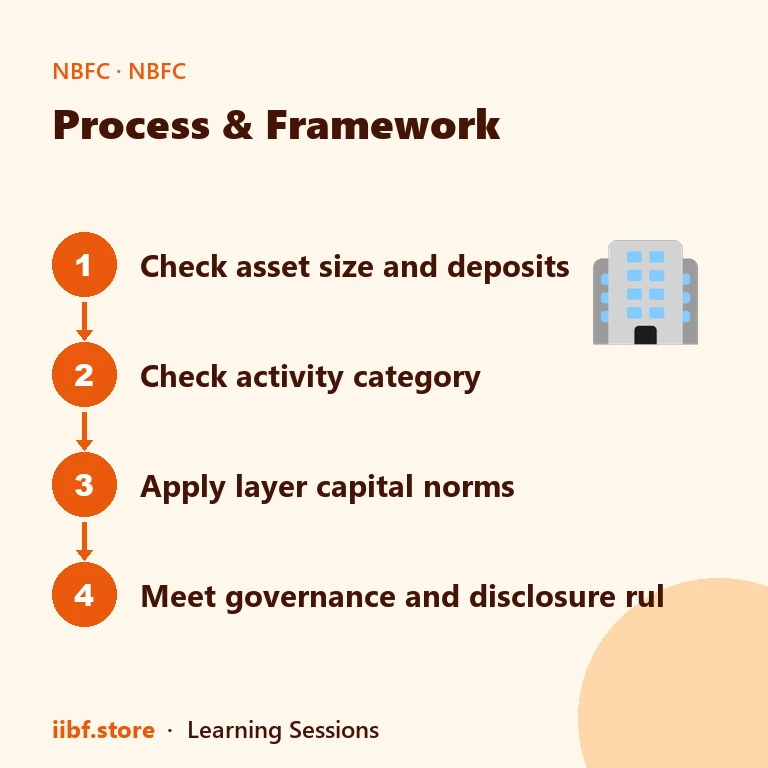
Net Owned Fund is the entry ticket. Under the glide path announced with SBR, NBFC-ICCs, NBFC-MFIs and NBFC-Factors must reach a Net Owned Fund of ₹10 crore by 31 March 2027, after clearing an interim milestone on 31 March 2025. Categories with their own historical minimums — NBFC-P2P, account aggregators, infrastructure finance companies, infrastructure debt funds and core investment companies — were left untouched by this glide path, so do not apply the ₹10 crore figure to them in an exam answer.
On risk-weighted capital, Middle Layer NBFCs carry the familiar minimum CRAR of 15% of risk-weighted assets, of which Tier I capital must be at least 10%. Base Layer NBFCs are not subject to CRAR at all; instead the existing ceiling on the leverage ratio of 7 continues to bind them. Upper Layer NBFCs face the toughest test — in addition to CRAR they must maintain Common Equity Tier 1 capital of at least 9% of risk-weighted assets, which forces genuine equity rather than hybrid instruments into the capital stack.
Upper Layer entities also run a board-approved Internal Capital Adequacy Assessment Process, face differential standard asset provisioning by exposure type, and must comply with a large exposure framework. Alongside this, the sector completed its migration to the 90-day overdue norm for NPA recognition, with Base Layer NBFCs finishing the staged glide path on 31 March 2026. Since these thresholds are periodically revised, always cross-check the current master direction before quoting a figure in professional work; the compliance detail is set out in the chapter on regulatory requirements and compliance.
⚠️ Common Mistake: Candidates apply CRAR of 15% to Base Layer NBFCs. Base Layer entities are governed by the leverage ratio ceiling of 7, not by a CRAR requirement. CET1 of 9% is exclusive to the Upper Layer.
⚖️ Exposure Limits, Governance and IPO Funding Under SBR
SBR rationalised concentration norms in the Middle Layer by merging the separate lending and investment ceilings into a single exposure limit for a counterparty and for a group of connected counterparties, expressed as a percentage of Tier I capital. Upper Layer NBFCs move up to a large exposure framework closely modelled on the bank regime. The arithmetic and the carve-outs are worth learning separately — our detailed piece on NBFC concentration and exposure norms walks through the limits with worked examples.
One number that examiners love is the IPO funding ceiling. From 1 April 2022, no NBFC may lend more than ₹1 crore to a single borrower for subscribing to an initial public offer. NBFCs may fix a lower internal ceiling, but they cannot exceed this cap. Similarly, NBFCs must set board-approved internal limits for sensitive sector exposures such as capital markets and commercial real estate, and loans to directors, their relatives and connected entities above prescribed thresholds require board sanction and disclosure.
Governance obligations scale up in step. Middle and Upper Layer NBFCs must appoint a Chief Compliance Officer, and a Chief Risk Officer is mandatory for larger Middle Layer entities. Compensation guidelines for key managerial personnel and senior management, a risk management committee of the board, a functionally independent internal audit, and a fit-and-proper policy for directors all apply as the layer rises. Upper Layer NBFCs must additionally list their shares within three years of being identified, and follow listed-company disclosure discipline even before listing happens. Customer-facing compliance — including the standards covered in KYC, AML and CFT norms — applies across all layers without dilution.
📌 Remember: Once RBI places an NBFC in the Upper Layer, enhanced regulation continues for at least five years, even if the entity later falls below the parametric cut-off. Exit is not automatic.
🗓️ Transition Timeline and Impact on NBFC Business Models
The framework circular was issued in October 2021, most instructions took effect from 1 October 2022, and RBI publishes the list of Upper Layer NBFCs annually, the first list having been released in September 2022. The Net Owned Fund glide path runs to 31 March 2027, and the staged tightening of NPA recognition concluded on 31 March 2026, so an NBFC reading its position today is essentially in the final stretch of the transition.
Commercially, SBR has changed how boards think about growth. Crossing ₹1,000 crore in assets is no longer a milestone to celebrate quietly; it moves the entity into the Middle Layer with CRAR, governance and disclosure consequences. Several small NBFCs have responded by consolidating, by shifting to co-lending and business correspondent models that are lighter on balance sheet, or by surrendering their certificate of registration where compliance cost outweighs the business — a route explained in our note on cancellation of NBFC registration. Microfinance lenders faced a parallel overhaul, summarised in our guide to NBFC-MFI regulations in India.
At the other end, Upper Layer NBFCs now look and behave much like banks: higher core equity, listed status, board committees, ICAAP and a large exposure framework. That convergence is precisely why several large NBFCs evaluate a banking licence, a journey comparable to the small finance bank to universal bank transition. Operational practice, from account opening to servicing, is covered in the chapter on operational aspects of opening accounts, and more NBFC explainers are collected on our NBFC blog tag hub. Policy rates and prudential reference numbers change often, so keep the RBI rates page handy while revising.

🧠 Practice MCQs: Scale Based Regulation for NBFCs
Q1. Under the Scale Based Regulation framework, which NBFCs are placed in the Upper Layer irrespective of any other parameter? (a) All deposit-taking NBFCs (b) The ten largest NBFCs by asset size (c) All infrastructure finance companies (d) All NBFCs with asset size above ₹1,000 crore
Answer: (b) — RBI places the top ten NBFCs by asset size in the Upper Layer as a rule, whatever their parametric score.
Q2. What is the minimum Common Equity Tier 1 capital requirement for an NBFC in the Upper Layer? (a) 7% of risk-weighted assets (b) 8% of risk-weighted assets (c) 9% of risk-weighted assets (d) 10% of risk-weighted assets
Answer: (c) — NBFC-UL must maintain CET1 of at least 9% of risk-weighted assets, over and above the CRAR requirement.
Q3. What is the ceiling on NBFC financing to a single borrower for subscription to an IPO? (a) ₹1 crore (b) ₹5 crore (c) ₹10 crore (d) ₹25 lakh
Answer: (a) — With effect from 1 April 2022, NBFC lending for IPO subscription is capped at ₹1 crore per borrower per IPO.
Q4. Under the SBR glide path, what Net Owned Fund must an NBFC-ICC reach by 31 March 2027? (a) ₹2 crore (b) ₹5 crore (c) ₹7 crore (d) ₹10 crore
Answer: (d) — The glide path takes NBFC-ICC, NBFC-MFI and NBFC-Factor to a Net Owned Fund of ₹10 crore by 31 March 2027.
Q5. Which layer of the SBR framework is expected to remain empty unless supervisors see a substantial increase in systemic risk? (a) Base Layer (b) Middle Layer (c) Top Layer (d) Upper Layer
Answer: (c) — The Top Layer is kept vacant by design; an NBFC is moved there from the Upper Layer only on a specific supervisory judgement.
Want chapter-wise mock tests with 100+ MCQs? Start practising free →
❓ Frequently Asked Questions
Does an NBFC choose its own layer under SBR?
No. Base and Middle Layer placement follows automatically from asset size, deposit acceptance and category. Upper Layer placement is decided by RBI using its scoring methodology and published as a list, and the Top Layer is populated only by supervisory decision.
Do activity-based categories such as NBFC-ICC or NBFC-MFI still exist?
Yes. SBR added a layer dimension on top of the existing categories. An entity remains, say, an NBFC-MFI while simultaneously being a Base Layer or Middle Layer NBFC, and it must meet the requirements of both its category and its layer.
What happens if an Upper Layer NBFC shrinks below the cut-off?
Enhanced regulation continues for a minimum period of five years from identification, even if the NBFC no longer meets the parametric criteria. This prevents entities from managing their balance sheet down temporarily to escape the stricter regime.
Are housing finance companies covered by the layered framework?
Yes. Housing finance companies are placed in the Middle Layer regardless of asset size, and they continue to follow the specific directions issued for HFCs alongside the layer-wise requirements applicable to NBFC-ML.
Conclusion: Treat the four layers as a ladder — each rung adds capital, governance and disclosure. If you can state who sits in each layer, the CRAR and CET1 numbers, the leverage ceiling for the Base Layer, the ₹1 crore IPO funding cap and the five-year Upper Layer lock-in, you have covered most of what the paper asks on this topic. Consolidate the theory with the full syllabus coverage on our CAIIB and certification courses, then test yourself with timed chapter-wise papers at iibf.store mock tests.
Source and further reading: Reserve Bank of India and the Indian Institute of Banking & Finance.
Practice this topic
Take a free mock test, download chapter PDFs, or watch a video class — all included on iibf.store.