Reputational Risk in Financial Services: Drivers & Framework
Reputational risk in financial services rarely shows up on a balance sheet. Yet it can wipe out more shareholder value in a week than a full credit cycle does in a year. For IIBF Risk in Financial Services (RFS) candidates, this topic bridges operational risk, conduct risk and enterprise risk management. Examiners like to test whether you can tell a trigger event from the risk itself. This article explains what reputational risk in financial services actually means and where it comes from. It also covers how banks measure something so intangible, and how a sound framework contains it before a rumour becomes a run.
📉 What Is Reputational Risk in Financial Services
Reputational risk is the current or prospective risk to earnings, capital or franchise value. It arises from an adverse perception of the institution by customers, counterparties, shareholders, investors, regulators or the public. Unlike credit or market risk, it has no single pricing model. It is a second-order risk, usually triggered by a failure elsewhere in the risk universe. Common triggers include a mis-sold product, a data breach, a regulatory penalty, or a badly handled customer grievance. RBI's guidance on operational risk management explicitly lists reputational loss as a consequence of operational failures. That is why RFS treats it as a cross-cutting risk rather than a standalone silo.
What makes reputational risk in financial services distinct is speed and asymmetry. A bank can spend decades building trust and lose a meaningful share of it in a single viral social-media thread. Weak underwriting practices studied under credit risk models can quietly convert into headline reputational events once asset quality problems surface publicly. So can poor loan classification under the credit risk management framework.
🔍 Sources and Triggers of Reputational Risk
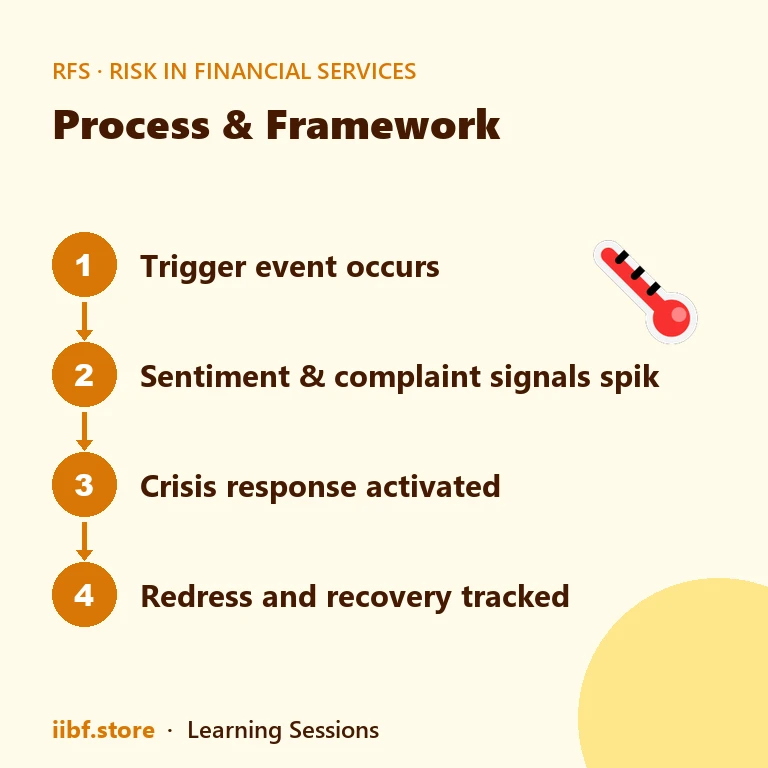
Examiners expect candidates to classify triggers rather than list them randomly. Sources fall into four buckets. Product-related triggers include mis-selling, hidden charges and unsuitable advice. Operational triggers include fraud, system outages, cyber incidents and data leaks. Governance-related triggers include regulatory strictures, board disputes and whistle-blower disclosures. Market-linked triggers include rumours about solvency, rating downgrades, and sudden withdrawal of a large depositor. Any one of these can cascade into the others. A governance lapse invites a regulatory penalty, the penalty becomes a headline, and the headline triggers deposit flight.
Credit-side triggers deserve special attention in RFS. Deterioration flagged through portfolio credit risk analysis, or a sharp downgrade under the institution's credit rating system, rarely stays a purely internal matter. Analysts, media and depositors read published disclosures and rating actions as trust signals. This is also why conduct failures matter so much. An institution that gets its conduct risk in financial services practices wrong on product suitability often ends up defending its reputation in the press months later. Liquidity stress is the sharpest amplifier. Once depositors doubt an institution's soundness, the panic itself becomes self-fulfilling. This dynamic is explored further in coverage of liquidity risk management in NBFCs, where a reputational dent can trigger redemption pressure within days.
📊 Measuring and Monitoring Reputational Risk
Reputational risk resists the neat statistical treatment available to market or credit risk. Institutions still need leading indicators rather than waiting for damage to appear in the P&L. Common practice blends three tools. Qualitative scorecards track media sentiment, social listening and complaint escalation ratios. Quantitative proxies cover share price volatility around adverse events, CASA outflow spikes and customer attrition rate. Governance triggers count regulatory show-cause notices, upheld ombudsman complaints and whistle-blower cases. The table below shows how different trigger categories typically get monitored, and whether they carry direct reputational contagion risk.
| Trigger Category | Typical Monitoring Tool | Direct Reputational Contagion | Speed of Impact |
|---|---|---|---|
| Mis-selling / conduct lapse | Complaint & ombudsman MIS | ✅ Yes | Fast (days-weeks) |
| Cyber incident / data breach | SOC alerts, incident register | ✅ Yes | Immediate |
| Credit rating downgrade | External rating watch | ✅ Yes | Fast (days) |
| Routine loan loss provisioning | Portfolio credit risk MIS | ❌ No (unless disclosed adversely) | Slow (quarters) |
| Regulatory penalty / strictures | Compliance tracker | ✅ Yes | Immediate |
| Minor process delay | TAT dashboards | ❌ No | Negligible |
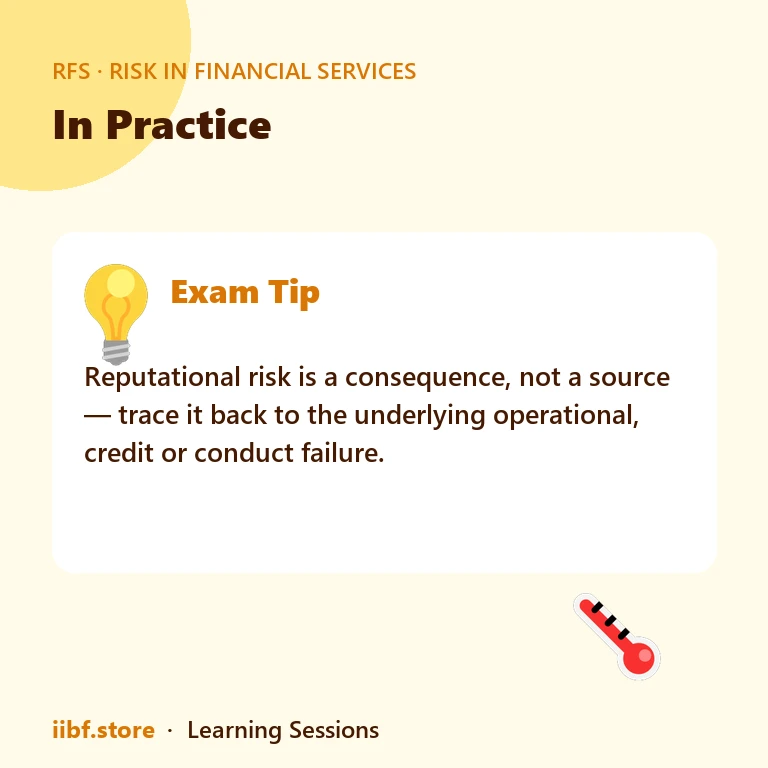
💡 Exam Tip: If a question asks you to distinguish reputational risk from operational risk, remember this: reputational risk is almost always a consequence, not a source. The source is the underlying operational, credit, or conduct failure.
🛡️ Building a Reputational Risk Management Framework
A workable framework starts with board-level ownership. Reputational risk appetite should be stated explicitly, not left implicit inside the operational risk policy. Institutions typically embed four layers. Prevention covers strong conduct culture, product suitability checks and robust cyber controls. Early warning relies on sentiment dashboards, complaint trend analysis and escalation matrices. Response means a crisis communication protocol with pre-approved spokespeople and holding statements. Recovery covers post-incident customer redress, transparent disclosure, and remediation tracking shared with the board risk committee. Internal audit and the compliance function jointly test whether the escalation matrix triggers before a story breaks in the media, not after.
Training matters as much as policy. Frontline staff are the first line of defence once they understand how a single bad customer interaction can turn into a trending complaint. Institutions also run scenario simulations that stress-test the crisis communication protocol, the same way they stress-test market risk exposures. A reputational shock can move funding costs and stock price just as sharply as a market event.
⚠️ Common Mistake: Treating reputational risk purely as a public-relations problem. RFS candidates should remember it is a board-level risk category with its own appetite statement, KRIs and escalation path. It is not just a media-handling exercise.
🏦 Reputational Risk Across NBFCs, Insurers and MFIs
The same principles play out differently by segment. NBFCs depend heavily on wholesale funding and market confidence, which makes them especially vulnerable. A reputational hit can freeze commercial paper rollovers within days, tightening the same liquidity buffers examined under liquidity risk frameworks. Insurers face a parallel exposure through claim-settlement disputes and solvency perception. This is closely tied to how comfortably an insurer holds its regulatory solvency margin for insurers buffer above the required minimum. A thin buffer invites exactly the kind of market rumour that reputational risk frameworks are designed to catch early.
Microfinance institutions carry perhaps the sharpest version of this risk. Their business model depends on community trust and door-step collection practices. Aggressive recovery methods and borrower over-indebtedness have triggered some of India's most damaging reputational episodes for the sector. This is discussed in detail in coverage of multiple lending and over-indebtedness in microfinance. These episodes prompted RBI to tighten its fair-practices code. RFS candidates should note this cross-linkage. Reputational risk is rarely subject-specific, and the syllabus expects you to connect it across credit, conduct, liquidity and sector-specific chapters.
📌 Remember: Reputational risk capital is not separately charged under Basel Pillar 1. Supervisors expect it to be assessed under Pillar 2 (ICAAP) as part of the institution's overall risk appetite framework.
For the full RBI perspective on how operational failures translate into reputational exposure, see the primary guidance published at rbi.org.in. Candidates preparing the RFS paper should also revisit the full Risk in Financial Services chapter set. It shows how reputational risk threads through credit, market and conduct topics rather than standing alone.
🧠 Practice MCQs: Reputational Risk in Financial Services
Q1. Reputational risk in financial services is best described as: (a) A standalone risk priced under Basel Pillar 1 (b) A second-order risk usually triggered by failures in other risk categories (c) A risk relevant only to public-sector banks (d) A risk that only affects listed insurers
Answer: (b) — Reputational risk typically arises as a consequence of operational, credit, or conduct failures rather than existing independently.
Q2. Under the Basel framework, capital for reputational risk is: (a) Charged explicitly under Pillar 1 (b) Assessed qualitatively under Pillar 2 / ICAAP (c) Not considered by supervisors at all (d) Charged only for NBFCs
Answer: (b) — Reputational risk has no Pillar 1 capital charge but is expected to be assessed under the ICAAP as part of Pillar 2 supervisory review.
Q3. Which of the following is the FASTEST-acting trigger of reputational contagion? (a) Routine loan loss provisioning (b) A cyber incident or data breach disclosed publicly (c) A minor process turnaround-time delay (d) Annual audit report filing
Answer: (b) — Cyber incidents and data breaches spread through media and social channels almost immediately, unlike routine provisioning or minor delays.
Q4. Which sector is MOST exposed to reputational risk through wholesale funding withdrawal? (a) Public sector undertakings (b) NBFCs dependent on commercial paper rollovers (c) Retail jewellery chains (d) Government securities dealers only
Answer: (b) — NBFCs rely heavily on market confidence for commercial paper and bond rollovers, making them acutely sensitive to reputational shocks.
Q5. An effective reputational risk framework's "response" layer primarily consists of: (a) Product pricing models (b) A crisis communication protocol with pre-approved spokespeople (c) Credit rating models (d) Interest rate gap analysis
Answer: (b) — The response layer of a reputational risk framework centres on a tested crisis communication protocol, not pricing or rate-risk tools.
Want chapter-wise mock tests with 100+ MCQs? Start practising free →
❓ Frequently Asked Questions
Is reputational risk part of operational risk in IIBF's RFS syllabus?
It is closely linked to operational risk since most reputational events originate from operational, conduct or credit failures, but RFS treats it as a distinct, cross-cutting risk category with its own monitoring and escalation framework.
How do banks quantify something as intangible as reputational risk?
Banks use proxy indicators — complaint volumes, media/social sentiment scores, share price reaction around adverse events, deposit or CASA outflow spikes — rather than a single statistical model, since reputational loss has no direct pricing formula.
Does RBI prescribe a separate capital charge for reputational risk?
No. There is no Pillar 1 capital charge, but RBI's supervisory review expects banks to assess reputational risk qualitatively under the ICAAP process as part of Pillar 2.
Why are NBFCs and MFIs more vulnerable to reputational risk than large banks?
NBFCs depend on wholesale market confidence for funding rollovers, while MFIs rely on community trust for door-step collections — both business models can be disrupted quickly once public trust is shaken, unlike a diversified deposit-funded bank.
Reputational risk in financial services sits at the intersection of every other risk you study for RFS — credit, conduct, liquidity and operational. That is exactly why examiners test it through scenario-based questions rather than definitions alone. Strengthen your recall with topic-wise practice before exam day. Attempt free RFS mock tests and revisit the linked chapters above to see how a single trigger event cascades across the syllabus.
Practice this topic
Take a free mock test, download chapter PDFs, or watch a video class — all included on iibf.store.
Keep reading