Types of Risk in Financial Services: A Complete Guide
Understanding the different types of risk in financial services is the foundation of the IIBF Risk in Financial Services certification and a core competency for every banker in India. Whether you work in a scheduled commercial bank, an NBFC or a small finance bank, the ability to identify, measure and mitigate risk decides whether an institution thrives or fails. This guide walks through the major risk categories recognised by the Reserve Bank of India and the Basel framework, and explains how a modern enterprise-wide risk management framework ties them together.
Risk, in banking terms, is simply the possibility that actual outcomes differ from expected ones in a way that erodes capital, earnings or reputation. The goal is never to eliminate risk entirely, because risk-taking is how banks earn returns, but to price it correctly and hold enough capital against it. That balance runs through every chapter of the syllabus.
Credit Risk and Counterparty Risk
Credit risk is the single largest source of loss for Indian banks. It is the risk that a borrower or counterparty fails to meet its obligations as they fall due, whether that is a farmer defaulting on a Kisan Credit Card, a corporate skipping a term-loan instalment, or a counterparty failing to settle a derivatives trade. When a loan is not serviced for 90 days it becomes a Non-Performing Asset (NPA), triggering provisioning under the RBI's Income Recognition and Asset Classification (IRAC) norms.
Banks manage credit risk through disciplined underwriting, credit scoring, exposure limits and collateral. At the portfolio level, concentration limits stop a bank over-lending to a single borrower, group or sector. The RBI's Prudential Norms on Large Exposures cap how much a bank can lend to any one counterparty as a percentage of its eligible capital base. Provisioning and capital under the Basel III standardised or internal ratings-based approaches absorb expected and unexpected losses respectively.
A closely related idea is counterparty credit risk in treasury and derivatives, where exposure changes with market movements. Techniques such as netting agreements, margining and central clearing reduce this. Candidates preparing through the JAIIB and CAIIB programmes will recognise credit risk as the thread linking asset quality, capital adequacy and profitability.
Market Risk, Liquidity Risk and Interest Rate Risk
Market risk is the risk of loss from adverse movements in market prices: interest rates, foreign-exchange rates, equity prices and commodity prices. For most Indian banks the biggest exposure sits in the trading book of government securities, where a rise in yields lowers bond values. Banks measure this using Value at Risk (VaR), duration analysis and stress tests, and hold specific capital charges against it under Basel norms.
Interest Rate Risk in the Banking Book (IRRBB) is distinct from trading-book market risk. It arises because assets and liabilities reprice at different times; a bank funding long-term fixed-rate home loans with short-term deposits is exposed if deposit rates climb. Gap analysis and Economic Value of Equity models help quantify it.
Liquidity risk is the risk that a bank cannot meet obligations as they fall due without incurring unacceptable losses. It has two faces: funding liquidity risk and market liquidity risk. Post-2008, Basel III introduced two key ratios that the RBI has adopted:
- Liquidity Coverage Ratio (LCR) — enough high-quality liquid assets to survive a 30-day stress scenario.
- Net Stable Funding Ratio (NSFR) — stable funding to support assets over a one-year horizon.
You can track live policy rates that drive these risks on our RBI rates resource, and test your grasp of the ratios in the practice tests section.
Operational, Model and Reputational Risk
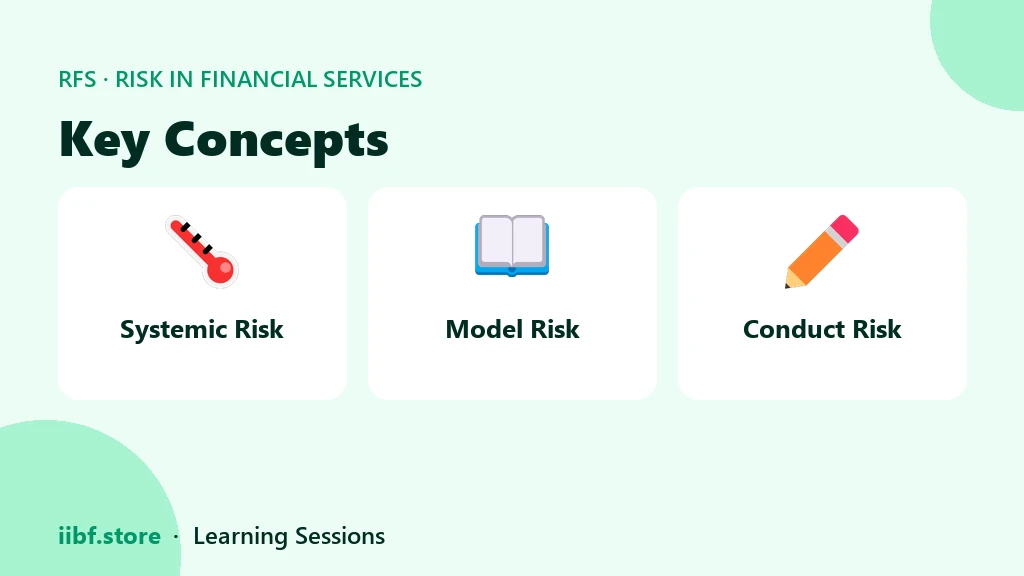
Operational risk is the risk of loss from inadequate or failed internal processes, people and systems, or from external events. It covers everything from a fraudulent transaction and a cyber breach to a natural disaster shutting a branch. Unlike credit or market risk, banks do not deliberately take operational risk to earn a return; they simply have to manage it. Basel prescribes capital charges for it, and the RBI expects a strong internal control culture, business continuity plans and cyber-resilience frameworks.
Model risk has grown sharply as banks rely on statistical models for credit scoring, VaR, provisioning and pricing. It is the risk that a model is wrong or misused, producing flawed decisions. Sound model governance requires independent validation, documentation and periodic back-testing.
Reputational risk is the danger that negative perception among customers, investors or regulators damages a bank's business, even when no rule has been broken. A viral complaint, a mis-selling scandal or an IT outage can trigger deposit flight. Because it feeds off every other risk, reputational risk is best managed by transparency, prompt grievance redressal and strong conduct standards. Sharpen these concepts with our risk matching game.
Systemic Risk, Concentration Risk, ESG Risk and the Risk Framework
Systemic risk is the risk that the failure of one institution or market cascades through the whole financial system, as the 2008 global crisis showed. In India the RBI mitigates it by designating Domestic Systemically Important Banks (D-SIBs), which carry extra capital buffers, and through macro-prudential tools such as the countercyclical capital buffer. Concentration risk, whether by borrower, sector, geography or collateral type, can turn a manageable shock into an existential one, which is why diversification and prudent exposure limits matter.
ESG risk, covering environmental, social and governance factors, is the newest addition to the syllabus. Climate transition risk, physical risk from extreme weather, and governance failures can all translate into credit and reputational losses. The RBI has issued guidance encouraging banks to build climate-risk assessment into their frameworks and to disclose relevant exposures.
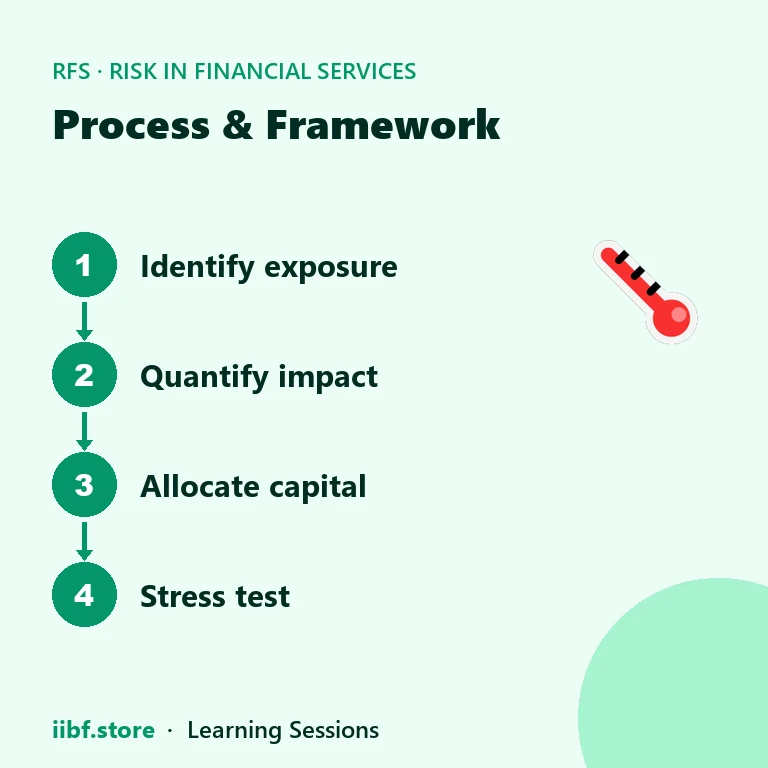
All these risks are woven together by an enterprise-wide risk management framework built on three lines of defence: business units that own risk, an independent risk-and-compliance function, and internal audit. The board sets the risk appetite; the Chief Risk Officer operationalises it. The RBI's Risk-Based Supervision (RBS) approach assesses each bank's risk profile holistically rather than checking rules mechanically. Stay current with regulatory shifts on our IIBF news page and the wider exam blog.
Frequently Asked Questions
What are the main types of risk in financial services?
The main types of risk are credit risk, market risk, liquidity risk, operational risk, interest rate risk, systemic risk, concentration risk, reputational risk, model risk and ESG risk. Credit, market and operational risk carry explicit capital charges under the Basel framework adopted by the RBI.
How is credit risk different from market risk?
Credit risk arises when a borrower or counterparty fails to repay, leading to loan defaults and NPAs. Market risk arises from adverse movements in prices such as interest rates, exchange rates or bond yields, mainly affecting a bank's trading book. Both require capital, but they are measured and managed with different tools.
What is the three lines of defence model?
It is a governance structure where the first line is the business units that own and manage risk daily, the second line is the independent risk-management and compliance function that sets policy and monitors, and the third line is internal audit that provides independent assurance to the board.
Why is ESG risk important for the IIBF exam?
ESG risk is a growing focus of the RBI and global regulators. Climate and governance factors can translate into credit, operational and reputational losses, so the Risk in Financial Services syllabus now expects candidates to understand how banks integrate ESG considerations into their risk frameworks.
Mastering the types of risk in financial services is not just about passing the IIBF certification; it is about becoming the kind of banker who protects both the institution and its customers. Work through each category, connect it to real RBI norms and Basel ratios, and practise until the framework feels intuitive. Ready to test yourself? Take a full-length mock on our practice tests page or enrol in the structured CAIIB course to lock in your preparation.
Practice this topic
Take a free mock test, download chapter PDFs, or watch a video class — all included on iibf.store.
Keep reading