Asset-Liability Management (ALM) and the LCR/NSFR Framework

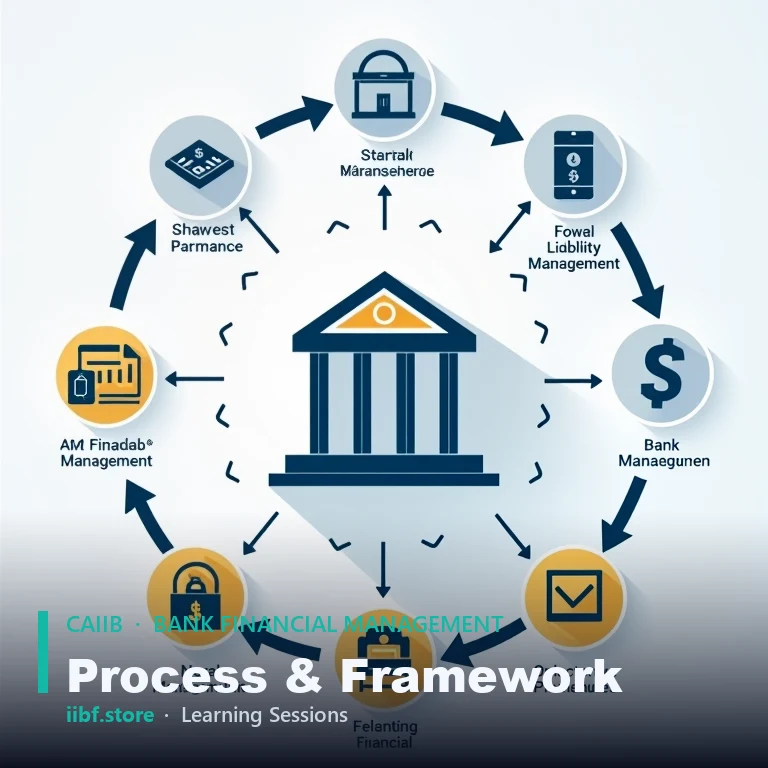
Asset-Liability Management is the discipline that keeps a bank solvent and liquid by balancing the maturities. Rates, and currencies of what it owns against what it owes. For CAIIB Bank Financial Management (BFM). Asset-Liability Management (ALM) is a flagship topic, covering gap analysis, interest-rate and liquidity risk, and the Basel III ratios — the Liquidity Coverage Ratio (LCR) and the Net Stable Funding Ratio (NSFR). This guide explains the ALM framework and these two ratios in clear, exam-ready terms grounded in the Reserve Bank of India's prudential norms.
Banks fund long-term loans with short-term deposits, so their balance sheet is inherently mismatched. ALM is the structured process of measuring, monitoring, and managing the risks that arise from these mismatches.
What is Asset-Liability Management?
Asset-Liability Management is the coordinated management of a bank's assets and liabilities to protect its net interest margin and ensure it can meet obligations as they fall due. It is overseen by the Asset-Liability Committee (ALCO), a senior management body that sets policy on funding, pricing, and risk limits. The two principal risks ALM addresses are liquidity risk (the inability to meet cash obligations) and interest-rate risk (the impact of rate movements on earnings and economic value).
The RBI requires banks to run a robust ALM system with a clearly defined risk-management structure. ALCO reviews the maturity profile of assets and liabilities, decides the deposit and lending rate strategy, and ensures compliance with regulatory liquidity ratios. Effective Asset-Liability Management is not about eliminating mismatch — some mismatch is how banks earn money — but about keeping it within prudent. Board-approved limits so that a sudden deposit run or rate shock does not threaten the bank. This governance-plus-measurement combination is exactly what BFM examiners expect candidates to articulate.
Gap analysis and interest-rate risk
The classic ALM tool is the maturity gap analysis. Where assets and liabilities are slotted into time buckets (overnight, 1-14 days, and so on) according to when they mature or reprice. For each bucket, the bank computes the gap between rate-sensitive assets (RSA) and rate-sensitive liabilities (RSL):
- A positive gap (RSA > RSL) benefits the bank when interest rates rise, as more assets reprice upward.
- A negative gap (RSA < RSL) benefits the bank when rates fall.
- A large gap in either direction signals higher interest-rate risk to earnings.
Two perspectives are used. The earnings perspective focuses on the short-term impact on net interest income (measured by traditional gap analysis). The economic value perspective looks at the long-term impact on the present value of the bank's equity, using duration gap analysis. Liquidity is tracked through a structural liquidity statement (a maturity ladder), where cumulative negative gaps in near-term buckets must stay within RBI-prescribed tolerance limits. Strong Asset-Liability Management answers in CAIIB combine both the gap concept and these two perspectives.

The Liquidity Coverage Ratio (LCR)
The Liquidity Coverage Ratio is a Basel III short-term liquidity standard adopted by the RBI. It requires a bank to hold enough High Quality Liquid Assets (HQLA) — chiefly cash. Central bank reserves, and government securities — to survive a 30-day acute stress scenario. The formula is straightforward:
LCR = HQLA ÷ Total net cash outflows over 30 days ≥ 100%
HQLA are assets that can be converted to cash quickly with little or no loss of value. The denominator estimates the net cash that could flow out in a 30-day stress, applying run-off rates to deposits and other liabilities. By maintaining an LCR of at least 100%, a bank demonstrates it can withstand a month of severe funding pressure without external help. The LCR addresses the short end of liquidity risk, complementing the structural liquidity statement used in Asset-Liability Management. The detailed norms are set out in RBI's Basel III liquidity guidelines on the Reserve Bank of India website.
The Net Stable Funding Ratio (NSFR)
While the LCR covers a 30-day horizon, the Net Stable Funding Ratio addresses structural funding over a one-year horizon. It encourages banks to fund their activities with stable sources rather than relying on volatile short-term wholesale funding. The formula compares available and required stable funding:
NSFR = Available Stable Funding (ASF) ÷ Required Stable Funding (RSF) ≥ 100%
Available Stable Funding weights a bank's capital and liabilities by how reliable they are over a year (equity and long-term deposits score high; short-term wholesale funding scores low). Required Stable Funding weights assets by how illiquid or long-term they are (long-dated loans need more stable funding than cash). Maintaining NSFR at or above 100% means a bank's longer-term assets are matched by sufficiently stable funding, reducing rollover risk. Together, LCR and NSFR form the liquidity pillar of Basel III that modern Asset-Liability Management must satisfy.
| Metric | Horizon | Purpose |
|---|---|---|
| LCR | 30 days | Survive a short-term liquidity stress with HQLA |
| NSFR | 1 year | Ensure stable funding for longer-term assets |

Studying ALM, LCR and NSFR for CAIIB BFM
Before that, it helps to see how the pieces connect in practice. A bank's treasury runs the daily liquidity position. ALCO sets the deposit and lending strategy to keep gaps within limits, and the regulatory ratios act as hard floors the bank cannot breach.
Sound Asset-Liability Management therefore blends internal gap analysis with external Basel III compliance. So a bank is protected against both a slow structural mismatch and a sudden liquidity shock. Candidates who can tell this single, joined-up story tend to score well.
This topic rewards a clear mental map: ALCO and gap analysis for the framework, LCR for short-term liquidity, and NSFR for structural funding. Practise interpreting gap statements and computing the two ratios from given data. Build mastery with the structured CAIIB course on iibf.store, attempt BFM-focused practice tests, track policy via RBI rates and circulars, and read more explainers on the iibf.store blog.
What does ALCO do?
The Asset-Liability Committee (ALCO) is a senior management body that sets a bank's funding, pricing and risk-limit policy. It reviews the maturity profile of assets and liabilities and ensures compliance with liquidity and interest-rate risk limits.
What is a positive gap in ALM?
A positive gap means rate-sensitive assets exceed rate-sensitive liabilities in a time bucket. The bank benefits when interest rates rise, because more assets reprice upward than liabilities, improving net interest income.
What is the minimum LCR requirement?
Under Basel III as adopted by the RBI. Banks must maintain a Liquidity Coverage Ratio of at least 100%, meaning their High Quality Liquid Assets must cover estimated net cash outflows over a 30-day stress period.
How does NSFR differ from LCR?
LCR covers short-term resilience over 30 days using HQLA, while NSFR covers structural funding over a one-year horizon. NSFR ensures longer-term assets are backed by stable funding such as capital and long-term deposits.
Conclusion: Asset-Liability Management, together with the LCR and NSFR, is how banks stay both profitable and resilient — and it is a high-yield area of CAIIB BFM. Map the framework, practise the ratios, and test yourself under exam conditions. Start now with a CAIIB BFM mock test on iibf.store, or enrol in the complete CAIIB course to clear your exam with confidence.
Quick quiz on this topic
5 exam-style questions from our free test bank — check yourself before you move on.
Practice this topic
Take a free mock test, download chapter PDFs, or watch a video class — all included on iibf.store.
Keep reading