Audit of Investment Portfolio in Banks: Verification and Provisioning (CAAP)
For a statutory or concurrent auditor, the audit of investment portfolio in banks is one of the highest-risk areas of any bank audit assignment. The investment book drives SLR compliance, capital adequacy, and a large share of treasury P&L, so a single classification or valuation error can misstate the balance sheet materially. This guide walks through the checks you need for verification, classification, income recognition, and depreciation provisioning on bank investments — exactly the way examiners expect it in the CAAP paper.
🔍 Verifying Holdings Against SGL, CSGL and Depository Statements
Government securities settle through RBI's e-Kuber system, which has replaced the old paper-based SGL (Subsidiary General Ledger) forms. A bank's own SLR holdings sit in its SGL account with RBI, while securities the bank holds as custodian for clients or primary dealers sit in a CSGL (Constituents' SGL) account. The first audit step is to obtain a balance confirmation of both accounts as at the balance sheet date and reconcile it, security-wise, against the bank's investment general ledger.
For equity shares, corporate bonds, and mutual fund units held in dematerialised form, the equivalent check is a depository statement from NSDL or CDSL. Any mismatch — an unsettled trade, a corporate action not yet reflected, or a scrip lying in a suspense demat account — needs to be traced to source and explained. This reconciliation exercise runs on the same logic as any other bank reconciliation statement check: identify the reconciling items, confirm they clear in the ordinary course, and flag anything stale.
Where a bank holds securities as an intermediary rather than as owner, verify that the CSGL and demat balances are held distinctly from the bank's own investment book, and that no client security has been used to prop up the bank's own SLR or trading position. This is conceptually close to how an auditor checks that drawing power in a cash credit account is computed only from what actually belongs to the borrower — in both cases the audit objective is the same: confirm that what is recorded as held is genuinely held, on the right account, for the right party.
🗂️ Classification Checks: HTM, AFS and FVTPL
Under RBI's investment classification framework, every security a bank holds must sit in one of three categories: Held to Maturity (HTM), Available for Sale (AFS), or Fair Value through Profit and Loss (FVTPL, which replaced the older Held for Trading category under RBI's revised Master Direction effective from April 2024). The auditor's job is not to re-decide classification but to test whether management's classification is consistent with the bank's stated investment policy and with how the security is actually intended to be used.
A security parked in HTM but sold well before maturity, other than for the limited exceptions RBI permits, is a red flag — it can force reclassification of the whole HTM category and attract a value-strain disclosure. Similarly, a security held purely for short-term trading should never sit in AFS just to avoid daily mark-to-market. Test a sample of shifts between categories during the year and check board or ALCO approval, since inter-category transfers require documented sanction and are valued at the lower of cost or fair value on the date of transfer, with any depreciation provided for immediately.
Classification also has to tie back to the accounting framework banks currently follow. Read this alongside our guide on accounting standards applicable to banks for how AS 13 principles map onto RBI's own investment classification rules, since the CAAP paper frequently tests this overlap. For balance sheet presentation, investments appear in Schedule 8 of the banking company's format, and category-wise break-up is a disclosure item auditors verify against the bank balance sheet schedules prescribed under the Banking Regulation Act's Third Schedule.
💡 Exam Tip: If a question describes a security moved out of HTM before maturity without a listed exception, the auditor's action is to question the classification and check for the mandated value-strain disclosure — not to simply note it as a routine transfer.
💰 Income Recognition and Broken Period Interest
Interest income on investments is recognised on an accrual basis, except where the security itself is non-performing, in which case income recognition stops and the asset follows the same prudential norms as a non-performing advance. When auditing income, separate coupon interest actually accrued from broken period interest paid at purchase — the latter is not income, it is a recoverable that offsets the next coupon receipt, and treating it as income overstates the P&L for the period.
Premium paid over the face value of an HTM security is not expensed upfront. It is amortised over the residual period to maturity, so check that the amortisation schedule matches the security's actual maturity date and that the charge each period is being correctly routed through the profit and loss account rather than capitalised. Discount on acquisition, conversely, is generally not accreted as income for HTM securities under RBI's conservative approach — verify the bank's policy note is consistent with what RBI prescribes.
Dividend income on equity investments is recognised only when the right to receive payment is established, and profit or loss on sale of investments needs to be computed category-wise, not netted across HTM, AFS, and FVTPL. This is exactly the kind of head-wise segregation covered in our chapter on classification of income and expenditure — a strong foundation before you tackle investment-specific income tests. Cross-check that profit on sale of HTM investments credited to P&L is, where required, appropriated to the Capital Reserve rather than left available for dividend distribution.

📉 Valuation and Depreciation Provisioning
Valuation is where classification decisions turn into P&L impact. HTM securities are carried at acquisition cost or amortised cost, and are not marked to market — provisioning is required only where there is other-than-temporary, permanent diminution in value, such as with a defaulting issuer. AFS and FVTPL securities are marked to market at fair value, scrip-wise, using the rates published by the RBI-recognised valuation agency (currently FBIL — Financial Benchmarks India Limited), typically at least at every quarter-end for AFS and more frequently for FVTPL.
The provisioning rule auditors must test carefully is the no-netting principle: within a category, net depreciation across scrips is provided for through the P&L or the AFS reserve as applicable, while net appreciation is ignored and never taken to income. Depreciation in one classification category cannot be set off against appreciation in another. A common audit finding is a branch or treasury desk netting AFS gains against AFS losses across dissimilar security types instead of computing depreciation classification-wise as RBI requires.
Also verify that the bank has not offset HTM appreciation, which is not even recognised, against AFS depreciation, which must be provided for. Trace the depreciation provision entry back to the valuation working paper, confirm the FBIL/market rates used are as of the balance sheet date, and re-perform the calculation for a sample of large-value scrips.
⚠️ Common Mistake: Treating broken period interest paid on purchase as investment income, or netting depreciation in one category against appreciation in another — both overstate reported profit and are classic exam traps.
| Category | Valuation Basis | Marked to Market | Where Gains/Losses Go |
|---|---|---|---|
| Held to Maturity (HTM) | Acquisition cost / amortised cost | ❌ No (except permanent diminution) | Not routed to P&L periodically; premium amortised over residual maturity |
| Available for Sale (AFS) | Fair value, scrip-wise | ✅ Yes, at least quarterly | Net depreciation provided for; net appreciation ignored |
| Fair Value through P&L (FVTPL) | Fair value, scrip-wise | ✅ Yes, frequently | Both gains and losses recognised through P&L |
🕵️ Concurrent Audit Coverage of Treasury Operations
RBI requires banks to place treasury and investment operations under concurrent audit, given the speed and value at which these transactions move. The concurrent auditor's brief typically covers deal-slip to deal-confirmation matching, adherence to counterparty and exposure limits, timely settlement, and same-day reconciliation of the SGL/CSGL and demat positions discussed earlier — catching errors while they are still fixable rather than months later at year-end.
This is a different lens from the statutory audit, which forms an opinion on the year-end financial statements, but the two overlap heavily on investments: the statutory auditor typically relies on concurrent audit reports for evidence on transaction-level controls, while independently re-verifying period-end balances, classification, and provisioning. If you are unclear on how concurrent audit fits alongside statutory, branch, and other audit types in a bank, revisit the chapter on bank audit and various types of audits in banks before attempting scenario-based questions.
Sale transactions in HTM securities, transfers between categories, high-value or off-market deals, and any transaction with a related counterparty are the items concurrent auditors are expected to flag for the statutory auditor's specific attention. The verification discipline here mirrors what you would apply while studying verification of advances in bank audit — sampling high-value and high-risk transactions rather than relying only on aggregate totals.
📌 Remember: Concurrent audit gives transaction-level assurance on treasury deals; it does not replace the statutory auditor's own testing of year-end classification, valuation and depreciation provisioning on the investment portfolio.
✅ Conclusion: Building an Audit Checklist for Investments
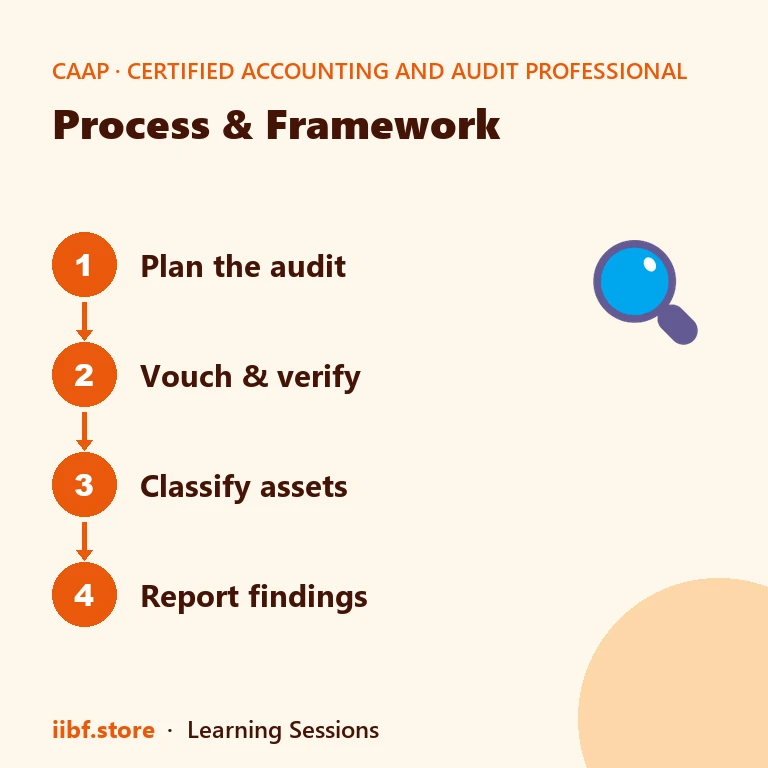
A sound audit of investment portfolio in banks always follows the same sequence: verify existence against SGL/CSGL and depository statements, test classification against RBI's HTM/AFS/FVTPL framework and board-approved policy, re-check income recognition including broken period interest, and re-perform valuation and depreciation provisioning scrip-wise and category-wise. Layer concurrent audit findings on top of your own testing rather than substituting one for the other. For the full RBI framework, see the Master Directions published on rbi.org.in. For more study material on this paper, browse our Certified Accounting and Audit Professional articles, and when you are ready to test yourself, attempt a full chapter-wise mock at iibf.store/tests.
🧠 Practice MCQs: Audit of Investment Portfolio in Banks
Q1. Government securities held by a bank on behalf of a client or primary dealer are recorded in which account? (a) SGL account (b) CSGL account (c) Demat account with NSDL (d) Nostro account
Answer: (b) — The Constituents' SGL (CSGL) account is used when a bank, as custodian, holds securities for a client rather than for itself.
Q2. Under RBI's revised investment classification framework effective April 2024, the erstwhile Held for Trading category was replaced by: (a) Available for Sale (b) Fair Value through Profit and Loss (c) Fair Value through OCI (d) Held to Maturity
Answer: (b) — RBI's Master Direction replaced Held for Trading with Fair Value through Profit and Loss (FVTPL) as a distinct category.
Q3. While auditing HTM investments, the auditor should specifically verify that: (a) All HTM securities are marked to market monthly (b) Premium paid over face value is amortised over the residual maturity (c) HTM securities are valued at the lower of cost or market price (d) Depreciation on HTM is netted against AFS appreciation
Answer: (b) — Premium on HTM securities is amortised over the period remaining to maturity and charged to the P&L each period; HTM securities are not marked to market.
Q4. For audit purposes, net depreciation identified within the AFS category should be: (a) Netted off against net appreciation in the HTM category (b) Ignored if prices are expected to recover (c) Provided for category-wise, without netting against appreciation in another category (d) Carried forward to the next financial year without provisioning
Answer: (c) — Depreciation is provided for on a no-netting-across-categories basis; appreciation in one category cannot offset depreciation in another.
Q5. Broken period interest paid by a bank at the time of purchasing an investment should be treated as: (a) Investment income for the period of purchase (b) A recoverable that offsets the next coupon receipt, not income (c) A capitalised addition to the cost of the security (d) A provision against the investment
Answer: (b) — Broken period interest paid on purchase is not income; it is recovered from the next coupon payment received.
Want chapter-wise mock tests with 100+ MCQs? Start practising free →
What documents does an auditor primarily check to verify a bank's investment holdings?
Balance confirmations of the bank's SGL and CSGL accounts for government securities, and depository statements from NSDL or CDSL for equity and corporate bonds held in dematerialised form, reconciled against the investment general ledger as at the balance sheet date.
What is the difference between an SGL account and a CSGL account?
An SGL (Subsidiary General Ledger) account holds a bank's own government securities directly with RBI's settlement system, while a CSGL (Constituents' SGL) account is maintained by a custodian bank on behalf of clients or primary dealers who do not hold a direct SGL account.
How is depreciation on a bank's investment portfolio provided for?
Depreciation is computed scrip-wise and then aggregated category-wise for AFS and FVTPL investments; net depreciation in a category is provided for, net appreciation is ignored, and depreciation in one category is never netted against appreciation in another.
Does concurrent audit cover investment and treasury transactions in banks?
Yes. RBI requires treasury and investment operations to be covered under concurrent audit, which tests deal confirmation, settlement timeliness, and limit compliance on a near-real-time basis, complementing the statutory auditor's year-end testing of classification, valuation and provisioning.
Practice this topic
Take a free mock test, download chapter PDFs, or watch a video class — all included on iibf.store.