Sanctioned Limit vs Drawing Power: The Difference That Costs Marks

Ask a new branch officer what a borrower with a ₹1 crore cash credit limit can withdraw, and the answer comes back instantly: one crore. It is wrong more often than it is right. The sanctioned limit is only the outer ceiling. What the borrower can actually draw on any given day is the drawing power, and it moves every single month with the stock statement. Confusing the two is the fastest way to lose easy marks in JAIIB AFM — and the fastest way to create an irregular account at the counter.
Working capital: sanctioned limit vs drawing power · Watch on YouTube
Two numbers, two completely different jobs
The sanctioned limit is an appraisal decision. It is fixed once, at sanction, after the bank assesses the borrower's projected turnover, operating cycle and working capital gap. It sits in the sanction letter, it does not change month to month, and it represents the maximum exposure the bank has agreed to carry on that facility.
The drawing power is an operational number. It is recomputed every month from the current value of the security actually available — paid stock and eligible book debts, less creditors, less the prescribed margin. It answers a different question entirely: given what the borrower is holding today, how much of that ceiling is safe to release right now?
The operative rule is simple. The borrower can draw the lower of the two. A sanctioned limit with no security behind it is an empty promise, and a computed figure above the limit is capped at the limit. Neither number alone tells you what is available.

How drawing power is computed
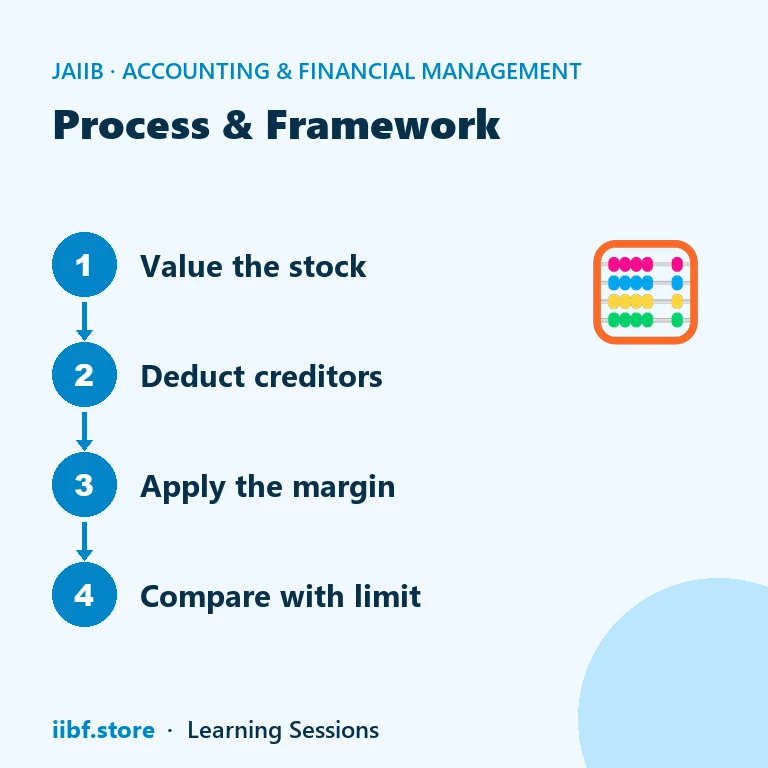
The standard working is short, and every step of it earns marks:
- Take the closing stock as per the stock statement, valued at cost or market price, whichever is lower.
- Deduct sundry creditors for goods, because unpaid stock is already financed by the supplier. What remains is paid stock.
- Add eligible book debts — usually receivables up to 90 days; older debts are excluded.
- Apply the margin prescribed for each category and take the balance.
- Cap the result at the sanctioned limit.
Work through a live example. A firm holds a sanctioned CC limit of ₹1 crore, with a 25% margin on stock and a 40% margin on book debts.
| Particulars | Month 1 | Month 2 |
|---|---|---|
| Closing stock | ₹90 lakh | ₹110 lakh |
| Less: sundry creditors for goods | ₹30 lakh | ₹20 lakh |
| Paid stock | ₹60 lakh | ₹90 lakh |
| Paid stock after 25% margin | ₹45 lakh | ₹67.50 lakh |
| Eligible book debts (up to 90 days) | ₹40 lakh | ₹50 lakh |
| Book debts after 40% margin | ₹24 lakh | ₹30 lakh |
| Drawing power | ₹69 lakh | ₹97.50 lakh |
| Sanctioned limit | ₹100 lakh | ₹100 lakh |
| Amount actually available | ₹69 lakh | ₹97.50 lakh |
In month one the borrower may believe a crore is available, but only ₹69 lakh is. In month two, better stock levels and lower creditors push the drawing power to ₹97.50 lakh — still under the ceiling. Had the calculation crossed ₹100 lakh, the answer would simply be ₹100 lakh, because the limit caps it.
What happens when the outstanding crosses it
This is where the topic stops being academic. Under the RBI income recognition and asset classification norms, a cash credit or overdraft account is treated as out of order when the outstanding balance remains continuously in excess of the sanctioned limit or the drawing power for 90 days, or when the outstanding is within the limit but there are no credits continuously for 90 days, or the credits are not enough to cover the interest debited during that period. An out of order account is classified as a non-performing asset.
Two consequences follow for the branch. First, a fall in stock quietly reduces the drawing power even though the outstanding has not moved — the account can turn irregular without the borrower withdrawing another rupee. Second, delayed or inflated stock statements are not a compliance nuisance; they directly determine an asset classification outcome. That is why banks insist on the statement by a fixed date each month and why physical inspection of stock matters.
📖 Also read: accounting for bills purchased and discounted — Accounting for Bills Purchased and Discounted by Banks
The exam angle for JAIIB AFM
Expect the paper to give you stock, creditors, book debts and margins, then ask for the amount available for withdrawal. The three traps repeat year after year: forgetting to deduct creditors before applying the margin, including book debts older than 90 days, and reporting a computed figure that exceeds the sanctioned limit instead of capping it. Write the working in the five steps above and each of those disappears.
The conceptual questions are just as predictable. Know that the limit is fixed at sanction while drawing power is dynamic; that margin protects the bank against a fall in the value of security; and that the borrower always draws the lower of the two. Revise the full working capital chapter on the JAIIB course page, then run the numericals under a clock.
Practise the calculation sets on our JAIIB mock tests, schedule the revision on the study planner, and keep current policy rates from the RBI rates page beside you while you solve. The underlying prudential norms are published in full by the Reserve Bank of India.
Can drawing power ever be higher than the sanctioned limit?
The computation can throw up a higher figure when stock and receivables are strong, but the amount available is always capped at the sanctioned limit. The borrower draws the lower of the two, so a computed value above the limit is simply reported as the limit.
Why are sundry creditors deducted before applying the margin?
Stock bought on credit is already financed by the supplier. Lending against it again would mean the same goods carry two lenders. Deducting creditors leaves only the paid stock, which is the portion the borrower has genuinely funded.
Are book debts older than 90 days counted?
Normally no. Most sanction terms restrict eligible receivables to those up to 90 days, on the view that older debts are of doubtful realisability. Always follow the eligibility period stated in the sanction letter when the question specifies one.
What makes a cash credit account out of order?
Per RBI norms, when the outstanding stays continuously above the sanctioned limit or drawing power for 90 days, or when there are no credits for 90 days, or credits are insufficient to cover the interest debited in that period. An out of order account is classified as an NPA.
Quick quiz on this topic
5 exam-style questions from our free test bank — check yourself before you move on.
Practice this topic
Take a free mock test, download chapter PDFs, or watch a video class — all included on iibf.store.
Keep reading