Banking Regulation Act 1949: CAIIB BRBL 2026 Guide
The Banking Regulation Act 1949 is the master legislation that governs how banks are licensed, capitalised, managed and supervised in India, and it sits at the very heart of the CAIIB Banking Regulations and Business Laws (BRBL) paper. If you understand this single statute well, a large slice of the exam becomes intuitive, because most RBI directions, licensing conditions and supervisory actions ultimately trace their legal authority back to it. In this 2026-framed guide we walk through the sections that examiners repeatedly test, the powers the Reserve Bank draws from the Act, and the recent amendments that have reshaped its scope.
Scope, definitions and the meaning of "banking"
The Act opens by defining the very activity it regulates. Section 5(b) defines banking as accepting deposits of money from the public, for the purpose of lending or investment, repayable on demand or otherwise and withdrawable by cheque, draft or order. This definition is deliberately narrow: an entity that merely lends but does not accept demand deposits (such as an NBFC) is not a "bank" under this Act. Section 5(c) defines a banking company, and Section 6 lists the forms of business a bank may lawfully transact, while Section 8 prohibits banks from trading in goods.
- Section 5(b) — statutory definition of banking (accept deposits, lend/invest, repayable, withdrawable by cheque).
- Section 6 — permitted forms of business, from borrowing and lending to acting as agent.
- Section 7 — only a banking company may use the words "bank", "banker" or "banking".
- Section 8 — general prohibition on trading, to keep banks out of commodity risk.
Examiners love the distinction between what a bank must do to be a bank (5(b)) and what it may do (6). Candidates preparing the wider syllabus should pair this with the CAIIB course modules on business laws.
Licensing, capital and management controls
The Act gives RBI a tight grip over entry and structure. Section 22 requires every banking company to hold a licence from the Reserve Bank before commencing business, and RBI can cancel that licence if conditions are breached. Section 11 prescribes minimum paid-up capital and reserves, while Section 12 regulates the capital structure and caps the voting rights of any single shareholder. Section 17 mandates transfer of a portion of profits to a statutory reserve fund before any dividend, and Section 18 governs the maintenance of the cash reserve for non-scheduled banks.
On governance, Section 10A requires that at least 51% of directors have special knowledge in fields such as accountancy, agriculture, economics, law or banking, and Section 10B deals with the appointment of a whole-time chairman or managing director. Section 20 restricts loans to a bank's own directors and the companies in which they are interested, a classic conflict-of-interest safeguard. Section 21 empowers RBI to issue directions on advances, and Section 23 controls the opening of new branches. Together these sections show how the statute regulates a bank end to end: entry, capital, ownership, board and lending. Test yourself on these with our practice tests and reinforce recall using the match-the-section game.
RBI's supervisory and control powers
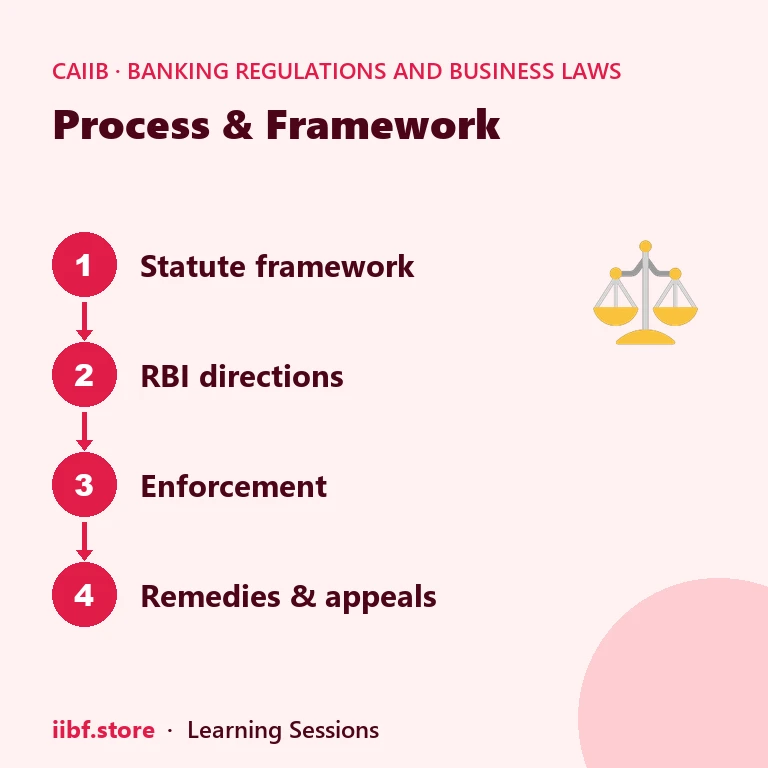
The most heavily examined portion is RBI's arsenal of supervisory tools. Section 21 lets the Reserve Bank determine policy on advances (for example, margins and interest); Section 22 covers licensing; Section 35 empowers RBI to inspect any banking company and its books; and Section 35A is the sweeping "power to give directions" in the public interest or in the interest of depositors. Section 36 allows RBI to give further assistance and issue directions, and Section 36AA/36AB permit removal of managerial persons and appointment of additional directors.
- Section 35 / 35A — inspection and the power to issue binding directions.
- Section 36ACA — supersession of a bank's board (used in real resolution cases).
- Section 45 — moratorium and RBI-driven amalgamation of a distressed bank.
- Section 47A — power to impose monetary penalties for contraventions.
It helps to see these powers as a graduated ladder. RBI can begin with inspection under Section 35 to gather facts, escalate to binding directions under Section 35A, remove or supersede errant management under Sections 36AA and 36ACA if governance has failed, impose penalties under Section 47A for specific contraventions, and reach for Section 45 amalgamation only when the institution can no longer stand alone. Understanding this escalation logic — from information-gathering to full resolution — is more valuable for the exam than memorising section numbers in isolation, because it explains why a particular power is used at a particular stage of distress. Section 45 acquired fresh prominence when RBI used it to place a large private bank under moratorium and drive a rescue scheme, illustrating how a decades-old provision powers modern crisis management. For live rate and policy context that examiners increasingly weave into questions, keep an eye on current RBI rates.
Recent amendments and 2026 relevance
The Act has been amended repeatedly to keep pace with reform. The Banking Regulation (Amendment) Act 2020 brought all cooperative banks more firmly under RBI supervision and gave RBI power to reconstruct or amalgamate a bank without first imposing a moratorium — a direct response to depositor-protection failures. The Banking Laws (Amendment) Act 2025 further modernised the framework: it raised the number of nominees a depositor may name (allowing successive and simultaneous nominations), redefined "substantial interest" thresholds, and adjusted tenure and reporting provisions for directors and auditors. For BRBL 2026, expect at least one question testing awareness of these changes.
Read amendments alongside their purpose rather than as isolated facts — depositor protection, financial-stability resolution, and governance tightening are the three recurring themes. Candidates who also sit the JAIIB legal papers should revisit the foundational material in the JAIIB course, and follow the latest circulars via IIBF news and the official Reserve Bank of India website.
Frequently asked questions
Related study material
Go deeper with the full chapter notes and the complete article hub for this subject:
- Returns, inspection, acquisition, winding up
- Banking Regulation Act 1949
- All Banking Regulations and Business Laws articles & notes
Which section defines "banking" under the Banking Regulation Act 1949?
Section 5(b) defines banking as accepting deposits from the public for lending or investment, repayable on demand or otherwise and withdrawable by cheque, draft, order or otherwise. This is the core definition that separates a bank from other lenders.
What power does Section 35A give the Reserve Bank of India?
Section 35A empowers RBI to issue binding directions to banking companies in the public interest, in the interest of depositors, or to secure proper management. It is one of the widest supervisory powers in the Act.
How did the 2020 amendment change RBI's control over cooperative banks?
The Banking Regulation (Amendment) Act 2020 brought cooperative banks squarely under RBI's banking-supervision powers and allowed RBI to prepare a scheme of reconstruction or amalgamation without first imposing a moratorium, strengthening depositor protection.
What does the Banking Laws (Amendment) Act 2025 change for depositors?
Among other reforms, it increased the number of nominees a depositor can appoint for deposits and lockers, permitting both successive and simultaneous nomination, and updated definitions such as "substantial interest" and certain director-tenure rules.
Conclusion and next step
The Banking Regulation Act 1949 rewards structured study: master the definition sections, the licensing and capital chain, RBI's supervisory powers and the 2020/2025 amendments, and you have covered the bulk of what BRBL asks. Do not memorise section numbers in isolation — link each to the problem it solves. Ready to lock it in? Attempt a full BRBL mock on our CAIIB practice tests or enrol in the complete CAIIB BRBL course to clear the paper in one attempt.
Quick quiz on this topic
5 exam-style questions from our free test bank — check yourself before you move on.
Practice this topic
Take a free mock test, download chapter PDFs, or watch a video class — all included on iibf.store.
Keep reading