
Is the CCFE exam preparation book right for you? An honest guide
You finish at the branch, the cash is tallied, the day's rush is over, and now you are supposed to open a foreign exchange syllabus. Exchange quotations, FEMA, letters of credit, export finance, Foreign Trade Policy. It feels endless, and you have probably been pitched more than one "complete package" already. So let us do something different: an honest look at whether the CCFE exam preparation book is right for you at all.
I am not going to tell you it will change your life. I will tell you what is in it, who it suits, who it does not, and what to pair it with. If you decide it is not for you, you should still leave with a usable plan.
First, decide how you actually study
Before you compare any book, answer three plain questions. They matter more than the brand on the cover.
- How many hours do you really get? Not the hours you wish for. Count a normal working week and be pessimistic.
- Do you retain better from paper or from a screen? Many bankers spend eight hours on a monitor and cannot face another one at night.
- Have you attempted this paper before? A repeat attempt needs a different plan from a first one.
Your answers decide the profile you fit into below. Foreign exchange is a paper where the topics connect: a remittance rule in FEMA affects what a documentary credit can finance, and what an export bill needs. A tired, scattered reading pattern punishes you here more than in some other papers, so a fixed order and a fixed place on the desk help more than extra hours.
What the printed book actually contains
Let us stick to facts. The Foreign Exchange Operations (CCFE) printed book is the 2026 edition: 199 pages, 48 chapters, 720 questions, organised into six modules.
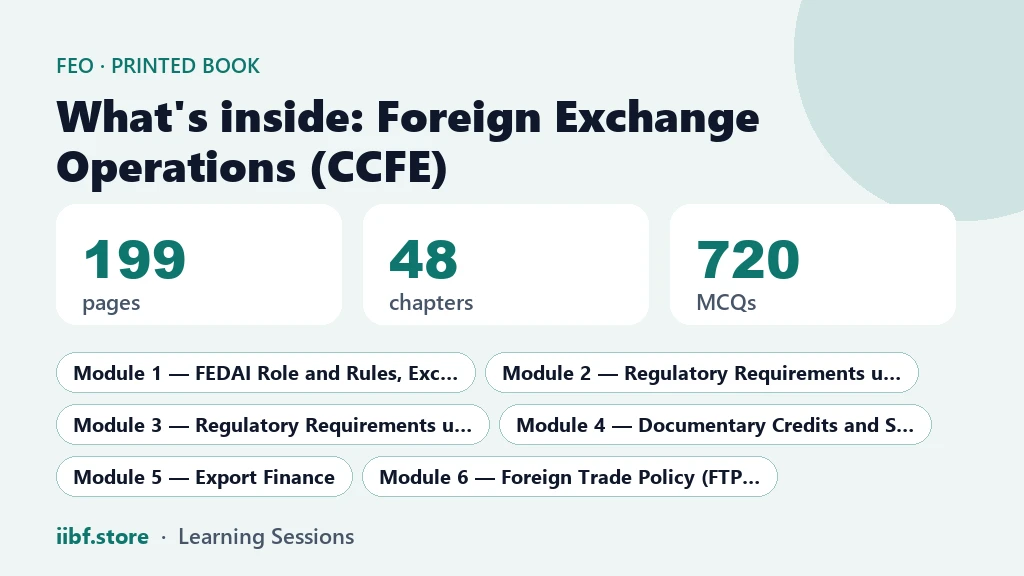
The modules run in a sensible order:
- Module 1 covers FEDAI's role and rules, exchange rates, risk management and the code of conduct (7 chapters).
- Module 2 covers FEMA for resident and non-resident individuals, including the Liberalised Remittance Scheme and NRE, NRO and FCNR(B) accounts (8 chapters).
- Module 3 covers FEMA for entities: imports, exports, ECB, overseas investment, FDI and FPI (11 chapters).
- Module 4 covers documentary credits and standby credits, UCP 600, URC 522, URDG 758 and Incoterms (12 chapters).
- Module 5 covers export finance: packing credit, PCFC, post-shipment finance, factoring, forfaiting and ECGC (5 chapters).
- Module 6 covers Foreign Trade Policy 2023 (5 chapters).
Beyond the chapters, the book lists 80 case studies (320 questions) and 5 mega tests (500 questions). Case studies are where this subject is usually won or lost, because the exam likes to wrap one rule inside a short real-life situation.
Reader profile 1: the first-attempt candidate
If this is your first try, your biggest enemy is not difficulty. It is not knowing where the syllabus ends. A structured CCFE exam preparation book with 48 chapters in six modules gives you a visible finish line, and that alone calms a lot of anxiety.
How to use it
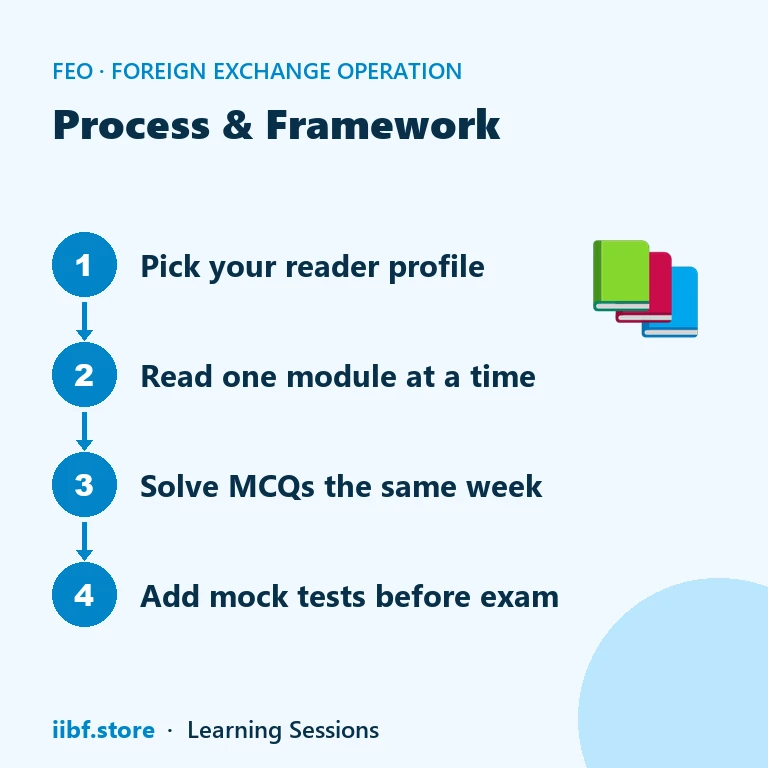
Read one module at a time, in the printed order. Do not jump to Module 4 because letters of credit "sound important". The early chapters on quotations and customer rates are the grammar the later ones use. After each chapter, solve its questions the same week while the logic is fresh.
When it is not enough
A book gives you knowledge, not exam-hall speed. Before the exam cycle, you need timed practice. The free mock tests at iibf.store/tests are a reasonable place to test yourself under a clock before you spend anything more.
Reader profile 2: the repeat-attempt candidate
You have been here before. You know the rules roughly, yet marks slipped. In most cases the problem is not missing knowledge. It is applying a rule to a slightly changed situation: the same FEMA provision, a different type of remitter.
How to use it
Do not re-read the whole book. Start from the case studies and the mega tests, mark every question you got wrong, and trace each one back to its chapter. Your reading list is then your own mistake list, which is far shorter than 199 pages.
When it is not enough
If you keep failing on the same module, the issue may be a concept gap that practice questions alone will not fix. Go back to that module's chapters slowly, and consider checking the free PDFs at iibf.store/free-material for a second explanation of the same topic.
Reader profile 3: the candidate who is short on time
Some of you have a month, some have three weeks, and branch work will not wait. Be realistic: a book cannot give you time. What it can do is stop you wasting the time you have on collecting notes from ten places.
How to use it
Give your first week to Modules 1 and 2, since they form the base for everything else. Spend the next stretch on Module 3 and Module 4, which are the heaviest, then finish with Modules 5 and 6, which are shorter at five chapters each. Keep your last days for case studies and a mega test, not for new reading.
When it is not enough
If you cannot find even four or five hours a week, no book will rescue you. Consider moving to the next exam cycle instead of sitting unprepared. The official schedule is on the IIBF website, and you should check it rather than rely on anyone's memory, including mine.
Reader profile 4: the one who prefers paper over screens
This is a genuine reason, not a weakness. If you read a PDF for ten minutes and your eyes drift to your phone, paper changes the game. You can underline, fold a corner, write the "why" in the margin, and carry it in your bag for the metro or the bus.
How to use it
Keep one pen colour for rules and another for exceptions. Foreign exchange is full of "permitted, but only if" statements, and a margin note that says "but only if" saves you in the exam. Treat the book as a workbook, not a display piece.
When it is not enough
Paper cannot update itself. Rules in this area change, and a printed book is a snapshot of its edition, which here is 2026. Always cross-check anything that looks time-sensitive on the regulator's own website before you rely on it.
A simple plan for working bankers
Whichever profile you are, this routine for the CCFE exam preparation book fits around a branch job. It is deliberately small, because a plan you can keep beats a perfect plan you drop in week two.
| You are... | Start with | Pair it with |
|---|---|---|
| First attempt | Modules 1 to 6 in order | Free mock tests, once per module |
| Repeat attempt | Case studies and mega tests | Your own mistake list |
| Short on time | Modules 1 and 2, then 3 and 4 | One timed mega test |
| Prefers paper | Margin notes while reading | Regulator website for updates |
Notice that every row ends with something outside the book. That is not an accident. Reading alone passes very few people, and practice is the other half of the job.
Price, and what you are really paying for
The book is listed at ₹700 against an MRP of ₹2,398. Prices can change, so treat the book page as the current word. Ask yourself a simple question about the CCFE exam preparation book: what would it cost you to assemble 48 chapters of reliable notes yourself, and how many evenings would it take? If your evenings are already scarce, that time is the real price.
You can also browse other titles at iibf.store/books, and the blog has more study guides. There is a free sample of the book too, so look at the writing style before you commit. If the sample does not suit how you learn, that is a perfectly good reason to say no.
The honest bottom line
The CCFE exam preparation book suits you if you want one organised, paper-based source across all six modules, with questions and case studies to practise on. It will not suit you if you only learn from video, or if you are hoping a book will replace practice and revision. Pair it with timed mocks, keep a mistake list, and check the official schedule on the IIBF site before you plan your dates.
Whatever you choose, start this week. A short, steady routine beats a long plan you never begin.
Frequently asked questions
Is the book enough to pass on its own?
For most candidates, no. It gives you structured content, case studies and mega tests, but you also need timed mock practice and revision of your weak areas. Treat it as the main source, not the only one.
Can I preview the book before buying?
Yes. The CCFE exam preparation book page has a free sample you can read first, so you can judge the explanation style before you order.
How many questions does the book have?
The 2026 edition lists 720 questions across 48 chapters and six modules, along with 80 case studies and 5 mega tests as described on the book page.
Where do I find the official exam dates?
Always use the IIBF website, iibf.org.in, for the upcoming exam cycle and any rule changes. Do not rely on third-party dates.
Prefer revising from a printed book?
Chapter-wise books with MCQs after every chapter — minimal pages, complete coverage, delivered anywhere in India. Every book has a free sample to read first.


















































Quick quiz on this topic
5 exam-style questions from our free test bank — check yourself before you move on.
Practice this topic
Take a free mock test, download chapter PDFs, or watch a video class — all included on iibf.store.