Cash Transaction Report under PMLA: Branch Guide for CBCP
A customer walks in on the 3rd of the month and deposits Rs 4 lakh in cash. On the 11th he deposits Rs 4 lakh again, and on the 24th another Rs 3 lakh. No single deposit looks big, and the cashier does not blink. Yet by month-end the account has taken in more than Rs 10 lakh in cash, and your bank now owes the Financial Intelligence Unit a filing. This is exactly the situation the cash transaction report under PMLA is designed to catch, and it is also a favourite scenario in the Banking Compliance Professional (CBCP) paper.
In this article we go through the legal basis, the triggers in the PML Rules, who files what and by when, how the Principal Officer fits in, and how IIBF frames questions on it. Read it as a senior colleague explaining what actually happens behind the counter.
What is a cash transaction report and where does it come from?
The Prevention of Money-laundering Act, 2002 (PMLA) obliges every reporting entity, which includes a banking company, to maintain records of certain transactions and to furnish information about them to the Director, Financial Intelligence Unit - India (FIU-IND). The details of which transactions and how quickly are not in the Act itself. They sit in the Prevention of Money-laundering (Maintenance of Records) Rules, 2005, commonly called the PML Rules, made under section 73 of the Act.
A cash transaction report (CTR) is the monthly return a bank files with FIU-IND listing the cash transactions that crossed the threshold in Rule 3. It is automatic and rule-based. It is not an accusation, and it does not mean the customer did anything wrong. A shopkeeper who deposits his weekly sales will appear in a CTR. That is why the CTR is distinct from the Suspicious Transaction Report (STR), which depends on judgement and suspicion, not on a number.
RBI brings these obligations into banking supervision through the Reserve Bank of India (Commercial Banks - Know Your Customer) Directions, 2025, issued on 28 November 2025 in place of the earlier KYC instructions for commercial banks. Its chapter on reporting requirements to FIU-India tells banks to furnish information to the Director under rule 7 of the PML Rules, to use FIU-IND's prescribed formats and utilities, and to treat each day of delay as a separate violation. The Direction also requires the bank to communicate the name, designation and address of its Principal Officer to FIU-IND and to RBI.
The triggers in Rule 3 of the PML Rules
Rule 3(1) lists the transactions a reporting entity must keep a record of. For a banker the ones to know cold are these:
- Clause (A): all cash transactions of the value of more than ten lakh rupees, or its equivalent in foreign currency.
- Clause (B): all series of cash transactions integrally connected to each other, each individually valued below ten lakh rupees, where the series has taken place within a month and the monthly aggregate exceeds ten lakh rupees (or the foreign-currency equivalent).
- Clause (BA): all transactions involving receipts by non-profit organisations of value more than ten lakh rupees or the equivalent in foreign currency.
- Clause (C): all cash transactions where forged or counterfeit currency notes or bank notes have been used as genuine, or where a forgery of a valuable security or document has taken place facilitating the transaction.
- Clause (D): all suspicious transactions, whether or not made in cash.
The rule also covers cross-border wire transfers where the origin or destination of funds is in India, and purchases and sales of immovable property of fifty lakh rupees or more registered by the reporting entity. For this article we stay with the cash side, because that is where a branch banker is most exposed.
Single transaction versus integrally connected series
The two cash triggers are different tests, and exam questions love to blur them.
- Clause (A) looks at a single cash transaction. The wording is "more than" ten lakh, so exactly Rs 10,00,000 does not satisfy clause (A) on its own.
- Clause (B) looks at a series. Every transaction in it is individually below ten lakh, they are integrally connected, they fall within one month, and the monthly aggregate exceeds ten lakh.
Splitting a large cash deposit into smaller pieces to stay below the line is the classic structuring pattern. Clause (B) exists to defeat it. Your core banking system should therefore aggregate cash credits and debits by customer, and not merely by account, because one customer may run several accounts.
Who files, to whom, and by when
Rule 8(1) puts the duty on the Principal Officer of the reporting entity. The Principal Officer must furnish the information on transactions under clauses (A), (B), (BA), (C) and (E) of Rule 3(1) every month to the Director, FIU-IND, by the 15th day of the succeeding month. So the cash transactions of April are reported by 15 May.
A few features are worth remembering because they are tested:
- The Principal Officer is a person designated by the bank, and the Rules require such an officer to be at the management level.
- The bank must tell the Director the name, designation and address of the Principal Officer (Rule 7), and RBI's KYC Directions adds that the same details go to RBI.
- A copy of the information furnished is retained by the Principal Officer for official record.
- Rule 8(4) states that each day of delay in reporting, or in rectifying a mis-reported transaction, beyond the time limit is a separate violation. A report filed ten days late is therefore ten violations, not one.
Suspicious transactions run on a different clock. Rule 8(2) says that once the Principal Officer is satisfied a transaction is suspicious, the information must be furnished promptly, not saved up for the monthly cycle. A CTR is calendar-driven. An STR is judgement-driven and immediate.
Step-by-step: how a branch transaction becomes a CTR
In most banks the filing is system-generated, but the compliance chain still depends on people. Here is the flow you should be able to describe in an exam answer and, more importantly, in a branch audit.
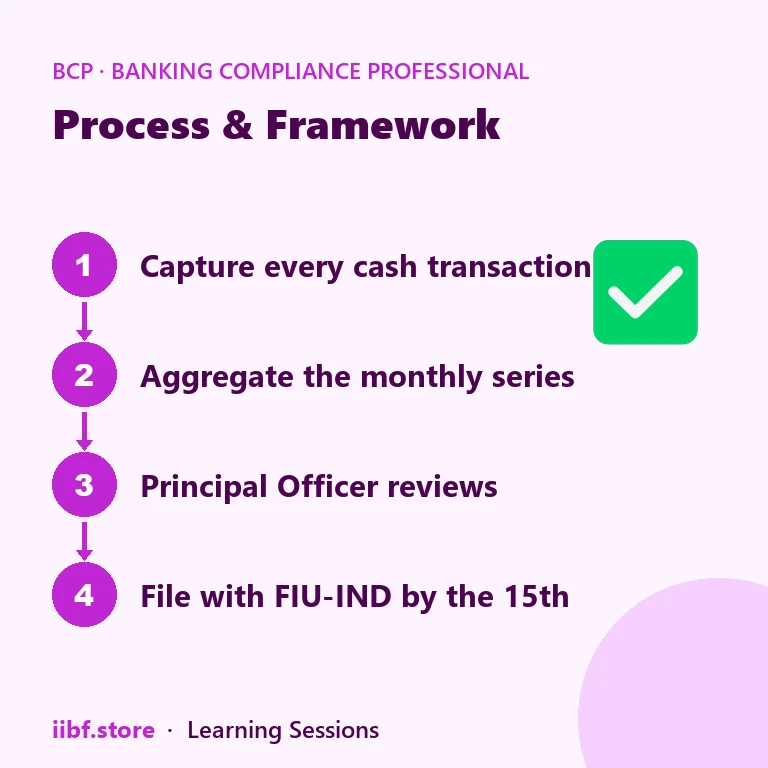
- Capture. Every cash deposit and withdrawal is posted with the customer ID, so that the system can aggregate across accounts.
- Aggregate. At month-end the system tests each customer against clause (A) and clause (B) of Rule 3(1), including foreign-currency equivalents.
- Review. The Principal Officer's team checks the output: mismatched customer IDs, missing PAN or identity data, wrongly classified transactions, and accounts that should have been merged.
- File. The report goes to the Director, FIU-IND, using the FIU-IND formats and utilities, before the 15th of the next month.
- Retain. The bank preserves transaction records for at least five years from the date of the transaction, as RBI's KYC Directions require.
A worked example
Take a trader, Mr Verma, with two current accounts in your branch. In one month he deposits Rs 6 lakh and Rs 3 lakh in the first account, and Rs 2.5 lakh in the second. Each deposit is below Rs 10 lakh. The total is Rs 11.5 lakh. Are they integrally connected? They belong to the same customer and the same business flow, so the bank must treat them as a series. The aggregate exceeds ten lakh, so clause (B) is triggered and the transactions go into that month's CTR, due by the 15th of the next month.
Now change the facts. He deposits Rs 6 lakh and Rs 3 lakh, a total of Rs 9 lakh in the month. No clause (A) or clause (B) trigger arises, so no CTR entry. The transaction may still be reported if, on other grounds, it looks suspicious, because an STR has no monetary floor.
CTR, STR and counterfeit currency report compared
| Feature | Cash Transaction Report (CTR) | Suspicious Transaction Report (STR) | Counterfeit Currency Report |
|---|---|---|---|
| Rule 3(1) clause | (A) and (B) | (D) | (C) |
| Trigger | Value test: above Rs 10 lakh single, or monthly aggregate above Rs 10 lakh | Principal Officer's satisfaction that the transaction is suspicious; no value floor | Forged or counterfeit notes used as genuine, or forgery of a valuable security or document |
| Nature | Automatic, rule-based | Judgement-based | Event-based |
| Timing under Rule 8 | Monthly, by the 15th of the succeeding month | Promptly, once satisfied | Monthly, by the 15th of the succeeding month |
| Filed by | The Principal Officer, to the Director, FIU-IND | ||
Confidentiality and what you must not do
Rule 8(6) requires every reporting entity, its directors, officers and all employees to keep confidential the fact that records have been maintained and that information has been furnished to the Director. In plain language: never tell the customer that his transaction has been reported. RBI's KYC Directions repeats the point and adds that the bank must not put any restriction on operations in an account merely because an STR has been filed.
Two practical consequences follow. First, a teller who asks, "Sir, why are you depositing so much cash, we will have to report it?" is creating a compliance problem, although asking about the source of funds as part of ordinary customer due diligence is perfectly proper. Second, the CTR must not be used as a reason to freeze or harass an ordinary customer. A CTR entry alone is not suspicion.
Common branch errors
- Aggregating by account number rather than by customer, so that a split across accounts goes unnoticed.
- Ignoring foreign-currency cash when testing the threshold.
- Missing a correction: a mis-reported transaction that is not rectified in time attracts the separate-violation rule for each day of delay.
- Not updating the Principal Officer's details with FIU-IND and RBI when the officer is transferred or replaced.
How IIBF tests the cash transaction report under PMLA
Questions in the CBCP paper on this topic are almost always one of three types: a threshold-and-aggregation calculation, a timeline recall, or a "who is responsible" question. The traps are consistent.
- Exactly Rs 10 lakh. Clause (A) says "more than" ten lakh. Read the option wording slowly.
- Series versus single. A series requires each transaction to be individually below Rs 10 lakh and the monthly aggregate to exceed Rs 10 lakh.
- Monthly versus immediate. CTR is monthly by the 15th; STR is prompt once the Principal Officer is satisfied.
- Responsibility. The Principal Officer furnishes the information. It is not the branch manager, the auditor or the CCO who files, although all of them support the process.
Practice questions
Q1. A customer makes five cash deposits of Rs 2.5 lakh each in a single calendar month in the same account. Is a CTR entry required? Answer: Yes. Each deposit is below ten lakh, but they form an integrally connected series within a month and the monthly aggregate of Rs 12.5 lakh exceeds ten lakh, so clause (B) applies.
Q2. The CTR for cash transactions of September is due by which date? Answer: By 15 October, being the 15th day of the succeeding month under Rule 8(1).
Q3. A bank files its CTR seven days after the due date. How many violations does this represent? Answer: Seven. Rule 8(4) treats delay of each day as a separate violation.
To practise this type of scenario under timed conditions, try the Banking Compliance Professional mock tests, and revise the regulatory background from the BCP printed book.
Quick revision points
- The legal source is the PMLA, 2002 and the PML (Maintenance of Records) Rules, 2005; RBI's KYC Directions operationalises it for banks.
- Rule 3(1)(A): single cash transaction of more than ten lakh rupees, or equivalent in foreign currency.
- Rule 3(1)(B): integrally connected series, each below ten lakh, within a month, monthly aggregate above ten lakh.
- Rule 8(1): the Principal Officer files monthly with the Director, FIU-IND, by the 15th of the succeeding month.
- Rule 8(4): every day of delay is a separate violation.
- Rule 8(6): the fact of reporting is confidential; no tipping off.
- Records are kept at least five years from the date of the transaction.
If you are building a complete preparation plan, the Banking Compliance Professional course places this topic inside the wider AML and KYC chapters, so you see how the CTR links with customer due diligence, monitoring and STR escalation. You can also browse the free study material for extra revision notes. For the official schedule of the upcoming exam cycle, always check the IIBF website.
Frequently asked questions
Is a cash transaction report the same as a suspicious transaction report?
No. A cash transaction report is triggered by a value test in Rule 3(1)(A) or (B) and is filed monthly. A suspicious transaction report is triggered by the Principal Officer's satisfaction that a transaction is suspicious, has no value floor, and is furnished promptly.
Does exactly Rs 10 lakh in cash trigger a report?
Clause (A) of Rule 3(1) uses the words more than ten lakh rupees, so a single cash transaction of exactly Rs 10 lakh does not meet it. Always check the series test as well, because other cash transactions in the month may take the aggregate above the line.
Who files the CTR in a bank?
The Principal Officer of the bank, who is an officer at the management level designated by the bank, furnishes the information to the Director, FIU-IND under Rule 8. The branch supports with accurate data and customer records.
What happens if the CTR is filed late?
Under Rule 8(4) each day of delay beyond the time limit, or in rectifying a mis-reported transaction, is treated as a separate violation, which can attract action under the PMLA framework.
Can we tell the customer that his transaction has been reported?
No. Rule 8(6) requires the bank, its directors, officers and employees to keep the fact of furnishing information to the Director confidential.
Conclusion
The cash transaction report under PMLA is one of the simplest compliance filings to understand and one of the easiest to get wrong in practice. Remember the two value tests, the monthly clock ending on the 15th, the Principal Officer as the filer, the daily-violation rule and the strict confidentiality. If you can explain the Rs 4 lakh, Rs 4 lakh and Rs 3 lakh example from the start of this article in two sentences, you are ready for any CTR question the exam throws at you. Facts here were checked against the PML Rules and RBI's KYC Directions; always confirm the latest text on the RBI and FIU-IND websites before applying it at work.
Prefer revising from a printed book?
Chapter-wise books with MCQs after every chapter — minimal pages, complete coverage, delivered anywhere in India. Every book has a free sample to read first.


















































Practice this topic
Take a free mock test, download chapter PDFs, or watch a video class — all included on iibf.store.
Keep reading