
New CPI Series Base Year 2024: What Changed for JAIIB
You open the newspaper on the 12th of a month, and the headline says retail inflation has moved. Your branch manager asks you to explain the number to a customer who wants a fixed deposit. Since February 2026 you also need to know that the number now comes from the new CPI series base year 2024, not from the old 2012 base. If you are preparing for JAIIB Indian Economy and Indian Financial System (IE & IFS), this is exactly the kind of current, factual topic that appears as a statement-based or match-the-following question.
In this guide we explain what a base year is, what MoSPI changed in the revision, how the old and new series are stitched together, and why the RBI cares. We keep to figures published by MoSPI and the RBI, and we avoid numbers we could not verify on the primary source.
What is the Consumer Price Index and why does the base year matter?
The Consumer Price Index (CPI) measures the change over time in the general level of retail prices of selected goods and services that households buy for consumption. Inflation is simply the year-on-year percentage change in the index: the CPI of this month minus the CPI of the same month last year, divided by the last year's CPI, multiplied by 100.
The base year is the reference point where the index is set to 100. Every later reading is compared with it. A base year that is too old is a problem, because households change what they buy. Think of how much your own spending on mobile data, online streaming, air tickets or food delivery has changed in a decade. If the basket still reflects the spending pattern of 2011-12, the index misdescribes the price pressure a modern household feels.
That is why statistical agencies revise the base every so often. The Ministry of Statistics and Programme Implementation (MoSPI) has published the all-India CPI for rural, urban and combined sectors since January 2011, initially with base 2010=100, and later with 2012=100. The new CPI series base year 2024 is the latest revision, with the index set to 2024=100 and the first data released on 12 February 2026.
Three reference periods you must not mix up
MoSPI separates three ideas that students often confuse:
- Index reference period: the period for which the index equals 100. For the current CPI it is 2024.
- Weight reference period: the period whose spending data decide the weights. Here it is the Household Consumption Expenditure Survey (HCES) 2023-24.
- Price reference period: the period in which base prices are collected. For this series it is calendar year 2024.
A favourite examiner trap is to say the base year and the weight year are the same. In this revision they are not: weights come from the 2023-24 survey, while the index is set to 100 in 2024.
What changed in the new CPI series base year 2024
MoSPI describes a base updation as a revision of the item basket and weights using the latest HCES, along with a fresh market survey, base price collection and methodological refinements. The headline changes are these.
A bigger and more modern basket
At the all-India level the number of weighted items rose from 299 to 358. Goods items rose from 259 to 308, and services items from 40 to 50. Newer items reflect how people actually spend: airfares, mobile telephone plans (both prepaid and postpaid) and over-the-top streaming subscriptions are priced from administrative or online sources.
International classification: COICOP 2018
The series adopts the Classification of Individual Consumption According to Purpose (COICOP) 2018, developed by the United Nations Statistics Division. This makes India's CPI comparable with indices published elsewhere. The structure is 12 divisions, 43 groups, 92 classes and 162 sub-classes.
Wider market coverage
The new series covers 1,465 rural markets and 1,395 urban markets across 434 towns. In addition, 12 online markets are covered across 12 towns with a population of more than 25 lakh, to capture prices of goods sold on e-commerce platforms. Price data from physical markets are collected monthly, and online prices weekly. Prices are captured on tablets using Computer Assisted Personal Interview (CAPI) software, instead of paper schedules.
Better methods
Elementary indices are compiled with the Jevons formula, and higher-level indices with the Young (modified Laspeyres) index. Administrative data are used where they are more reliable: retail fuel prices come from the Petroleum Planning and Analysis Cell, rail fares from the Ministry of Railways and postal charges from the Department of Posts. Free social transfers are not counted, because CPI should include only items on which households actually spend money.
You can read all of these points in MoSPI's own FAQ document on the CPI 2024 series. Before an exam, it is worth reading it once.
Old series versus the new CPI series base year 2024
The table below puts the two series side by side so that you can revise quickly.
| Feature | CPI (2012=100) | CPI (2024=100) |
|---|---|---|
| Weights based on | Earlier consumption survey | HCES 2023-24 |
| Weighted items (all India) | 299 (259 goods, 40 services) | 358 (308 goods, 50 services) |
| Classification | Older group structure | COICOP 2018: 12 divisions, 43 groups, 92 classes, 162 sub-classes |
| Markets | Physical markets | 1,465 rural and 1,395 urban markets, plus 12 online markets |
| Price collection | Paper-based | Tablet-based CAPI; weekly online prices |
| Higher-level index | Laspeyres type | Young / modified Laspeyres |
Memorise the 299 to 358 jump and the COICOP 2018 adoption. These are the facts a question-setter can turn into a clean one-line option.
How the old and new series are linked
A new base creates a break in the data. If you simply compare an index of 2024=100 with an old index of 2012=100, you would be comparing different yardsticks. MoSPI therefore publishes a linking factor.
The overlap is calendar year 2025, when both CPI 2012 and CPI 2024 were available. The linking factor is the annual average (geometric mean) of the new series in the overlap year divided by the annual average of the old series in the same year. An earlier month's old index multiplied by this factor gives the linked value, which lets you build a back series. MoSPI publishes all-India indices for rural, urban and combined sectors for January 2013 to December 2024, and annual inflation rates for January 2014 to December 2024.
Why should a banker care? Because an analyst who reads a long inflation chart must know that the earlier part has been linked and not measured directly. The break and the linking are a technical point that makes a good statement-based question.
Steps in building the CPI
The process behind the index can be remembered as a chain, and the numbered card below shows the same logic.
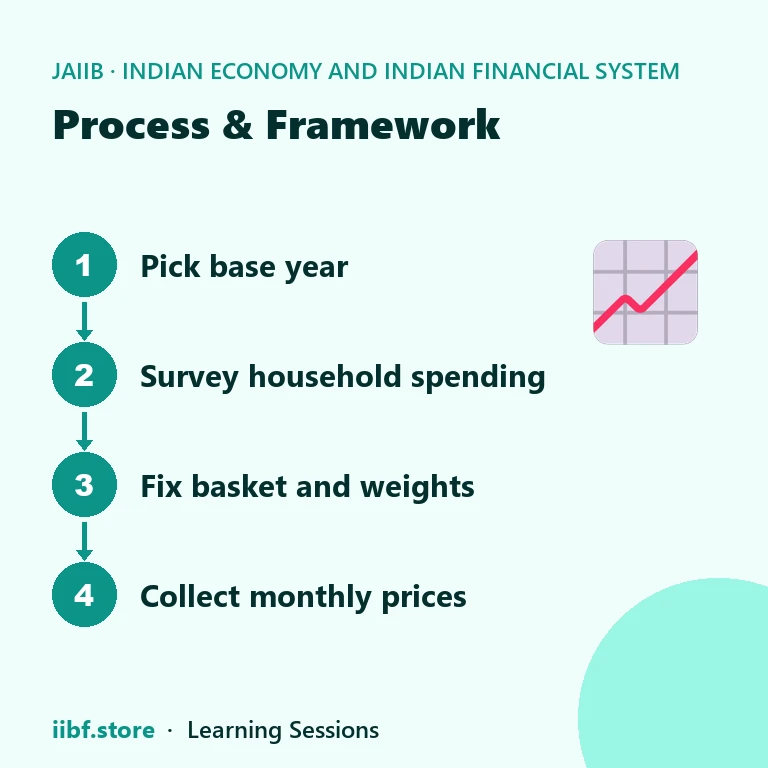
- Choose the base year and set the index to 100.
- Run the household consumption survey, here HCES 2023-24.
- Fix the item basket and the weights from the survey.
- Collect prices in sample markets every month, with weekly online prices.
- Compile elementary and higher-level indices, then link with the older series.
Why the RBI cares: CPI, the 4 per cent target and monetary policy
The CPI is not just a statistic; it is the yardstick of India's monetary policy. Under Section 45ZA of the RBI Act, the inflation target is set in terms of the Consumer Price Index. According to the RBI, the Government renewed the target at 4 per cent with a tolerance band of plus or minus 2 per cent, by Gazette notification dated 25 March 2026, for the period through March 2031. You can read the context in the RBI Bulletin, which also refers to the recent revision of the CPI basket by MoSPI.
For the Monetary Policy Committee, this means that the quality of the index directly shapes the decisions on the repo rate. A basket that mirrors current household spending produces a number that is closer to the real price pressure. If you want the policy side in more detail, revise the full JAIIB IE & IFS course, where inflation, the repo rate and the policy transmission are connected chapter by chapter.
Impact on a branch banker
Inflation shapes real returns on deposits, the pricing of floating-rate loans linked to an external benchmark, and the advice you give to customers about long-term savings. When you hear that the index has a new base, the practical message is that month-to-month figures from February 2026 are compiled on the new basis, and that comparisons with older years rely on linked data.
How IIBF can test the new CPI series base year 2024
IE & IFS questions on inflation usually test concepts, definitions and recent facts. Expect these patterns:
- Direct fact: What is the base year of the new CPI series? Answer: 2024=100.
- Source of weights: Which survey supplies the weights? Answer: HCES 2023-24.
- Statement-based: Two or three statements on COICOP, the number of items or the linking factor, asking which are correct.
- Link to policy: The RBI's inflation target is expressed in terms of which index? Answer: CPI.
The common traps are mixing the weight year with the base year, confusing CPI with a wholesale price index, and quoting 299 items for the new series when it is the old number.
Practice questions
Q1. The weights of the CPI 2024 series are derived from which survey? (a) HCES 2023-24 (b) Periodic Labour Force Survey (c) Annual Survey of Industries (d) Census 2011. The correct option is (a). MoSPI states that the item basket and weights are updated using the Household Consumption Expenditure Survey 2023-24, so the other surveys do not feed the weights.
Q2. Which classification does the new CPI adopt? (a) ISIC (b) COICOP 2018 (c) NIC 2008 (d) HS code. The correct option is (b). COICOP classifies household expenditure by purpose, and its use makes India's CPI comparable with the CPIs of other countries.
Q3. The linking factor between CPI 2012 and CPI 2024 is based on which overlapping year? (a) 2012 (b) 2023 (c) 2024 (d) 2025. The correct option is (d). Both series were available in 2025, and the ratio of the geometric-mean annual averages gives the factor.
Quick revision points
- Base year is the reference where the index equals 100; the new CPI base is 2024=100.
- Weights come from HCES 2023-24; price reference period is calendar year 2024.
- Items rise from 299 to 358 (goods 259 to 308, services 40 to 50).
- COICOP 2018: 12 divisions, 43 groups, 92 classes, 162 sub-classes.
- Coverage: 1,465 rural and 1,395 urban markets across 434 towns, plus 12 online markets.
- Elementary index uses Jevons; higher level uses Young / modified Laspeyres.
- Linking uses 2025 as the overlap year, with a geometric-mean ratio.
- RBI target: 4 per cent with a band of plus or minus 2 per cent, in terms of CPI, under Section 45ZA.
To turn these facts into exam speed, attempt the JAIIB mock tests after each revision round, and keep the IE & IFS printed book with chapter-wise MCQs beside you for the definitions. If you are planning the whole JAIIB attempt, the JAIIB offer page shows the current bundle, and the free study material library has more notes. For the official schedule of the upcoming exam cycle, check iibf.org.in.
Frequently asked questions
What is the base year of the new CPI series?
The base year is 2024, with the index set to 2024=100. MoSPI released the first data on this basis on 12 February 2026, replacing the 2012 base.
Which survey is used for the weights of the new CPI?
MoSPI uses the Household Consumption Expenditure Survey 2023-24 to update the item basket and the weights of the CPI 2024 series.
How many items does the new CPI basket have?
At the all-India level the number of weighted items increased from 299 to 358, with goods rising from 259 to 308 and services from 40 to 50.
How are the old and new CPI series linked?
MoSPI uses 2025 as the overlapping year and divides the new series' annual geometric-mean average by the old series' average to get a linking factor. Multiplying earlier old-series indices by it creates the back series.
Which index does the RBI use for its inflation target?
Section 45ZA of the RBI Act sets the target in terms of the Consumer Price Index. The renewed target is 4 per cent with a band of plus or minus 2 per cent, through March 2031.
Conclusion
The new CPI series base year 2024 is a small topic with a high exam value: one base year, one survey, one classification, one linking idea and one RBI connection. Learn those five links and you can answer almost any question on it, whether it is a direct fact or a statement-based one. More importantly, you will be able to explain headline inflation properly to a customer at your counter, which is what a good banker does.
Bookmark MoSPI's FAQ and the RBI Bulletin as your primary references, revise the table above, and go back to the IE & IFS course for the wider story of inflation and monetary policy.
Prefer revising from a printed book?
Chapter-wise books with MCQs after every chapter — minimal pages, complete coverage, delivered anywhere in India. Every book has a free sample to read first.


















































Quick quiz on this topic
5 exam-style questions from our free test bank — check yourself before you move on.
Practice this topic
Take a free mock test, download chapter PDFs, or watch a video class — all included on iibf.store.


