Is the DIBF Printed Book Right for You? An Honest Guide
It is 9 pm. You have closed the branch, reconciled the day, answered one last customer call, and now a syllabus on international banking is waiting for you at home. Letters of credit, Basel norms, syndicated loans, FEMA, maritime frauds. It feels endless, and you have probably been sold a few "complete packages" already that promised to make it easy.
So let us skip the sales language. This article is a straight answer to one question: is the DIBF printed book right for you? Some readers will find it a good fit. Some will need to pair it with other things. A few should not buy it at all. By the end you will know which group you are in, and you will have a study method you can use even if you never buy anything from us.
Why the DIBF Syllabus Feels So Heavy for Working Bankers
The Diploma in International Banking and Finance (DIBF) from IIBF is not a single-subject exam. It spreads across three papers, and each paper is split into modules that touch very different worlds: treasury and forex in one place, trade finance and ICC rules in another, then country risk, loan agreements, AML laws, bonds, project finance and more.
Most candidates are not full-time students. You are a clerk, an officer or a manager with a branch to run. Your problems are usually not about intelligence. They are about three things:
- Fragmented time. Forty minutes on a weekday, three hours on a Sunday if the family allows.
- Scattered material. Notes in one place, circulars in another, a PDF you downloaded months ago and never opened.
- No feedback loop. You read a lot, but you do not know whether you can actually answer a question until the exam hall.
A good book can fix the first two. The third needs practice. Keep that split in mind, because it decides who benefits most from the DIBF printed book.
What the DIBF Printed Book Actually Contains
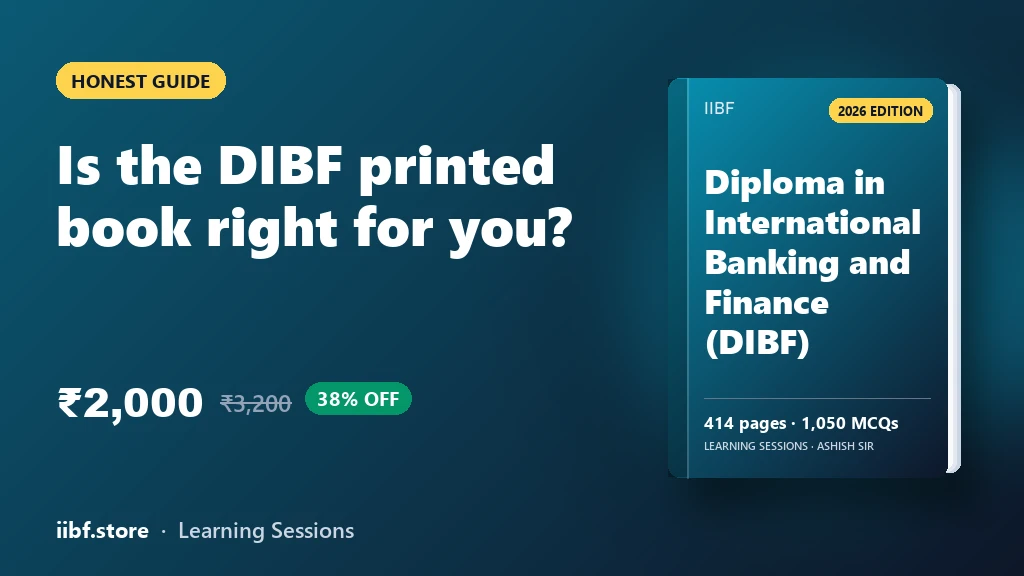
Here are the facts, without adjectives. The 2026 edition runs to 414 pages across 70 chapters, with 1,050 practice questions. It is organised by module and follows the three papers, so you can study in the same order as the syllabus. The listing also mentions extras: three volumes (Papers 1, 2 and 3), 130 case studies carrying 520 questions, and 15 mega tests carrying 1,500 questions. Check the book page for exactly what is included in your order.
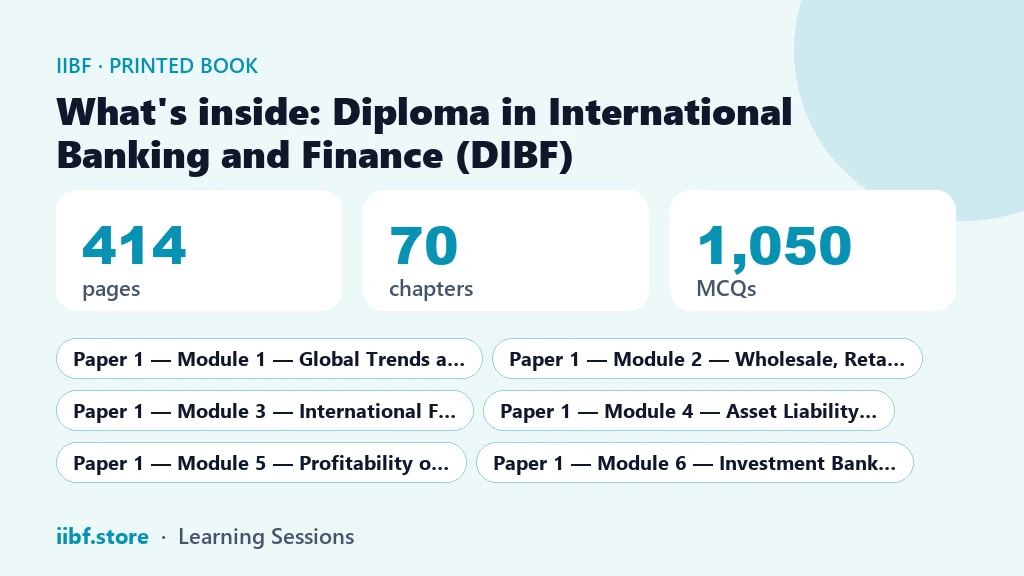
To give you a feel for the spread, here is how the modules cluster:
- Paper 1: global trends, wholesale and retail banking, offshore centres, asset liability management, investment banking, correspondent banking and SWIFT, international institutions such as the IMF, World Bank and BIS, treasury, FEMA, and a long trade finance module (letters of credit, UCP 600, collections under URC 522, reimbursements under URR 725).
- Paper 2: regulatory architecture and Basel norms, international law and jurisdiction, loan agreements and covenants, country risk, debt management, anti-money laundering, maritime frauds, accounting standards, arbitration and mediation.
- Paper 3: lending to MNCs, rating agencies, ECBs and FCNR(B), bond markets, syndicated loans, project and infrastructure finance, corporate treasury, derivatives, and foreign investment.
The price at the time of writing is ₹2,000 against an MRP of ₹3,200 (38% off). Prices can change, so treat the book page as the current word.
Four Reader Profiles: Which One Are You?
Instead of telling you everyone should buy, let us sort readers honestly. Find yourself in one of these four, and read the "not enough on its own" line carefully.
Profile 1: The first-attempt candidate
You have never sat a DIBF paper. Everything is new, including the vocabulary. For you, the biggest risk is starting without structure and burning your first month on random YouTube videos.
How to use the book: go module by module in syllabus order. Read a chapter once for understanding, then close the book and write three lines of what you remember. Only then attempt that chapter's questions. Start with Paper 1, because the forex, treasury and trade finance ideas return in later papers.
Not enough on its own: a first-timer usually overestimates how much they have retained. Add full-length practice through the free mock tests once you finish each paper, so you learn your pace before the real exam.
Profile 2: The repeat-attempt candidate
You have been here before. You know the pain of a result that came a few marks short. You do not need to relearn everything; you need to find what went wrong.
How to use the book: do not read it cover to cover. Start with the questions. Attempt a module's MCQs cold, mark every miss, and read only the chapters behind those misses. Keep a one-page "error list" of concepts you keep getting wrong, such as which ICC rule governs which document, or how a covenant differs from an event of default.
Not enough on its own: if your earlier attempts failed on time management rather than knowledge, another reading will not help. You need timed papers and a habit of skipping and returning.
Profile 3: The candidate who is short on time
Maybe the exam window is close, or your branch is in audit season. You have a few weeks, not months.
How to use the book: be ruthless. Divide the 70 chapters by the days you really have and give each day a fixed quota, even if it is just one chapter plus its questions. Do not try to master every module. Cover everything once, then spend your remaining hours on the heavy areas such as trade finance, treasury and Basel.
Not enough on its own: a book cannot compress a syllabus that needs months into a fortnight. If you are very short on time, be honest about whether this cycle is realistic, and check the official schedule at the IIBF website before you decide.
Profile 4: The reader who prefers paper to screens
After a day of staring at CBS screens, the last thing you want is another glowing display. You think better with a pen, a highlighter and margins to scribble in.
How to use the book: this is where the DIBF printed book fits most naturally. Mark definitions in one colour and numerical or rule-based points in another. Fold the corner of pages you need to revisit. Carry one volume in your bag and use the metro or bus commute for a chapter.
Not enough on its own: paper cannot update itself. For anything that changes with regulation, check the official site or our free study material for current notes. And paper has no timer, so you still need a screen for mock tests.
A Four-Step Plan to Use the DIBF Printed Book Well
Whichever profile you matched, the same simple loop works for a tired working person. It keeps each session short and gives you feedback every time.
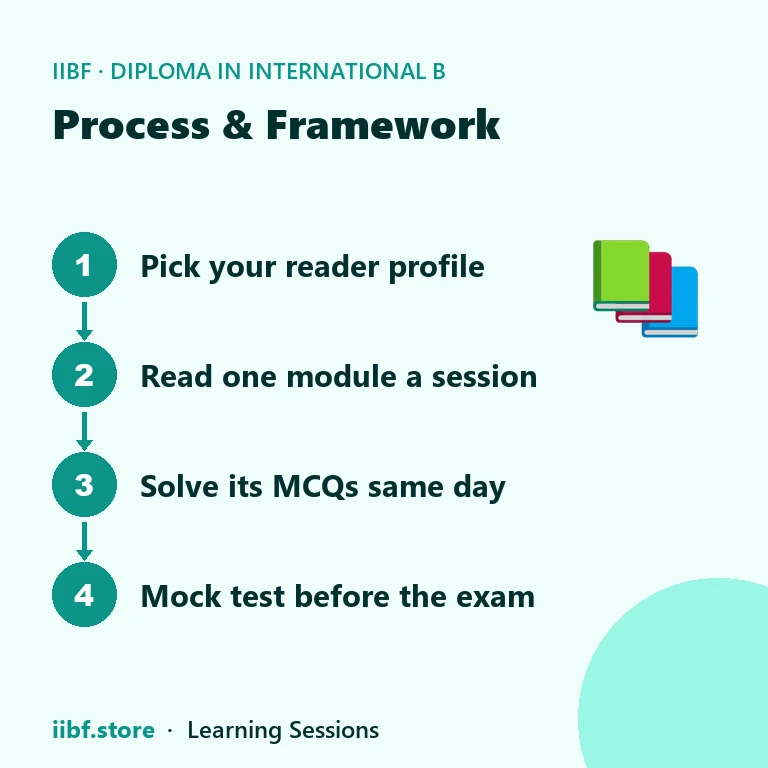
- Pick your profile and your pace. Decide how many chapters you can honestly finish per week and write it on the inside cover.
- Read one module per session. Modules are small enough to finish in one sitting. Stop when the module ends.
- Solve its questions the same day. Memory fades fast. Questions attempted within hours of reading stay with you.
- Test yourself before the exam. Finish each paper, then take a timed mock and review every wrong answer.
This is the method we would suggest even if you used a different book. The loop matters more than the publisher.
When the DIBF Printed Book Is Not the Right Choice
Honesty works both ways, so here is when you should hold back:
- You only read on a phone. If you will never carry or open a physical volume, a printed book will sit on the shelf. Use the free resources instead.
- You want a shortcut. No book, ours or anyone's, guarantees a pass. A book gives you organised content and practice. The effort is still yours.
- You have not seen the syllabus yet. Look at the official syllabus first, then see whether the module list above matches what you need.
- You are unsure. Open the free sample on the book page and read a real chapter before paying anything.
Pairing the Book With Free Practice
A printed book gives you depth. Practice gives you speed. The two together are far stronger than either alone. Here is a simple way to split your effort.
| Stage | Main tool | Purpose |
|---|---|---|
| Learning a module | Printed book chapters | Understand concepts and vocabulary |
| Same-day check | Chapter MCQs in the book | Find gaps while the topic is fresh |
| Paper-level revision | Your error list and highlights | Re-read only weak areas |
| Exam readiness | Free mock tests | Build speed and exam-hall nerves |
You can also browse the wider range at our books page and read more guides on the blog.
Our Honest Verdict
The DIBF printed book is a good fit if you want one organised, module-wise source for all three papers, you like learning on paper, and you will back it up with timed practice. It is a weaker fit if you are looking for a guaranteed result, you only study on screens, or you have very little time left. Prices can change, so confirm the current figure on the DIBF printed book page, and read the free sample first. If the writing style helps you understand a tough chapter, that is your answer.
Frequently Asked Questions
Is the DIBF printed book enough to clear the exam by itself?
It covers the syllabus module by module and includes practice questions, but no book alone guarantees a pass. Pair it with timed mock tests so you build exam-hall speed, and follow the official updates on the IIBF website.
How many chapters and questions are in the book?
The 2026 edition has 414 pages, 70 chapters and 1,050 practice questions, organised across the three papers and their modules.
Can I try the book before buying?
Yes. The book page offers a free sample so you can read a real chapter and judge the style before you order.
Where do I find the exam schedule and official syllabus?
Always use the official IIBF website at www.iibf.org.in for dates and syllabus. We do not quote them here because they can change.
Prefer revising from a printed book?
Chapter-wise books with MCQs after every chapter — minimal pages, complete coverage, delivered anywhere in India. Every book has a free sample to read first.


















































Practice this topic
Take a free mock test, download chapter PDFs, or watch a video class — all included on iibf.store.