Repo and Reverse Repo in Banks: Rules, Pricing and Exam Traps
It is 3:30 in the afternoon and the treasury desk of your bank is short of funds for tonight. The Government securities (G-Secs) sitting in the portfolio are earning a coupon and you do not want to sell them outright. So the dealer calls another bank and says: "Take these securities, give me cash, and I will take them back tomorrow with interest." That single phone call is the heart of repo and reverse repo in banks, and it is one of the most repeated topics in the Treasury Management paper.
In this article we go through what a repo is, how it differs from a reverse repo, what the RBI's current Master Direction allows, how the two legs are priced, how it affects CRR and SLR, and how IIBF frames questions on it. Read it once for the concept and once more as a revision sheet before the upcoming exam cycle.
What is a repo, and what is a reverse repo?
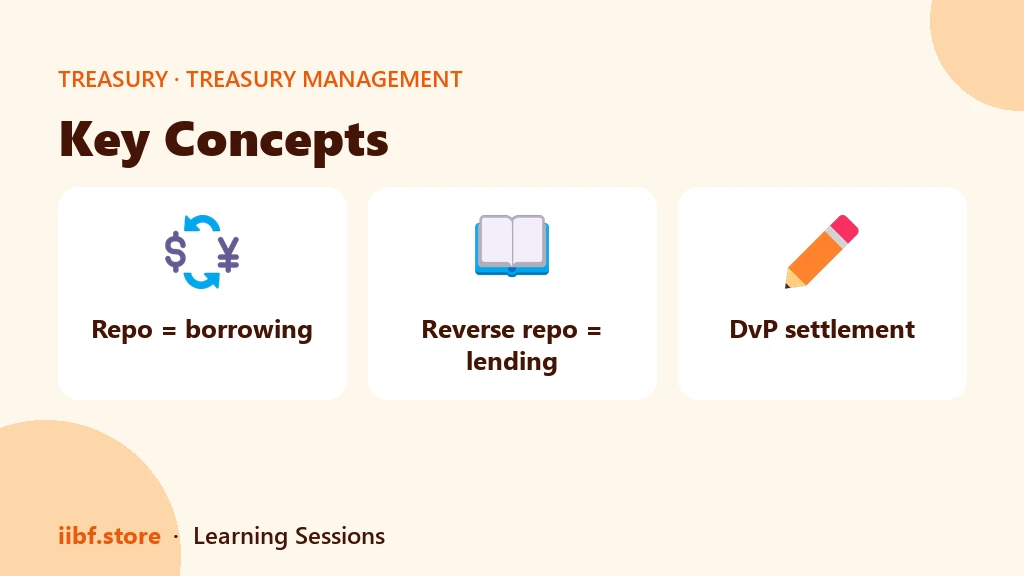
A repo (repurchase transaction) is a borrowing. One party sells securities and, at the same time, agrees to buy them back on a fixed future date at a fixed price. That price includes interest for the funds used. A reverse repo is the same trade seen from the other side: the party that gives cash and receives securities is doing a reverse repo. The RBI Master Direction says this plainly: a repo for one entity is a reverse repo for its counterparty.
The legal meaning of both terms comes from Sections 45U(c) and 45U(d) of the Reserve Bank of India Act, 1934, which the Master Direction adopts in its definitions. In day-to-day branch language you can remember it like this:
- Repo: you need cash, you have securities. You borrow.
- Reverse repo: you have surplus cash, you want safe, collateralised placement. You lend.
Economically a repo is a collateralised loan. Legally the securities move to the lender for the life of the deal, which is why the lender can use them, within limits we will see below. This is also why repo is considered safer than uncollateralised call money: if the borrower fails, the lender holds the securities.
Why banks use repo
- To manage day-to-day liquidity without selling investments, so the bank keeps its coupon income and avoids booking a trading loss.
- To deploy short-term surplus funds against collateral rather than taking unsecured exposure on another bank.
- To fund trading positions in the treasury book at a short-term rate.
- To meet temporary mismatches that show up in the ALM structural liquidity statement, a link you will also see in our note on the Treasury Management course.
The regulatory framework behind repo and reverse repo in banks
The governing document today is the Master Direction - Reserve Bank of India (Repurchase Transactions (Repo)) Directions, 2025, issued on 11 November 2025 under Sections 45W and 45U of the RBI Act and effective immediately. It consolidates and replaces the earlier Repurchase Transactions (Repo) (Reserve Bank) Directions, 2018, and notably brings Municipal Debt Securities into the list of eligible collateral. If an older question bank still quotes the 2018 Directions, treat it as the earlier version and check the points below against the new text.
One scoping point is a favourite exam trap. The Master Direction does not apply to repo and reverse repo done under the Liquidity Adjustment Facility (LAF) or the Marginal Standing Facility (MSF). Those are the RBI's own policy operations with banks and continue under separate regulations. The Master Direction covers the market repo between participants, whether on a recognised stock exchange, an electronic trading platform or over the counter.
Eligible securities
The Direction lists the collateral that can be used:
- Central Government and State Government securities.
- Listed corporate bonds and debentures.
- Commercial Papers and Certificates of Deposit.
- Units of Debt Exchange Traded Funds.
- Municipal Debt Securities, and other local authority securities that the Central Government specifies.
There is an important safeguard: a participant cannot borrow against its own corporate bonds or debentures, or those of a related entity. Without this, a company could simply fund itself by pledging its own paper.
Eligible participants
Regulated entities (banks, NBFCs, insurers and so on) are the core group. The Direction also allows listed corporates, unlisted companies that hold special securities issued by the Government of India (they can use only those securities as collateral), All India Financial Institutions such as Exim Bank, NABARD, NHB, SIDBI and NaBFID, and any other entity the RBI approves.
How the two legs of a repo work
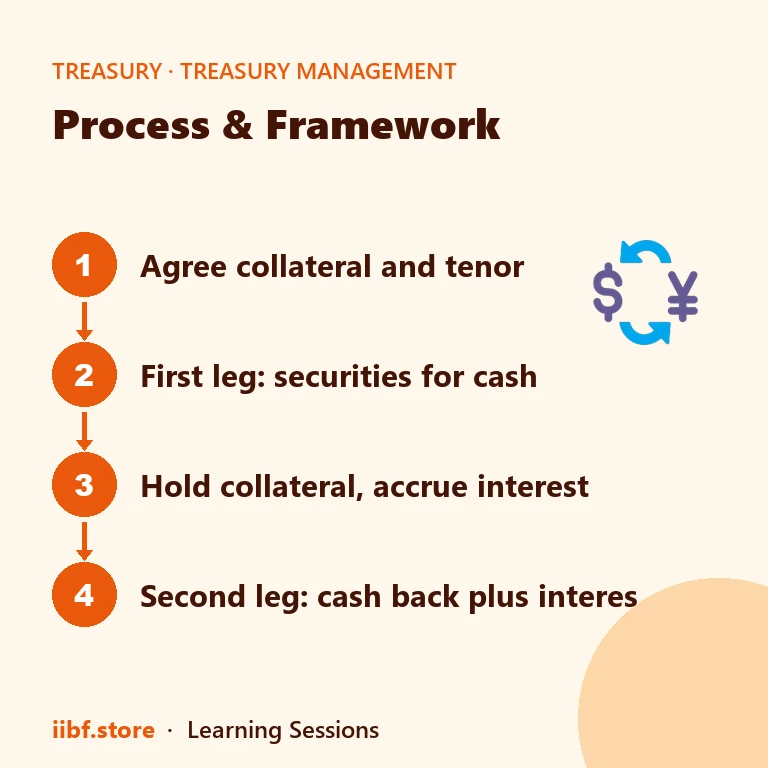
Every repo has two legs. Think of them as a loan being drawn and then repaid.
First leg
The borrower delivers securities and receives cash. The securities are priced at prevailing market prices on this date. Under the Direction the first leg settles on T+0 or T+1.
Second leg
On the agreed date the borrower returns the cash and takes back the securities. The second-leg price equals the first-leg price plus interest at the agreed repo rate. The tenor must be at least one day and cannot exceed one year.
Settlement and clearing
All repos must settle on a delivery-versus-payment (DvP) basis, meaning securities and cash move together so neither side is left exposed. Repos in Government securities settle through CCIL or another RBI-approved clearing agency. Repos in other eligible securities settle through the clearing house of an exchange or another RBI-approved entity.
Worked example: a 7-day repo on the treasury desk
Suppose Bank A needs Rs 100 crore for seven days and Bank B has surplus funds. The numbers below are purely illustrative, not a market quote, and assume an actual/365 day count.
- Bank A sells G-Secs with a market value that covers the borrowing and receives Rs 100 crore (first leg).
- The agreed repo rate is 6.50% a year, for 7 days.
- Interest = 100 crore x 6.50% x 7 / 365, which is about Rs 0.1247 crore, or roughly Rs 12.47 lakh.
- On day 7 Bank A pays back about Rs 100.1247 crore and gets the securities back (second leg).
For Bank A this is a repo; for Bank B the very same deal is a reverse repo. Bank B earned the interest, and held G-Secs as protection throughout.
Notice that Bank A keeps the market risk on the securities, because it takes them back at the end. That is why a repo is treated as financing and not as a true sale in the borrower's books, and why the Direction requires RBI-regulated entities to follow the accounting prescribed in its annex.
Haircuts, margins and sourcing of collateral
A haircut is the discount applied to the market value of collateral so that the lender is protected if prices fall during the deal. For G-Secs the margin is determined by the clearing house or agreed bilaterally. The Master Direction prescribes floors for other collateral:
| Collateral | Minimum haircut (on market value) | Note |
|---|---|---|
| Listed corporate bonds and debentures | 2% | Extra haircut possible for tenor and illiquidity |
| Local authority securities | 2% | Extra haircut possible for tenor and illiquidity |
| Commercial Papers and Certificates of Deposit | 1.5% | Floor on market value |
| Government securities | Set by clearing house or agreed bilaterally | No fixed floor in this clause |
On re-use of collateral, the Direction lets the receiver of securities in a repo sell them outright or use them in another repo. Outright sale is allowed only for entities that are permitted to short sell under RBI directions, and only in securities that may be short sold. Securities can also be substituted under the rules of an approved clearing agency.
CRR and SLR treatment
This is where banking exam questions get tricky, because the treatment depends on the collateral:
- Funds a bank borrows under repo in Government securities, including tri-party repo, are exempt from CRR and SLR computation. Securities acquired under repo can count towards SLR if they are SLR-eligible.
- Funds a bank borrows under repo in corporate bonds and debentures count as liabilities for CRR and SLR purposes.
In plain language: borrowing against G-Secs does not enlarge your net demand and time liabilities for reserve purposes, but borrowing against corporate bonds does.
Reporting, documentation and controls
A trade that is not done on a recognised exchange or an approved platform that disseminates trade information has to be reported within 15 minutes. Government securities repos are reported to CROMS and other eligible securities to F-TRAC. Bilateral deals use a master repo agreement based on FIMMDA documentation, while multilateral trades follow platform rules.
For you as a banker, this ties directly into the front, middle and back office structure of the treasury. The dealer does the deal, the middle office checks limits and haircuts, and the back office confirms, settles and reports. A late report or a missing master agreement is an operational lapse that concurrent auditors pick up.
How IIBF tests repo and reverse repo in banks
Questions usually fall in four buckets: definition and direction (who is lending), regulation (what the Master Direction allows), arithmetic (interest or second-leg value), and policy link (LAF and MSF). Practise these with the chapter-wise MCQs in the Treasury Management printed book and test your speed with the mock tests for this paper.
Common traps
- Mixing up the direction: the cash giver is always the reverse repo party.
- Assuming the Master Direction governs LAF and MSF. It does not.
- Treating a repo as a sale for accounting. It is financing, with the securities coming back.
- Forgetting that a minimum tenor of one day and a maximum of one year apply.
- Quoting an old haircut or the 2018 Directions as if they were current.
Practice question 1
A bank borrows cash against G-Secs for 14 days and returns the securities at the end. For the counterparty, the transaction is a (a) repo, (b) reverse repo, (c) outright purchase, (d) call loan. The answer is (b). The bank that borrows is doing the repo; the party giving cash and taking securities does a reverse repo.
Practice question 2
Which of the following is excluded from the scope of the RBI's Repo Master Direction? (a) Corporate bond repo on an exchange, (b) Repo on a CP, (c) Repo and reverse repo under LAF and MSF, (d) Municipal debt repo. The answer is (c), because LAF and MSF are the RBI's own operations governed by separate regulations.
Practice question 3
A bank borrows Rs 50 crore at 6% for 10 days (actual/365). The interest payable is about (a) Rs 8.22 lakh, (b) Rs 82.2 lakh, (c) Rs 3 lakh, (d) Rs 30 lakh. The answer is (a): 50 crore x 6% x 10 / 365 is about Rs 0.0822 crore, which is Rs 8.22 lakh.
Quick revision points
- Repo equals borrowing against securities; reverse repo equals lending against securities.
- The 2025 Master Direction replaced the 2018 Directions and added Municipal Debt Securities as eligible collateral.
- Tenor: minimum one day, maximum one year; all repos settle on a DvP basis.
- Haircut floors: 2% for listed corporate bonds and local authority securities, 1.5% for CPs and CDs.
- Repo borrowing in G-Secs is exempt from CRR and SLR computation; corporate bond repo borrowing is not.
- Off-platform trades must be reported within 15 minutes, to CROMS (G-Secs) or F-TRAC (others).
- LAF and MSF operations sit outside the Master Direction.
For related reading, browse the free notes at iibf.store/free-material, and always check the official schedule and notices for the next cycle at iibf.org.in.
Frequently asked questions
What is the difference between repo and reverse repo in banks?
In a repo, the bank sells securities and agrees to buy them back, so it raises cash. In a reverse repo, the bank buys securities and agrees to sell them back, so it lends cash. They are the two sides of one trade.
Which RBI document governs repo transactions today?
The Master Direction - Reserve Bank of India (Repurchase Transactions (Repo)) Directions, 2025, issued on 11 November 2025. It replaced the 2018 Directions and covers repo on exchanges, trading platforms and the OTC market.
Are LAF and MSF covered by the Repo Master Direction?
No. Repo and reverse repo under the Liquidity Adjustment Facility and the Marginal Standing Facility are excluded and remain under separate RBI regulations.
What is the maximum tenor of a repo?
The tenor must be at least one day and at most one year under the Master Direction.
Does repo borrowing attract CRR and SLR?
Borrowing against Government securities, including tri-party repo, is exempt from CRR and SLR computation. Borrowing against corporate bonds and debentures counts as a liability for CRR and SLR.
Conclusion
Repo and reverse repo in banks look simple on the surface, but the paper rewards precision: the direction of each leg, what the 2025 Master Direction covers, the haircut floors, the reserve-requirement treatment and the reporting timeline. Learn the two-leg structure first, then add the regulatory details, and keep an eye on the RBI website for amendments before you appear. To build the full picture of treasury operations, work through the complete Treasury Management course and practise repeatedly with mocks.
Prefer revising from a printed book?
Chapter-wise books with MCQs after every chapter — minimal pages, complete coverage, delivered anywhere in India. Every book has a free sample to read first.


















































Practice this topic
Take a free mock test, download chapter PDFs, or watch a video class — all included on iibf.store.
Keep reading