CAIIB ITDB Study Plan: Finish the Paper in 21 Days While Working
It is 9:30 pm. You have closed the branch, reconciled the day, answered one last call from the regional office, and reached home with a head full of numbers. The CAIIB elective you picked looks like it covers everything from computers to cyber security. Where do you even begin? A sensible CAIIB ITDB study plan starts from that exact tiredness, not from an ideal day with six free hours.
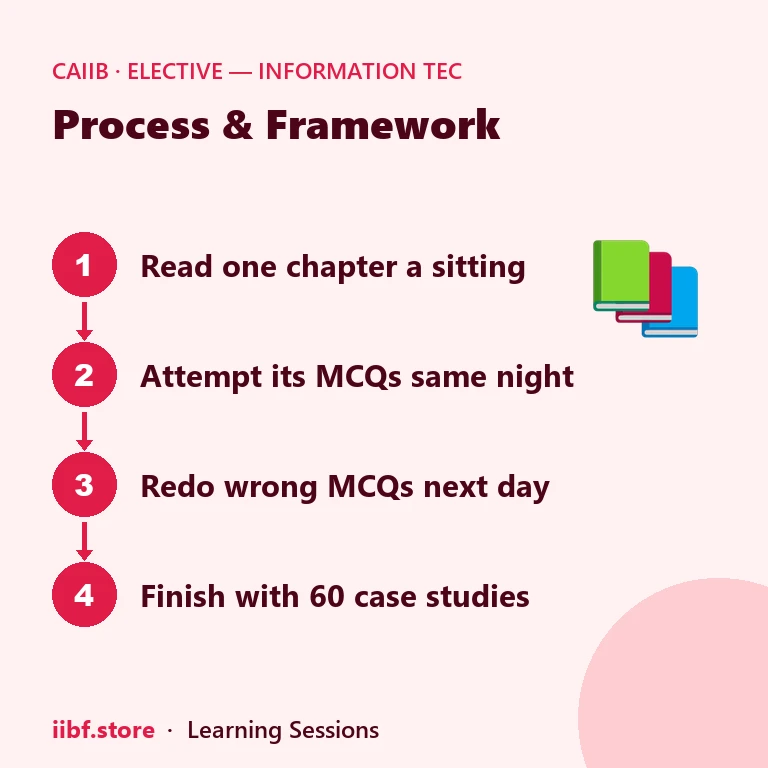
This article gives you a 21-day schedule for Information Technology and Digital Banking that assumes you can give 60 to 90 minutes on weekdays and a little more on weekends. The plan is free to use whether or not you ever buy a book. The method is simple: read one chapter, attempt its questions the same night, revisit what you got wrong the next day, and keep the case studies for the last week.
Why ITDB feels harder than it is
Most bankers who postpone this elective do so because of the vocabulary. DBMS, data mining, RTGS, SLA, RFP, business continuity, information system audit. On a first look it seems like an engineering syllabus. It is not. The paper is about how a bank uses technology and how it keeps that technology safe and under control. If you have worked on core banking, handled a card complaint or seen an IS audit objection at your branch, you already know half the story.
The real difficulty is breadth, not depth. The paper moves from basic computing to networking, then to databases, then to payments, then to law and cyber security. Students who study it in random order tend to forget the early chapters by the time they reach the last ones. That is why the order of study matters more than the number of hours.
Three honest facts about studying after work
- Your best concentration is the first 40 minutes. Put the new chapter there, not the revision.
- Reading alone gives a false feeling of progress. Questions tell you what actually stayed in your head.
- A missed day is not a failure. A plan with one buffer day per week survives real life; a plan with none collapses on the first late meeting.
What the paper covers: four modules, twenty chapters
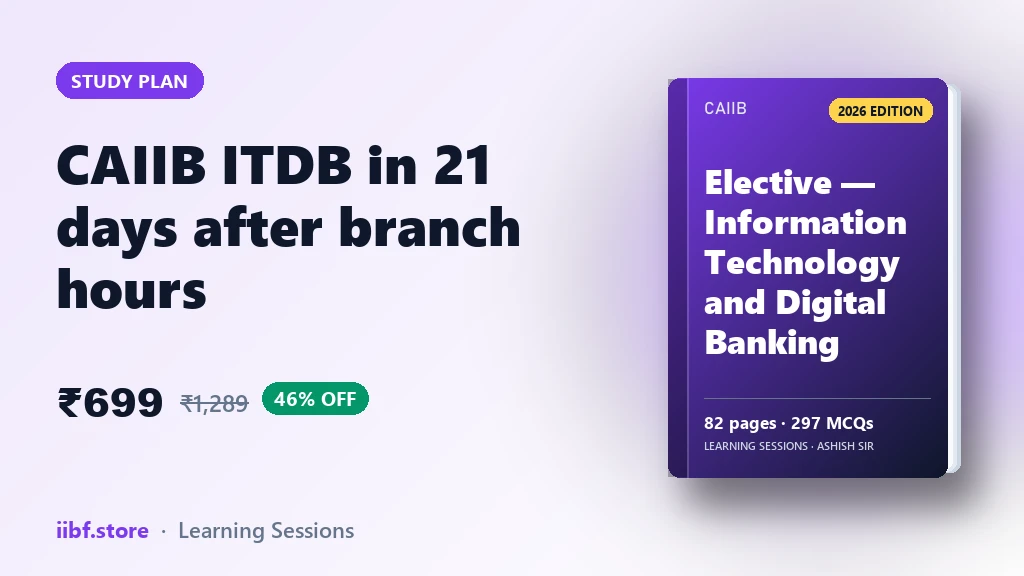
Before you plan days, know the map. The printed CAIIB Information Technology and Digital Banking book is organised into four modules and 20 chapters across 82 pages, with 297 questions at the end of the chapters (2026 edition).
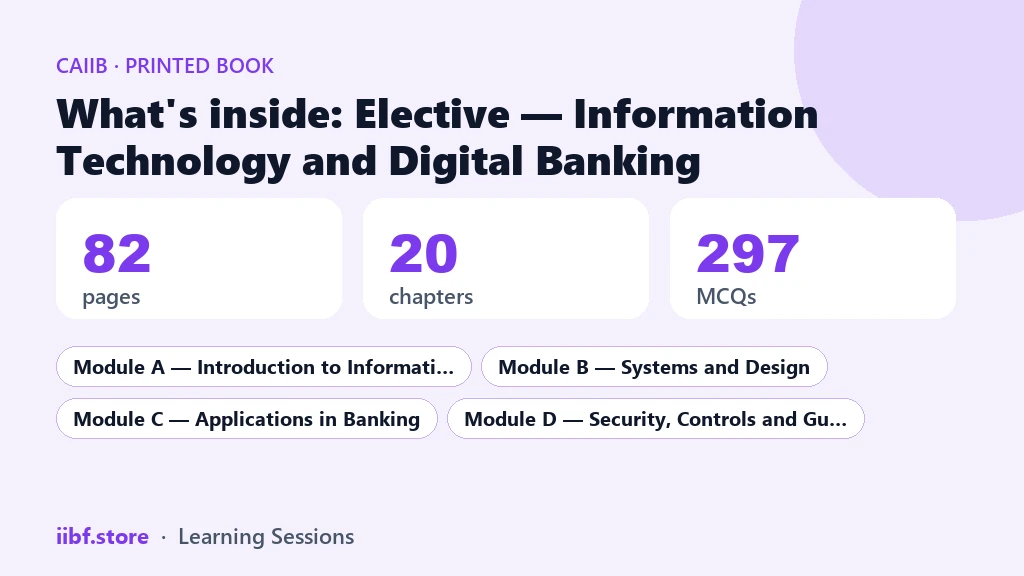
- Module A, Introduction to Information Technology: Information Technology and its Implications; Introduction to Computing; Introduction to Software; Networking Systems.
- Module B, Systems and Design: Introduction to Information Systems; Database Management Systems; Data Warehousing and Data Mining.
- Module C, Applications in Banking: E-Learning Environment; Banking Software; Electronic Clearing and Settlement Systems; Plastic Money; Electronic Commerce and Banking; IT Act 2000, 2008; Emerging Technologies.
- Module D, Security, Controls and Guidelines: Computer Security; Communication Security; Business Continuity and Disaster Recovery planning; Information System Audit; Competitive Bid Process (RFP and SLA); RBI Guidelines on Cyber Security (2016) and Digital Payment Security (2021).
Notice the shape. Module A is the foundation, Module B builds the technical vocabulary, Module C is where most bankers feel at home, and Module D is where exam questions tend to test judgement. Studying in this order lets the easy middle section build your confidence before the controls-and-guidelines section arrives.
Because the whole paper is only 82 pages in this book, you are not facing a mountain of reading. You are facing 20 short chapters, which is exactly why a day-wise CAIIB ITDB study plan works better than waiting for a free month.
The 21-day CAIIB ITDB study plan, day by day
Here is the schedule. Each row is a block of days, and the third column is the question target for that block. The book has 297 questions across 20 chapters, which averages out to about 15 per chapter, so the targets below assume you attempt the full set of end-of-chapter MCQs for every chapter you read. Treat the numbers as a guide, not a rule; some chapters will have fewer questions and some more.
| Days | What to read | MCQ target |
|---|---|---|
| 1-2 | Module A: Information Technology and its Implications; Introduction to Computing | All end-of-chapter MCQs for both chapters |
| 3-4 | Module A: Introduction to Software; Networking Systems | All MCQs; redo Day 1-2 mistakes |
| 5-6 | Module B: Introduction to Information Systems; Database Management Systems; Data Warehousing and Data Mining | All MCQs for three chapters over two sittings |
| 7-8 | Module C: E-Learning Environment; Banking Software; Electronic Clearing and Settlement Systems | All MCQs; list every payment system name you missed |
| 9-10 | Module C: Plastic Money; Electronic Commerce and Banking | All MCQs; redo Day 7-8 mistakes |
| 11-12 | Module C: IT Act 2000, 2008; Emerging Technologies | All MCQs for both chapters |
| 13-14 | Module D: Computer Security; Communication Security | All MCQs; redo Module C mistakes |
| 15-16 | Module D: Business Continuity and Disaster Recovery planning; Information System Audit | All MCQs for both chapters |
| 17-18 | Module D: Competitive Bid Process (RFP and SLA); RBI Guidelines on Cyber Security (2016) and Digital Payment Security (2021) | All MCQs; reread the RBI guidelines chapter once |
| 19-20 | The 60 case studies (240 questions) in the book, about 30 cases per day | Attempt every case question; mark the ones you guessed |
| 21 | Buffer and revision: only the wrong and guessed questions from all modules | Redo your marked list, nothing new |
How a single weekday sitting should look
Take a 75-minute evening as the model. Spend the first 35 minutes reading one chapter with a pencil, underlining only definitions, full forms and lists. Spend the next 30 minutes on that chapter's questions, closed-book. Use the last 10 minutes to write the questions you got wrong on one page. That page becomes tomorrow's five-minute warm-up before you start the next chapter.
If your evening is only 30 minutes, do not skip the day. Read half a chapter or attempt only the questions. A thin day keeps the habit alive, and the buffer day on Day 21 gives you room to catch up.
How to treat the questions and the case studies
Many candidates treat MCQs as a test to take after finishing the syllabus. That wastes their best learning tool. In a paper with this much terminology, the question is what teaches you the difference between two near-identical terms: data warehousing and data mining, communication security and computer security, a disaster recovery site and a business continuity plan.
- Attempt first, check later. Never peek at the answer. A wrong answer you commit to is remembered; a right answer you glanced at is not.
- Mark guesses separately. A lucky guess is a weak spot in disguise. Count it as wrong on your revision page.
- Do not memorise options. If you recognise an answer by its position, you have learned the paper, not the subject.
The book also carries 60 case studies with 240 questions. Keep them for Days 19 and 20 on purpose. By then you know all four modules, so a case that mixes a payment failure, a security lapse and an audit finding will feel like a puzzle instead of a shock. Read the case twice before you look at any question; most wrong answers come from missing a detail in the first paragraph.
Making this plan fit your life
No plan survives contact with month-end, an inspection or a family function unchanged. A few adjustments keep the schedule honest.
If you have only 40 minutes on weekdays
Stretch the plan to 30 days instead of 21. Give each chapter one full evening, but split the reading and the questions across two days. Use weekends for the longer chapters in Module D, which carry the guidelines and the audit material that reward careful reading.
If you work in a technology-heavy role already
Compress Module A to a single weekend. Read the chapters quickly, then go straight to the questions; if you score well, move on. Spend the days you saved on Module C and Module D, where banking-specific rules, the IT Act and the RBI guidelines are less forgiving of general knowledge.
If you have failed this elective before
Do not restart from page one. Start with the questions of each chapter, find where you lose marks, and read only those sections first. The 21-day route then becomes a second pass, not a first one. Sit through the RBI guideline chapter slowly, since cyber security and digital payment security are areas where a precise point can decide a question.
Where the printed book fits, and where it does not
You can follow this schedule with any source that covers the same twenty chapters. What the CAIIB ITDB printed book gives you is a compact, chapter-by-chapter layout with the end-of-chapter MCQs and the 60 case studies in one place, so you do not carry three sources into a 9 pm study session. Its listed price is ₹699 against an MRP of ₹1,289 (46% off). Prices can change, so check the book page for the current figure, and use the free sample there to see whether the writing style suits you before you decide.
One honest limit: a book alone will not give you exam-hall speed. Pair it with timed practice. The free mock tests at iibf.store/tests are a good next step once you finish Day 21, and the free study material and the CAIIB course page help for the rest of your papers. You can browse the rest of our shelf at iibf.store/books.
For the exam schedule, eligibility and the latest notices, always rely on the official site of the institute: www.iibf.org.in. Plan your 21 days backwards from the upcoming exam cycle once the dates are announced there, and give yourself a few extra days if you can.
Your first week, in one paragraph
Tonight, open the first chapter, set a timer for 35 minutes, and read. Then attempt its questions and write down what you missed. Tomorrow, do the same with the second chapter after a five-minute look at yesterday's mistakes. Repeat for the first week, take a breath on the weekend, and carry on into Module B. That is the whole CAIIB ITDB study plan: small, repeatable evenings that add up, not heroic weekends that burn you out. Pace yourself, stay consistent, and trust the loop.
Frequently asked questions
Is 21 days enough to prepare for CAIIB Information Technology and Digital Banking?
For many working bankers, yes, provided you have 60 to 90 minutes daily and you cover all 20 chapters with their questions. If your time is shorter or the subject is new to you, stretch the plan to 30 days using the same chapter order.
Which module should I study first?
Follow the book's order, Module A to Module D. Module A builds the vocabulary that the later modules assume, and finishing Module D last means the security, audit and RBI guideline chapters are fresh when you take mock tests.
How many questions does the book have?
The printed ITDB book has 297 questions across its 20 chapters, plus 60 case studies carrying 240 questions. The 2026 edition runs to 82 pages, so the reading load is light and the practice load is heavy, which suits late-night study.
Can I use this plan if I have no IT background?
Yes. Keep the same sequence but give Module A an extra two days and do not skip its questions. The paper is about how banks use and protect technology, and the vocabulary becomes comfortable after a few chapters.
Prefer revising from a printed book?
Chapter-wise books with MCQs after every chapter — minimal pages, complete coverage, delivered anywhere in India. Every book has a free sample to read first.
82 pages · 297 MCQs
Learning Sessions · Ashish Sir
148 pages · 478 MCQs
Learning Sessions · Ashish Sir
151 pages · 465 MCQs
Learning Sessions · Ashish Sir
148 pages · 375 MCQs
Learning Sessions · Ashish Sir
216 pages · 895 MCQs
Learning Sessions · Ashish Sir
109 pages · 300 MCQs
Learning Sessions · Ashish Sir
104 pages · 360 MCQs
Learning Sessions · Ashish Sir
151 pages · 600 MCQs
Learning Sessions · Ashish Sir
98 pages · 282 MCQs
Learning Sessions · Ashish Sir
131 pages · 672 MCQs
Learning Sessions · Ashish Sir
221 pages · 831 MCQs
Learning Sessions · Ashish Sir
128 pages · 524 MCQs
Learning Sessions · Ashish Sir
107 pages · 445 MCQs
Learning Sessions · Ashish Sir
132 pages · 225 MCQs
Learning Sessions · Ashish Sir
188 pages · 435 MCQs
Learning Sessions · Ashish Sir
117 pages · 236 MCQs
Learning Sessions · Ashish Sir
Learning Sessions · Ashish Sir
118 pages · 299 MCQs
Learning Sessions · Ashish Sir
Learning Sessions · Ashish Sir
Learning Sessions · Ashish Sir
Learning Sessions · Ashish Sir
115 pages · 255 MCQs
Learning Sessions · Ashish Sir
Learning Sessions · Ashish Sir
334 pages · 936 MCQs
Learning Sessions · Ashish Sir
Learning Sessions · Ashish Sir
115 pages · 344 MCQs
Learning Sessions · Ashish Sir
107 pages · 240 MCQs
Learning Sessions · Ashish Sir
90 pages · 150 MCQs
Learning Sessions · Ashish Sir
Learning Sessions · Ashish Sir
Quick quiz on this topic
5 exam-style questions from our free test bank — check yourself before you move on.
Practice this topic
Take a free mock test, download chapter PDFs, or watch a video class — all included on iibf.store.