CAIIB Risk Management Study Plan for Working Bankers: 6 Weeks
It is 9:40 pm. You have closed the cash, finished the day's pending reports, reached home, eaten something quick, and now the Risk Management syllabus is staring at you. Basel, VaR, ICAAP, credit derivatives, swaps. It feels endless. If this sounds familiar, this CAIIB Risk Management study plan is written for you, not for someone with a free month and a quiet room.
I will be honest about one thing at the start: the paper is wide, not impossibly deep. Forty chapters across six modules is a lot of names and definitions, but most of it follows a pattern. Once you see that pattern, a tired hour a day is enough to make real progress. Below is the plan, the reasoning behind it, and how to adjust it when your branch suddenly gets busy.
Why Risk Management feels harder than it is
Most candidates do not fail this elective because the content is too difficult. They fail because they study it in the wrong order, or they read for three weeks and never test themselves until it is too late.
Three things make it feel heavy:
- Too many frameworks at once. Credit risk, market risk and operational risk each come with their own models, ratios and regulatory treatment. Mixing them in one sitting creates confusion.
- Numbers without practice. Duration, VaR, capital charge and probability questions are only comfortable after you have solved a few. Reading the formula is not the same as using it.
- Regulation that keeps moving. Basel III and RBI's supervisory approach are easy to mix up if you read them in fragments.
The fix is simple and boring: follow the syllabus order, finish one chapter before starting the next, and attempt questions the same day you read. That is exactly what the plan below does.
Know the paper before you plan it
A plan is only as good as the map it is drawn on. The CAIIB Risk Management book is laid out in six modules, and the module order is the order you should study in:
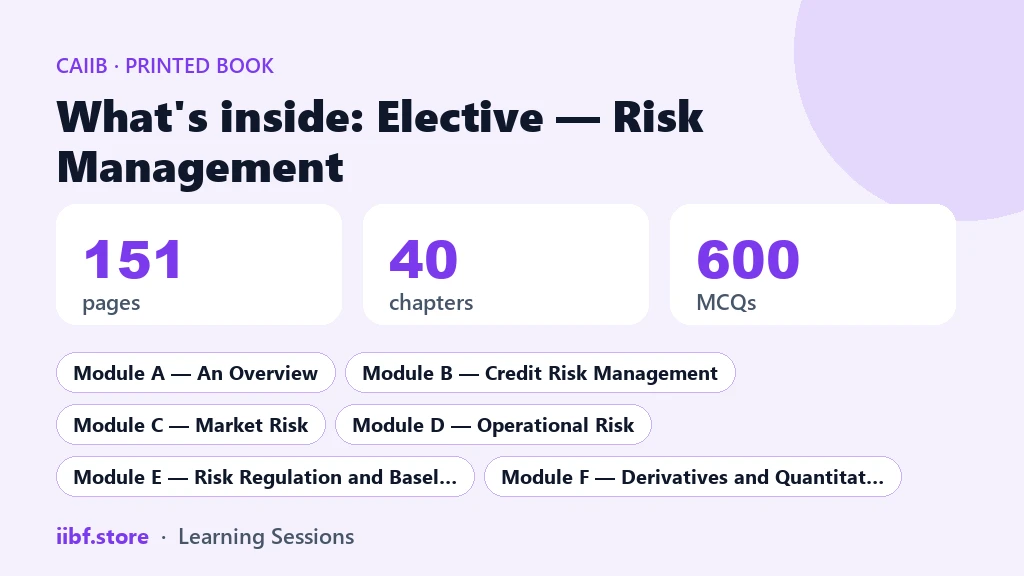
- Module A, An Overview: 5 chapters, from why banks are special to ALM, interest rate risk in the banking book and liquidity risk.
- Module B, Credit Risk Management: 7 chapters, covering the framework, obligor risk, rating systems, portfolio risk, models, measurement and credit derivatives.
- Module C, Market Risk: 4 chapters, namely market risk, fixed income securities, measurement of interest rate risk and Value at Risk.
- Module D, Operational Risk: 6 chapters, including loss data, RCSA and KRI, technology risk, corporate governance, and climate risk with sustainable finance.
- Module E, Risk Regulation and Basel Framework: 11 chapters, from the case for regulation and Basel III to capital adequacy, ICAAP, stress testing, market discipline, buffers and ratios, risk based supervision and risk based internal audit.
- Module F, Derivatives and Quantitative Techniques: 7 chapters, covering derivatives, forwards, futures, options, swaps, statistical measures and probability theory.
That is 40 chapters in all. The book runs to 151 pages, so each chapter is short enough to finish in a single evening sitting. Each chapter also carries its own MCQs, which is what makes a one-chapter-a-day rhythm possible.
Alongside the chapter MCQs there are 60 case studies with 240 questions. We will save those for the final weeks, once the concepts are settled.
The four-step daily routine that fits a bank job
You do not need a three-hour block. You need a routine you can repeat when you are tired. For a CAIIB Risk Management study plan to survive a month of month-end closings, it has to be small enough that you do it even on bad days.
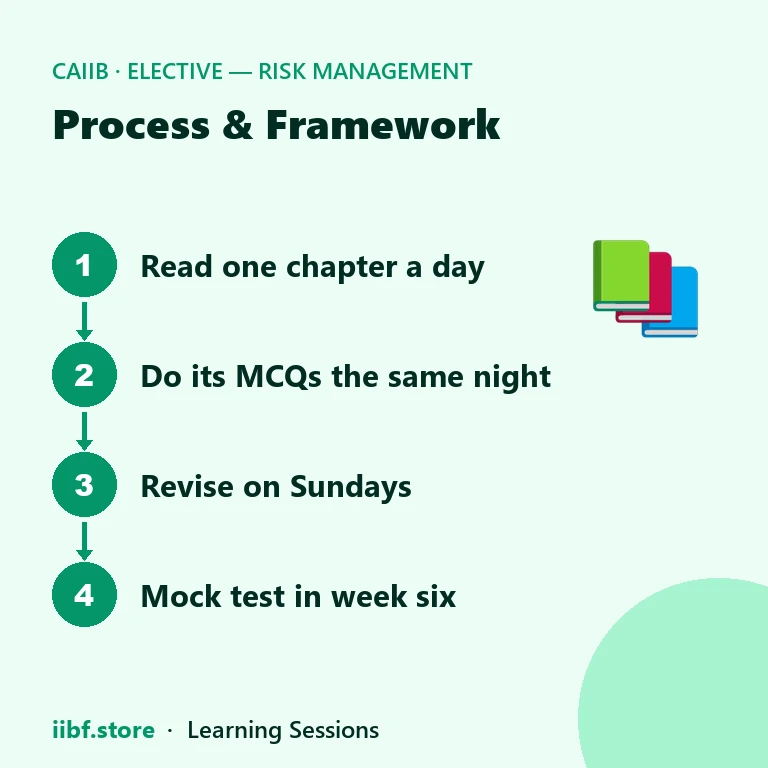
Step 1: Read one chapter (30 to 40 minutes)
Read it once, with a pencil. Underline definitions, lists and any number. Do not try to memorise on the first pass. You are only building the outline in your head.
Step 2: Do that chapter's MCQs the same night (20 to 25 minutes)
This is the step most people skip, and it is the one that matters. With 600 MCQs across 40 chapters, you get about 15 questions per chapter on average. Attempt them without looking at the text. Mark every wrong answer and read the explanation.
Step 3: Revise on Sunday
Spend an hour on the week's wrong answers, not on re-reading whole chapters. Your mistakes are a personal syllabus.
Step 4: A mock test in the last week
Reading speed and exam-hall speed are different skills. You can practise timed papers on the free mock tests section of iibf.store.
The six-week CAIIB Risk Management study plan, day by day
Here is the full schedule. It assumes about one chapter a day on weekdays, a slightly longer sitting on some Saturdays, and a lighter Sunday for revision. The MCQ counts are approximate, based on the average of about 15 per chapter, so treat them as a guide rather than a promise for each chapter.
| Days | What to read | MCQs to attempt |
|---|---|---|
| Days 1 to 5 | Module A: Why Banks are Special, Risks and Risk Management, Risk Management Framework, ALM and IRRBB, Liquidity Risk | About 75 |
| Days 6 to 12 | Module B: Credit Risk Management Framework to Credit Derivatives (7 chapters) | About 105 |
| Days 13 to 17 | Module C: Market Risk, Fixed Income Securities, Measurement of Interest Rate Risk, Value at Risk (4 chapters, one extra day for numericals) | About 60 |
| Days 18 to 23 | Module D: Operational Risk framework, loss data, RCSA and KRI, Technology Risk, Corporate Governance, Climate Risk | About 90 |
| Days 24 to 31 | Module E: Basel III, capital adequacy, market risk and operational risk capital, ICAAP, stress testing, market discipline, buffers, supervision, internal audit (11 chapters) | About 165 |
| Days 32 to 37 | Module F: Derivatives, Forwards, Futures, Options, Swaps, Statistical Measures, Probability Theory (7 chapters) | About 105 |
| Days 38 to 42 | Wrong-answer revision, the 60 case studies, one or two full mock tests | 240 case-study questions plus mocks |
Notice the shape. Modules A to D build your base. Module E, the largest, gets the most days because Basel questions are where marks and confusion both pile up. Module F is saved for later because derivatives and probability make more sense once you understand why banks hedge in the first place.
How to study each module without burning out
Modules A and B: build the vocabulary
These are mostly conceptual. Make a one-page sheet listing each type of risk and one line on how a bank measures it. When you reach credit rating systems and credit derivatives, you will find the earlier sheet useful.
Module C: slow down for numbers
Fixed income, duration and Value at Risk are the first places where tired brains slip. Give this module its extra day. Solve every numerical question twice: once with the book open, once without.
Module D: connect it to your own branch
Operational risk, technology risk and governance are easier because you see them at work: a wrong entry, a system outage, a control that was bypassed. Use your own examples to remember the framework.
Module E: group the regulation by purpose
Do not memorise eleven chapters as eleven separate topics. Think of them as three clusters: why regulation exists and how Basel III arose; how capital is measured and allocated across risks; how supervisors and banks check it (ICAAP, stress testing, market discipline, supervision and audit). The sequence in the CAIIB Risk Management book follows that logic already, so stay in order.
Module F: practise, do not just read
Derivatives and statistics reward repetition. Even ten minutes of extra practice on options and swaps will pay back in the exam hall.
What to do when the plan breaks
It will break. A surprise audit, a festival rush, a sick child. Here is how to recover without panic:
- Do not double up. Never try to read two chapters to "catch up". Push the whole schedule by a day instead.
- Protect the MCQs. If time is short, read a chapter more lightly but still attempt its questions. Practice beats passive reading.
- Use the buffer. Days 38 to 42 are deliberately loose. They absorb about a week of slippage.
- Take the exam seriously, not personally. A missed day is a missed day, not a failed plan.
Where the book helps, and where it will not
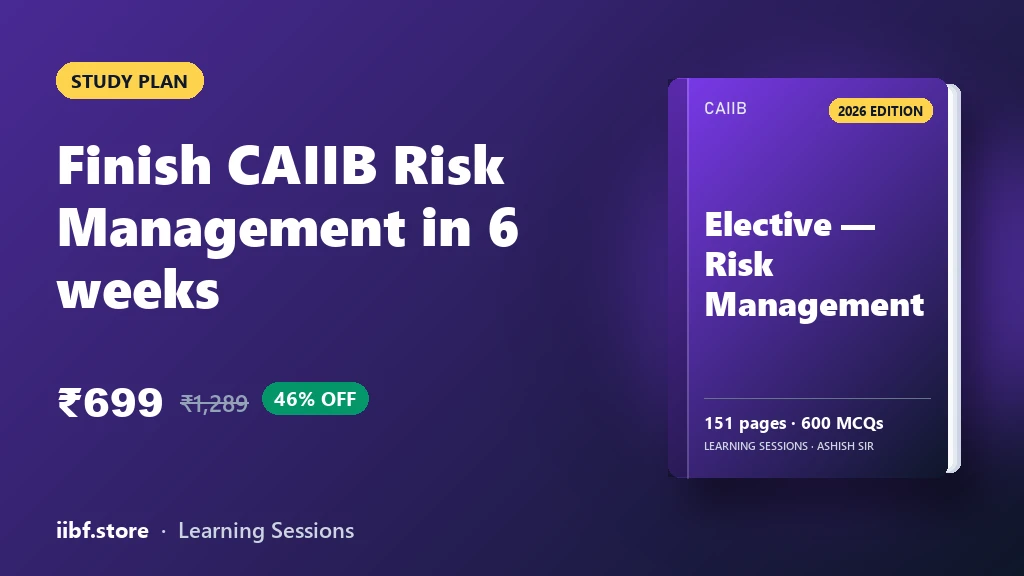
If you want the plan above in a single, ordered package, the Risk Management elective book is built for it: 151 pages, 40 chapters in six modules, 600 MCQs and 60 case studies with 240 questions. The current price is ₹699 against an MRP of ₹1,289, which is about 46 percent off. Prices can change, so the book page is always the current source. You can also read a free sample before deciding, and browse all titles on the books page.
One honest limit: a book alone will not give you exam-hall speed. Pair it with timed mocks, and check the official schedule and syllabus notices on the IIBF website for the upcoming exam cycle. For free PDFs to support your revision, see the free material library, and the CAIIB course page for other papers.
Your first three days, starting tonight
You do not need to start on Monday or on the first of the month. Tonight, open Module A, read "Why Banks are Special", and attempt its questions. Tomorrow, repeat with "Risks and Risk Management in Banks". By the third night you will have a rhythm, and rhythm is what a working banker needs more than motivation.
A CAIIB Risk Management study plan works because it asks little each day and asks it every day. Forty chapters sounds like a mountain, but it is just forty evenings of thirty to sixty minutes. Start with the first one.
Frequently asked questions
Can I really finish CAIIB Risk Management in six weeks while working full time?
Yes, if you keep the routine small and regular. The plan asks for roughly an hour on weekdays, one chapter and its MCQs. If your branch is busy, use the buffer days at the end or stretch the plan to seven or eight weeks. The order matters more than the speed.
Should I read the whole book first and then do the MCQs?
No. Attempt each chapter's questions the same night you read it. That is when mistakes show up while the topic is fresh, and you correct them immediately instead of discovering gaps weeks later.
Which module should I give the most time?
Module E, Risk Regulation and Basel Framework, has 11 chapters and needs the most days. Module C, with Value at Risk and duration numericals, needs slow, careful practice even though it has only 4 chapters.
Where do I find the official exam dates and syllabus?
Always check the IIBF website at iibf.org.in for the schedule, eligibility and syllabus for the upcoming exam cycle. Plan your six weeks backwards from the date published there.
Prefer revising from a printed book?
Chapter-wise books with MCQs after every chapter — minimal pages, complete coverage, delivered anywhere in India. Every book has a free sample to read first.
151 pages · 600 MCQs
Learning Sessions · Ashish Sir
148 pages · 478 MCQs
Learning Sessions · Ashish Sir
151 pages · 465 MCQs
Learning Sessions · Ashish Sir
148 pages · 375 MCQs
Learning Sessions · Ashish Sir
216 pages · 895 MCQs
Learning Sessions · Ashish Sir
109 pages · 300 MCQs
Learning Sessions · Ashish Sir
104 pages · 360 MCQs
Learning Sessions · Ashish Sir
82 pages · 297 MCQs
Learning Sessions · Ashish Sir
98 pages · 282 MCQs
Learning Sessions · Ashish Sir
131 pages · 672 MCQs
Learning Sessions · Ashish Sir
221 pages · 831 MCQs
Learning Sessions · Ashish Sir
128 pages · 524 MCQs
Learning Sessions · Ashish Sir
107 pages · 445 MCQs
Learning Sessions · Ashish Sir
132 pages · 225 MCQs
Learning Sessions · Ashish Sir
188 pages · 435 MCQs
Learning Sessions · Ashish Sir
117 pages · 236 MCQs
Learning Sessions · Ashish Sir
Learning Sessions · Ashish Sir
118 pages · 299 MCQs
Learning Sessions · Ashish Sir
Learning Sessions · Ashish Sir
Learning Sessions · Ashish Sir
Learning Sessions · Ashish Sir
115 pages · 255 MCQs
Learning Sessions · Ashish Sir
Learning Sessions · Ashish Sir
334 pages · 936 MCQs
Learning Sessions · Ashish Sir
Learning Sessions · Ashish Sir
115 pages · 344 MCQs
Learning Sessions · Ashish Sir
107 pages · 240 MCQs
Learning Sessions · Ashish Sir
90 pages · 150 MCQs
Learning Sessions · Ashish Sir
Learning Sessions · Ashish Sir
Quick quiz on this topic
5 exam-style questions from our free test bank — check yourself before you move on.
Practice this topic
Take a free mock test, download chapter PDFs, or watch a video class — all included on iibf.store.