CAIIB Central Banking Study Plan for Working Bankers: 21 Days
It is 9:40 pm. The branch closed late, the audit queries are still open in your head, and the CAIIB elective you chose looks like an ocean of RBI history, monetary theory and regulation. If that is you, this CAIIB Central Banking study plan is written for exactly your evening: tired, short on hours, and tired of plans that assume you have a free month.
Let us be honest about the problem first. Central Banking is not hard because any single idea is difficult. It is hard because it is wide: the evolution of central banks, the Reserve Bank's functions, monetary and credit policy, forex reserves, regulation of banks and NBFCs, financial stability. Wide papers punish people who read randomly. They reward people who read in a fixed order and test themselves often.
Why a plan beats extra hours
Most working bankers do not fail because they studied too little. They fail because their hours were scattered: forty minutes on monetary policy on Monday, a random chapter on Thursday, nothing for a week, then a panic weekend. By the time they reach Module F, Module A has faded.
A good plan does three things. It fixes the order so you never waste energy deciding what to open tonight. It caps each sitting at something a tired person can finish, around 60 to 90 minutes. And it forces recall, because reading a chapter once feels like learning but is not. Questions are what turn reading into marks.
What you can do even without any book
- Fix one slot (say 9:30 to 10:45 pm) and protect it like a branch deadline.
- Study one module at a time, never two in parallel.
- End every sitting by writing five lines from memory, then check them.
- Keep Sundays for revision only, not for new chapters.
Check the official syllabus and schedule for the upcoming exam cycle on the IIBF website before you start, so your plan is built on current information and not on someone's WhatsApp message.
What the Central Banking paper actually covers
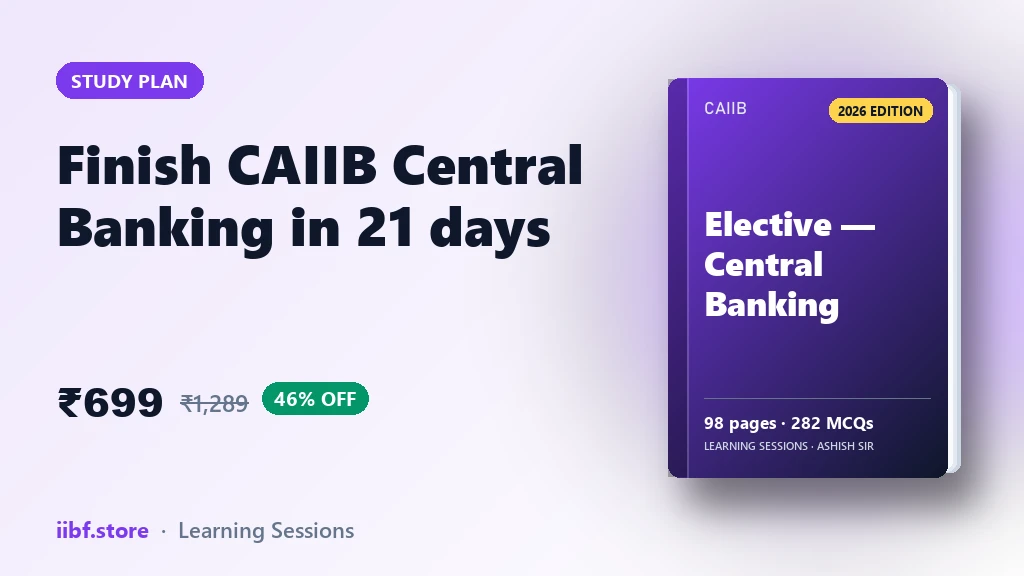
The Central Banking book is organised into six modules and 18 chapters across 98 pages. That compact size matters for a working banker: you can see the whole paper, and a sitting is about one chapter, not one heavy textbook section.
- Module A, Rationale and Functions of Central Bank: evolution of central banking theory and practice, functions of central banks, and contemporary issues (3 chapters).
- Module B, Central Banking in India: the Reserve Bank of India, India-specific issues, financial inclusion and development (3 chapters).
- Module C, Monetary Policy and Credit Policy: monetary policy, credit policy, fiscal-monetary relations and liquidity management (4 chapters).
- Module D, Management of Foreign Exchange Reserves and Constituents of Indian Financial Market: forex reserves management and the structure of the Indian financial system (2 chapters).
- Module E, Regulation, Supervision and Financial Stability: evolution of regulation, scheduled commercial banks, co-operative banks and financial stability (4 chapters).
- Module F, Non-Banking Financial Companies and Primary Dealers: NBFIs and the role of primary dealers in the government securities market (2 chapters).
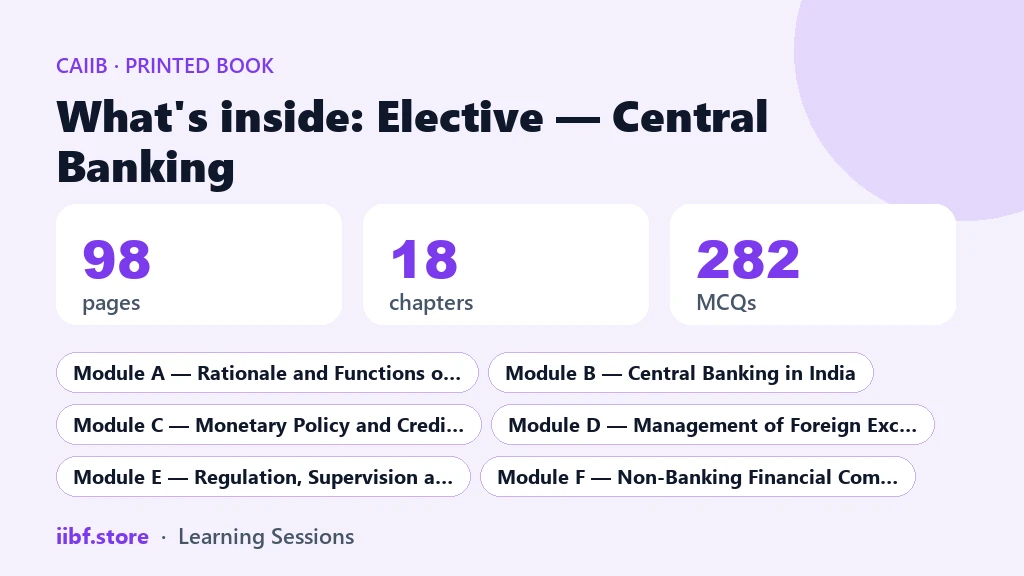
Beyond the chapters, the book carries 60 case studies (240 questions) and an appendix on Central Banking. The total question count is 282, so MCQ practice is built into the book and you do not need to hunt for questions elsewhere on day one.
The 21-day CAIIB Central Banking study plan
Here is the plan in one table. It assumes you can give 60 to 90 minutes on weekdays and a longer block on weekends. It follows the book's own module order, so there is nothing to rearrange. Treat the MCQ column as a target, not a rule: with 282 questions in total, about 13 to 15 a day keeps you on pace to finish the bank once with time left for repeats.
| Days | What to read | MCQ target |
|---|---|---|
| Days 1-2 | Module A: evolution, functions of central banks, contemporary issues | Chapter MCQs of all 3 chapters |
| Days 3-4 | Module B: Reserve Bank of India, Indian-specific issues, financial inclusion | Chapter MCQs of all 3 chapters |
| Days 5-8 | Module C: monetary policy, credit policy, fiscal-monetary relations, liquidity management (one chapter a day) | Chapter MCQs the same night |
| Days 9-10 | Module D: forex reserves management, Indian financial system structure | Chapter MCQs of both chapters |
| Days 11-14 | Module E: regulation evolution, commercial banks, co-operative banks, financial stability | Chapter MCQs the same night |
| Days 15-16 | Module F: NBFIs and primary dealers | Chapter MCQs of both chapters |
| Days 17-18 | Case studies, a few each evening | Case-study questions, steadily |
| Day 19 | Appendix plus your three weakest chapters | Re-attempt all wrong answers |
| Days 20-21 | Full revision of notes, then timed practice | Mixed MCQs and a free mock |
If your branch has a month-end crunch, do not abandon the plan. Slide it. Two lost days means the whole table moves two days, and the order stays intact. That is the real value of fixing the sequence in advance.
How to run each evening
The table tells you what to open. This tells you how to use the 75 minutes once it is open.
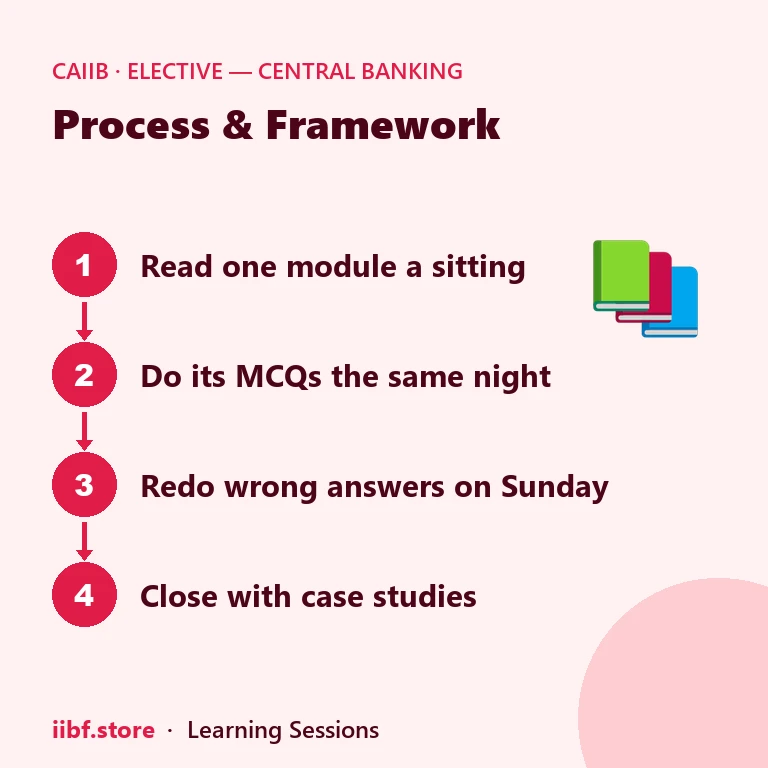
Step 1: read with a pencil, not a highlighter
Spend the first 35 to 40 minutes reading the chapter once, straight through. Do not stop to memorise. Make a pencil tick beside anything that looks like a definition, a list, an institution or a function. Those ticks are your exam targets.
Step 2: attempt the MCQs the same night
Close the book and attempt the chapter's questions. Do not peek. A question you get wrong tonight is worth far more than a page you passively reread, because the mistake tells you precisely what your memory dropped.
Step 3: keep a one-page wrong-answer log
Write each wrong question in one line with the right answer. On Sunday you revise from this log, not from the whole book. By the third week the log is your most valuable page, and it takes five minutes to scan before sleeping.
Step 4: finish the paper with case studies
The case studies come last in this CAIIB Central Banking study plan on purpose. They test whether you can apply a concept to a situation, and that is only possible after you have read all six modules. Doing them early just produces frustration.
Module-by-module notes for a tired reader
Not all modules deserve the same kind of attention. Here is how an experienced candidate would treat them.
Modules A and B: build the vocabulary
These are the foundation. You are learning why central banks exist, what they do, and how the Reserve Bank fits into that picture. Read for clarity, not speed. If you understand the functions in Module A, many later questions become common sense instead of rote.
Module C: slow down
Monetary policy, credit policy, fiscal-monetary relations and liquidity management are linked ideas. This is why the plan gives them four separate days. If you rush, the four chapters blur into one. Keep your tool simple: for each chapter, write down what the instrument is, who uses it and what it is meant to achieve.
Modules D and E: lists and institutions
Forex reserves and the structure of the financial system, then regulation and supervision of commercial banks and co-operative banks, are about who does what. Make small comparison tables in your notebook. The book's chapters give you the material; the table you build yourself is what sticks.
Module F: finish strong
NBFIs and primary dealers are only two chapters, so they can feel like an afterthought. Do not skip them just because the paper feels almost done. Short modules are often where the easy marks hide.
What this book does, and what it will not do
Used well, the CAIIB Central Banking book gives you a fixed chapter order, a compact 98 pages and 282 questions with 60 case studies in one place, so your plan has a single source of truth. The current price is ₹699 against an MRP of ₹1,289; prices may change, so the book page always shows the latest figure.
Now the honest part. A book alone will not give you exam-hall speed. You also need to practise under time pressure, and for that you should pair this plan with the free mock tests at iibf.store/tests. If you want to sample before deciding, the book page has a free sample. And if you are still choosing between electives, the wider range is at iibf.store/books.
For extra revision material that costs nothing, browse the free study material and the blog. None of it replaces the plan; it just gives you more places to test yourself.
Common mistakes that break this plan
- Skipping the MCQs when tired. The nights you least feel like doing questions are the nights they help most. Even ten questions beat none.
- Starting with the case studies. They look like the real exam, so they tempt you, but they need the whole syllabus behind them.
- Rewriting notes beautifully. Neat notes feel productive. A messy wrong-answer log produces marks.
- Treating the plan as a pass or fail. Miss two days, shift the table, carry on. The plan is a tool, not a test of your discipline.
Your first step tonight
Do not wait for a perfect Monday. Tonight, open Module A, read the first chapter on the evolution of central banking, attempt its questions and start your wrong-answer log. That single evening is the start of your CAIIB Central Banking study plan, and it is worth more than a week of intending to begin.
Pick your slot, protect it, and move one module at a time. Twenty-one honest evenings will do more for this paper than a panic month ever will. Verify the exam schedule on the official site, keep your log, and trust the order.
Frequently asked questions
Can I really finish Central Banking in 21 days while working full time?
For many candidates, yes, because the book is a compact 98 pages in 18 chapters. The plan needs about 60 to 90 minutes on weekdays and a longer block on weekends. If your branch is busy, shift the whole table by a few days rather than skipping modules.
How many MCQs should I attempt every day?
The book has 282 questions in total, plus 60 case studies. Roughly 13 to 15 questions a day keeps you on pace over three weeks, and you should always redo your wrong answers on Sunday.
Do I need mock tests as well as the book?
Yes. A book gives you content and practice, but timed mocks build exam-hall speed. Use the free mock tests on iibf.store alongside the plan, especially in the last two days.
Where do I check the official exam dates and rules?
Always use the official IIBF website at iibf.org.in for the schedule and rules of the upcoming exam cycle. This article does not quote dates or fees because they can change.
Prefer revising from a printed book?
Chapter-wise books with MCQs after every chapter — minimal pages, complete coverage, delivered anywhere in India. Every book has a free sample to read first.
98 pages · 282 MCQs
Learning Sessions · Ashish Sir
148 pages · 478 MCQs
Learning Sessions · Ashish Sir
151 pages · 465 MCQs
Learning Sessions · Ashish Sir
148 pages · 375 MCQs
Learning Sessions · Ashish Sir
216 pages · 895 MCQs
Learning Sessions · Ashish Sir
109 pages · 300 MCQs
Learning Sessions · Ashish Sir
104 pages · 360 MCQs
Learning Sessions · Ashish Sir
82 pages · 297 MCQs
Learning Sessions · Ashish Sir
151 pages · 600 MCQs
Learning Sessions · Ashish Sir
131 pages · 672 MCQs
Learning Sessions · Ashish Sir
221 pages · 831 MCQs
Learning Sessions · Ashish Sir
128 pages · 524 MCQs
Learning Sessions · Ashish Sir
107 pages · 445 MCQs
Learning Sessions · Ashish Sir
132 pages · 225 MCQs
Learning Sessions · Ashish Sir
188 pages · 435 MCQs
Learning Sessions · Ashish Sir
117 pages · 236 MCQs
Learning Sessions · Ashish Sir
Learning Sessions · Ashish Sir
118 pages · 299 MCQs
Learning Sessions · Ashish Sir
Learning Sessions · Ashish Sir
Learning Sessions · Ashish Sir
Learning Sessions · Ashish Sir
115 pages · 255 MCQs
Learning Sessions · Ashish Sir
Learning Sessions · Ashish Sir
334 pages · 936 MCQs
Learning Sessions · Ashish Sir
Learning Sessions · Ashish Sir
115 pages · 344 MCQs
Learning Sessions · Ashish Sir
107 pages · 240 MCQs
Learning Sessions · Ashish Sir
90 pages · 150 MCQs
Learning Sessions · Ashish Sir
Learning Sessions · Ashish Sir
Quick quiz on this topic
5 exam-style questions from our free test bank — check yourself before you move on.
Practice this topic
Take a free mock test, download chapter PDFs, or watch a video class — all included on iibf.store.