CMA data in credit appraisal: forms, ratios and limits (CCP)
CMA data in credit appraisal is the single most examined input a credit officer handles: a standard set of statements in which the borrower lays out past audited performance, the current year's estimate and forward projections, all in a format the bank can compare across accounts. CMA stands for Credit Monitoring Arrangement, a legacy of the era when large limits had to be reported to the Reserve Bank of India. The reporting requirement went, the format stayed — because nothing else forces a borrower to reconcile the profit and loss account, the balance sheet, the build-up of current assets and the funds flow in one place. For CCP candidates, questions on this topic are rarely definitional; they test whether you can spot an inconsistency between two forms.
📋 What CMA Data Actually Contains
A complete CMA set is six linked statements covering, typically, two audited years, the current year as an estimate, and one or two projected years. The linkage is the point. Sales in the operating statement drive the receivables and inventory figures in the current-assets statement; those in turn drive the working capital gap; the gap drives the limit sought in the first form. Change one number and the others must move with it.
The forward years are the borrower's assertion, not the auditor's. That distinction governs how much weight you give each figure. Audited years are evidence. The current-year estimate is a half-verified claim you can test against provisional financials and the operating account turnover. Projections are a proposal, and the appraisal note must say why the bank accepted them.
Before you read a single CMA form, be clear about what the bank is trying to fund. The principles of lending — safety, liquidity, purpose, profitability, diversification — decide which projections matter, and your bank's own credit policy fixes the entry barriers on ratios, promoter stake and rating. CMA data does not replace judgement; it supplies the arithmetic on which judgement rests.
💡 Exam Tip: Remember the direction of flow — operating statement → current assets build-up → working capital gap → limit. Questions often give you a changed sales figure and ask which form moves first.
🗂️ The Six CMA Forms Compared
Learn the six forms by what each one answers, not by rote numbering. Form I is a declaration of existing exposure and the fresh ask; Form II is profitability; Form III restates the balance sheet in the bank's classification; Form IV isolates current assets and current liabilities; Form V computes the working capital requirement; Form VI shows where the funds came from and went.
| Form | What it answers | Typical periods | Audited source? |
|---|---|---|---|
| Form I | Existing fund-based and non-fund-based limits, and the fresh limit sought | As on date of application | ❌ Borrower declaration, verify against records |
| Form II — Operating statement | Sales, cost of sales, operating profit, net profit, cash accruals | 2 audited + estimate + projections | ✅ For past years only |
| Form III — Analysis of balance sheet | Reclassified assets and liabilities, net worth, term liabilities | 2 audited + estimate + projections | ✅ For past years only |
| Form IV — Current assets and liabilities | Item-wise build-up of inventory, receivables, creditors, other CL | Same as above | ❌ Projected years are assertions |
| Form V — Working capital computation | Working capital gap, margin, permissible bank finance | Projected year | ❌ Derived from Form IV |
| Form VI — Funds flow | Sources and uses of funds, change in net working capital | Year on year | ✅ Derivable from audited pairs |
Form IV is where an appraisal is won or lost, because every holding level is stated in months or days of consumption and can be benchmarked against the industry. If you have not yet worked through the classification rules, the chapter on credit appraisal sets out how each head is reclassified and why bank borrowings for working capital are treated as current liabilities.
📈 Reading Ratios and Funds Flow from CMA
Once the forms are filled, the ratios fall out almost mechanically. The current ratio measures liquidity and, in the bank's classification, is directly affected by whether a loan is short-term or term. The total outside liabilities to tangible net worth ratio measures leverage and is usually the harder covenant to meet. Interest coverage and debt service coverage test whether the operating profit in Form II can actually carry the interest and instalments. Turnover ratios — inventory, receivables, creditors — convert Form IV holdings into days and expose padding.
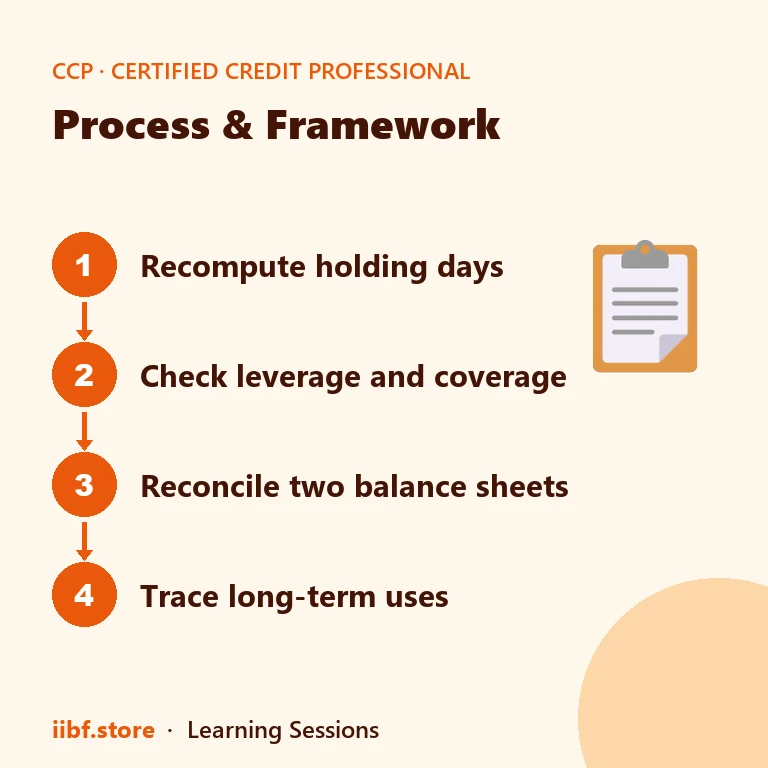
Funds flow in Form VI is the honesty check. It reconciles two balance sheets and shows whether long-term sources funded long-term uses. The classic red flag is a business that funded capital expenditure or a promoter withdrawal out of short-term bank finance: net working capital falls, the current ratio slips, and the borrower returns next year asking for an enhancement to plug a hole that is structural rather than seasonal. That is diversion, and Form VI reveals it without any accusation being made.
Ratios read from CMA data also feed the internal rating model, so the appraisal and the rating are not independent exercises — see the chapter on credit rating for how financial parameters are scored alongside management and industry factors. Where the borrower's business is genuinely seasonal or project-linked, banks increasingly test the CMA numbers against actual collections, which is the logic behind cash flow based lending for smaller units.
⚠️ Common Mistake: Treating instalments of term loans falling due within twelve months as long-term. They are current liabilities. Misplacing them inflates the current ratio and understates the funding need.
🚩 Sanity-Checking Projections in the CMA
Projections are where CMA data is most often massaged, and the manipulations follow a small number of patterns. Sales are projected to jump far beyond both past growth and installed capacity. Receivable days are quietly cut so the working capital gap looks smaller than the sales growth implies. Sundry creditors are shown at an implausibly long credit period to reduce the gap further. Slow-moving inventory and disputed receivables sit in current assets at full value. Group company advances are parked under loans and advances instead of being treated as non-current.
The tests are simple and you should be able to list them in an exam answer. Compare projected growth with the last three actual years and with installed capacity. Recompute holding levels in days and compare them with the audited years and the industry. Check that projected profit is consistent with the projected sales mix rather than assuming a sudden margin expansion. Tally projected turnover against operating account credits. Ask for an ageing of receivables and an inventory statement, and verify them through stock statements and inspection.
Where numbers do not reconcile, the correct response is to rework the CMA on the bank's own assumptions and appraise the reworked version, recording the deviation in the note. A sanctioned limit built on the borrower's untested projections becomes an excess within two quarters. The chapter on types of borrowers and credit facilities is useful here, because the plausibility of a build-up depends heavily on constitution, scale and the facility mix being sought.
📌 Remember: A projection you cannot explain in one sentence to the sanctioning authority is a projection you have not verified.
🔗 From Build-Up to the Sanctioned Limit
Form V converts the accepted build-up into a number. The working capital gap is current assets less current liabilities other than bank borrowings. From that gap the borrower's own contribution — the margin — is deducted, and the balance is what the banking system can fund. Under the second method of lending popularised by the Tandon Committee, the margin benchmark was a quarter of current assets, which produced a current ratio of about 1.33. RBI later gave banks freedom to design their own assessment methods, so the exact margin now follows your bank's loan policy, the borrower's rating and the facility type. Quote the policy, not a remembered percentage.
Two practical points follow. First, the limit is for the banking system as a whole, so existing limits with other banks and the non-fund-based exposure declared in Form I must be netted out. Second, the assessment is only as good as the current assets you accepted — if you disallowed padded receivables in Form IV, the disallowance flows straight into the limit. How the sanctioned limit is then made available as cash credit, a working capital demand loan or a bill facility is covered in the credit delivery chapter.
Large exposures assessed this way are frequently shared, which is where loan syndication in banks becomes relevant, and where a common CMA set circulated to all participants keeps the assessment consistent. If a unit later deteriorates despite a sound appraisal, recovery routes such as one time settlement of loans come into play. Candidates writing both credit and trade papers should also read documentary collections under URC 522, since the payment terms a borrower agrees with buyers directly determine the receivable days shown in Form IV. More CCP material is collected on the CCP blog tag hub.

🧠 Practice MCQs: CMA Data in Credit Appraisal
Q1. In the CMA format, which form presents the item-wise build-up of current assets and current liabilities? (a) Form IV (b) Form II (c) Form VI (d) Form I
Answer: (a) — Form IV gives the comparative item-wise statement of current assets and current liabilities; Form II is the operating statement.
Q2. A borrower funds a new machine out of cash credit. Which CMA statement will most clearly expose this? (a) Form I (b) Form II (c) Form VI (d) Form III
Answer: (c) — The funds flow statement matches sources with uses and shows a long-term use funded by a short-term source, with net working capital falling.
Q3. While reclassifying the balance sheet, instalments of a term loan payable within twelve months should be shown as (a) term liabilities (b) current liabilities (c) net worth (d) contingent liabilities
Answer: (b) — Any long-term liability maturing within the next twelve months is a current liability in the bank's classification.
Q4. Projected sales rise 60 per cent while projected receivable days fall sharply and creditor days rise sharply. The most appropriate action is to (a) sanction as sought (b) reject the proposal outright (c) ignore the ratios since sales are audited (d) rework the projections on the bank's own assumptions and record the deviation
Answer: (d) — Projections are assertions; the appraiser reworks them on tested assumptions and documents the basis in the note.
Q5. In the working capital computation, the working capital gap is (a) current assets minus all current liabilities (b) current assets minus current liabilities other than bank borrowings (c) current assets minus net worth (d) total assets minus total liabilities
Answer: (b) — Bank borrowings for working capital are excluded, because the gap is precisely what the banking system is being asked to fund.
Want chapter-wise mock tests with 100+ MCQs? Start practising free →
What does CMA stand for in banking?
CMA stands for Credit Monitoring Arrangement. It began as a reporting discipline for large borrowal accounts and survives as the standard format in which borrowers submit past, estimated and projected financial data to banks.
How many years of data are submitted in a CMA?
Usually two audited years, the current year as an estimate and one or two projected years, though the exact spread is fixed by the bank's loan policy and the size of the limit sought.
Is CMA data required for every borrower?
No. Banks generally call for full CMA data above a threshold limit set in their own credit policy, and use simplified formats or turnover-based assessment for smaller working capital limits.
Which CMA form is used to compute the permissible bank finance?
Form V. It takes the accepted current assets and current liabilities from Form IV, derives the working capital gap, deducts the borrower's margin and arrives at the finance the banking system can extend.
✅ Conclusion
Handled properly, CMA data in credit appraisal is not a filing formality but a cross-verification device: six statements that must agree with each other, with the audited accounts and with the operating account. Learn the flow from operating statement to build-up to limit, learn to convert holdings into days, and learn the handful of manipulations that recur. That is enough to answer most CCP questions on this topic and to write a defensible appraisal note. Test yourself on the full chapter-wise bank at iibf.store mock tests, or work through the structured syllabus on the CAIIB and certification courses page.
Source and further reading: Reserve Bank of India and the Indian Institute of Banking & Finance.
Quick quiz on this topic
5 exam-style questions from our free test bank — check yourself before you move on.
Practice this topic
Take a free mock test, download chapter PDFs, or watch a video class — all included on iibf.store.
Keep reading