Compliance Breach Reporting and Root Cause Analysis (BCP)
Compliance breach reporting and root cause analysis is the part of the compliance officer's job that decides whether a bank keeps repeating the same mistake or actually fixes it. A breach report that stops at "staff error, retrained" tells an examiner nothing about why the control failed in the first place. The IIBF Banking Compliance Professional syllabus expects candidates to know how a breach gets classified, escalated, root-caused and closed — and real banks are marked down hard when the same finding reappears in the next audit cycle because nobody asked why it happened.
🚨 What Counts as a Compliance Breach in a Bank
A compliance breach is any instance where a bank's action, or inaction, falls outside a regulatory requirement, an internal policy, or a board-approved limit. This is broader than fraud. A branch disbursing a loan without the mandatory sanction note, a delay in filing a statutory return, or a lapse in following the restrictions covered in the loans and advances regulatory restrictions chapter are all compliance breaches even when no money is lost and no customer complains.
Banks typically log breaches into three buckets: process breaches (a step was skipped), limit breaches (a board-approved or regulatory ceiling was crossed), and reporting breaches (a required disclosure was late or wrong). A breach that crosses an exposure ceiling, for instance, sits differently on the register than a missed signature, because the first one usually needs to be reported upward faster and closed with board-level sign-off. Compliance officers studying for the exam should be comfortable classifying a scenario into the right bucket before deciding on the reporting path, since the exam frequently tests this classification step rather than the technical rule itself.
🔍 Root Cause Analysis: Moving Beyond the Symptom
Root cause analysis (RCA) is the discipline of tracing a breach back to the control that should have stopped it, instead of stopping at the individual who made the error. A common technique is the "five whys" — asking why the breach happened, then why that cause existed, and repeating until the answer points to a system, policy or training gap rather than a person. Another is a simple fishbone breakdown across people, process, system and external factors, which helps when several causes combine to produce one breach.
Good RCA distinguishes a one-off human error from a design flaw. If ten branches make the same mistake in the same month, the honest root cause is rarely "careless staff" — it is usually an unclear policy, a system that allows an override with no second check, or a training gap that was never closed after the last audit. The compliance function's credibility rests on writing that down plainly, even when it points at head office policy rather than a branch.
💡 Exam Tip: If a case study gives you a breach that repeats across multiple branches, the expected answer is a systemic or policy-level root cause, not an individual lapse.
RCA quality also matters when a breach touches an area already flagged in an earlier cycle, such as gaps found while examining the IRAC norms and wilful defaulters chapter. A repeat finding with a shallow root cause is exactly what draws sharper questions in the next RBI inspection.
📋 Breach Classification and Escalation Matrix
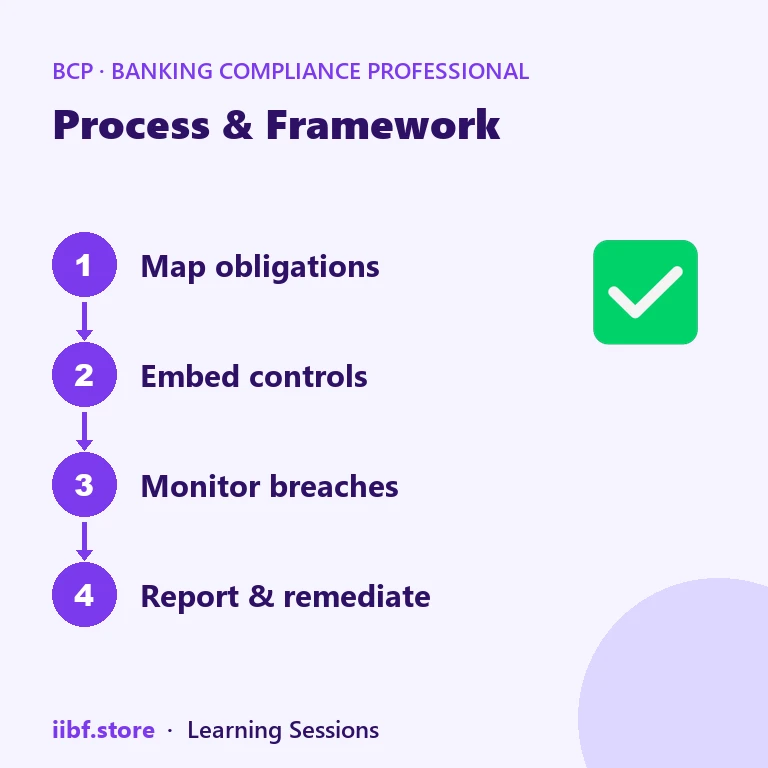
Once a breach is identified and its root cause is understood, it needs a severity rating that decides how fast it moves up the chain and who signs off on closure. Most banks use a four-tier matrix broadly similar to the one below, though the exact thresholds are set by each bank's own compliance policy.
| Severity | Typical Example | Reporting Timeline | Board/Audit Committee Sign-Off |
|---|---|---|---|
| Minor / Operational | Missed internal checklist step | Monthly compliance report | ❌ |
| Moderate | Policy deviation, no loss | Next compliance committee meeting | ❌ |
| Major / Regulatory | Exposure or credit limit breach | Immediate escalation to CCO | ✅ |
| Fraud-linked | Suspected wilful concealment | Immediate, per RBI fraud reporting norms | ✅ |
A breach that is misclassified — rated minor when it is actually major — is itself a compliance failure, because it deprives the audit committee of information it is entitled to see. Compliance testing and monitoring teams should periodically re-sample closed breaches to confirm the original severity rating was reasonable, not just check that a corrective action was recorded.
⚠️ Common Mistake: Treating "no financial loss" as proof that a breach is minor. Severity should be based on control failure and regulatory sensitivity, not just whether money was actually lost this time.
🛠️ Corrective Action Plans and Closure Tracking
Every breach above the minor tier needs a written corrective action plan (CAP) with an owner, a target date and a measurable closure condition — not a vague promise to "sensitise staff." A CAP tied to root cause might mean rewriting a policy clause, adding a system-level hard stop, or changing a sanctioning authority matrix, rather than simply issuing a circular.
Closure should never be self-certified by the same team that caused the breach. Compliance, or internal audit acting on the compliance function's behalf, verifies that the CAP was actually implemented and, ideally, tests a sample of transactions after implementation to confirm the fix holds. A breach register that shows CAPs closed on time but keeps seeing the same root cause reopen next quarter is a red flag examiners are trained to look for, and it usually means the CAP addressed the paperwork rather than the control.
Where a breach touches large credit exposures — for example, an account reviewed under the large exposures and exposure norms chapter — the CAP should also confirm whether any related account needs a fresh look, not just the one flagged in the original finding.
🏛️ Governance: Board, Audit Committee and RBI Reporting
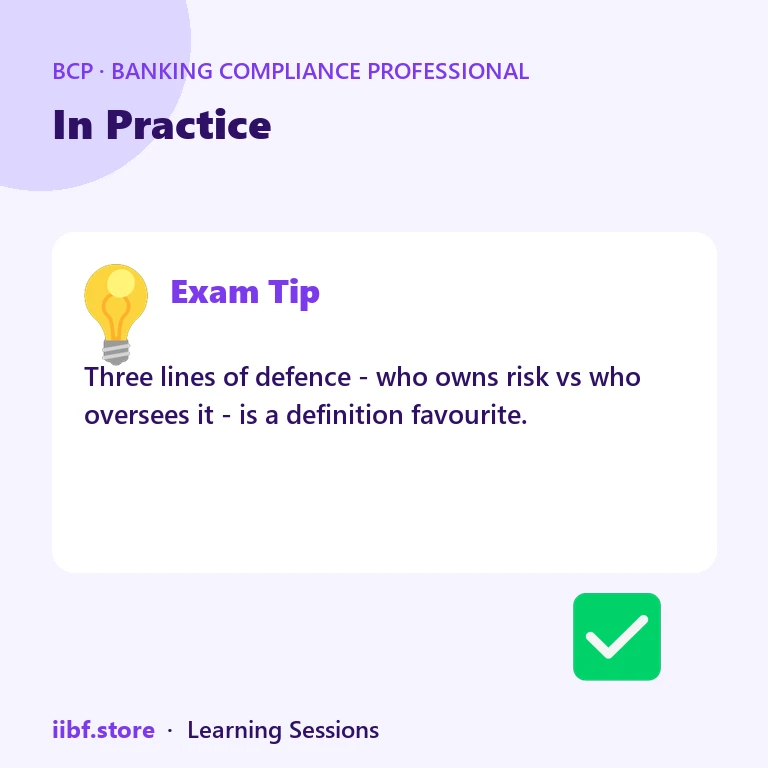
Breach reporting is not just a compliance-department exercise; it feeds a governance chain. Major and fraud-linked breaches go to the Audit Committee of the Board, and certain categories carry statutory reporting timelines to the RBI regardless of the amount involved. A bank's own escalation matrix must never be looser than what the regulator requires — internal policy can be stricter than the regulatory minimum, never more lenient.
The same discipline that governs breach reporting should apply consistently across every compliance domain a bank monitors, whether that is a lapse connected to FEMA compliance for banks or a gap surfaced through enhanced due diligence checks on a higher-risk customer. A breach register that treats some domains casually and others strictly signals a governance weakness on its own.
Boards also expect trend reporting: how many breaches were logged this quarter versus last, how many closed on time, and how many are repeat root causes. This trend view is often more useful to a board than any single breach, because it shows whether the compliance function's corrective actions are actually reducing risk over time. Persistent, unaddressed breach trends are a common trigger for a formal RBI enforcement action on banks, and a bank that can show a falling repeat-breach rate is in a materially stronger position during a supervisory review. Banks that also run a functioning whistle blower mechanism often catch breaches earlier, before they escalate into reportable events. For the RBI's own guidance on fraud classification and reporting timelines, the master direction is published on the Reserve Bank of India website.
🧠 Practice MCQs: Compliance Breach Reporting and Root Cause Analysis
Q1. In root cause analysis, what does the "five whys" technique primarily help a compliance officer avoid? (a) Skipping the audit committee (b) Stopping the analysis at individual blame instead of the systemic cause (c) Filing the RBI return late (d) Reducing the breach severity rating
Answer: (b) — The five whys technique pushes analysis past individual blame to the systemic or policy-level cause.
Q2. Ten branches commit the identical documentation error in the same month. What is the most likely appropriate root cause classification? (a) Ten unrelated cases of staff carelessness (b) A systemic policy or system design gap (c) A one-off training lapse at a single branch (d) Insufficient CCTV monitoring
Answer: (b) — A repeated identical error across multiple branches almost always points to a systemic or policy-level gap rather than isolated individual error.
Q3. Which factor should primarily determine a breach's severity rating? (a) Whether any financial loss actually occurred (b) The seniority of the employee involved (c) The extent of control failure and regulatory sensitivity (d) Whether the customer complained
Answer: (c) — Severity should reflect the extent of control failure and regulatory sensitivity, not merely whether a loss happened to occur this time.
Q4. Who should verify that a corrective action plan (CAP) has actually been implemented? (a) The same team that caused the breach, through self-certification (b) Compliance or internal audit, independently of the team that caused the breach (c) The customer affected by the breach (d) No verification is required once a CAP is filed
Answer: (b) — CAP closure must be independently verified by compliance or internal audit, never self-certified by the team responsible for the breach.
Q5. What does a bank's internal breach escalation matrix need to satisfy in relation to regulatory reporting timelines? (a) It can be more lenient than the regulatory minimum for minor breaches (b) It must never be looser than the regulatory reporting requirement (c) It only applies to fraud-linked breaches (d) It replaces the need for RBI reporting entirely
Answer: (b) — A bank's internal escalation matrix must never be more lenient than the statutory reporting timeline the regulator requires.
Want chapter-wise mock tests with 100+ MCQs? Start practising free →
What is the difference between a compliance breach and a fraud?
A compliance breach is any departure from a regulatory requirement, policy or approved limit, which can happen without any intent to deceive; fraud specifically involves dishonest intent and triggers separate, faster reporting norms.
Why is root cause analysis important if the breach caused no financial loss?
A breach with no loss can still reveal a control gap that will cause a loss the next time conditions are slightly different, so root cause analysis prevents recurrence rather than just recording an isolated incident.
Who is responsible for closing a corrective action plan?
The business or process owner implements the corrective action plan, but compliance or internal audit must independently confirm it was actually carried out before the finding is marked closed.
Does every compliance breach need to go to the Audit Committee of the Board?
No. Minor and moderate breaches are typically tracked through routine compliance reporting, while major and fraud-linked breaches are escalated to the Audit Committee of the Board and, where required, reported to the RBI within statutory timelines.
Compliance breach reporting and root cause analysis is what separates a bank that learns from its mistakes from one that keeps repeating them in front of the same examiner. Officers who can classify a breach correctly, push the analysis past individual blame, and track a corrective action plan to genuine closure will handle this part of the BCP syllabus with confidence. Explore more chapter notes on the Banking Compliance Professional tag hub, and take a free mock test to check your grasp of the escalation and reporting rules.
Practice this topic
Take a free mock test, download chapter PDFs, or watch a video class — all included on iibf.store.