Compliance Risk RCSA for Banks: IIBF BCP Exam Guide
A compliance risk RCSA is the structured exercise in which a bank lists every regulatory obligation it carries, rates how badly things could go wrong before controls, rates how well the existing controls actually work, and arrives at a residual rating that decides where the compliance department spends its testing hours next year. For the IIBF Banking Compliance Professional paper, this is a high-yield chapter: examiners like it because it forces you to separate inherent risk from residual risk, and to know that a self-assessment signed off by the business is still owned by compliance.
This guide walks through the obligation register, the scoring grid, control testing, board reporting and the errors that cost marks. Every rate-sensitive number is deliberately left to the live page at RBI policy rates rather than quoted here.
🧭 What a Compliance Risk RCSA Actually Assesses
An RCSA is not an audit and it is not a risk register copied from the operational risk department. It is a bottom-up assessment in which the process owner states what could go wrong against a defined regulatory requirement, and the compliance function challenges, calibrates and consolidates that answer.
The unit of assessment is the obligation, not the department. "Branch operations" is not an assessable item; "obtaining and verifying customer due diligence records at account opening as required by the Master Direction on KYC" is. This granularity is what makes the output usable, because each line can be mapped to an owner, a control and a test.
Three questions drive every row:
- What is the obligation? The specific direction, master circular, statute or internal policy clause.
- What could fail? The failure scenario in plain language — a missed reporting deadline, a breach of a ceiling, a mis-sold product.
- What stops it? The preventive or detective control, named and owned.
Regulatory expectations for the function itself flow from the Reserve Bank's framework for the compliance function and the role of the Chief Compliance Officer, issued in September 2020; the current text sits on the RBI's notifications portal. The Basel Committee's 2005 paper on compliance in banks remains the conceptual parent, and the two together give you the framing examiners expect: the assessment must be documented, periodic, and placed before the Audit Committee of the Board.
💡 Exam Tip: If a question asks who "owns" a risk identified in an RCSA, the answer is the business line that runs the process — compliance owns the framework and the challenge, never the risk itself.
🧱 Building the Regulatory Obligation Register
The register is the foundation, and a weak register makes every downstream score meaningless. It is built by walking the bank's licence and product set, then mapping each activity to the directions that govern it. Credit exposure limits, priority sector targets, deposit rules, capital and liquidity ratios, foreign exchange, customer protection and reporting all become branches of the same tree.
In practice a mid-sized Indian bank ends up with several thousand obligation lines. They are grouped by regulator, by business line and by theme so that reporting can roll up cleanly. A useful discipline is to tag each line with the consequence of failure — monetary penalty, business restriction, capital add-on, customer redress, or reputational only.
Some of the densest obligation clusters map directly to your BCP syllabus. Credit-side restrictions are covered in the chapter on loans and advances regulatory restrictions, while concentration ceilings and counterparty grouping rules sit in large exposures and exposure norms. Reserve requirement obligations, which are among the easiest to test because they are arithmetic, are set out in CRR and SLR.
Targeted lending obligations deserve their own segment because the sub-targets differ by bank type — remember that a small finance bank carries a 60 per cent priority sector target, not the 40 per cent that applies to a universal commercial bank. The chapter on priority sector, MSME and microfinance is the reference point for that segment of the register.
📊 Scoring Inherent Risk, Controls and Residual Risk
Scoring is where candidates lose marks, because the vocabulary is precise. Inherent risk is the exposure assuming controls do not exist. Control effectiveness is a judgement on both design and operation. Residual risk is what remains once effective controls are credited. Residual risk can never be worse than inherent risk, and a control can never reduce a risk below the level the regulator itself treats as unacceptable.
Most banks use a five-point or four-point scale for each axis and a fixed matrix to combine them, so that the outcome is repeatable rather than negotiable. The table below shows a typical four-band grid and how each band is treated.
| Residual band | Typical trigger | Testing frequency | Board / ACB reporting | Action plan mandatory? |
|---|---|---|---|---|
| High | High inherent risk with weak or untested controls | Quarterly | Every meeting, by name | ✅ |
| Medium-High | High inherent risk with partially effective controls | Half-yearly | Summary with ageing | Yes |
| Medium | Moderate inherent risk, controls broadly effective | Annual | Aggregate only | No |
| Low | Low inherent risk, controls effective and evidenced | Cyclical, risk-based | Aggregate only | ❌ |
Two calibration rules keep the grid honest. First, any obligation whose breach attracts a monetary penalty or a business restriction gets a floor on inherent risk regardless of how strong the controls feel. Second, a control that has never been independently tested cannot be rated fully effective — untested is not the same as working. Applying those two rules alone usually moves five to ten per cent of a first-draft register upward, which is exactly the correction the exercise exists to produce.
⚠️ Common Mistake: Treating a low residual score as permission to stop monitoring. Residual rating drives frequency and depth of testing; it never switches monitoring off entirely for a live regulatory obligation.
🧪 Testing Controls and Evidencing the Assessment
A self-assessment that no one challenges is a questionnaire, not an RCSA. The compliance function converts scores into a testing plan, and the testing plan produces the evidence that supports next cycle's ratings. Testing is normally split into design effectiveness and operating effectiveness, and the two failures carry different remedies: a design gap needs a process change, an operating gap usually needs training, capacity or supervision.
Sampling should be risk-weighted rather than uniform. High residual obligations get larger samples, exception-based selection and, where the data supports it, full-population analytics. Reporting obligations are the natural first candidates for automation, because timeliness and completeness are machine-checkable.
Evidence quality is what supervisors probe. For each tested control the file should hold the population definition, the sample basis, the tester's name and independence, the exceptions found, the root cause and the agreed remediation with a dated owner. Where an exception meets the bank's breach threshold, it leaves the RCSA process and enters the incident and reporting workflow.
The independence question matters here, and it is examinable in its own right — the reporting line, tenure protection and non-executive access that keep the assessment credible are unpacked in independence of compliance function in banks. Cross-border reporting obligations show how a single failed control can produce both a domestic and a foreign consequence, which is why FATCA CRS reporting for banks usually sits in the high band on a first assessment.
Testing findings also feed the statutory audit trail. Auditors reuse compliance testing results when they build their own coverage, a linkage explained in Long Form Audit Report.
🏦 Supervisory Use, Reporting and Refresh Cycle
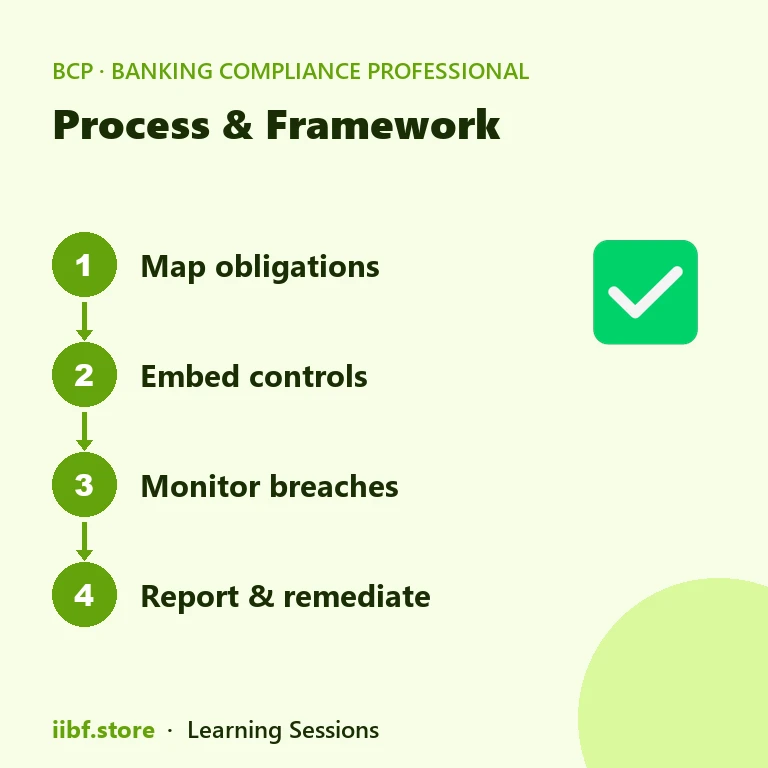
The finished assessment is not a filing-cabinet document. It is placed before the Audit Committee of the Board, drives the annual compliance testing calendar, and is one of the first artefacts a supervisory team asks for. Supervisors read it backwards: they compare the risks you rated low against the breaches you actually reported, and a mismatch between the two is treated as a governance weakness rather than a scoring error.
That comparison is the heart of risk-based supervision, and the assessment methodology behind it is covered in RBI SPARC supervisory framework. The practical implication is simple: your ratings must be defensible with evidence, and they must move when reality moves.
Refresh is therefore both periodic and event-driven. The full cycle typically runs annually with a board-approved policy review in the same window. Between cycles, four triggers force an out-of-cycle re-assessment:
- A new or amended regulatory direction affecting an existing obligation.
- A confirmed breach, penalty or supervisory observation.
- A new product, channel, outsourcing arrangement or acquisition.
- A material control failure identified by audit or by the business itself.
Government-sponsored lending programmes are a recurring source of the third trigger, since scheme guidelines change more often than banking regulations do; the lead bank scheme and government schemes chapter is worth reading alongside this topic. For the full set of BCP study notes and practice sets, work through the Banking Compliance Professional tag hub.
🧠 Practice MCQs: Compliance Risk RCSA
Q1. In a compliance risk RCSA, the primary purpose of the assessment output is to — (a) replace the internal audit plan (b) compute regulatory capital for operational risk (c) prioritise compliance monitoring and testing effort across the bank (d) certify the annual financial statements
Answer: (c) — The RCSA is a prioritisation tool; it directs where limited compliance testing capacity is deployed, and does not replace audit or capital computation.
Q2. Residual risk in an RCSA is best described as — (a) inherent risk remaining after the effect of existing controls is considered (b) inherent risk measured before any control is applied (c) the portion of risk transferred to an insurer (d) the arithmetic total of all high-rated risks
Answer: (a) — Residual risk is what survives the credited effect of controls; option (b) defines inherent risk.
Q3. A control is well designed on paper but is performed inconsistently by branches. It should be rated — (a) effective, because the design is adequate (b) not applicable, as design governs (c) outside the scope of the RCSA (d) ineffective, because operating effectiveness has failed
Answer: (d) — Control effectiveness requires both sound design and consistent operation; failure of either makes the control ineffective.
Q4. Which RCSA output most directly determines the frequency of the annual compliance testing plan? (a) the inherent risk score taken alone (b) the residual risk ranking of each obligation (c) the headcount of the branch network (d) the bank's capital to risk-weighted assets ratio
Answer: (b) — Testing frequency and sample depth are set by residual ranking, since that reflects exposure after controls.
Q5. A new RBI direction is issued four months into the assessment cycle. The correct response is to — (a) wait for the next annual cycle (b) delete the superseded obligation without replacement (c) update the obligation register and re-assess affected risks on an event-driven basis (d) refer the matter only to internal audit
Answer: (c) — Regulatory change is a standard out-of-cycle trigger; the register and the affected ratings are updated immediately.
Want chapter-wise mock tests with 100+ MCQs? Start practising free →
❓ Frequently Asked Questions
How often must a bank run a compliance risk assessment?
The board-approved compliance policy sets the cycle, and an annual full assessment reviewed by the Audit Committee is the common standard. Event-driven updates are expected in between whenever a regulation, product or breach changes the picture.
Who signs off the RCSA — the business or compliance?
The business line owns and signs its own assessment, because it runs the process and the controls. The compliance function designs the methodology, challenges the ratings, consolidates the results and reports them to the board.
Is an RCSA the same as an operational risk assessment?
No. The methodology is similar, but the scope of a compliance RCSA is limited to regulatory, statutory and policy obligations. Many banks run both and reconcile them so that a single control failure is not rated two different ways.
What is the most common weakness supervisors flag in bank RCSAs?
An incomplete or stale obligation register. If a direction issued during the year never entered the register, no rating, control or test can exist for it, and the gap surfaces only when a breach or an inspection finds it.
✅ Key Takeaways for the BCP Exam
Learn the three-step chain — obligation, inherent rating, control rating, residual rating — and be able to state who owns each step. Remember that untested controls cannot be rated fully effective, that penalty-bearing obligations carry an inherent risk floor, and that regulatory change is an event-driven trigger rather than an annual one.
Test yourself on the full Banking Compliance Professional syllabus with timed mocks at iibf.store practice tests, and keep an eye on the IIBF official site for syllabus notifications before you book your attempt.
Prefer revising from a printed book?
Chapter-wise books with MCQs after every chapter — minimal pages, complete coverage, delivered anywhere in India. Every book has a free sample to read first.
Learning Sessions · Ashish Sir
132 pages · 225 MCQs
Learning Sessions · Ashish Sir
188 pages · 435 MCQs
Learning Sessions · Ashish Sir
117 pages · 236 MCQs
Learning Sessions · Ashish Sir
Learning Sessions · Ashish Sir
118 pages · 299 MCQs
Learning Sessions · Ashish Sir
Learning Sessions · Ashish Sir
Learning Sessions · Ashish Sir
Learning Sessions · Ashish Sir
115 pages · 255 MCQs
Learning Sessions · Ashish Sir
Learning Sessions · Ashish Sir
334 pages · 936 MCQs
Learning Sessions · Ashish Sir
Learning Sessions · Ashish Sir
115 pages · 344 MCQs
Learning Sessions · Ashish Sir
107 pages · 240 MCQs
Learning Sessions · Ashish Sir
90 pages · 150 MCQs
Learning Sessions · Ashish Sir
131 pages · 672 MCQs
Learning Sessions · Ashish Sir
221 pages · 831 MCQs
Learning Sessions · Ashish Sir
128 pages · 524 MCQs
Learning Sessions · Ashish Sir
107 pages · 445 MCQs
Learning Sessions · Ashish Sir
148 pages · 478 MCQs
Learning Sessions · Ashish Sir
151 pages · 465 MCQs
Learning Sessions · Ashish Sir
148 pages · 375 MCQs
Learning Sessions · Ashish Sir
216 pages · 895 MCQs
Learning Sessions · Ashish Sir
109 pages · 300 MCQs
Learning Sessions · Ashish Sir
104 pages · 360 MCQs
Learning Sessions · Ashish Sir
82 pages · 297 MCQs
Learning Sessions · Ashish Sir
151 pages · 600 MCQs
Learning Sessions · Ashish Sir
98 pages · 282 MCQs
Learning Sessions · Ashish Sir
Practice this topic
Take a free mock test, download chapter PDFs, or watch a video class — all included on iibf.store.
Keep reading