Independence of Compliance Function in Banks: BCP Exam Guide
The independence of compliance function in banks is one of the first structural principles the IIBF BCP syllabus drills into candidates, and for good reason: a compliance department that answers to the same business head whose lending decisions it is supposed to police cannot do its job. RBI's guidelines on the compliance function and the role of the Chief Compliance Officer (CCO), issued for scheduled commercial banks in September 2020, exist precisely to fix this conflict. This article covers the structural safeguards examiners expect you to know, where banks have historically fallen short, and how independence connects to the wider compliance framework.
🏛️ Why Independence Is the Foundation of the Compliance Function
Compliance is not just a checklist function — it is the bank's internal early-warning system for regulatory breaches. If the officer running that system reports to, and is appraised by, the same business line whose targets create pressure to bend a rule, the warning system fails exactly when it is needed most.
The Basel Committee's foundational paper on compliance, which RBI's own framework draws on, defines compliance risk as the risk of legal or regulatory sanctions, financial loss, or reputational damage arising from failure to comply with laws, regulations, and codes of conduct. Independence is the mechanism that lets the compliance function flag that risk without fear of being overruled by the very unit generating it.
For BCP candidates, the exam angle is usually structural: which reporting lines are permitted, which combinations of roles are barred, and what happens when a bank gets this wrong. This article works through each of those in turn, alongside the related concept of the three lines of defence in bank compliance, where compliance sits as the second line, distinct from both business (first line) and internal audit (third line).
💡 Exam Tip: If a question describes compliance staff taking instructions from a business head on a compliance matter, the answer is almost always "this violates independence" — regardless of how the rest of the scenario is worded.
👤 The Chief Compliance Officer: Tenure, Reporting Line and Dual-Hatting
RBI's 2020 guidelines require every scheduled commercial bank (other than regional rural banks) to appoint a CCO with a minimum fixed tenure, ordinarily three years, so that the officer cannot be removed simply for raising an inconvenient finding. Early removal needs board approval, and the reasons must be recorded and made available to RBI on request.
The reporting line is deliberately split: the CCO reports functionally to the Board or its Audit Committee (ACB), and administratively to the MD/CEO. This dual line means the CCO's performance is not assessed solely by the executive whose conduct the CCO may need to escalate.
Equally important is the bar on "dual-hatting" — the CCO cannot simultaneously hold charge of internal audit, business, or (barring narrow, board-approved exceptions in smaller banks) risk management. Combining compliance with a revenue-generating or control function that compliance itself is meant to oversee defeats the entire purpose of the appointment. The full text of RBI's notifications on the compliance function is available on the RBI notifications page for candidates who want to read the source language directly.
⚠️ Common Mistake: Candidates confuse the CCO's functional and administrative reporting lines. Functional (for performance and independence purposes) goes to the Board/ACB; administrative (day-to-day, HR-linked) goes to the MD/CEO. Both exist together — it is not an either/or.
📋 Structural Safeguards RBI Expects Banks to Build
Beyond the CCO's individual position, RBI expects the compliance department as a whole to be insulated from business pressure. Compliance staff should have unrestricted access to records and information across the bank, a seat at relevant management committees, and a status and stature comparable to other senior control functions such as risk and internal audit.
Compensation is a recurring supervisory theme: a compliance officer's pay and career progression should not be linked to the performance of the business unit under review, since that link quietly reintroduces the very conflict independence is meant to remove. Boards are expected to review and approve the compliance policy and staffing levels at least annually.
Many of the specific regulatory areas a compliance function monitors — for example, loans and advances regulatory restrictions and guarantees, acceptances and finance to NBFCs — are precisely the areas where sanctioning authority sits with business. Independence is what allows compliance to question a sanction on regulatory grounds without that question being seen as insubordination.
| Independence Safeguard | Requirement | Compliant Practice | Common Violation |
|---|---|---|---|
| CCO tenure | Minimum fixed term, ordinarily 3 years | ✅ Board-approved term, early removal only with recorded reasons | ❌ CCO rotated or removed mid-term after a critical finding |
| Reporting line | Functional to Board/ACB, administrative to MD/CEO | ✅ Both lines documented and followed in practice | ❌ CCO effectively reports only to the business-side CEO on substance |
| Role combination | No dual-hatting with audit or business | ✅ CCO holds compliance charge only | ❌ CCO also heads internal audit or a business vertical |
| Compensation | Not linked to business unit performance | ✅ Appraised on compliance outcomes and objectivity | ❌ Bonus tied to the profitability of units under review |
🔍 Compliance Risk Assessment and the Three Lines of Defence
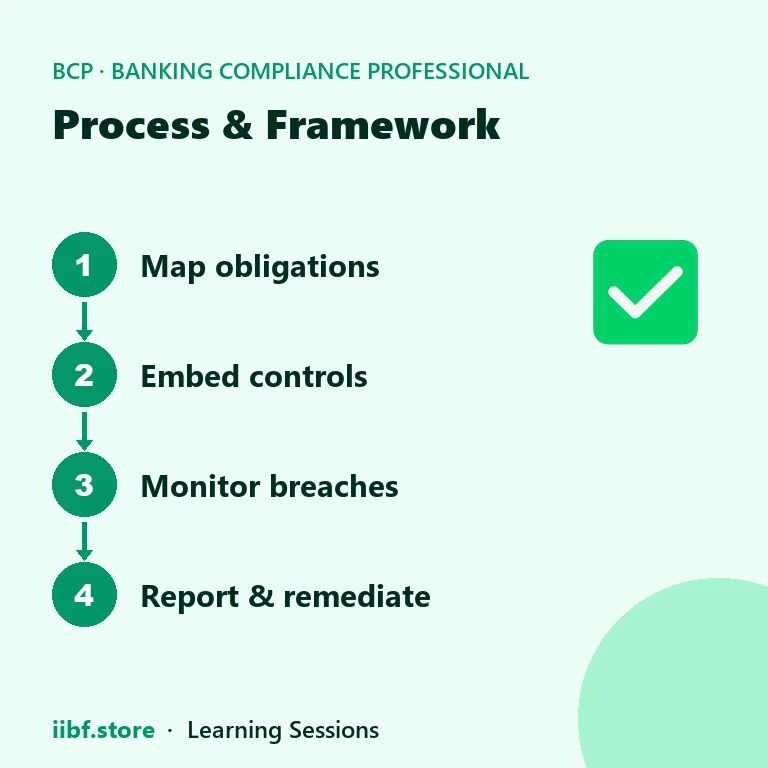
Independence is only useful if it is backed by a working process. Banks are expected to carry out a compliance risk assessment at least annually, mapping regulatory obligations across products, processes, and business lines, and rating the residual risk after existing controls. High-risk areas then receive more frequent testing and monitoring through the year rather than a once-a-year tick.
This risk assessment feeds directly into the compliance function's annual plan — the same plan discussed in detail under the annual compliance programme in banks, which sequences testing, training, and reporting activities across the year. Within the broader three-lines structure, business and operations units (first line) own the risk day-to-day, compliance and risk management (second line) set the framework and test adherence independently, and internal audit (third line) provides assurance over both.
Interest rate and pricing conduct — covered separately under interest rates on advances — and asset classification discipline under IRAC norms and wilful defaulters are both examples of areas where second-line compliance testing routinely surfaces exceptions that first-line business would not flag on its own.
📌 Remember: An independent compliance function does not eliminate compliance risk — it ensures the risk is identified, escalated, and tracked to closure without being filtered through the business line that created it.
⚖️ How Supervisors Detect Independence Breaches
RBI's supervisory process, including the risk-based inspection approach discussed under the RBI SPARC supervisory framework, specifically probes whether a bank's compliance function is independent in substance and not merely on an organisation chart. Supervisors look at whether compliance findings actually change business decisions, whether escalations reach the ACB unfiltered, and whether the CCO's tenure and removal history show a pattern of turnover after adverse findings.
A frequent red flag is a compliance function that is adequately staffed on paper but starved of access — meetings it is not invited to, systems it cannot query directly, or sign-offs it is asked to provide after a decision has already been implemented. Supervisors treat "compliance as a rubber stamp" findings as seriously as an outright reporting-line violation, because the practical effect on risk is the same.
Weak independence also shows up indirectly in audit outcomes. When compliance testing has been diluted by business pressure, the gaps typically resurface later during statutory or branch audits — the kind of cross-check explored in joint audit of bank branches, where auditors independently re-test controls that compliance was supposed to have already validated.
🎯 BCP Exam Focus: What to Remember
For the exam, keep the structural facts separate from the judgement-based scenario questions. The structural facts are fixed: minimum CCO tenure of roughly three years, dual reporting to Board/ACB and MD/CEO, no dual-hatting with audit or business, and compensation delinked from the business unit reviewed.
The scenario questions test whether you can spot a violation described in narrative form — a CCO who is also the retail banking head, a compliance bonus tied to branch profitability, or a CCO removed two months after flagging a lending irregularity. In every such case, the underlying principle is the same one this article opened with: compliance must be able to say no without risking its own position.
Keep a running list of RBI's numeric thresholds (tenure, reporting frequency, review cycles) separate from the conceptual material, since BCP papers mix both in the same paper and candidates who blur the two lose easy marks.
🧠 Practice MCQs: Independence of the Compliance Function
Q1. Under RBI's guidelines on the compliance function, the Chief Compliance Officer's functional reporting line is to: (a) the MD/CEO only (b) the Board or its Audit Committee (c) the head of internal audit (d) the business head of the largest vertical
Answer: (b) — Functional reporting goes to the Board/ACB to keep the CCO's performance assessment independent of business; administrative reporting is to the MD/CEO.
Q2. What is the ordinarily prescribed minimum fixed tenure for a bank's CCO under RBI's September 2020 guidelines?
Answer: Three years, with early removal requiring board approval and recorded reasons.
Q3. Which role combination ("dual-hatting") is generally barred for a bank's CCO? (a) Compliance and risk in a very small bank with board approval (b) Compliance and internal audit or business (c) Compliance and training coordination (d) Compliance and regulatory correspondence
Answer: (b) — Combining compliance with internal audit or business defeats independence; a narrow board-approved exception to combine with risk exists only for smaller banks.
Q4. In the three-lines-of-defence model, where does the compliance function sit?
Answer: The second line, alongside risk management — distinct from business/operations (first line) and internal audit (third line).
Q5. A CCO's annual bonus is linked to the profit growth of the retail lending vertical she also oversees for compliance testing. This arrangement primarily violates which safeguard? (a) Minimum tenure (b) Compensation independence (c) Committee representation (d) Access to records
Answer: (b) — Linking compliance compensation to the performance of the business unit under review reintroduces the conflict independence is designed to remove.
Want chapter-wise mock tests with 100+ MCQs? Start practising free →
❓ Frequently Asked Questions
Why can't a bank's CCO also head internal audit?
Internal audit is meant to independently assess the compliance function's own effectiveness. If one officer runs both, there is no independent check on compliance itself, which defeats the purpose of having separate second and third lines of defence.
Does RBI's compliance function guideline apply to all banks equally?
The core September 2020 guideline applies to scheduled commercial banks excluding regional rural banks; RBI has issued separate, broadly similar guidance for urban co-operative banks and NBFCs, with scale-based variations in staffing expectations.
What happens if a CCO is removed before completing the minimum tenure?
The bank's board must approve the early removal and record the reasons, which must be made available to RBI on request. This is designed to deter removal simply for raising uncomfortable compliance findings.
How does compliance independence relate to compliance risk assessment?
Independence is the structural safeguard; risk assessment is the process it protects. An independent compliance function can rate a business line's regulatory risk honestly, without softening the rating to avoid friction with that business line's leadership.
The independence of compliance function in banks is not a soft governance ideal — it is a set of specific, testable structural requirements, and BCP examiners expect candidates to know exactly where the reporting lines and role restrictions sit. Revisit the related concepts in the banking compliance professional series, and work through timed practice tests to convert this structural knowledge into exam-ready recall.
Practice this topic
Take a free mock test, download chapter PDFs, or watch a video class — all included on iibf.store.
Keep reading