
Credit Risk Management in Banks: CAIIB ABM Complete Guide

For CAIIB candidates, credit risk management in banks is one of the highest-yield topics in the Advanced Bank Management (ABM) paper. Examiners repeatedly test how a lending institution identifies, measures, monitors and controls the risk that a borrower fails to meet contractual obligations. This guide breaks the subject into exam-ready blocks: the risk framework, measurement tools, the Basel capital linkage, and the governance controls the Reserve Bank of India expects every bank to run. Master these and you can answer both the conceptual multiple-choice questions and the numerical case-study problems that ABM loves to set.
Credit risk is the single largest risk on most Indian banks' balance sheets, so the syllabus weights it heavily. We keep every figure qualitative or sourced to primary regulators, because ABM penalises invented numbers as harshly as conceptual errors.
What credit risk management means in banking
Credit risk is the possibility that a borrower or counterparty will fail to meet its obligations in accordance with agreed terms. It arises not only from loans and advances but also from off-balance-sheet exposures such as guarantees, letters of credit, and derivative contracts. For the CAIIB exam, remember the three components examiners test: default risk (the borrower stops paying), exposure risk (the amount outstanding at default), and recovery risk (how much is lost after collateral is realised). Together these feed the classic expected-loss identity: Expected Loss = Probability of Default × Exposure at Default × Loss Given Default.
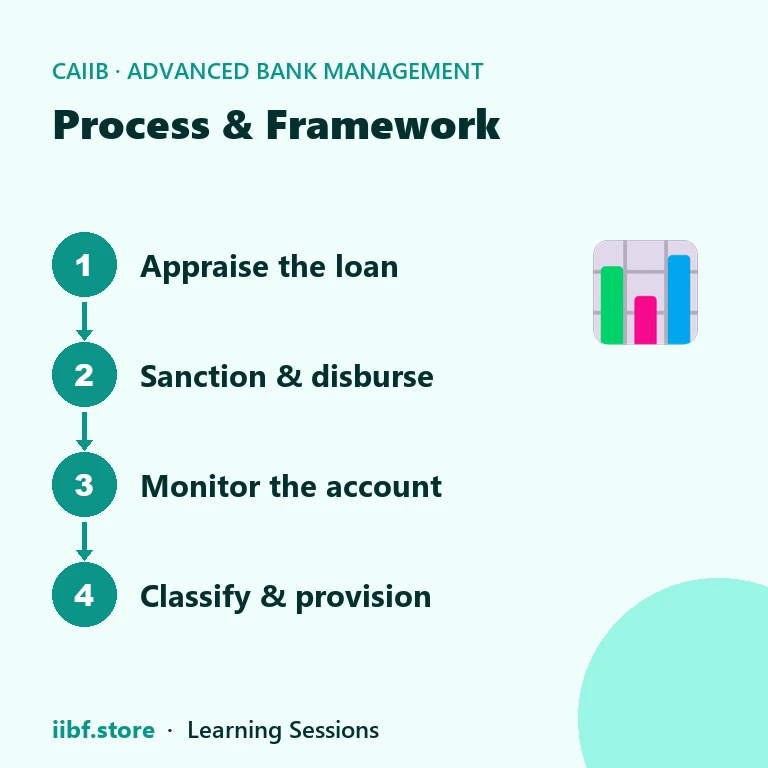
Effective credit risk management in banks is therefore a full life-cycle discipline. It begins at origination with borrower appraisal and credit scoring, continues through sanction with prudent structuring and covenants, and runs into the monitoring phase where early-warning signals flag stress before an account slips into non-performing territory. A sound framework rests on four pillars the RBI expects: a board-approved credit risk policy, clear organisational accountability, robust measurement systems, and independent review. The statistical foundations matter too — appraising a borrower's cash flows draws directly on the quantitative techniques CAIIB tests, so revisit correlation and regression to understand how banks model the relationship between financial ratios and default. A disciplined process converts subjective lending judgement into a repeatable, auditable system that both protects capital and satisfies supervisory scrutiny.
How banks measure and rate credit risk
Measurement is where ABM's numerical questions live. Banks convert qualitative judgement into a rating grade using internal credit rating models that combine financial, business, management and industry factors. Each grade maps to an estimated probability of default, allowing the bank to price loans, set exposure limits and compute provisions consistently. Larger banks adopt statistical scorecards for retail portfolios and expert-judgement models for corporate exposures, validating both against actual default experience.
Portfolio-level tools extend the single-borrower view. Credit Value at Risk (Credit VaR) estimates the maximum portfolio loss over a horizon at a given confidence level, while concentration analysis caps exposure to any single borrower, group or industry so one shock cannot threaten solvency. Migration analysis studies how accounts move between rating grades over time, and stress testing shocks the portfolio with adverse scenarios such as a sectoral downturn. Because these techniques rest on sampling and distribution theory, a strong grasp of sampling methods genuinely helps in the exam. You can drill the underlying quantitative concepts across the full Advanced Bank Management revision hub, which collects statistics, credit and treasury topics in one place for focused practice before the paper.
Basel norms and the regulatory capital link
Credit risk is the largest driver of a bank's regulatory capital requirement, which is why the Basel framework sits at the heart of this syllabus. Under Basel norms as implemented by the RBI, banks compute risk-weighted assets (RWAs) for credit exposures and must hold minimum capital against them. India follows the Basel III standards, layering a capital conservation buffer and a leverage ratio on top of the minimum total capital requirement to strengthen loss absorption. The exact percentages are set by RBI circulars, so quote them qualitatively unless you have verified the current figure from a primary source.
The table below summarises the approaches ABM expects you to distinguish. Note that the Standardised Approach uses external ratings and regulator-set risk weights, while the Internal Ratings-Based (IRB) approaches let qualifying banks use their own PD and LGD estimates, subject to supervisory approval.
| Approach | Who sets risk inputs | Key feature |
|---|---|---|
| Standardised Approach | Regulator (fixed risk weights) | Uses external credit ratings; simplest to apply |
| Foundation IRB | Bank estimates PD; regulator sets LGD/EAD | Partial internal modelling, needs RBI approval |
| Advanced IRB | Bank estimates PD, LGD and EAD | Most risk-sensitive; strictest validation |
For the exam, link the measurement concepts above to capital: a higher probability of default raises the risk weight, which increases RWAs and therefore the capital the bank must hold. This feedback loop is why disciplined rating and provisioning directly protect the capital adequacy ratio. Read the primary framework on the Reserve Bank of India website to confirm current buffers before relying on any specific percentage in an answer.
RBI governance, monitoring and control
The final block covers the control environment, and it is where conceptual questions cluster. The RBI requires every bank to run credit risk management under a board-approved policy that defines risk appetite, delegation of sanctioning powers, prudential exposure limits and the framework for pricing risk. Independence is central: the credit risk management department must be functionally separate from the business units that originate loans, so that risk assessment is not compromised by growth targets. A Credit Risk Management Committee typically owns policy, while a loan review mechanism independently re-examines large and sensitive accounts after sanction.
Monitoring turns policy into daily practice. Early-warning systems track covenant breaches, cheque returns, declining turnover and overdue interest to catch stress before an account becomes a non-performing asset. Prudential norms on income recognition and asset classification then govern how the bank recognises and provisions for deterioration, tying credit risk directly to reported profitability. Banks also use collateral, guarantees and, increasingly, credit risk transfer instruments to mitigate exposure. Estimating expected recovery from stressed accounts again relies on quantitative judgement — the estimation chapter underpins how banks project loss given default. To consolidate the full topic, work through the structured lessons in the CAIIB course and benchmark yourself with timed mock tests so recall becomes automatic under exam pressure.
Quick revision and exam tips
Before the exam, lock in the high-frequency facts. First, memorise the expected-loss formula and be ready to compute it from PD, EAD and LGD in a numerical question. Second, know the difference between the Standardised and IRB approaches under Basel — a favourite comparison question. Third, be clear that credit risk feeds regulatory capital through risk-weighted assets, so tighter risk management supports the capital adequacy ratio. Fourth, remember that the RBI mandates functional independence of the credit risk function and a board-approved policy; questions on governance almost always hinge on this separation.
Balance conceptual and numerical practice. ABM rewards candidates who can both define terms and apply them to a case, so alternate between reading notes and solving problems. Keep your regulatory figures current from primary sources rather than coaching PDFs, since Basel buffers and prudential norms are periodically revised. Spaced repetition of the rating, measurement, capital and governance blocks in this article will cover the bulk of what the paper asks on credit risk, leaving you time to focus on the statistics and treasury modules that round out the ABM syllabus.
Frequently asked questions
What is credit risk in the context of CAIIB Advanced Bank Management?
Credit risk is the possibility that a borrower or counterparty fails to meet its financial obligations under agreed terms. In ABM it is examined across loans, guarantees, letters of credit and derivatives, and is broken into default risk, exposure risk and recovery risk, which combine in the expected-loss formula PD × EAD × LGD.
How does credit risk affect a bank's capital requirement?
Credit risk is the biggest driver of risk-weighted assets. A higher probability of default raises the risk weight on an exposure, which increases RWAs and the minimum capital the bank must hold under Basel norms. Disciplined rating and provisioning therefore directly protect the capital adequacy ratio.
What is the difference between the Standardised and IRB approaches?
The Standardised Approach uses external credit ratings and regulator-set risk weights, making it simple to apply. The Internal Ratings-Based approaches let qualifying banks use their own estimates of PD (Foundation IRB) or PD, LGD and EAD (Advanced IRB), subject to RBI supervisory approval and stricter model validation.
What governance does the RBI expect for credit risk management?
The RBI expects a board-approved credit risk policy defining risk appetite and exposure limits, a credit risk management function that is independent of business origination units, a credit risk management committee owning policy, and an independent loan review mechanism that re-examines large accounts after sanction.
Ready to score this topic in the exam? Reinforce every concept above with structured lessons in the CAIIB Advanced Bank Management course and put your knowledge to the test with full-length CAIIB mock tests. Consistent, timed practice on credit risk is the fastest route to a confident pass.
Quick quiz on this topic
5 exam-style questions from our free test bank — check yourself before you move on.
Practice this topic
Take a free mock test, download chapter PDFs, or watch a video class — all included on iibf.store.
Keep reading



