
Is the CTP Exam Preparation Book Right for You? An Honest Guide
It is 10:40 at night. You have closed the branch, reached home, eaten something quick, and now a treasury syllabus is staring at you: money markets, bond duration, forex, swaps, options, dealing-room ethics. You are not lazy. You are tired, and you want to know whether one more purchase will actually help or whether it will become another unopened parcel on the shelf.
This guide is for that moment. We will go through who a CTP exam preparation book suits, who it does not suit on its own, and what to pair it with. Even if you never buy anything from us, the profiles and the checklist below should help you decide how to spend your limited evenings.
First, what does a CTP exam preparation book actually need to do?
The Certified Treasury Professional (CTP) paper is not a one-night subject. It mixes theory (markets, regulation, ethics) with numbers (bond pricing, time value of money, forex valuation). A good book for it has to do three jobs:
- Compress a wide syllabus into something you can finish while working full time.
- Organise topics in the order the syllabus follows, so you always know where you are.
- Test you while you read, because recognising a formula is very different from using it in a question.
A book cannot give you exam-hall speed by itself, and it cannot replace the official syllabus. Always confirm the current syllabus and the exam schedule for the upcoming cycle on the official site, www.iibf.org.in. With that said, let us look at what is in the book.
What is inside the Certified Treasury Professional printed book
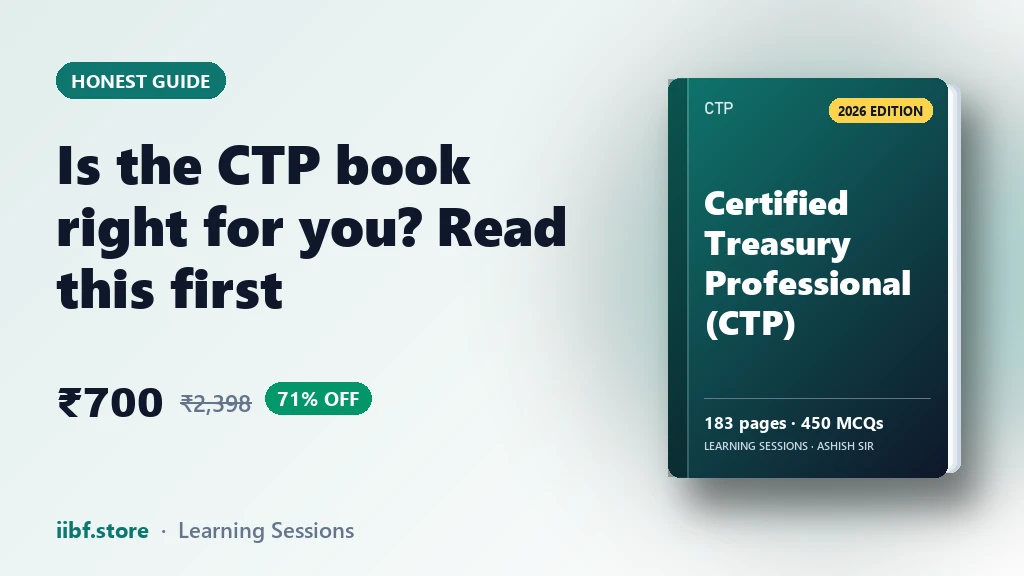
The Certified Treasury Professional printed book (2026 edition) runs to 183 pages and 30 chapters, with 450 questions. The chapters are grouped into seven modules:
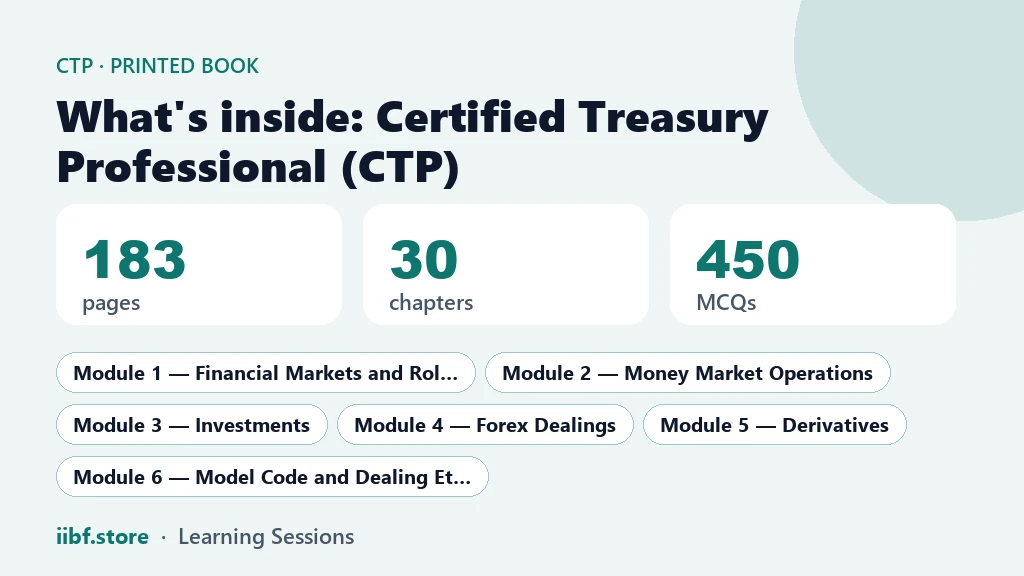
- Module 1: Financial Markets and Role of Treasury (3 chapters)
- Module 2: Money Market Operations (3 chapters)
- Module 3: Investments (13 chapters, including bond pricing, duration and convexity, accounting and valuation, exposure norms, audit and regulation)
- Module 4: Forex Dealings (5 chapters)
- Module 5: Derivatives (4 chapters, covering swaps, options and interest rate futures, caps and floors)
- Module 6: Model Code and Dealing Ethics (1 chapter)
- Module 7: Time Value of Money and Interest Rate Calculations (1 chapter)
Notice that Module 3 alone holds 13 of the 30 chapters. If you are short of time, that single fact should shape your plan. The listing also mentions extras: 60 case studies (240 questions) and 5 mega tests (500 questions). Check the book page for exactly how these are delivered, because that is where details are kept current.
Which reader are you? Four honest profiles
Most working bankers fall into one of four situations. Find yours, and read the "when it is not enough" line carefully.
Profile 1: First attempt, studying after office hours
You have never written the paper, and you are not sure where to begin. A structured CTP exam preparation book helps here because it removes the first big decision: what to read and in what order.
- How to use it: Go module by module in the printed order. Read one chapter, then immediately attempt its questions without looking at the answers. Keep a small notebook of formulas.
- Spend extra time on: Module 7 (time value of money) early, because bond pricing and forex valuation lean on it.
- When it is not enough: If you only read and never test yourself, you will feel prepared and still lose marks on application questions. Add timed mock tests in the last few weeks.
Profile 2: Repeat attempt
You have already written the paper once and fell short, or you postponed. Do not start from page one again. That is the most common mistake repeat candidates make.
- How to use it: Begin with the questions, not the text. Attempt a module's questions cold, mark what you got wrong, and read only those chapters. The 450 questions work as a diagnostic.
- Look for patterns: Are your errors in calculation (duration, forex valuation), or in recall (regulation, exposure norms, ethics)? The fix is different for each.
- When it is not enough: If your earlier attempt failed on time management rather than knowledge, another reading will not help. You need full-length practice under a timer.
Profile 3: Very short on time
Perhaps the exam is close and your branch is in audit season. Be realistic: a short book is not magic, but 183 pages is a manageable size to finish while someone else might still be choosing a source.
- How to use it: Prioritise by weight of chapters. Module 3 has the most chapters, so give it the biggest share. Do the numerical chapters (bond pricing, duration, time value of money, forex valuation) with a pen, not by reading.
- Skip nothing blindly: Short chapters such as ethics and the dealing-room code are quick to read and often easy marks.
- When it is not enough: If you have only days left, the book is for revision and question practice, not first-time learning of derivatives from scratch. Be honest with yourself about what you can cover.
Profile 4: You simply prefer paper
Some people retain far more from a page than a phone. If your eyes are tired of screens after a full day at the counter, a printed book is not a luxury. It is a way to keep studying at all.
- How to use it: Pencil in margins, flag pages with sticky tabs, and keep it in your bag for commute reading.
- The trade-off: Paper does not give you instant timed feedback. Use the free mock tests at iibf.store/tests on a screen for exam-style practice, and keep the book for reading and revision.
A simple comparison before you decide
Here is a quick table to match your situation with the way to use a CTP exam preparation book most effectively.
| Your situation | Start with | Pair it with |
|---|---|---|
| First attempt | Module order, chapter then questions | Timed mocks in final weeks |
| Repeat attempt | Questions first, then weak chapters | Full-length mocks for time practice |
| Short on time | Module 3 and numerical chapters | Quick revision of ethics and regulation |
| Prefers paper | Annotated reading, margin notes | Free online mocks for speed |
A four-step method that works for any profile
Whichever profile fits you, the following loop keeps your study honest. It is the plan we would suggest to a colleague who asked us over tea.
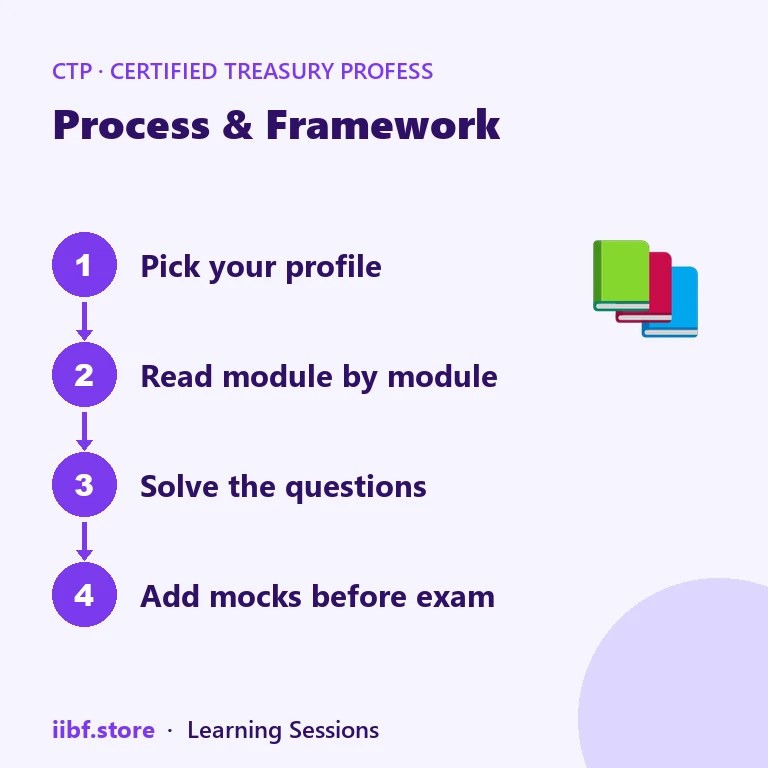
- Pick your profile. Decide whether you are in learning mode or revision mode. This changes where you start.
- Read module by module. Do not jump around. Finish a module before opening the next, and note formulas separately.
- Solve the questions. Treat the 450 questions as the real test of reading. Redo wrong answers after two or three days.
- Add mocks before the exam. In the last weeks, practise full-length papers on a timer. This is where speed comes from.
If you want free material to begin with before spending anything, browse free study material on our site and see how the topics are explained. You can also read the free sample for the book, so you judge the writing style before ordering.
When you should probably NOT buy this book
Trust matters more than a sale, so here are honest reasons to hold back:
- You already have a full set of notes you trust and you finish them on time. Another source may only add confusion.
- You want a book that replaces classroom explanation of derivatives. A compact book is a revision and practice tool, and some topics may need a lecture or video alongside.
- You expect a printed book to guarantee a pass. No book does. Your hours, your practice and your attempt strategy decide the result.
If, on the other hand, you want one organised, printed source across all seven modules with a large question bank, the CTP printed book is a reasonable fit. It is currently listed at ₹700 against an MRP of ₹2,398 (prices may change, so the book page is always the current reference). You can also see other titles on the books page.
Final thought: choose the tool that you will actually open
The best CTP exam preparation book is the one you open at 10:40 at night when you would rather sleep. Look at your profile, be honest about your weak spots, add mock tests for speed, and keep checking the official exam notices. Small, steady sessions across seven modules beat one heroic weekend every time.
Frequently asked questions
Is one book enough to clear the CTP exam?
A book is the base, not the whole plan. Pair it with timed mock tests and the official syllabus from the IIBF website. Reading alone rarely builds exam-hall speed.
How many pages and questions does the book have?
The 2026 edition has 183 pages, 30 chapters and 450 questions, organised into seven modules from financial markets to time value of money.
Can I see the content before ordering?
Yes. A free sample is available on the book page, so you can judge the style and level of explanation first.
Where do I find the exam date and fees?
Always check the official IIBF website at www.iibf.org.in for the schedule of the upcoming exam cycle, since dates and fees can change.
Prefer revising from a printed book?
Chapter-wise books with MCQs after every chapter — minimal pages, complete coverage, delivered anywhere in India. Every book has a free sample to read first.


















































Quick quiz on this topic
5 exam-style questions from our free test bank — check yourself before you move on.
Practice this topic
Take a free mock test, download chapter PDFs, or watch a video class — all included on iibf.store.