Data Encryption in Banks: IIBF IT Security Exam Guide
Data encryption in banks is the backbone of modern IT security, and it is one of the most heavily examined topics in the IIBF IT Security certificate. When a bank stores customer PINs, transmits SWIFT payment messages, or backs up core-banking data, encryption is what keeps that information unreadable to anyone without the right key. For candidates preparing the IT Security paper, understanding how encryption works — and where the RBI expects it to be applied — is not optional. This guide breaks down the algorithms, the key-management discipline, and the regulatory expectations you must know, mapped directly to the exam syllabus so you can revise efficiently and score confidently.
What Data Encryption Means in a Banking Context
Encryption is the process of converting readable information (plaintext) into an unreadable form (ciphertext) using an algorithm and a key. Only a party holding the correct key can reverse the process and recover the original data. In banking, this protects two states of information: data at rest (stored on disks, databases, tapes, and backups) and data in transit (moving across networks, ATMs, internet-banking channels, and interbank links).
The IIBF syllabus distinguishes between two broad families. Symmetric encryption uses a single shared secret key for both encryption and decryption — AES (Advanced Encryption Standard) is the dominant example, valued for speed on large volumes. Asymmetric encryption uses a mathematically linked key pair, a public key and a private key; RSA and ECC are the common schemes, and they underpin digital signatures and secure key exchange. Most real bank systems combine the two: asymmetric cryptography exchanges a session key, then fast symmetric cryptography protects the bulk data. A candidate who understands this hybrid model, along with the role of hashing (SHA-256) for integrity, has covered the conceptual core the exam tests. This foundation connects directly to the wider access-control and asset-protection topics you will study under the security-controls modules.
Encryption Algorithms and Standards You Must Know
The exam expects familiarity with the main algorithms, their key lengths, and where each is used. AES with 128-, 192-, or 256-bit keys is the accepted standard for symmetric encryption; the older DES (56-bit) is considered broken and Triple-DES (3DES) is being retired globally. For asymmetric work, RSA typically uses 2048-bit or larger keys, while ECC achieves comparable strength with much shorter keys, making it efficient for mobile and card environments. Transport security relies on TLS (Transport Layer Security), the successor to SSL, to encrypt internet-banking and API traffic.
| Algorithm | Type | Typical Key Length | Primary Banking Use |
|---|---|---|---|
| AES | Symmetric | 128 / 192 / 256-bit | Database, disk and backup encryption |
| 3DES | Symmetric | 112 / 168-bit | Legacy card / PIN systems (being retired) |
| RSA | Asymmetric | 2048-bit and above | Key exchange, digital signatures |
| ECC | Asymmetric | 256-bit (approx. RSA-3072) | Mobile banking, smart cards |
| SHA-256 | Hash (one-way) | 256-bit digest | Integrity checks, password storage |
| TLS 1.3 | Protocol | Negotiated | Internet banking, secure APIs |
Note the distinction the exam loves: hashing is one-way (you cannot recover the input) and is used for integrity and password verification, whereas encryption is reversible with a key. Confusing the two is a classic trap. You can drill deeper into how these controls are embedded during coding in the Controls in Software Development and Maintenance chapter.
Key Management: Where Most Failures Actually Happen
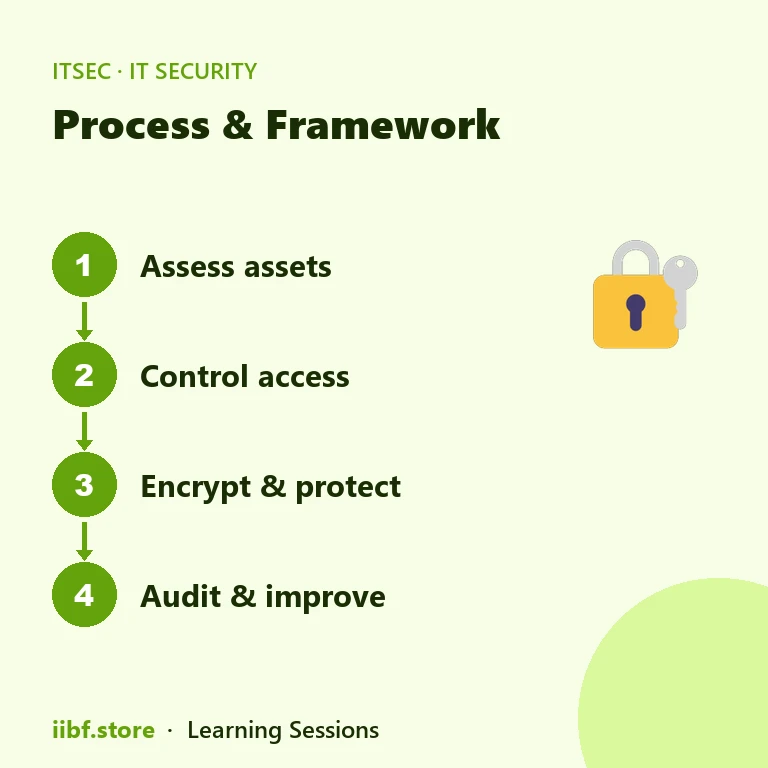
An encryption algorithm is only as strong as the secrecy of its keys. In practice, banks lose data not because AES was broken but because keys were stored carelessly, shared over insecure channels, or never rotated. The IIBF syllabus therefore stresses the full key lifecycle: generation (using strong random sources), distribution (secure exchange, often via asymmetric methods), storage (inside Hardware Security Modules, or HSMs), rotation (periodic replacement), and destruction (secure deletion of retired keys).
HSMs are tamper-resistant hardware devices that generate and hold keys so that the plaintext key never leaves the secure boundary — card networks and payment switches depend on them. Alongside keys, banks rely on a Public Key Infrastructure (PKI): Certificate Authorities issue digital certificates that bind a public key to a verified identity, enabling trusted TLS connections and digital signatures on documents and transactions. Understanding certificate validity, revocation (CRL / OCSP), and the role of the CA is frequently tested. Weak key management also intersects with physical safeguards, which is why you should review the Physical and Environmental Security Controls chapter — an attacker with server-room access can defeat even strong cryptography. For a broader view of the threat landscape these controls defend against, the IT Security Threats chapter is essential reading.
RBI Expectations and Regulatory Framework
Encryption in Indian banks is not merely good practice — it is a supervisory expectation. The Reserve Bank of India's cyber-security and IT-governance directions require regulated entities to protect sensitive customer and transaction data using strong, industry-accepted cryptographic controls, to manage keys securely, and to avoid deprecated algorithms. The RBI's guidance on internet banking, mobile banking, and its cyber-security framework consistently emphasises confidentiality of data in transit and at rest, secure configuration of channels, and end-to-end protection of payment messages. Candidates should treat encryption as one pillar of a layered defence rather than a standalone fix.
Internationally, standards such as ISO/IEC 27001 for information-security management and PCI-DSS for card data reinforce the same principles: encrypt cardholder data, restrict key access, and audit cryptographic operations. For authoritative primary-source reading, review the RBI's official circulars on the Reserve Bank of India website, which remain the definitive reference for what Indian banks must implement. Because regulatory numbers and framework versions can change, always verify the current circular status rather than memorising a figure that may be superseded. To keep your revision anchored to the correct syllabus, browse the full IT Security topic hub and stay current with policy shifts via our IIBF news and updates page.
How This Topic Is Tested and How to Revise
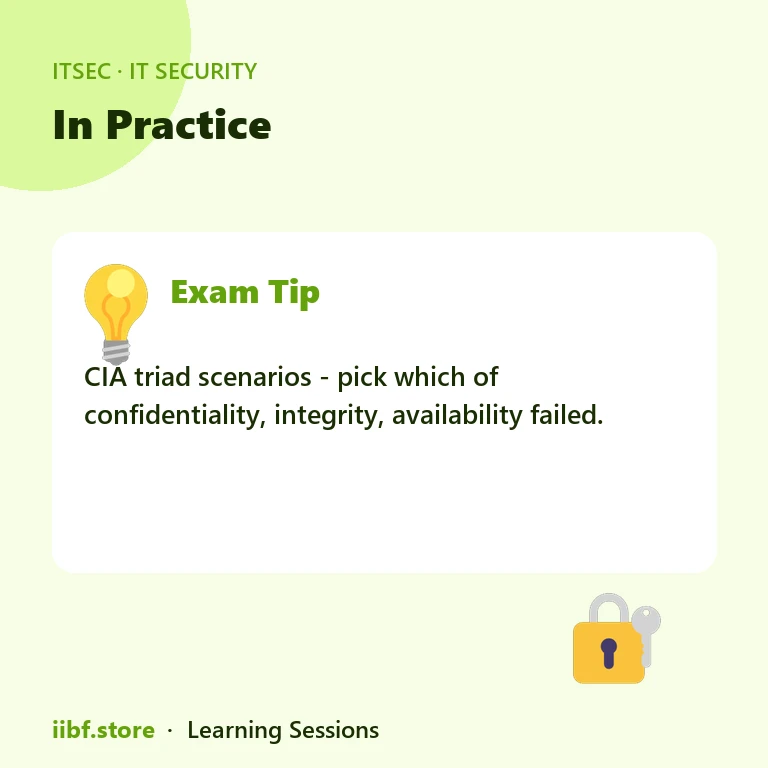
In the IT Security paper, encryption questions cluster around a few predictable areas: identifying whether a scenario needs symmetric or asymmetric encryption, matching algorithms to key lengths, distinguishing hashing from encryption, and recognising sound key-management practice. Expect application-style MCQs — for example, "Which technique ensures a message has not been altered in transit?" (answer: hashing / message digest) or "Which key does the sender use to create a digital signature?" (answer: the sender's private key).
The most efficient revision strategy is active recall on these distinctions, followed by timed practice. Read the security-standards material, then immediately test yourself so the concepts stick. Build a one-page summary comparing algorithm families, then rehearse the key lifecycle out loud. Reinforce weak spots with our match-the-concept game before moving to full-length mocks. Pairing conceptual reading with repeated question practice is what separates a comfortable pass from a near miss, because IT Security rewards precise terminology far more than rote memorisation of long definitions.
Frequently Asked Questions
What is the difference between symmetric and asymmetric encryption?
Symmetric encryption uses one shared secret key for both encryption and decryption and is fast, making it ideal for bulk data such as databases and backups (AES is the standard). Asymmetric encryption uses a linked public-private key pair; it is slower but enables secure key exchange and digital signatures. Banks typically combine both in a hybrid model.
Is hashing the same as encryption?
No. Encryption is reversible — with the correct key you can recover the original data. Hashing (for example SHA-256) is a one-way function: you cannot reverse a hash back to the input. Hashing is used for integrity verification and secure password storage, while encryption is used to protect confidentiality.
Why is key management so important in banks?
Because a strong algorithm is useless if its keys are exposed. Poor key generation, storage, or rotation is the most common cause of encryption failures. Banks use Hardware Security Modules (HSMs) to store keys securely and follow a full lifecycle — generation, distribution, storage, rotation, and destruction — to keep keys protected.
Does the RBI require banks to use encryption?
Yes. The RBI's cyber-security and IT-governance directions expect regulated entities to protect sensitive customer and transaction data with strong, industry-accepted cryptographic controls, both in transit and at rest, and to avoid deprecated algorithms. Always check the latest RBI circulars on rbi.org.in for the current requirements.
Conclusion
Data encryption in banks turns unreadable ciphertext into a genuine safeguard only when the right algorithm, disciplined key management, and RBI-aligned governance work together. Master the symmetric-versus-asymmetric distinction, the algorithm-to-key-length map, the key lifecycle, and the hashing-versus-encryption trap, and you will have covered the bulk of what the IT Security paper asks. Now convert that understanding into marks: attempt a full-length IT Security mock test to pressure-test your recall under exam conditions, and read the Security Standards and Best Practices chapter to lock in the framework knowledge examiners reward.
Practice this topic
Take a free mock test, download chapter PDFs, or watch a video class — all included on iibf.store.