Debt-Equity Ratio & Net Worth: JAIIB AFM Quick Revision
If you have five minutes before you close your books tonight, the debt-equity ratio is the single most rewarding topic to revise in JAIIB AFM. It shows up almost every session, the calculation is short, and once you understand what it is really measuring you rarely get it wrong again. This quick revision walks you through net worth first, then the debt-equity ratio itself, a fully worked example, the values examiners treat as "safe", and the small traps that cost candidates a mark they should have banked.
Debt-Equity Ratio & Net Worth in 5 Minutes · Watch on YouTube
Start with net worth, not the ratio
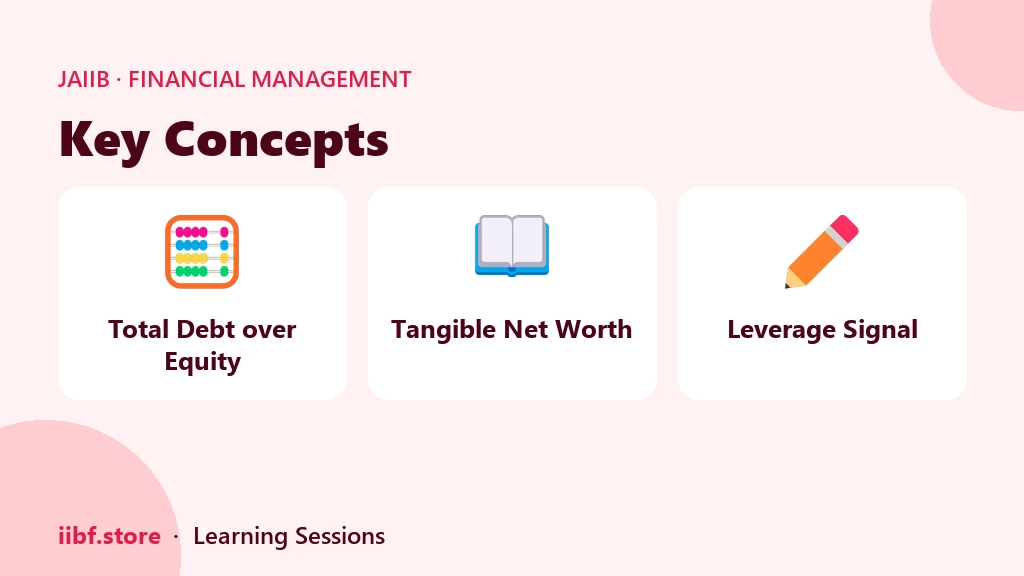
Net worth is simply what the owners of a business truly own once every outside claim is paid off. On a balance sheet it equals share capital plus reserves and surplus, which is the same as total assets minus total outside liabilities. When an examiner mentions "tangible net worth", they want you to further remove intangible items such as goodwill, preliminary expenses and accumulated losses, because a banker cannot recover money against a brand name. Getting net worth right is half the battle, because the debt-equity ratio is built directly on top of it.
The debt-equity ratio formula
The debt-equity ratio compares how much of the business is funded by borrowed money against how much is funded by the owners. The formula is:
Debt-Equity Ratio = Total Long-Term Debt ÷ Shareholders' Equity (Net Worth)
A ratio of 2:1 means the company has borrowed two rupees for every one rupee the owners have put in. Some questions ask for the "total debt to equity" version, which adds short-term borrowings into the numerator, so always read whether the examiner wants long-term debt only or all outside liabilities. This distinction is the most common reason a correct method still lands on the wrong option.
A worked example you can copy in the exam
Suppose a firm has term loans of ₹60 lakh, share capital of ₹20 lakh and reserves of ₹10 lakh. Net worth is ₹20 + ₹10 = ₹30 lakh. The debt-equity ratio is ₹60 ÷ ₹30 = 2:1. Now watch what happens if the firm has goodwill of ₹6 lakh: tangible net worth falls to ₹24 lakh, and the debt-equity ratio rises to 2.5:1. Same company, riskier picture once you strip the intangibles.
| Item | Amount (₹ lakh) |
|---|---|
| Term loans (debt) | 60 |
| Share capital | 20 |
| Reserves & surplus | 10 |
| Net worth | 30 |
| Debt-equity ratio | 2 : 1 |
| Tangible net worth (less ₹6 goodwill) | 24 |
| Adjusted debt-equity ratio | 2.5 : 1 |
What counts as a healthy debt-equity ratio?
As a broad banking benchmark, a debt-equity ratio up to 2:1 is generally considered comfortable for a manufacturing borrower, while capital-heavy sectors like infrastructure are allowed higher gearing. A very low ratio signals the owners are self-financing and may be under-using cheap borrowed funds; a very high ratio signals thin owner stake and higher default risk. Bankers read the debt-equity ratio alongside interest coverage and current ratio, never in isolation. For the exam, remember that a rising ratio over the years is a warning sign the examiner wants you to flag.
The MCQ traps to avoid
Three traps repeat every session. First, mixing up long-term debt with total outside liabilities in the numerator. Second, forgetting to deduct intangibles when the question says "tangible" net worth. Third, inverting the ratio and reporting equity over debt. Slow down for two seconds, label your numerator and denominator, and these three points are yours. Practise a handful of numericals daily and the debt-equity ratio becomes an automatic mark.
Reinforce it with a full mock on our JAIIB test series, keep your revision on schedule with the study planner, and browse the complete JAIIB course for the rest of the AFM ratio chapter. You can also confirm the current exam pattern on the official IIBF website before your attempt, and read more revision notes on the iibf.store blog.
Why the debt-equity ratio matters on the sanction desk
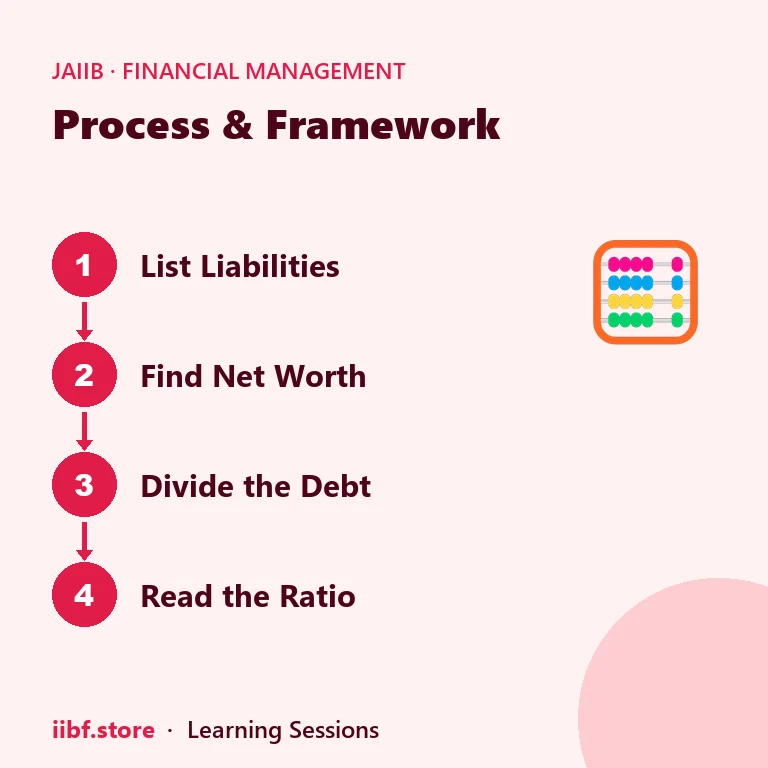
It helps to remember that the debt-equity ratio is not an academic exercise; it is one of the first numbers a credit officer looks at before recommending a loan. When a borrower approaches a bank for a term loan, the sanctioning authority checks how much skin the promoters already have in the game. A comfortable debt-equity ratio tells the banker that the owners have committed real capital and will fight to keep the business alive if things go wrong. A stretched ratio tells the opposite story: the promoters have put in very little and are asking the bank to carry most of the risk. That single insight is why the debt-equity ratio appears in almost every appraisal note, and why JAIIB AFM keeps returning to it.
There is also a margin angle. If a project needs ₹100 crore and the bank insists on a 2:1 debt-equity ratio, the promoters must bring in at least ₹33 crore of their own money before the bank funds the remaining ₹67 crore. Change the required ratio and you change the promoter contribution, so exam questions often work backwards: they give you the loan and the target debt-equity ratio and ask for the equity the promoter must inject. Practise that reverse calculation, because it is a favourite twist and it uses exactly the same formula, just rearranged.
Finally, treat the debt-equity ratio as a trend rather than a single snapshot. A ratio of 1.5:1 that has climbed steadily from 0.8:1 over three years is more worrying than a flat 2:1, because the direction signals a business leaning harder on borrowed money each year. Bankers and examiners both reward the candidate who reads the movement, not just the number. Combine that habit with the clean four-step method above and you will handle any debt-equity ratio question the paper offers.
What is the ideal debt-equity ratio for JAIIB AFM answers?
A debt-equity ratio up to 2:1 is usually treated as comfortable for a typical borrower, though capital-intensive industries are permitted higher gearing. Read each question for the sector before choosing an option.
Is net worth the same as tangible net worth?
No. Net worth is capital plus reserves. Tangible net worth removes intangible assets such as goodwill, preliminary expenses and accumulated losses, so it is always equal to or lower than net worth.
Do I use long-term debt or total debt in the ratio?
The classic debt-equity ratio uses long-term debt in the numerator. If the question says "total outside liabilities to net worth", include short-term borrowings too. The wording tells you which version to apply.
Why do bankers care about the debt-equity ratio?
It shows how much of the business is funded by lenders versus owners. A high ratio means a thin owner cushion and greater default risk, which affects sanction, pricing and margin decisions.
Prefer revising from a printed book?
Chapter-wise books with MCQs after every chapter — minimal pages, complete coverage, delivered anywhere in India. Every book has a free sample to read first.
128 pages · 524 MCQs
Learning Sessions · Ashish Sir
131 pages · 672 MCQs
Learning Sessions · Ashish Sir
221 pages · 831 MCQs
Learning Sessions · Ashish Sir
107 pages · 445 MCQs
Learning Sessions · Ashish Sir
148 pages · 478 MCQs
Learning Sessions · Ashish Sir
151 pages · 465 MCQs
Learning Sessions · Ashish Sir
148 pages · 375 MCQs
Learning Sessions · Ashish Sir
216 pages · 895 MCQs
Learning Sessions · Ashish Sir
109 pages · 300 MCQs
Learning Sessions · Ashish Sir
104 pages · 360 MCQs
Learning Sessions · Ashish Sir
82 pages · 297 MCQs
Learning Sessions · Ashish Sir
151 pages · 600 MCQs
Learning Sessions · Ashish Sir
98 pages · 282 MCQs
Learning Sessions · Ashish Sir
132 pages · 225 MCQs
Learning Sessions · Ashish Sir
188 pages · 435 MCQs
Learning Sessions · Ashish Sir
117 pages · 236 MCQs
Learning Sessions · Ashish Sir
Learning Sessions · Ashish Sir
118 pages · 299 MCQs
Learning Sessions · Ashish Sir
Learning Sessions · Ashish Sir
Learning Sessions · Ashish Sir
Learning Sessions · Ashish Sir
115 pages · 255 MCQs
Learning Sessions · Ashish Sir
Learning Sessions · Ashish Sir
334 pages · 936 MCQs
Learning Sessions · Ashish Sir
Learning Sessions · Ashish Sir
115 pages · 344 MCQs
Learning Sessions · Ashish Sir
107 pages · 240 MCQs
Learning Sessions · Ashish Sir
90 pages · 150 MCQs
Learning Sessions · Ashish Sir
Learning Sessions · Ashish Sir
Quick quiz on this topic
5 exam-style questions from our free test bank — check yourself before you move on.
Practice this topic
Take a free mock test, download chapter PDFs, or watch a video class — all included on iibf.store.