Standard Deviation, Variance & CV: CAIIB ABM Revision
Statistics feels heavy in CAIIB ABM until you realise most of the marks sit on one idea: the standard deviation. Get comfortable with it and variance, coefficient of variation and even the harder distribution questions fall into place. This quick revision keeps things concrete: what the standard deviation actually measures, how it links to variance, when to switch to the coefficient of variation, and the traps that catch candidates who memorise the formula without understanding it.
Standard Deviation, Variance & CV · Watch on YouTube
What the standard deviation measures
The standard deviation tells you how far, on average, the values in a data set sit from their mean. A small standard deviation means the data is tightly clustered and predictable; a large one means it is spread out and volatile. In banking this is exactly how risk is described, which is why the topic matters far beyond the exam hall. Whenever a question talks about consistency, stability or dispersion, the standard deviation is the tool the examiner has in mind.
Variance and standard deviation: the link
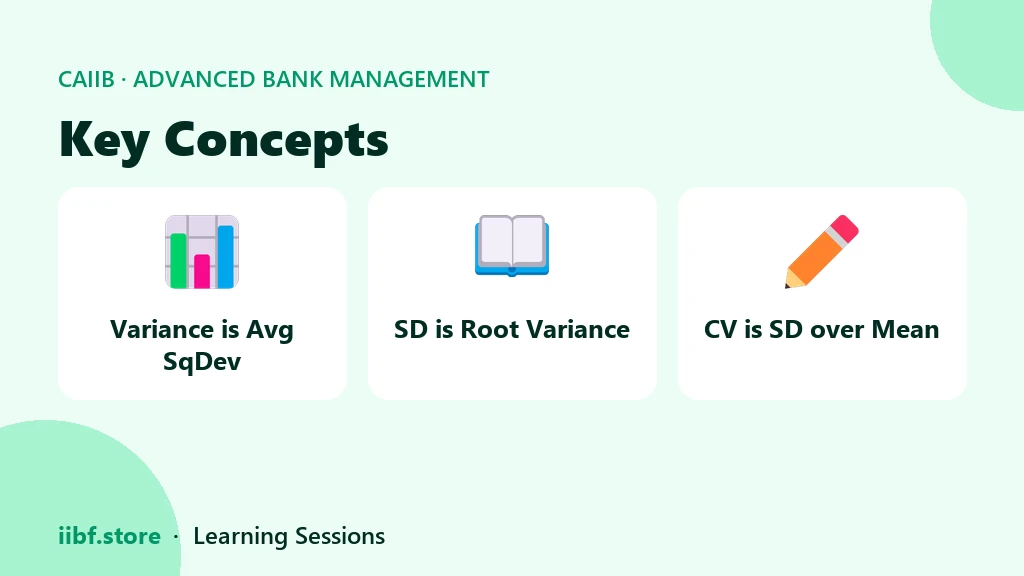
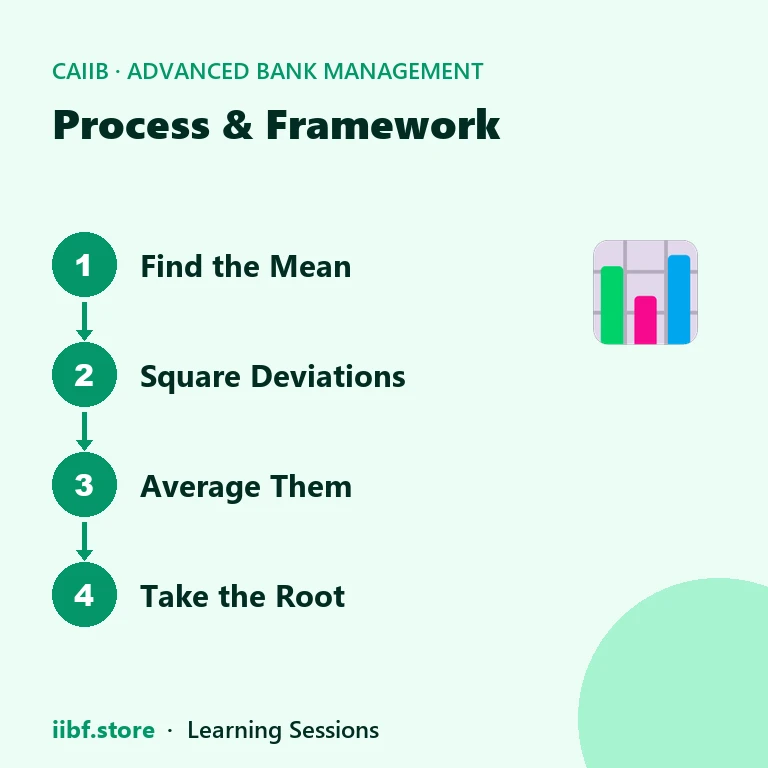
Variance and the standard deviation are two views of the same thing. Variance is the average of the squared deviations from the mean. Because it is in squared units it is hard to interpret, so we take its square root and get the standard deviation, which is back in the original units. In short: variance is the middle step, the standard deviation is the answer you report. The formulas are:
Variance = ∑(x − mean)² ÷ n
Standard Deviation = √Variance
A worked example you can reuse
Take five values: 2, 4, 6, 8, 10. The mean is 6. The deviations are −4, −2, 0, 2, 4 and their squares are 16, 4, 0, 4, 16, which add to 40. Variance is 40 ÷ 5 = 8, so the standard deviation is √8 ≈ 2.83. That single sequence of steps answers almost every direct numerical the exam throws at you.
| Value (x) | x − mean | (x − mean)² |
|---|---|---|
| 2 | −4 | 16 |
| 4 | −2 | 4 |
| 6 | 0 | 0 |
| 8 | 2 | 4 |
| 10 | 4 | 16 |
| Sum of squares | 40 | |
| Variance (40 ÷ 5) | 8 | |
| Standard deviation (√8) | ≈ 2.83 | |
Coefficient of variation: comparing two data sets
The standard deviation cannot fairly compare two data sets that are measured in different units or on very different scales. That is where the coefficient of variation (CV) comes in. CV = (standard deviation ÷ mean) × 100, expressed as a percentage. The data set with the lower CV is the more consistent one. A classic ABM question gives you two investments or two branches and asks which is more stable; the answer is always the one with the smaller CV, not the smaller standard deviation.
The traps that cost marks
First, forgetting to square-root the variance and reporting variance as the standard deviation. Second, dividing by the wrong denominator when the question specifies a sample rather than a population. Third, comparing raw standard deviations across data sets when the coefficient of variation is the correct measure. Label each step, and this is one of the most reliable scoring areas in the paper. Drill it with a full mock on our CAIIB test series, revise the wider syllabus in the Advanced Bank Management course, and explore the whole CAIIB programme. You can verify the current ABM syllabus on the official IIBF site and read more revision notes on the blog.
The standard deviation in day-to-day banking
The reason CAIIB spends so much time on the standard deviation is that risk management runs on it. When a bank measures the volatility of a stock, a bond portfolio or the daily movement of an exchange rate, the standard deviation is the headline number. A larger standard deviation means larger swings, which means the bank must hold more capital against that position. This is not theory tucked away in a textbook; it feeds directly into value-at-risk models, treasury limits and the way a dealer's book is monitored through the day. Understanding the standard deviation therefore pays off well beyond the exam.
Consider two loan portfolios that both return an average of 10 percent. If the first has a standard deviation of 2 percent and the second has a standard deviation of 6 percent, the second is three times as volatile even though the averages match. A prudent banker prefers the steadier portfolio, and the coefficient of variation makes that preference precise by scaling the standard deviation against the mean. Exam questions love this exact setup because it forces you to look past the average and reason about spread, which is the whole point of the topic.
One more practical note: real data is rarely as tidy as the five numbers in a worked example. Frequency-distribution questions give you class intervals and frequencies, and you compute the standard deviation using mid-points weighted by frequency. The logic is identical, only the arithmetic is longer, so keep your working neat and label every column. Master the small example first, then scale the same steps up to grouped data, and the standard deviation stops being intimidating and becomes one of the most dependable scoring areas in the ABM paper.
What does the standard deviation tell a banker?
It measures how spread out a data set is around its mean. A larger standard deviation means more volatility and, in banking terms, more risk; a smaller one means greater consistency.
How is variance different from the standard deviation?
Variance is the average of the squared deviations from the mean and is in squared units. The standard deviation is the square root of the variance, which brings the figure back into the original units.
When should I use the coefficient of variation instead?
Use CV when comparing two data sets with different means or units. CV equals the standard deviation divided by the mean, times 100; the lower CV indicates the more consistent series.
Do I divide by n or n minus 1?
For a full population divide by n. If the question clearly refers to a sample, divide by n minus 1. The wording of the CAIIB ABM question tells you which case applies.
Prefer revising from a printed book?
Chapter-wise books with MCQs after every chapter — minimal pages, complete coverage, delivered anywhere in India. Every book has a free sample to read first.
148 pages · 478 MCQs
Learning Sessions · Ashish Sir
151 pages · 465 MCQs
Learning Sessions · Ashish Sir
148 pages · 375 MCQs
Learning Sessions · Ashish Sir
216 pages · 895 MCQs
Learning Sessions · Ashish Sir
109 pages · 300 MCQs
Learning Sessions · Ashish Sir
104 pages · 360 MCQs
Learning Sessions · Ashish Sir
82 pages · 297 MCQs
Learning Sessions · Ashish Sir
151 pages · 600 MCQs
Learning Sessions · Ashish Sir
98 pages · 282 MCQs
Learning Sessions · Ashish Sir
131 pages · 672 MCQs
Learning Sessions · Ashish Sir
221 pages · 831 MCQs
Learning Sessions · Ashish Sir
128 pages · 524 MCQs
Learning Sessions · Ashish Sir
107 pages · 445 MCQs
Learning Sessions · Ashish Sir
132 pages · 225 MCQs
Learning Sessions · Ashish Sir
188 pages · 435 MCQs
Learning Sessions · Ashish Sir
117 pages · 236 MCQs
Learning Sessions · Ashish Sir
Learning Sessions · Ashish Sir
118 pages · 299 MCQs
Learning Sessions · Ashish Sir
Learning Sessions · Ashish Sir
Learning Sessions · Ashish Sir
Learning Sessions · Ashish Sir
115 pages · 255 MCQs
Learning Sessions · Ashish Sir
Learning Sessions · Ashish Sir
334 pages · 936 MCQs
Learning Sessions · Ashish Sir
Learning Sessions · Ashish Sir
115 pages · 344 MCQs
Learning Sessions · Ashish Sir
107 pages · 240 MCQs
Learning Sessions · Ashish Sir
90 pages · 150 MCQs
Learning Sessions · Ashish Sir
Learning Sessions · Ashish Sir
Quick quiz on this topic
5 exam-style questions from our free test bank — check yourself before you move on.
Practice this topic
Take a free mock test, download chapter PDFs, or watch a video class — all included on iibf.store.