Gold Loan vs Loan Against Securities: A Retail Banking Guide (2026)
A retail lending officer routinely gets asked the same question at the branch counter: should a customer pledge gold or pledge shares to raise quick funds? Understanding gold loan vs loan against securities is core JAIIB Retail Banking and Wealth Management syllabus, and it shows up again and again in exam case-lets that ask you to recommend the "right" secured facility for a given customer profile. Both products are secured, both are fast to sanction, and both avoid the paperwork of an unsecured personal loan — but the collateral, the loan-to-value (LTV) math, and the risk each carries for the bank are very different, and IIBF loves testing exactly where they diverge.
This guide walks through both products the way the introduction to retail banking chapter frames them — as everyday secured-lending tools inside a bank's retail book — before drilling into LTV caps, pricing, tenure and the exam angles you are likely to face.
🏦 What Is a Gold Loan?
A gold loan is a secured advance where a customer pledges gold jewellery or ornaments (and, in limited cases, gold coins up to 50 grams sold by the bank) as collateral. The bank appraises purity and net weight, values the gold at the average of the previous 30 days' closing price published by the India Bullion and Jewellers Association, and disburses funds against that valuation. This appraisal-driven, physical-collateral model is exactly the kind of retail lending activity covered under retail banking concepts in the JAIIB syllabus.
Gold loans are popular because turnaround time is measured in minutes to hours, not days. There is minimal income documentation — many banks skip ITRs or salary slips entirely because the gold itself is the primary security. Funds can be used for any purpose: working capital, medical emergencies, agriculture, or a wedding. Tenure is typically short, six months to three years, and repayment can be bullet (principal at end), EMI, or overdraft-style with interest serviced monthly. Because the collateral sits in the bank's strong room, default recovery is fast — the bank can auction the ornaments after a notice period, which is why gold loans carry lower credit risk than most unsecured retail products despite serving lower-income and self-employed borrowers who might not otherwise qualify.
📊 What Is a Loan Against Securities?
A Loan Against Securities (LAS) is a credit facility — usually structured as an overdraft or cash-credit line — sanctioned against the pledge or lien of financial instruments: listed equity shares held in demat form, debt instruments, government securities, insurance policies, or units of specified funds. Instead of a one-time disbursal, the bank typically opens a drawing-power-linked overdraft account, and the customer pays interest only on the amount actually utilised, not on the full sanctioned limit.
Because market-linked securities can swing in value daily, banks apply haircuts that are far more conservative than gold LTV norms, and they mark the pledged portfolio to market regularly. If the value of the pledged shares falls and drawing power drops below the outstanding utilisation, the bank issues a margin call asking the customer to either pledge more securities or repay the shortfall. LAS is popular with salaried and HNI-adjacent customers who don't want to liquidate a long-term equity or bond holding just to meet a short-term liquidity need — it lets the portfolio stay invested while still working as collateral.
⚖️ Gold Loan vs Loan Against Securities: Key Differences
The cleanest way to remember gold loan vs loan against securities for the exam is to anchor on three axes: what backs the loan, how volatile that backing is, and how the RBI caps the LTV as a result.
| Parameter | Gold Loan | Loan Against Securities |
|---|---|---|
| Collateral | Gold jewellery / ornaments | Shares, bonds, mutual fund units, insurance policies |
| Maximum LTV (RBI norm) | 75% of gold value | 50% for listed equity shares (higher for debt instruments) |
| Collateral volatility | Relatively low (bullion price) | High (equity market linked) |
| Facility type | Term loan / OD / bullet | Usually revolving overdraft |
| Disbursal speed | Same day, minimal docs | 1-2 days, demat pledge process |
| Income proof required | ❌ Usually not mandatory | ✅ Often required for limit review |
| Mark-to-market / margin calls | Not applicable | Frequent, especially for equities |
💰 Interest Rates, LTV Ratios and Tenure
Gold loan interest rates from scheduled commercial banks typically range from about 9% to 16% p.a., priced off the repo-linked lending rate plus a spread, with NBFCs often pricing higher. The RBI caps the LTV at 75% of the gold's value for consumption/other-purpose gold loans; agricultural gold loans under priority sector norms may see different treatment. Tenure is usually short — most banks cap gold loan tenure between 12 months and 3 years, encouraging periodic renewal and revaluation.
Loan Against Securities pricing tends to run slightly lower, roughly 9% to 12% p.a. for a well-diversified, low-volatility pledge, because the facility is typically an overdraft where interest accrues only on drawn amounts. The RBI's LTV cap of 50% for loans against dematerialised shares is meant to build in a cushion against a market correction — if equity prices fall 20%, the bank's exposure is still covered. Debt-oriented collateral such as government securities or debt mutual fund units usually gets a friendlier LTV, sometimes 80-90%, since price volatility is far lower than equities. LAS limits are typically reviewed and renewed annually, unlike a fixed-tenure gold loan.
💡 Exam Tip: If a question gives you an LTV figure of 75%, think gold loan. If it gives you 50% against listed shares, think Loan Against Securities. IIBF frequently swaps these numbers in distractor options.
🎯 Which Product Fits Which Customer?
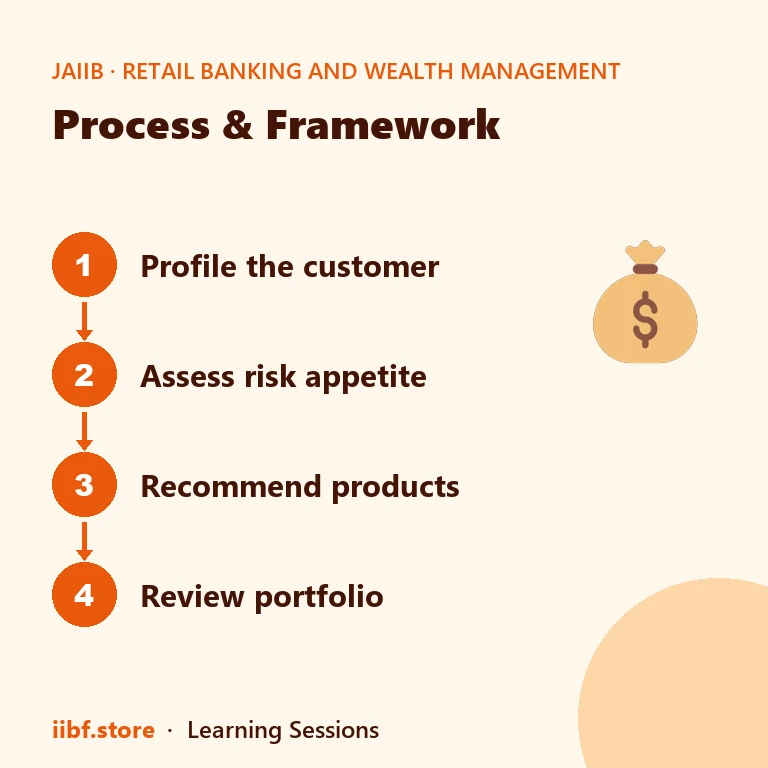
A candidate should be able to map customer profile to product in seconds. A self-employed shopkeeper needing same-day working capital, with gold jewellery at home and no formal income proof, is a textbook gold loan case — fast, low-documentation, and the gold itself de-risks the bank. A salaried professional holding a demat portfolio of blue-chip shares who needs bridge funding for three months, and does not want to sell and trigger capital gains tax, is the classic Loan Against Securities case — the portfolio stays invested and keeps earning dividends or interest while acting as collateral.
The exam also tests risk management angles: gold loan risk is concentrated in purity fraud and gold price crashes, so banks insure the pledged ornaments and conduct periodic physical verification. LAS risk is concentrated in market volatility, so banks build in margin calls and lien-marking with depositories. A well-prepared candidate connects both products back to the retail lending fundamentals taught alongside topics like turnover and collection ratios, since both areas test how a banker reads a borrower's cash-flow and asset profile before sanctioning credit.
⚠️ Common Mistake: Students often assume gold loans always carry lower interest than LAS. That is not guaranteed — pricing depends on the bank's cost of funds and the customer's relationship, not just the collateral type.
📌 Remember: LTV caps are set by the RBI to protect the bank's balance sheet from collateral-value erosion — gold at 75%, listed equity shares at 50%.
For customers who want to explore other secured, wealth-linked retail facilities, banks also cross-sell portfolio management services, while senior citizens with residential property but limited cash flow are usually routed toward a reverse mortgage loan scheme instead of a securities-backed facility. Higher-ticket relationship customers may eventually graduate into Private Banking Services for HNI Clients, where secured lending is bundled with a broader relationship-management approach. All of these sit under the same Retail Banking and Wealth Management syllabus umbrella, so treat them as one connected map rather than isolated topics.
🧠 Practice MCQs: Gold Loan vs Loan Against Securities
Q1. As per RBI norms, what is the maximum permissible LTV ratio for a bank's gold loan against jewellery/ornaments? (a) 50% (b) 60% (c) 75% (d) 90%
Answer: (c) — RBI caps gold loan LTV at 75% of the value of the pledged gold jewellery/ornaments.
Q2. Loans against listed equity shares held in demat form are subject to a maximum LTV of: (a) 50% (b) 65% (c) 75% (d) 90%
Answer: (a) — RBI mandates a 50% LTV cap for bank advances against dematerialised listed equity shares, reflecting their price volatility.
Q3. A Loan Against Securities facility is most commonly structured by banks as a: (a) fixed-tenure term loan (b) overdraft/cash-credit account against pledged securities (c) bullet-repayment personal loan (d) gold loan variant
Answer: (b) — LAS is usually an overdraft or cash-credit line where interest is charged only on the utilised drawing power.
Q4. What is the key structural difference driving the gap in LTV caps between a gold loan and a loan against securities? (a) both use identical collateral (b) gold value is relatively stable while listed security prices are market-volatile (c) LAS never requires income proof (d) gold loans cannot be renewed
Answer: (b) — Gold's relative price stability supports a higher LTV (75%), while equity market volatility justifies a lower cap (50%) to protect the bank against sharp price falls.
Q5. On default in a gold loan account, what is the bank's standard recourse after due notice? (a) freezing the customer's demat account (b) auctioning the pledged gold ornaments (c) selling the customer's pledged shares (d) attaching the customer's salary account directly
Answer: (b) — Physical gold collateral is liquidated through an auction process after the mandated notice period, distinguishing gold loan recovery from securities-based recovery mechanics.
Want chapter-wise mock tests with 100+ MCQs? Start practising free →
Frequently Asked Questions
Is a gold loan cheaper than a Loan Against Securities?
Not always. Gold loan rates typically run 9-16% p.a. and LAS rates 9-12% p.a., but actual pricing depends on the bank's cost of funds, the customer relationship, and the quality of the pledged securities, so it must be compared case by case rather than assumed.
Can mutual fund units be pledged for a Loan Against Securities?
Yes, banks accept units of specified mutual fund schemes as collateral for LAS, typically with a more conservative LTV for equity-oriented schemes and a relatively higher LTV for debt-oriented schemes, subject to the bank's internal policy.
What happens if the value of pledged shares falls sharply?
The bank marks the portfolio to market and may issue a margin call, requiring the customer to pledge additional securities or repay part of the outstanding amount to restore the required drawing power under the sanctioned LTV cap.
Why does gold loan vs loan against securities matter for the JAIIB exam?
IIBF frequently tests LTV percentages, collateral type, and facility structure as compare-and-contrast questions, so candidates need to clearly separate the fixed, appraisal-based gold loan model from the market-linked, overdraft-style Loan Against Securities model.
Master Retail Lending Products for JAIIB
Gold loans and Loans Against Securities both give a bank a fast, secured way to meet a customer's short-term liquidity need, but the collateral type drives everything else — LTV cap, pricing, facility structure, and default recovery. Locking in these differences pays off directly at the JAIIB RBWM exam table. Put it to the test with topic-wise mocks on the JAIIB course and track your accuracy chapter by chapter.
Prefer revising from a printed book?
Chapter-wise books with MCQs after every chapter — minimal pages, complete coverage, delivered anywhere in India. Every book has a free sample to read first.
107 pages · 445 MCQs
Learning Sessions · Ashish Sir
131 pages · 672 MCQs
Learning Sessions · Ashish Sir
221 pages · 831 MCQs
Learning Sessions · Ashish Sir
128 pages · 524 MCQs
Learning Sessions · Ashish Sir
148 pages · 478 MCQs
Learning Sessions · Ashish Sir
151 pages · 465 MCQs
Learning Sessions · Ashish Sir
148 pages · 375 MCQs
Learning Sessions · Ashish Sir
216 pages · 895 MCQs
Learning Sessions · Ashish Sir
109 pages · 300 MCQs
Learning Sessions · Ashish Sir
104 pages · 360 MCQs
Learning Sessions · Ashish Sir
82 pages · 297 MCQs
Learning Sessions · Ashish Sir
151 pages · 600 MCQs
Learning Sessions · Ashish Sir
98 pages · 282 MCQs
Learning Sessions · Ashish Sir
132 pages · 225 MCQs
Learning Sessions · Ashish Sir
188 pages · 435 MCQs
Learning Sessions · Ashish Sir
117 pages · 236 MCQs
Learning Sessions · Ashish Sir
Learning Sessions · Ashish Sir
118 pages · 299 MCQs
Learning Sessions · Ashish Sir
Learning Sessions · Ashish Sir
Learning Sessions · Ashish Sir
Learning Sessions · Ashish Sir
115 pages · 255 MCQs
Learning Sessions · Ashish Sir
Learning Sessions · Ashish Sir
334 pages · 936 MCQs
Learning Sessions · Ashish Sir
Learning Sessions · Ashish Sir
115 pages · 344 MCQs
Learning Sessions · Ashish Sir
107 pages · 240 MCQs
Learning Sessions · Ashish Sir
90 pages · 150 MCQs
Learning Sessions · Ashish Sir
Learning Sessions · Ashish Sir
Quick quiz on this topic
5 exam-style questions from our free test bank — check yourself before you move on.
Practice this topic
Take a free mock test, download chapter PDFs, or watch a video class — all included on iibf.store.