EPS, Dividend & PE Ratio: JAIIB AFM Quick Revision
Three investor ratios turn up together in JAIIB AFM almost every session: earnings per share, the dividend payout, and the PE ratio. They look intimidating because they mix profit, shares and market price, but each one is a single short division. This quick revision links them in the order you would actually calculate them, works a clean example, and points out the small mistakes that turn a right method into a wrong option. Get the PE ratio right and the whole cluster becomes easy marks.
EPS, Dividend & PE Ratio in 5 Minutes · Watch on YouTube
EPS: the starting point
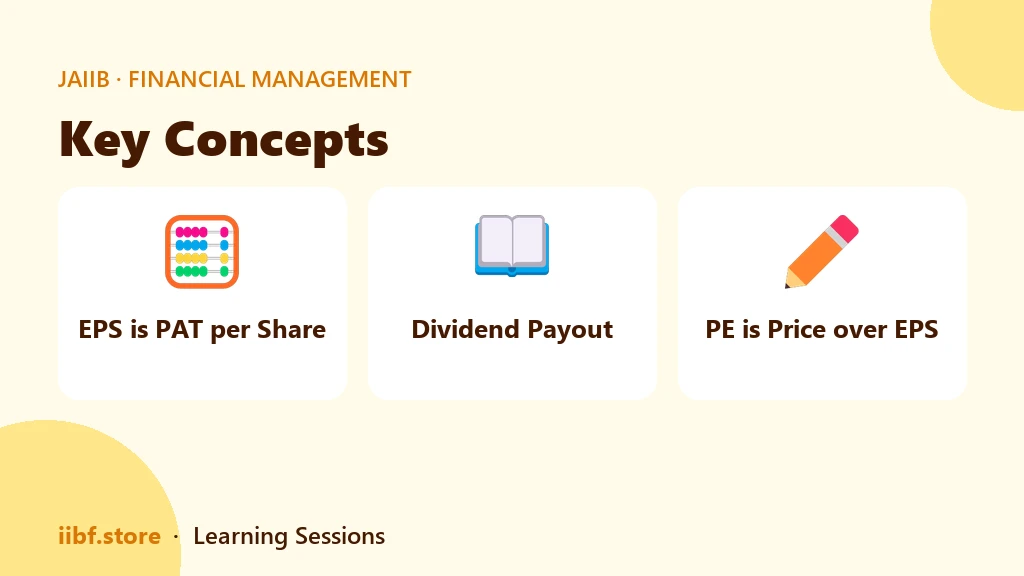
Earnings per share (EPS) is the profit the company earned for each equity share. The formula is profit after tax, less preference dividend, divided by the number of equity shares. EPS is the foundation of this whole topic because both the PE ratio and the dividend ratios build on it. If a question ever gives you net profit and the number of shares, your first move is almost always to compute EPS.
Dividend per share and payout ratio
Dividend per share (DPS) is the portion of EPS actually paid out to shareholders. The dividend payout ratio is DPS divided by EPS, expressed as a percentage, and it tells you how much profit the company returns versus how much it retains for growth. A high payout suits a mature company; a low payout suits one reinvesting heavily. Do not confuse the dividend payout with the dividend yield, which compares dividend to market price rather than to EPS.
The PE ratio and a worked example
The PE ratio, or price-to-earnings ratio, is the market price per share divided by EPS. It tells you how many rupees investors are willing to pay for one rupee of earnings, and it is the market's verdict on future growth. The formula is:
PE Ratio = Market Price per Share ÷ Earnings per Share (EPS)
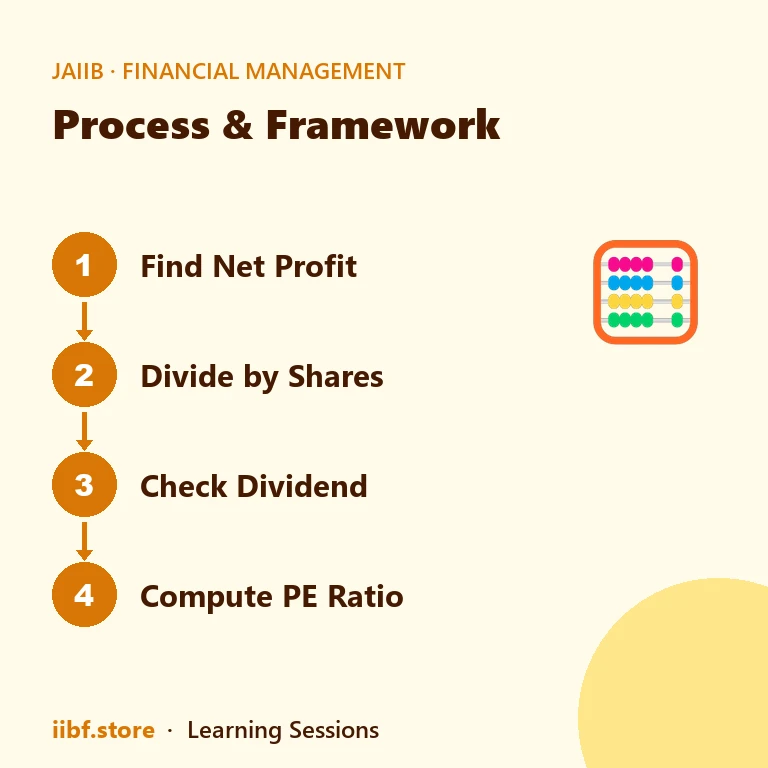
Say a company earns a profit after tax of ₹10 lakh on 1 lakh equity shares, so EPS is ₹10. If the share trades at ₹150, the PE ratio is 150 ÷ 10 = 15. If it also pays a dividend of ₹4 per share, the payout ratio is 4 ÷ 10 = 40%. One profit figure, three ratios.
| Item | Value |
|---|---|
| Profit after tax | ₹10,00,000 |
| Equity shares | 1,00,000 |
| EPS | ₹10 |
| Market price | ₹150 |
| PE ratio | 15 |
| Dividend per share | ₹4 |
| Payout ratio | 40% |
How to read the PE ratio
A high PE ratio means the market expects strong future growth and is paying a premium for it; a low PE ratio can mean either a cheap, undervalued stock or a business the market has lost confidence in. There is no universal "good" number, because the right level depends on the industry and the growth stage. For JAIIB, remember that the PE ratio is a market-based ratio, so it always needs the share price as an input, unlike EPS which comes purely from the accounts.
The MCQ traps
First, forgetting to subtract preference dividend before dividing to get EPS. Second, swapping the numerator and denominator of the PE ratio and reporting earnings over price. Third, mixing up dividend payout with dividend yield. Take a breath, write each formula down, and these three ratios become easy marks. Lock them in with a mock on our JAIIB test series, keep to a schedule with the study planner, and work through the rest of AFM in the JAIIB course. Confirm the latest exam pattern on the official IIBF website and find more revision notes on the iibf.store blog.
Reading the PE ratio like an analyst
Once you can calculate the PE ratio, the next skill is interpreting it, and this is where JAIIB questions become more thoughtful. Two companies in the same industry with very different PE ratios are telling you something about market expectations. The one with the higher PE ratio is being priced for faster growth, stronger management or a wider moat; the one with the lower PE ratio may be a genuine bargain or may be signalling trouble the market has already spotted. The PE ratio never answers "is this a good company", only "how much is the market willing to pay for its earnings right now", and keeping that distinction clear stops you from over-reading a single number.
It also helps to see how the three ratios connect. EPS feeds the PE ratio through the denominator and feeds the payout ratio through the same earnings figure, so a change in profit ripples through all three at once. If profit rises and the share price stays put, EPS goes up and the PE ratio falls, which can make a stock look suddenly cheaper. Exam setters build questions around exactly these movements, asking what happens to the PE ratio when earnings change but price does not, or the reverse. Reason through the direction rather than memorising a rule, and you will handle the tricky variants.
Finally, remember the limits. The PE ratio can be distorted by one-off profits, by companies with tiny or negative earnings, and by differences in accounting policy, which is why analysts pair it with other measures rather than trusting it alone. For JAIIB you do not need deep valuation theory, but you do need to state that the PE ratio is a relative, market-based measure best read within an industry and alongside EPS and the payout ratio. Show that balanced understanding and even the descriptive questions on the PE ratio become comfortable marks.
How is the PE ratio calculated?
The PE ratio equals the market price per share divided by earnings per share. It shows how many rupees investors pay for one rupee of the company's earnings.
What is a good PE ratio?
There is no single ideal figure. A high PE ratio signals expected growth and a premium price; a low PE ratio can mean value or weak confidence. Always judge it against the industry and growth stage.
Is dividend payout the same as dividend yield?
No. Dividend payout is dividend per share divided by EPS. Dividend yield is dividend per share divided by the market price. The payout uses earnings, the yield uses price.
Do I subtract preference dividend for EPS?
Yes. EPS is profit after tax minus preference dividend, divided by the number of equity shares. Skipping the preference dividend is a common reason EPS comes out slightly wrong.
Prefer revising from a printed book?
Chapter-wise books with MCQs after every chapter — minimal pages, complete coverage, delivered anywhere in India. Every book has a free sample to read first.
128 pages · 524 MCQs
Learning Sessions · Ashish Sir
131 pages · 672 MCQs
Learning Sessions · Ashish Sir
221 pages · 831 MCQs
Learning Sessions · Ashish Sir
107 pages · 445 MCQs
Learning Sessions · Ashish Sir
148 pages · 478 MCQs
Learning Sessions · Ashish Sir
151 pages · 465 MCQs
Learning Sessions · Ashish Sir
148 pages · 375 MCQs
Learning Sessions · Ashish Sir
216 pages · 895 MCQs
Learning Sessions · Ashish Sir
109 pages · 300 MCQs
Learning Sessions · Ashish Sir
104 pages · 360 MCQs
Learning Sessions · Ashish Sir
82 pages · 297 MCQs
Learning Sessions · Ashish Sir
151 pages · 600 MCQs
Learning Sessions · Ashish Sir
98 pages · 282 MCQs
Learning Sessions · Ashish Sir
132 pages · 225 MCQs
Learning Sessions · Ashish Sir
188 pages · 435 MCQs
Learning Sessions · Ashish Sir
117 pages · 236 MCQs
Learning Sessions · Ashish Sir
Learning Sessions · Ashish Sir
118 pages · 299 MCQs
Learning Sessions · Ashish Sir
Learning Sessions · Ashish Sir
Learning Sessions · Ashish Sir
Learning Sessions · Ashish Sir
115 pages · 255 MCQs
Learning Sessions · Ashish Sir
Learning Sessions · Ashish Sir
334 pages · 936 MCQs
Learning Sessions · Ashish Sir
Learning Sessions · Ashish Sir
115 pages · 344 MCQs
Learning Sessions · Ashish Sir
107 pages · 240 MCQs
Learning Sessions · Ashish Sir
90 pages · 150 MCQs
Learning Sessions · Ashish Sir
Learning Sessions · Ashish Sir
Quick quiz on this topic
5 exam-style questions from our free test bank — check yourself before you move on.
Practice this topic
Take a free mock test, download chapter PDFs, or watch a video class — all included on iibf.store.