Deposit Acceptance Rules for NBFCs: IIBF NBFC Exam Guide 2026
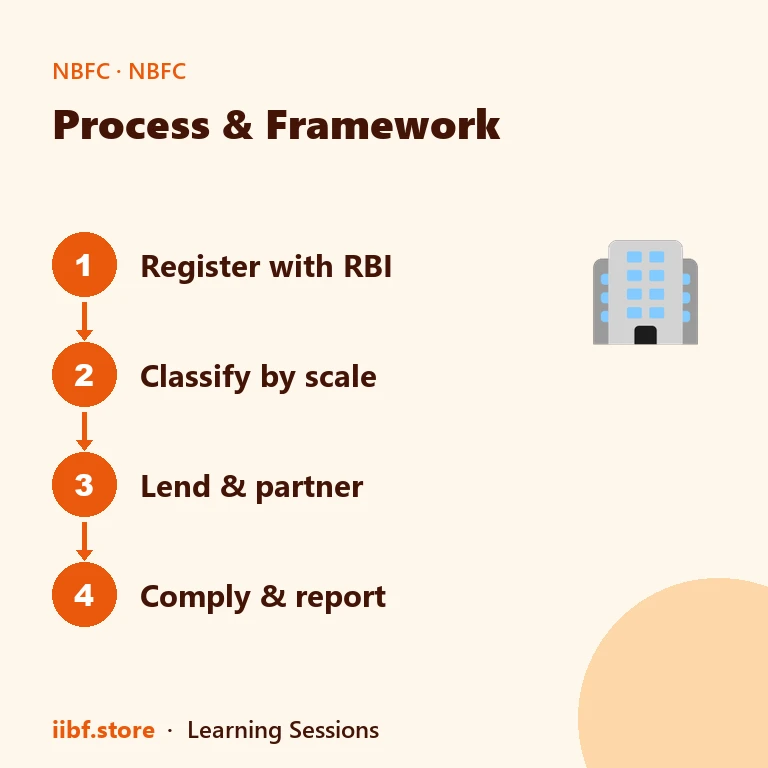
Not every NBFC can knock on the public's door for money. The deposit acceptance rules for NBFCs decide which companies may collect public deposits, how long they can hold that money, and what safeguards protect depositors if things go wrong — and this distinction is a favourite in the IIBF NBFC certificate exam. Get the NBFC-D vs NBFC-ND boundary wrong and half the paper's regulatory questions fall apart, so this guide walks through registration conditions, tenure and interest limits, and depositor-protection mechanisms in one place.
🏦 NBFC-D vs NBFC-ND: Who Can Accept Public Deposits
Every NBFC registered with the RBI falls into one of two deposit categories: NBFC-D (deposit-taking) or NBFC-ND (non-deposit-taking). Only an NBFC-D, holding a specific Certificate of Registration that authorises deposit acceptance, may raise public deposits at all. The much larger population of NBFC-ND companies — including systemically important ones (NBFC-ND-SI) — fund themselves through owned capital, bank borrowings, and debentures instead, and are barred from accepting deposits from the public regardless of their asset size. This split matters because the classification covered in the NBFC types and roles chapter is the starting point for every subsequent deposit-related question in the exam.
📋 RBI Registration and Credit Rating Conditions
Getting NBFC-D status is deliberately hard. An applicant must hold a minimum Net Owned Fund as prescribed by the RBI, obtain a specific deposit-taking Certificate of Registration, and — crucially — maintain an investment grade credit rating from an approved rating agency every single year. The moment the rating slips below investment grade, the company must stop accepting fresh deposits and renewing existing ones. This ongoing compliance burden is why the regulatory requirements and compliance chapter devotes so much space to periodic reporting, board-approved deposit policies, and RBI inspection rights over NBFC-D companies.
💡 Exam Tip: If a question describes an NBFC whose credit rating has just been downgraded below investment grade, the answer is almost always "stop accepting new/renewed deposits" — not "close down" or "convert to a bank."
💰 Deposit Acceptance Rules for NBFCs: Tenure and Interest Caps
Even an eligible NBFC-D cannot accept deposits on any terms it likes. Public deposits must have a minimum tenure of 12 months and a maximum tenure of 60 months — anything shorter or longer is not permitted. Demand deposits (repayable on demand, like a savings or current account) remain the exclusive privilege of banks; an NBFC-D can only take term deposits. Interest offered on these deposits is capped by an RBI-prescribed ceiling that is periodically reviewed, so candidates should treat the exact figure as illustrative for 2026 rather than memorise a number that regulators can revise — the current ceiling is always available on the RBI rates resource page. Renewal, premature withdrawal, and brokerage on deposits are also tightly regulated to prevent aggressive mobilisation practices.
⚠️ Common Mistake: Students often assume any large NBFC can take deposits because it is "systemically important." SI status affects prudential and governance norms, not deposit-taking eligibility — that depends solely on holding a deposit-taking CoR.
🔒 Depositor Safeguards: Liquid Assets, DEAF and Grievance Redressal
Because public deposits carry no explicit government guarantee, the RBI layers on protections. NBFC-D companies must maintain a prescribed percentage of outstanding public deposits in approved liquid assets such as government securities, held separately and reported regularly — this cushion exists specifically to meet depositor repayment obligations even under stress. Deposits that remain unclaimed for seven years must be transferred to the Depositor Education and Awareness Fund (DEAF), the same mechanism used for unclaimed bank balances. On the service side, every NBFC-D needs a documented grievance redressal mechanism and must direct unresolved complaints toward the RBI's Ombudsman framework, a theme also explored in the customer relationship chapter. Compliance teams handling KYC records for these depositors also need to stay alert to red flags covered in guidance on trade based money laundering, since suspicious fund flows can surface through deposit accounts too.
⚖️ NBFC Deposits vs Bank Deposits: A Quick Comparison
The table below summarises how deposit-taking NBFCs differ from banks and from non-deposit-taking NBFCs — a comparison IIBF examiners like to test through scenario-based questions.
| Feature | NBFC-D | Bank | NBFC-ND / NBFC-ND-SI |
|---|---|---|---|
| Can accept public deposits | ✅ Yes, only with deposit-taking CoR | Yes, without restriction | ❌ No, under any circumstances |
| Demand deposits allowed | No | Yes | Not applicable |
| Deposit tenure range | 12–60 months | No RBI ceiling on tenure | Not applicable |
| Deposit insurance (DICGC) | Not covered | Covered up to the prescribed limit | Not applicable |
| Unclaimed deposits after 7 years | Transferred to DEAF | Transferred to DEAF | Not applicable |
📌 Remember: Unlike bank deposits, NBFC-D public deposits are not covered by DICGC insurance — that single fact drives several exam questions on why prudential and rating norms for NBFC-D are so strict.
Regulators periodically revisit these thresholds as part of a broader move toward scale-based regulation for NBFCs, which tiers supervisory intensity by an NBFC's size and risk profile, and the asset-quality side of an NBFC-D's book still has to be assessed against IRAC norms for NBFC loans regardless of whether it funds itself through deposits or borrowings. Aspirants preparing for the certificate exam should read both alongside this topic, since examiners frequently combine deposit rules with classification and asset-quality questions in the same case study.
Official sources: cross-check the latest syllabus, circulars and rates on the IIBF official website and the Reserve Bank of India.

🧠 Practice MCQs: Deposit Acceptance Rules for NBFCs
Q1. Which category of NBFC is legally permitted to accept public deposits? (a) Any NBFC-ND-SI (b) Only an NBFC-D holding a deposit-taking Certificate of Registration (c) Any NBFC with positive net worth (d) All NBFCs above a certain asset size
Answer: (b) — Only NBFC-D companies with a specific deposit-taking CoR from the RBI may accept public deposits.
Q2. What is the maximum tenure permitted for public deposits accepted by an NBFC-D? (a) 24 months (b) 36 months (c) 60 months (d) 84 months
Answer: (c) — RBI directions cap NBFC-D public deposits at a maximum tenure of 60 months (5 years).
Q3. An NBFC-D's credit rating falls below investment grade. What must it do? (a) Nothing, ratings don't affect deposits (b) Stop accepting and renewing public deposits (c) Immediately repay all deposits within 24 hours (d) Convert into a bank
Answer: (b) — A sub-investment-grade rating bars the NBFC-D from accepting fresh deposits or renewing existing ones until the rating is restored.
Q4. Deposits with an NBFC-D remaining unclaimed for how many years must be transferred to the DEAF? (a) 3 years (b) 5 years (c) 7 years (d) 10 years
Answer: (c) — Unclaimed deposits are transferred to the Depositor Education and Awareness Fund after seven years, mirroring the rule for banks.
Q5. Which of the following deposit types can an NBFC-D legally offer? (a) Demand deposits repayable on demand (b) Savings bank deposits (c) Term deposits with a minimum 12-month tenure (d) Current account deposits
Answer: (c) — NBFC-D companies may only offer term/fixed deposits within the RBI-prescribed tenure band; demand, savings and current deposits remain bank-exclusive products.
Want chapter-wise mock tests with 100+ MCQs? Start practising free →
Can every RBI-registered NBFC accept public deposits?
No. Only NBFCs specifically granted a deposit-taking Certificate of Registration (NBFC-D) may accept public deposits; all other NBFCs, including large systemically important ones, are barred from doing so.
Are NBFC public deposits covered by deposit insurance like bank deposits?
No. Public deposits placed with an NBFC-D are not covered by DICGC insurance, which is one reason RBI imposes strict credit-rating, tenure and liquid-asset requirements on deposit-taking NBFCs.
What happens to an NBFC-D deposit that a depositor never claims?
If a deposit remains unclaimed for seven years, the NBFC-D must transfer the amount to the Depositor Education and Awareness Fund (DEAF), from which the original depositor can still claim it later through the RBI-prescribed process.
Can an NBFC-D accept a public deposit repayable on demand?
No. NBFC-D companies can only accept term deposits within the permitted 12-to-60-month tenure band; demand deposits remain an exclusive banking product under the Banking Regulation Act framework.
Master the Full NBFC Syllabus
Deposit acceptance rules are just one piece of the NBFC regulatory puzzle tested in the IIBF certificate exam — pair this with classification, IRAC and scale-based regulation topics, browse more NBFC articles on the blog, and lock in the concepts with timed practice at iibf.store/tests before exam day.
Practice this topic
Take a free mock test, download chapter PDFs, or watch a video class — all included on iibf.store.