Trade Based Money Laundering Red Flags: IIBF ITF Guide 2026
Every cross-border shipment leaves a paper trail — an invoice, a bill of lading, a letter of credit — and criminals exploit exactly that trail to move dirty money across jurisdictions. Trade based money laundering is one of the hardest laundering techniques for banks to detect because the transactions look, on the surface, like ordinary import-export business. For the IIBF ITF exam, and for any banker handling documentary credits or packing credit limits, spotting the red flags of trade based money laundering is now a core competency, not an optional add-on to KYC training.
📊 What Is Trade Based Money Laundering?
Trade based money laundering (TBML) is the process of disguising the proceeds of crime and moving value across borders by manipulating the price, quantity, or quality of goods and services in a legitimate-looking trade transaction. Unlike cash smuggling, TBML hides inside invoices, purchase orders, and shipping documents that pass through the formal banking channel, which is precisely why it is harder to detect than layering through shell bank accounts alone. FATF (the Financial Action Task Force) has flagged TBML as one of the three major methods used to launder criminal proceeds, alongside the use of financial institutions and physical movement of cash. Techniques include over-invoicing and under-invoicing, multiple invoicing for the same shipment, over- or under-shipment (phantom shipping), and misrepresentation of the quality or type of goods. Because these schemes ride on genuine-looking trade finance instruments — letters of credit, bank guarantees, open account terms — bank staff processing documents are the real front line of defence, well before any suspicious transaction report reaches a compliance desk.
💡 Exam Tip: If a question describes an invoice value that has no commercial logic — wildly above or below market price with no justification — treat it as a TBML red flag question, not a simple pricing dispute.
🚩 Common Red Flags Bankers Must Watch
Front-line staff are trained to watch for a defined set of red flags rather than relying on gut feeling. Price-based red flags include invoice values that are grossly inconsistent with the fair market price of the goods, or wide swings in unit price across shipments with no market explanation. Quantity-based red flags cover shipments that are significantly larger or smaller than the letter of credit or purchase order specifies, and repeated short-shipment claims. Documentation-based red flags are the most exam-relevant: mismatches between the goods description on the invoice, the bill of lading, and the packing list; commodities that do not match the declared business of the importer or exporter; and shipping routes that take a commercially illogical detour through a high-risk jurisdiction. Counterparty red flags include shell companies with no verifiable trading history, frequent changes in beneficiary details at the last stage of a transaction, and third-party payments that do not match the named parties in the trade documents. A deeper walkthrough of these controls sits inside the risk management chapter, which every ITF candidate should treat as required reading alongside this article.
📜 RBI, FATF and the Regulatory Framework
India's AML/CFT regime for banks rests on the Prevention of Money Laundering Act, 2002, and the Reserve Bank of India's Master Direction on Know Your Customer, which requires banks to apply customer due diligence, enhanced due diligence for higher-risk trade counterparties, and ongoing transaction monitoring. RBI's trade credit and import-export guidelines work alongside this KYC framework, and banks are expected to reconcile documentary evidence — invoices, bills of entry, shipping bills — against the underlying commercial rationale before releasing funds or confirming a letter of credit. Internationally, FATF's 40 Recommendations and its dedicated trade-based money laundering typology reports set the benchmark that RBI guidance is aligned to, and IIBF candidates should be comfortable linking Indian regulatory requirements back to these global standards. The full regulatory architecture — from PMLA obligations to RBI circulars on trade transactions — is mapped out in the regulatory framework chapter. For the primary source itself, see the RBI Master Direction on KYC at rbi.org.in, which every branch-level trade desk should keep as a reference.
⚠️ Common Mistake: Candidates often assume TBML controls are a compliance-department problem only. In the exam and in practice, front-line trade finance staff who scrutinise documents are the first control layer.
🔍 TBML Risk Across LCs, Packing Credit and Forfaiting
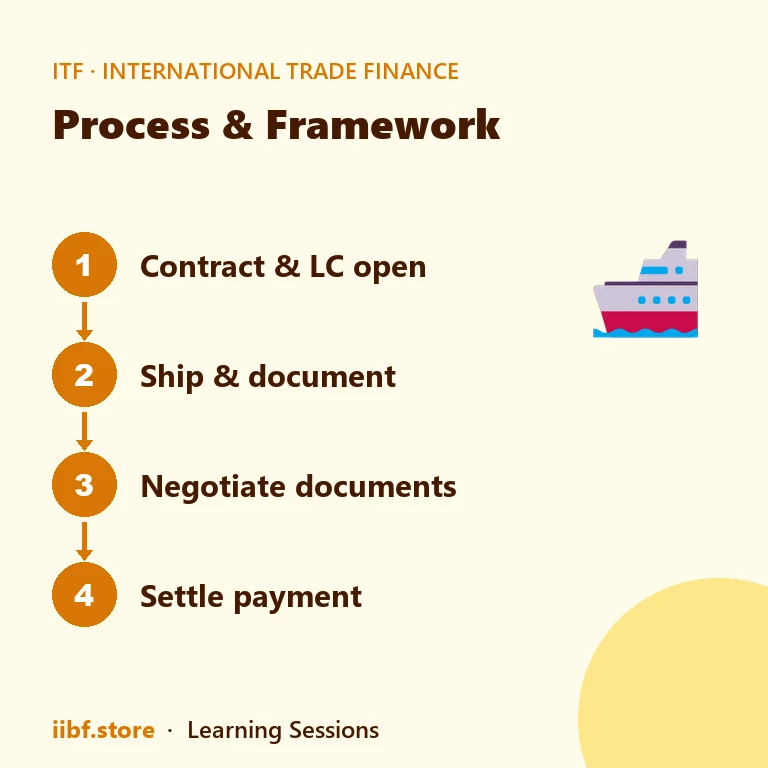
TBML risk is not evenly spread across trade finance products. A confirmed letter of credit under UCPDC 600 forces multiple layers of document scrutiny — the issuing bank, the confirming bank, and sometimes a nominated bank all examine the same set of documents for discrepancies, which naturally raises the chance that a manipulated invoice or falsified bill of lading gets flagged. Packing credit, sanctioned against a confirmed export order before shipment, carries its own risk if the underlying order itself is fictitious or inflated, so banks cross-check the buyer's credit history and, where available, ECGC cover before disbursing. Forfaiting, where a bank purchases an exporter's medium-term receivables without recourse, concentrates documentary scrutiny at the point of purchase since the forfaiter absorbs the underlying risk thereafter. The highest-risk channel by far is open account trade settled outside the banking system entirely, because no bank ever sees the invoice, the shipping document, or the payment instruction, removing the natural checkpoint that documentary trade finance provides. This is why regulators consistently push exporters and importers toward banked, documented trade rather than informal settlement. The mechanics of these instruments are covered in the trade finance chapter, and candidates should also revisit Letters of Credit UCPDC 600 for how document examination actually works in practice.
🛡️ Bank Controls: KYC, EDD and Trade Surveillance
Banks manage TBML risk through a layered control framework. At onboarding, KYC establishes the customer's identity, business profile and expected trade pattern, which becomes the baseline against which future transactions are measured. Enhanced due diligence (EDD) applies to higher-risk counterparties — new-to-bank importers/exporters, entities from high-risk jurisdictions, or businesses in sectors prone to TBML such as gold, textiles and electronics. Trade surveillance systems flag statistical outliers in pricing and shipment volume for manual review by trade operations staff, who compare the invoice against independent market price data and prior shipment history for the same counterparty. Where a transaction cannot be satisfactorily explained, banks are required to file a suspicious transaction report with the Financial Intelligence Unit-India. Trade operations teams typically maintain a watchlist of high-risk commodities and jurisdictions, refresh it periodically as typologies evolve, and calibrate transaction-monitoring thresholds so that genuine bulk exporters are not flagged as often as first-time or irregular counterparties. Staff training on document scrutiny is repeated at fixed intervals precisely because TBML techniques keep adapting to whatever control banks put in place last. The table below summarises how a genuine transaction typically differs from one carrying TBML red flags, a comparison that shows up frequently in ITF exam case studies.
| Indicator | Typical Genuine Trade | Possible TBML Red Flag | EDD Needed? |
|---|---|---|---|
| Invoice value vs market price | Matches prevailing market rate | Grossly over- or under-invoiced | ✅ Yes |
| Shipment routing | Direct port-to-port route | Circuitous routing via high-risk jurisdictions | ✅ Yes |
| Documentation consistency | Invoice, bill of lading, packing list match | Quantity/description mismatch across documents | ✅ Yes |
| Counterparty profile | Established trading history verifiable | Shell company with no trade record | ✅ Yes |
| Payment pattern | Payment linked to shipment milestones | Payment unrelated to shipment value/timing | ❌ No, if otherwise consistent |
📌 Remember: Documentary trade finance (LCs, bank guarantees) gives banks a natural checkpoint; open account and undocumented settlement do not — that gap is exactly where TBML risk concentrates.
Candidates preparing this topic alongside bank guarantees and Incoterms 2020 will notice how risk allocation, documentation and control design repeat across the ITF syllabus — the same due-diligence logic that applies to TBML also underpins how banks assess counterparty risk in a bank guarantee or an Incoterms-defined shipment. For a broader view of how credit risk frameworks carry across exam groups, see the CCP-side stressed asset resolution framework article, which shows the same layered-control philosophy applied to domestic lending.
🧠 Practice MCQs: Trade Based Money Laundering
Q1. Which of the following is the clearest red flag of trade based money laundering in an export transaction? (a) Invoice value matching the prevailing market price (b) Grossly over-invoiced shipment with no commercial justification (c) Shipment routed directly from origin to destination port (d) Payment received in line with the agreed credit period
Answer: (b) — Significant over- or under-invoicing with no commercial rationale is a classic TBML technique used to move value across borders.
Q2. Under the FATF framework, trade based money laundering is best described as: (a) Using trade transactions to disguise the proceeds of crime (b) A method of hedging foreign exchange risk (c) A type of documentary credit confirmation (d) A customs duty exemption scheme
Answer: (a) — FATF classifies TBML as one of the three major channels used to launder criminal proceeds internationally.
Q3. In a letter of credit transaction, which document mismatch would most likely trigger enhanced due diligence for TBML risk? (a) Minor spelling variation in the beneficiary's address (b) Quantity and description differing between the invoice and the bill of lading (c) Invoice dated one day after the bill of lading (d) Packing list printed on plain paper instead of letterhead
Answer: (b) — A genuine mismatch in quantity or description between core shipping documents is a documentation-based TBML red flag.
Q4. Which trade settlement method is most exposed to TBML risk due to the absence of bank document verification? (a) Packing credit against a confirmed export order (b) Open account trade settled outside the banking channel (c) Bank guarantee issued against cash margin (d) Forfaiting of an avalised bill of exchange
Answer: (b) — Open account trade settled outside the banking system removes the natural documentary checkpoint that LCs, guarantees and forfaiting provide.
Q5. A bank's first line of defence against trade based money laundering in cross-border transactions is: (a) The correspondent bank's SWIFT screening alone (b) Robust KYC, customer due diligence and trade document scrutiny at branch level (c) Reliance solely on the exporter's self-declaration (d) Post-shipment credit rating of the importing country
Answer: (b) — Front-line KYC, due diligence and document scrutiny catch TBML red flags before a transaction is even processed.
Want chapter-wise mock tests with 100+ MCQs? Start practising free →
What is trade based money laundering (TBML)?
TBML is the use of legitimate-looking trade transactions — invoices, shipping documents, letters of credit — to disguise the proceeds of crime and move value across borders, without relying on cash smuggling or shell bank accounts alone.
What are the most common red flags of trade based money laundering?
Grossly over- or under-invoiced shipments, quantity mismatches between invoice and bill of lading, shipping routes through high-risk jurisdictions with no commercial reason, and counterparties with no verifiable trading history are the most frequently tested red flags.
Which regulatory bodies set TBML guidance for Indian banks?
The Reserve Bank of India's Master Direction on KYC, read together with the Prevention of Money Laundering Act, 2002, forms the domestic framework, aligned to FATF's international recommendations and trade-based money laundering typologies.
Is TBML risk higher in open account trade or documentary credit transactions?
Open account trade settled outside the banking channel carries higher TBML risk because no bank examines the invoice, shipping documents or payment instruction, unlike a letter of credit where multiple banks scrutinise the same document set.
Trade based money laundering sits at the intersection of documentary trade finance and AML compliance, and it rewards ITF candidates who understand the mechanics of LCs, guarantees and packing credit as much as the regulatory text. Sharpen this topic further with full-length JAIIB and ITF mock tests, or browse the International Trade Finance tag hub for the complete chapter-linked series.
Practice this topic
Take a free mock test, download chapter PDFs, or watch a video class — all included on iibf.store.