Digital Banking in India: UPI, CBDC & Account Aggregator (IIBF 2026)
Digital banking in India has moved from a convenience to the very backbone of the financial system, and it is now one of the fastest-growing areas of the IIBF syllabus. India processes more real-time payments than any other country on earth, and the examiner expects every modern banker to understand the rails, the regulations and the emerging platforms that make this possible. This guide walks you through the entire ecosystem - the Unified Payments Interface, the central bank digital currency, the Account Aggregator framework, Video-KYC and the digital-lending safeguards - and shows you exactly how to study them for top marks.
Key takeaways
- UPI is an instant, 24x7 payment layer built by NPCI that moves bank deposits using a Virtual Payment Address (VPA) over the IMPS rails.
- CBDC (the e-Rupee) is sovereign legal tender issued directly by the RBI - a central-bank liability, not a bank deposit and not a cryptocurrency.
- The Account Aggregator framework lets customers share financial data with explicit, revocable consent through an RBI-regulated NBFC.
- Video-KYC and the Digital Lending Guidelines govern remote onboarding and app-based credit, backed by customer-protection rules.
- Exam success comes from applying each framework to a scenario, not just memorising the definition.
Why digital banking dominates the modern IIBF paper
Digital banking in India is reshaping how customers transact, borrow and share their financial data, and the IIBF has responded by giving these topics real weight in the question paper. A decade ago you could pass with textbook definitions of cheques and demand drafts. Today the examiner wants you to trace a UPI transaction across four parties, distinguish the e-Rupee from a bank balance, and name the players in a consent-based data flow.
The good news is that the ecosystem is logical once you see how the pieces fit. Payments, digital currency, data sharing and customer protection are not four unrelated chapters - they are four layers of the same stack. Understand the architecture and the answers write themselves.
The UPI ecosystem: the flagship of Indian digital banking
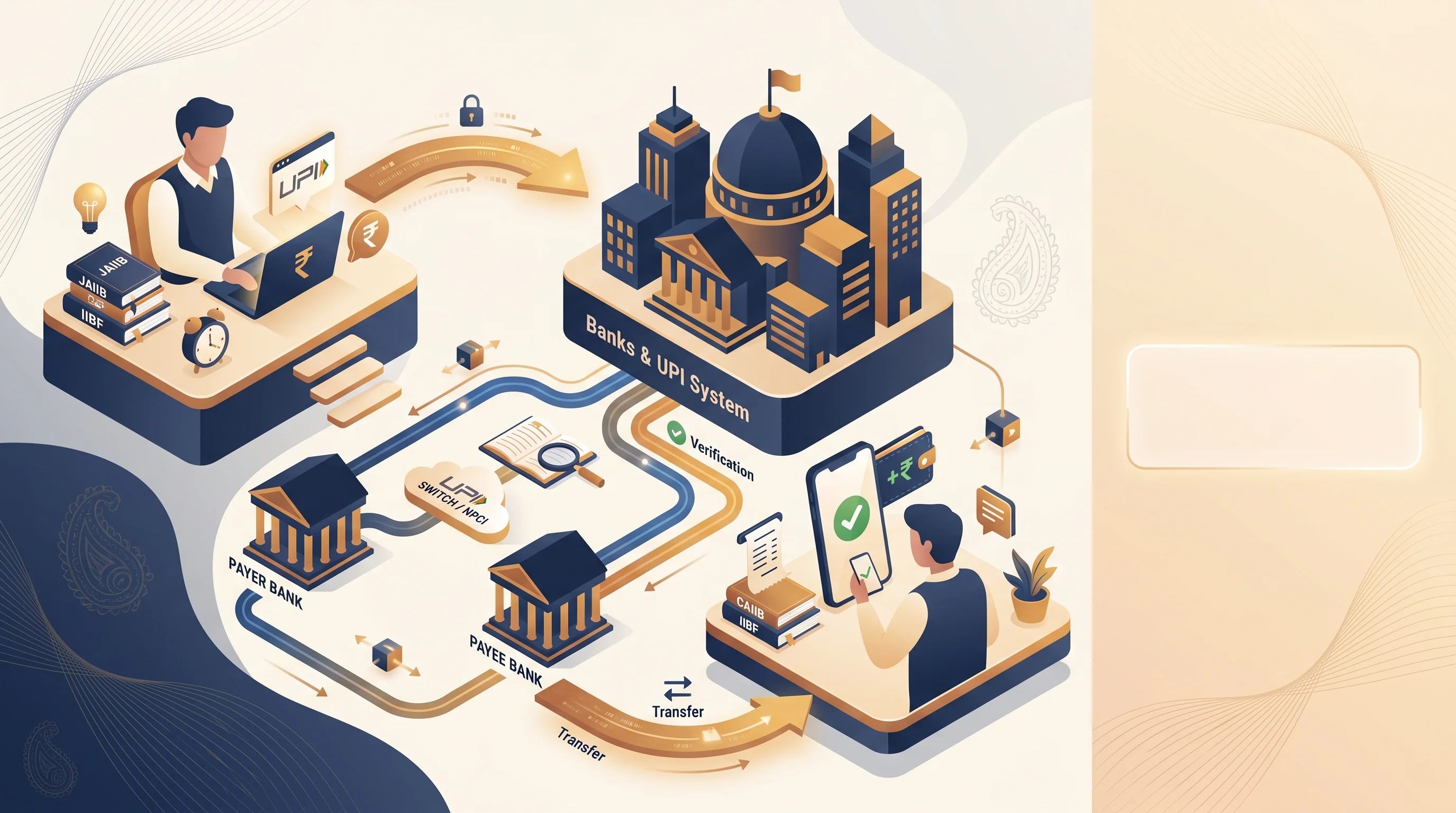
The Unified Payments Interface (UPI) is the centrepiece of any digital banking answer. It enables instant, round-the-clock fund transfers between bank accounts using a simple Virtual Payment Address (VPA) instead of account numbers, so a customer never has to share sensitive details to receive money.
UPI is built and operated by the National Payments Corporation of India (NPCI). It layers a single mobile interface over the underlying Immediate Payment Service (IMPS) rails, letting a customer link multiple bank accounts inside one app and switch between them effortlessly.
The system has expanded well beyond simple peer-to-peer transfers:
- UPI AutoPay handles recurring mandates such as subscriptions and SIPs.
- UPI Lite enables small-value, offline-style payments without a PIN for every transaction.
- Credit on UPI links pre-sanctioned credit lines and RuPay credit cards to the interface, blending payments with short-term credit.
The four-party model - payer, payer's bank, payee and payee's bank, all coordinated by NPCI - is a favourite diagram question. Make sure you can also explain interoperability and the role of Payment Service Providers (PSPs), which connect customer apps to the banking system. The sheer scale and elegant design of UPI are why it anchors almost every digital banking case study. You can rehearse the transaction-flow questions on our digital banking mock tests, and our deep dive on the UPI payment system explained for IIBF breaks the model down step by step.
CBDC and the e-Rupee: sovereign digital money
The Central Bank Digital Currency (CBDC), branded the e-Rupee, is a sovereign digital currency issued by the Reserve Bank of India. It is legal tender, equivalent to physical cash, and this single fact separates it from everything else in digital banking. Unlike UPI, which simply moves bank deposits, CBDC is a direct liability of the central bank.
The e-Rupee comes in two forms, and the distinction is a reliable exam point:
- CBDC-Wholesale - used for settlement between financial institutions, such as the interbank market.
- CBDC-Retail - used by the public for everyday payments through a token-based digital wallet.
The retail e-Rupee aims to offer the anonymity and finality of cash in digital form, with features such as offline functionality and programmability under exploration. For the exam, draw a sharp line between three things: CBDC is centrally issued legal tender; UPI moves commercial-bank deposits; and private crypto assets are neither issued by the central bank nor recognised as legal tender. Understand the motivations too - reducing cash-management cost, deepening financial inclusion and improving cross-border efficiency - along with the design trade-offs around privacy. Because the pilot keeps evolving, follow the latest position on India's Digital Rupee design and use cases rather than relying on a fixed figure, and reinforce the terminology with our fintech terms match game.
Account Aggregator and open banking: consent at the centre
The Account Aggregator (AA) framework is the quietly revolutionary layer of digital banking that lets customers securely share their financial data with explicit consent. An Account Aggregator is an RBI-regulated NBFC that acts as a consent manager, moving data from Financial Information Providers (FIPs) such as banks to Financial Information Users (FIUs) such as lenders - crucially, without storing that data itself.
The customer remains firmly in control: they decide what is shared, with whom and for how long, and they can revoke consent at any time. This consent-based architecture rests on the Data Empowerment and Protection Architecture (DEPA) principle, and it speeds up lending, financial advice and personal-finance management while protecting privacy.
The AA framework also complements India's broader open banking direction, where standardised APIs let regulated third parties build services on top of bank data. For the exam, be able to name the three AA roles - AA, FIP and FIU - and explain the consent flow in plain language. Detailed norms are issued by the regulator; you can read the official material on the IIBF website and confirm any rule against the latest released notification. To go deeper, study our dedicated explainer on the Account Aggregator framework: NBFC-AA, FIP, FIU and DEPA and the linked digital lending and Account Aggregator guide.
Video-KYC, digital lending and customer protection
Onboarding has gone fully digital through Video-based KYC (V-CIP), a consent-driven live video process that lets customers open accounts remotely. The session uses liveness detection and geo-tagging checks to confirm that a real, present person is being verified, closing the door on impersonation.
On the credit side, the RBI's Digital Lending Guidelines bring discipline to app-based lending. The core rules are easy to remember and often tested:
- Loan disbursals and repayments must flow directly between the borrower's and the lender's bank accounts - no pass-through pooling accounts of intermediaries.
- All fees must be disclosed upfront in a Key Fact Statement (KFS).
- A cooling-off period lets borrowers exit the loan without penalty.
Customer protection underpins the entire stack. The RBI's limited-liability framework caps a customer's loss for promptly reported unauthorised transactions, the integrated Ombudsman Scheme provides grievance redress, and tokenisation replaces stored card numbers with secure tokens. A banker who can connect the payment rails, the digital currency, the data-sharing framework and these protections has a genuinely complete grasp of digital banking. For the bigger picture, our overview of CBDC, Video-KYC and the Account Aggregator framework ties these threads together.
How the building blocks compare
One of the most common exam traps is confusing instruments that look similar. The table below summarises the differences that examiners love to test. Treat it as a revision sheet and reproduce it from memory until the distinctions are automatic.
| Feature | UPI | CBDC (e-Rupee) | Account Aggregator |
|---|---|---|---|
| What it moves | Bank deposits | Sovereign digital currency | Financial data, not money |
| Issuer / operator | NPCI over bank rails | Reserve Bank of India | RBI-regulated NBFC-AA |
| Liability of | Commercial bank | Central bank (direct) | Not applicable (no money held) |
| Core roles | Four-party model + PSP | Wholesale and Retail | AA, FIP, FIU |
A practical study plan for the digital banking module
Knowing the concepts is half the battle; organising your revision is the other half. Use this four-step plan to convert understanding into marks.
- Map the stack first. Spend your first session drawing the four layers - payments, currency, data, protection - on a single page so you always know where a topic sits.
- Master the diagrams. Be able to sketch the UPI four-party flow and the AA consent flow from memory. These are high-frequency, high-mark questions.
- Drill the distinctions. Keep a running list of easily-mixed terms - UPI vs CBDC, FIP vs FIU, Wholesale vs Retail - and test yourself with our match games until recall is instant.
- Simulate the exam. In the final week, attempt full-length, timed mock tests and review every wrong answer, revisiting only the topics where you stumble.
For the full topic list and weightage, keep the Digital Banking Certificate syllabus and free PDF open beside your notes, and browse every explainer for this paper from the Digital Banking course hub.
Common mistakes that cost marks
A frequent error in this paper is memorising definitions without being able to apply them to a scenario. The examiner often wraps the UPI four-party model, the CBDC design or the Account Aggregator roles inside a short case, so practise translating each concept into a worked example rather than reciting it.
- Confusing CBDC with UPI or crypto. Remember: e-Rupee is central-bank legal tender, UPI moves deposits, crypto is neither.
- Swapping FIP and FIU. The provider supplies data; the user consumes it. Anchor the words to the verbs.
- Forgetting the direct-flow rule in digital lending - money must move borrower-to-lender, never through an intermediary's pooled account.
- Missing negatively-phrased options such as "which is NOT". Read each stem twice before you commit.
- Ignoring recent updates. Frameworks evolve, so confirm time-sensitive specifics against the latest released IIBF notification instead of an old figure.
Finally, manage the clock in the exam hall by flagging difficult questions and returning to them, rather than losing momentum on a single item. You can find more guides for this paper in our digital banking blog.
Frequently asked questions
How is UPI different from CBDC?
UPI moves money that is held as bank deposits between two accounts, so it is essentially a fast messaging and settlement layer over the banking system. CBDC, the e-Rupee, is sovereign digital currency issued directly by the RBI as legal tender. In short, UPI moves a bank's liability while CBDC is the central bank's own liability.
What is an Account Aggregator?
An Account Aggregator is an RBI-regulated NBFC that acts as a consent manager for financial data. It moves a customer's data from Financial Information Providers, such as banks, to Financial Information Users, such as lenders, strictly with explicit consent. Importantly, it never stores or sees the underlying data itself - it only enables the secure, consented transfer.
What are the two forms of CBDC?
CBDC comes in a Wholesale form and a Retail form. CBDC-Wholesale is used for settlement between financial institutions, such as in the interbank market. CBDC-Retail is used by the general public for everyday payments through a token-based digital wallet.
What is a Key Fact Statement in digital lending?
A Key Fact Statement (KFS) is a standardised disclosure required by the RBI's digital-lending norms. It states the loan's all-in cost, fees and key terms upfront in a simple format. The aim is to let borrowers make an informed decision and compare offers without hidden charges.
How does Video-KYC keep onboarding secure?
Video-based KYC, or V-CIP, is a consent-driven live video process that verifies a customer remotely. It uses liveness detection to confirm a real, present person and geo-tagging to record location, which together prevent impersonation and spoofing. This lets banks open accounts digitally while still meeting strict identity-verification standards.
How much of the digital banking paper comes from these topics?
UPI, CBDC and the Account Aggregator framework, together with Video-KYC and digital lending, form a substantial and growing share of the question paper. Exact weightage varies by cycle, so always check the topic distribution against the latest released IIBF syllabus and notification. As a study rule, treat all of them as high-priority, frequently tested areas.
Conclusion
Digital banking in India rewards candidates who understand the architecture, not just the buzzwords - the UPI four-party model, the CBDC design, the Account Aggregator consent flow and the digital-lending safeguards. Learn each framework's roles and rules precisely, practise applying them to short cases, and keep one eye on the latest regulatory updates. Do that, and you will walk into the exam confident, well-prepared and ready to score. Start now with a timed digital banking mock test and explore the full Digital Banking course.
Related Guides
📚 Free Learning Sessions resources — connect & crack your exam
- 📝 Free mock tests — chapter-wise, exam-pattern, with instant solutions
- 🎮 Matching games — gamified revision of key terms & concepts
- 📄 Study notes & PDFs — downloadable chapter material
- 🎥 Video classes on YouTube — subscribe to @learningsessions
💬 Want the full course? WhatsApp your course name to 8360944207 and our team will set you up.
📱 Study on the go — get our iOS & Android app at iibf.store/app.
Quick quiz on this topic
5 exam-style questions from our free test bank — check yourself before you move on.
Practice this topic
Take a free mock test, download chapter PDFs, or watch a video class — all included on iibf.store.