Digital Banking 2026: UPI, CBDC and Account Aggregator Guide
For a banker sitting the IIBF Certificate examination in 2026, digital banking is no longer a peripheral chapter — it is the operating reality of every branch and back office in India. The customer who once queued at a teller window now opens an account through video-KYC, pays a vegetable vendor by scanning a QR code, shares her bank statement with a lender in seconds, and may soon hold central bank money in a wallet on her phone. Understanding this end-to-end customer journey, and the regulatory scaffolding behind it, is exactly what the exam rewards.
This guide deliberately avoids treating the subject as a generic information-technology topic. Instead it walks through the four pillars that define India's modern stack: the Unified Payments Interface (UPI), the Central Bank Digital Currency (CBDC or e-rupee), the Account Aggregator (AA) ecosystem, and the RBI's Digital Lending Guidelines. Each is heavily tested, each is uniquely Indian, and each ties directly to the conduct, risk and compliance themes IIBF loves to probe.
If you are studying alongside your core papers, keep your JAIIB and CAIIB preparation in view — many digital banking concepts recur there under payment systems and bank financial management.
UPI and the digital banking customer journey
The Unified Payments Interface, built and operated by the National Payments Corporation of India (NPCI), is the single most important rail of Indian digital banking. It collapses the old distinction between sending and receiving money into one virtual payment address (VPA) such as name@bank, removing the need to share account numbers or IFSC codes.
Key exam-ready facts you should internalise:
- Architecture: UPI sits on the Immediate Payment Service (IMPS) rails and works 24x7x365, including bank holidays.
- Two-factor authentication: device binding plus a UPI PIN satisfy RBI's AFA requirement; the PIN is never stored on the merchant side.
- Interoperability: any UPI app can pay any other, and UPI QR codes are interoperable across PSPs.
- Newer features: UPI Lite for small offline payments, UPI 123Pay for feature phones, credit-line-on-UPI, and RuPay credit card linkage.
For the customer, the journey is now branchless: onboarding via Aadhaar e-KYC or video-KYC, a VPA created in minutes, and instant peer-to-peer and peer-to-merchant payments. For the banker, the compliance burden shifts to monitoring, fraud detection and grievance redressal under the RBI's ombudsman scheme. You can confirm current transaction data and circulars at the NPCI website, which the exam expects you to recognise as the operator.
CBDC: the e-rupee pilots explained
The Central Bank Digital Currency, branded the e-rupee (e₹), is a sovereign liability of the Reserve Bank of India — a digital form of legal tender, not a private cryptocurrency. This distinction is a favourite examiner trap: the e-rupee carries no credit or liquidity risk because it is central bank money, whereas a bank deposit is a claim on a commercial bank.
The RBI runs two pilots that you must be able to separate:
- CBDC-Wholesale (e₹-W): launched first, used by financial institutions for the settlement of secondary-market government securities transactions, reducing settlement risk.
- CBDC-Retail (e₹-R): a token-based bearer instrument held in wallets offered through participating banks, designed to mimic the anonymity and finality of physical cash for small values.
The architecture is a two-tier model: the RBI issues the e-rupee, while banks distribute it and handle customer onboarding — preserving the existing banking relationship. Offline functionality and programmability (for example, restricting a subsidy to a defined use) are being tested. For an IIBF candidate, the takeaways are that CBDC is legal tender, non-interest-bearing, and a complement to — not a replacement for — UPI and physical cash. Keep an eye on policy updates through our IIBF news tracker.

The Account Aggregator framework
The Account Aggregator ecosystem is India's consent-based financial data-sharing layer, regulated by the RBI as a distinct class of NBFC (NBFC-AA). It is the quiet engine that makes modern digital banking lending fast and paperless. An AA itself sees no data in readable form — it is a consent manager and a secure pipe, not a data store.
The framework defines three roles you should memorise:
- Financial Information Provider (FIP): the institution holding the data — banks, mutual funds, insurers, the GSTN.
- Financial Information User (FIU): the institution consuming the data with consent — typically a lender assessing creditworthiness.
- Account Aggregator (AA): the licensed intermediary that obtains digital consent and routes encrypted data from FIP to FIU.
Consent is granular and time-bound, governed by the ReBIT-defined consent artefact specifying purpose, duration and the exact data sought. Data flows over the secure API standard and the AA cannot read it, reflecting a privacy-by-design philosophy aligned with the Digital Personal Data Protection Act, 2023. For the customer, this replaces photocopies and physical signatures with a one-tap, revocable digital consent. For the banker, it dramatically shortens loan turnaround and improves underwriting. Sharpen these definitions on our IIBF mock tests before exam day.
RBI digital lending guidelines and risk
The explosion of app-based credit forced the RBI to issue its Digital Lending Guidelines, a chapter that ties digital banking back to conduct, transparency and consumer protection — themes that dominate the IIBF syllabus. The core principle is that lending must flow only between the borrower and a regulated entity (RE), never an unregulated app pocketing the money.
Critical provisions to remember:
- Direct disbursal and repayment: funds must move directly between the borrower's and the RE's bank accounts, with no pass-through pooling by a Lending Service Provider (LSP).
- Key Fact Statement (KFS): the borrower must receive an upfront, standardised KFS disclosing the all-inclusive Annual Percentage Rate (APR) and a cooling-off period.
- No automatic credit-limit increase without explicit borrower consent.
- Data minimisation: apps may collect only need-based data, with no access to the phone's contacts, files or media.
These rules sit alongside fair-practice norms and the RBI ombudsman mechanism, and they recur in case-study questions about grievance redressal and mis-selling. Together with KYC/AML obligations under the PMLA, 2002, they define the compliance perimeter of every digital product a bank launches. Reinforce these through quick recall drills in our concept match game.
How it all fits together for the exam
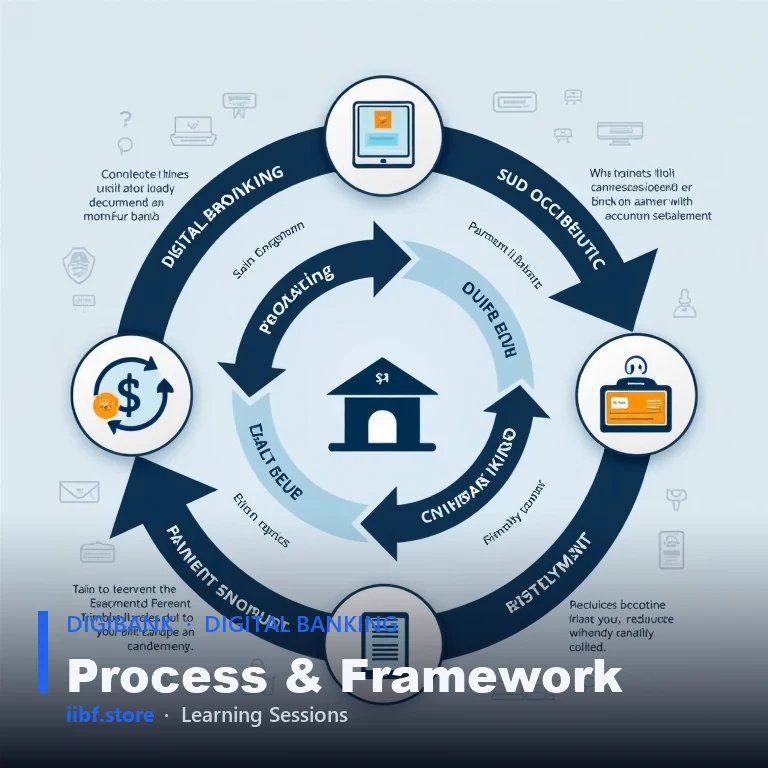
The four pillars are not silos — they form one continuous customer journey. A first-time borrower onboards via video-KYC, transacts daily over UPI, shares verified statements through an Account Aggregator with a single consent, receives a transparent loan governed by the Digital Lending Guidelines, and may settle dues using the e-rupee. Each step is regulated, auditable and consent-driven. When an IIBF question asks you to identify the risk owner, the data flow or the regulatory citation at any point in that chain, you will now have the map. Cross-check rate-linked questions against our live RBI rates page.
Frequently Asked Questions
Is the e-rupee the same as UPI?
No. UPI is a payment messaging rail that moves commercial bank deposit money between accounts. The e-rupee is itself a digital form of central bank money — a direct liability of the RBI and legal tender. UPI tells banks to move existing deposits; CBDC is the money being moved.
Can an Account Aggregator see my financial data?
No. An Account Aggregator works on a blind, consent-based model. It moves encrypted data from the provider to the user but cannot itself read, store or analyse it. It is licensed by the RBI purely as a consent manager and secure pipe, ensuring privacy by design under the framework.
What is a Key Fact Statement in digital lending?
A Key Fact Statement (KFS) is a standardised, upfront disclosure the RBI requires every digital lender to give the borrower. It states the all-inclusive Annual Percentage Rate, fees, recovery mechanism and cooling-off period in plain language, so the borrower understands the true cost of credit before signing.
Who operates UPI in India?
UPI is built and operated by the National Payments Corporation of India (NPCI), an umbrella organisation for retail payments set up by banks under RBI guidance. NPCI also runs RuPay, IMPS, AePS, NACH and the Bharat BillPay system, making it the backbone of India's retail payments ecosystem.
Final Takeaways
Digital banking in 2026 is a tightly regulated, consent-driven journey running on UPI rails, settled increasingly in e-rupee, fuelled by Account Aggregator data and disciplined by the RBI's Digital Lending Guidelines. Learn the roles, the risk owners and the regulatory citations, and these chapters become easy marks. Ready to test yourself? Take a full-length practice paper on our IIBF mock tests and read more on the iibf.store blog to lock in your score.
Quick quiz on this topic
5 exam-style questions from our free test bank — check yourself before you move on.
Practice this topic
Take a free mock test, download chapter PDFs, or watch a video class — all included on iibf.store.
Keep reading