Diversion of Funds: How One Machine Breaks a Cash Credit Account

A borrower with a clean repayment record, a sanctioned cash credit limit and one seemingly harmless decision: he buys a machine out of the CC account. No fraud, no missing money, nothing that shows up on a default list. And yet that single entry can quietly dismantle a working capital structure that took the branch years to build. This is textbook diversion of funds, and it is the mismatch every credit officer is trained to smell before the balance sheet confirms it.
The video below explains the mechanics in under a minute. The rest of this article takes it apart the way CAIIB ABM expects you to answer it in the exam hall — formula by formula, ratio by ratio.
Diversion of funds in working capital finance · Watch on YouTube
What diversion of funds actually means
Cash credit is sanctioned for exactly one job: short-term working capital. Raw material and stock, receivables that will be collected inside the operating cycle, wages, power bills, freight, day-to-day operating expenses. Every one of those items converts back into cash within months. That is what makes it safe to lend against them on a facility repayable on demand.
A machine does not behave that way. A machine is a fixed asset that releases its value slowly, over eight or ten years, through depreciation and the profits it helps generate. When short-term money funds a long-term asset, the money is locked. Bankers call that mismatch financing, or more bluntly, diversion of funds. The rupees have not been stolen and they have not left the business — they have simply been parked somewhere they cannot return from in time to service a demand facility.
The Reserve Bank draws a sharp line between this and siphoning. Diversion means borrowed funds were used for purposes other than those for which the facility was sanctioned, while the money broadly stayed inside the borrowing entity. Siphoning means funds were taken out of the entity altogether, for purposes unrelated to its operations, to the detriment of the lender. Both are serious. Only one of them still leaves an asset sitting on the borrower's own balance sheet.
Why net working capital falls the moment it happens
Net working capital can be computed two ways, and the exam loves the fact that both must agree:
- NWC = Current Assets − Current Liabilities
- NWC = Long-term Funds − Net Fixed Assets
Read the second formula slowly, because it is where the damage shows up. Buying a machine increases net fixed assets. If no fresh long-term funds — no term loan, no equity infusion, no retained profit — came in to pay for it, then long-term funds stayed flat while net fixed assets rose. Net working capital has to fall by exactly the amount of the machine.
Take a firm with a sanctioned CC limit of ₹1.5 crore. Before the purchase it carries current assets of ₹2.00 crore against current liabilities of ₹1.40 crore, of which the CC outstanding is ₹1.00 crore. Its long-term funds are ₹1.60 crore and net fixed assets are ₹1.00 crore. Now the promoter draws an extra ₹40 lakh on the CC account and buys a machine.
| Particulars | Before the machine | After the machine |
|---|---|---|
| Current assets | ₹2.00 crore | ₹2.00 crore |
| Current liabilities (incl. CC) | ₹1.40 crore | ₹1.80 crore |
| Net working capital (CA − CL) | ₹60 lakh | ₹20 lakh |
| Current ratio | 1.43 | 1.11 |
| Long-term funds | ₹1.60 crore | ₹1.60 crore |
| Net fixed assets | ₹1.00 crore | ₹1.40 crore |
| Net working capital (LTF − NFA) | ₹60 lakh | ₹20 lakh |
Both routes give the same answer, which is the check the examiner is looking for. Net working capital collapsed from ₹60 lakh to ₹20 lakh, and the current ratio slid from a comfortable 1.43 to a fragile 1.11 — all without a single rupee of sales being lost. The long-term cushion supporting current assets simply shrank.
The drawing power gap nobody notices until the stock statement lands
Here is the second consequence, and in practice the more dangerous one. Drawing power is computed from paid stock and eligible book debts after applying the prescribed margin. It does not care what the borrower spent the money on. So when ₹40 lakh leaves the CC account and turns into a machine, the outstanding rises immediately — but stock and receivables do not rise at all, because nothing was added to current assets.
If drawing power stood at ₹1.10 crore against an outstanding of ₹1.00 crore, the account had a ₹10 lakh cushion. After the purchase the outstanding is ₹1.40 crore against the same ₹1.10 crore drawing power. The account is now ₹30 lakh in excess of drawing power, and under the RBI income recognition and asset classification norms an account whose outstanding remains continuously in excess of the sanctioned limit or drawing power for more than 90 days is treated as out of order. A term-loan decision taken casually has become an asset-classification problem.
The early warning signal worth memorising
One line separates a bank that catches this in month two from one that discovers it at the annual review: sales are rising but net working capital keeps falling. Healthy growth consumes working capital and is normally funded by fresh long-term funds or retained profit, so NWC holds or improves. When turnover climbs while NWC drifts steadily down quarter after quarter, short-term money is leaking into long-term assets somewhere.
Supporting checks are simple and available every month. Compare the increase in gross fixed assets in the provisional balance sheet against term loan disbursements — an unexplained gap is your answer. Watch whether creditors are stretching while stock stays flat. Read the stock statement against the outstanding rather than against the sanctioned limit. And treat any capital expenditure by a working capital borrower without prior bank approval as a reportable event, not a formality. Most cases of diversion of funds are caught by one of these four checks long before an auditor arrives.
The rule that prevents all of it
Finance permanent assets from permanent funds, and working capital from short-term funds. That single sentence is the matching principle behind every question the CAIIB ABM paper will ask you on this topic. If a borrower genuinely needs the machine, the right answer is a term loan appraised on its own cash flows, with a repayment schedule matched to the asset's life — not a silent extra drawal on a facility designed to turn over every ninety days.
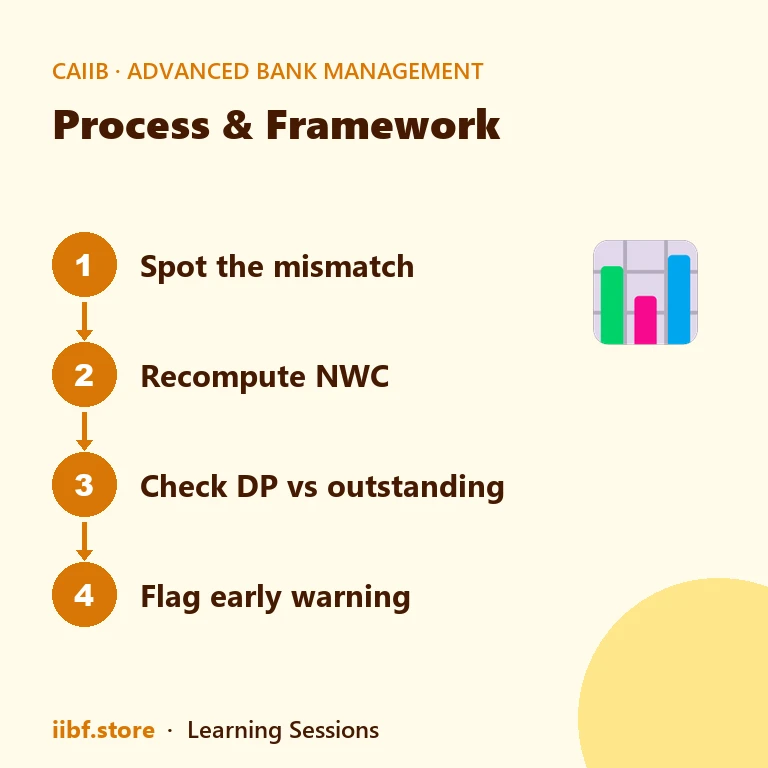
For the exam, remember the chain in order: mismatch, then net working capital falls, then current ratio deteriorates, then outstanding exceeds drawing power, then the account slips into irregularity. Numerical questions usually hand you two of those figures and expect you to derive the rest. Practise the two NWC formulas until they agree without thinking, and revise the full credit monitoring module on the CAIIB Advanced Bank Management course page before you attempt the ratio sums.
Once the concept is clear, test it under time pressure with the chapter-wise sets on our CAIIB mock tests, block your revision slots on the study planner, and keep the current policy rates handy from the RBI rates page. The primary norms themselves are published by the Reserve Bank of India, and reading the actual master circular language once is worth ten summaries.
Is diversion of funds the same as siphoning of funds?
No. Diversion of funds means the borrowed money was used for a purpose other than the one sanctioned while broadly remaining within the borrowing entity, such as buying a machine from a cash credit limit. Siphoning means funds were taken out of the entity entirely for purposes unrelated to its operations, to the detriment of the lender. RBI treats both seriously, but they are separately defined.
Can a borrower ever buy a fixed asset out of the cash credit account?
Only with the bank's prior approval, and normally the correct route is a separate term loan appraised on the asset's own cash flows. Unapproved capital expenditure funded from a working capital limit is precisely what the term means, regardless of how profitable the machine turns out to be.
Why does drawing power not fall along with the money spent?
Drawing power is derived from paid stock and eligible book debts after margin, not from how the money was used. Buying a machine raises the outstanding without adding anything to current assets, so drawing power stays where it was and the outstanding overshoots it.
What is the quickest early warning signal for this in monitoring?
Rising sales combined with continuously falling net working capital. Compare the increase in gross fixed assets with term loan disbursements for the same period — if fixed assets grew faster, short-term funds financed the difference.
Quick quiz on this topic
5 exam-style questions from our free test bank — check yourself before you move on.
Practice this topic
Take a free mock test, download chapter PDFs, or watch a video class — all included on iibf.store.
Keep reading