Early Warning Signals in Credit Monitoring: RBI EWS Framework for CCP (2026)
Early warning signals in credit monitoring are the specific red flags — irregular conduct of an account, delayed stock statements, a sudden ratings downgrade, or diversion of funds — that alert a bank to stress in a borrower's account well before it slips into a non-performing asset. For anyone preparing for the Certified Credit Professional (CCP) exam, understanding how these signals are identified, escalated and reported under the RBI framework is core syllabus material, not an optional add-on. This article walks through what EWS actually covers, how it links to SMA classification and fraud reporting, and how credit monitoring teams use it day to day.
Banks do not wait for a default to act. The entire logic of modern credit monitoring rests on catching deterioration early enough that corrective action — additional security, revised terms, or a restructuring conversation — is still possible. That is precisely the job of an early warning signal: it converts scattered operational data into a structured, actionable alert.
🚦 What Are Early Warning Signals in Credit Monitoring
An early warning signal (EWS) is any observable indicator — financial, operational, or behavioural — that suggests a borrower's account may be moving towards stress or default. Unlike an audit finding, which looks backward at a period that has already closed, an EWS is meant to be forward-looking and continuous. It is generated from data the bank already holds: account conduct, stock statements, insurance renewals, statutory returns, and market or media information about the borrower.
The purpose of building an EWS framework into credit monitoring is threefold. First, it shortens the gap between the onset of stress and the bank's response. Second, it standardises what a relationship manager or branch official must watch for, rather than leaving it to individual judgement. Third, it feeds directly into a bank's asset classification and provisioning process, since accounts flagged under EWS are typically moved to a closer review cycle even while they remain technically standard.
For CCP candidates, the key distinction to remember is that EWS is a monitoring tool, not a sanctioning tool. It operates after disbursement, throughout the life of the facility, and is distinct from — though closely linked to — the credit appraisal exercise carried out before the loan is sanctioned. You can revisit how appraisal parameters are set in the Credit Appraisal chapter for that earlier stage of the credit cycle.
💡 Exam Tip: If a question asks "when does EWS monitoring begin," the answer is post-disbursement and continuous — not at the sanction stage.
🔍 Categories of EWS Indicators Banks Track
EWS indicators are generally grouped into a few broad buckets, and CCP questions often test whether you can correctly classify an example into the right bucket.
- Financial indicators: declining sales or operating margins, a widening gap between projected and actual performance, deteriorating debt-service coverage, or a qualified statutory audit report.
- Conduct-of-account indicators: frequent overdrawing beyond the sanctioned limit, return of cheques, delayed or irregular submission of stock and book-debt statements, and ad hoc drawing power adjustments.
- Operational and external indicators: non-renewal or lapse of insurance cover, non-cooperation during inspections, adverse news reports about the promoter group, litigation, or a downgrade by an external credit rating agency.
- Group and related-party indicators: diversion of funds to associate concerns, delays in servicing other lenders in a multiple-banking arrangement, or frequent changes in management and auditors.
A single indicator rarely triggers escalation on its own. Credit monitoring teams look for a combination or a trend — for instance, a rating downgrade coinciding with delayed stock statements is treated far more seriously than either signal in isolation. This links back to the credit rating discipline: a rating action is itself one of the most reliable external EWS triggers a bank receives.
📌 Pushpin: Conduct-of-account signals are usually the earliest to appear because they surface from the bank's own transaction data, before external financials or ratings catch up.
🏦 RBI's Framework for EWS, SMA and Red-Flagged Accounts
The Reserve Bank of India has, over successive guidance to banks, tied early warning signals into the broader stressed-asset and fraud risk management architecture. The starting point is the Special Mention Account (SMA) classification, under which an account overdue for 1–30 days is tagged SMA-0, 31–60 days SMA-1, and 61–90 days SMA-2 — all before it becomes an NPA at 90-plus days past due. EWS observations often precede any overdue at all, which is why banks are expected to act on them independent of the SMA trigger.
Where EWS observations in a large exposure raise a suspicion of fraud rather than ordinary business stress, RBI's fraud risk management guidance requires banks to examine the account more closely, often through a forensic audit, and — where warranted — report it as a suspected fraud through the prescribed channels, including to other lenders and investigative agencies. This escalation path exists precisely so that genuine business stress (which may be resolved through restructuring) is not treated the same way as suspected diversion or misrepresentation.
Because these thresholds and escalation triggers are periodically revised by RBI, CCP candidates should focus on the sequence and logic of the framework — EWS observation, closer review, SMA tracking, and fraud escalation where warranted — rather than memorising any specific day-count or rupee threshold, which can change between circulars.
⚠️ Warning: Do not assume every SMA-2 account is a fraud case, or that every EWS flag means SMA classification has already happened. The two tracks are related but separate, and exam questions frequently test this exact confusion.
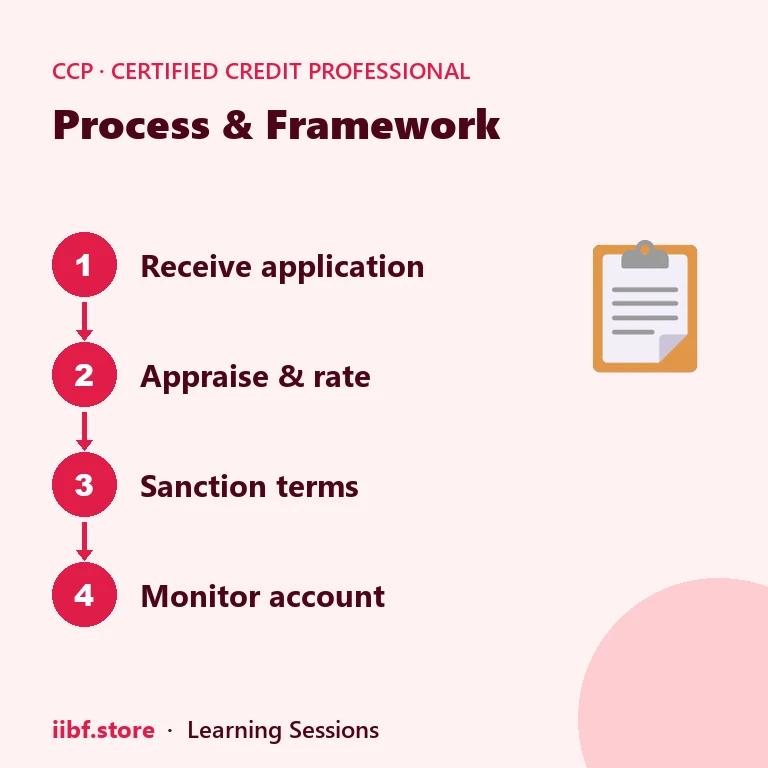
📋 How Banks Operationalise Credit Monitoring After Disbursement
In practice, EWS is only as good as the monitoring infrastructure that generates and reviews it. A bank's credit monitoring or loan review mechanism typically relies on a mix of routine and trigger-based checks: periodic scrutiny of stock and book-debt statements against sanctioned drawing power, unit visits and stock audits for larger exposures, review of conduct of account in the core banking system, tracking of statutory compliance (GST filings, EPF/ESI dues, insurance renewal), and monitoring of external data such as credit information reports and rating actions.
Large or consortium-financed accounts are usually monitored more intensively, with information shared among lenders so that a signal noticed by one bank — say, a cheque return at another lender — is visible across the lending group. This is one reason why the credit monitoring function sits close to, but organisationally distinct from, the sanctioning function: the same team that structured the facility should not be the sole judge of whether it is deteriorating. The underlying credit policy that sets out these monitoring responsibilities and escalation matrices is covered in the Credit Policy chapter, which is worth revisiting alongside this topic.
When multiple signals accumulate, banks typically respond with one or more of: a special review or joint lenders' meeting, revised terms or additional security, a stock audit, or — where the account is genuinely viable but facing temporary stress — consideration under the applicable resolution framework rather than immediate recovery action.
📊 EWS, SMA and Red-Flagged Accounts at a Glance
| Aspect | Early Warning Signal (EWS) | SMA Classification | Red-Flagged Account (Fraud Track) |
|---|---|---|---|
| When it applies | Any time during the account's life, even while standard | Once overdue days accumulate (1–90 days) | When EWS/forensic review raises fraud suspicion |
| Primary trigger | Financial, conduct, or external indicators | Overdue principal/interest | Diversion, misrepresentation, or wilful default indicators |
| Tied to overdue status? | ❌ No — can precede any overdue | ✅ Yes — day-count driven | ❌ No — driven by intent/conduct, not just ageing |
| Typical bank response | Closer review, information sharing with lenders | Provisioning review, closer supervision | Forensic audit, reporting to investigative agencies |
| Reversible with normal conduct? | ✅ Yes | ✅ Yes, on regularisation | ❌ Rarely, once confirmed |
Monitoring outcomes also inform whether an account needs a fresh look at its credit rating or its capital treatment; a downgrade can, in turn, affect the risk weight the bank must hold, a link explored in the Capital Adequacy chapter. Sound monitoring is really an extension of sound lending discipline established at origination — see the foundational principles of sound lending for that connection, and the related discussion of SMA classification norms for how overdue-based triggers interact with EWS.
EWS is not limited to fund-based facilities either. Non-fund exposures such as letters of credit and guarantees carry their own conduct signals — devolvement, frequent invocation requests, or non-submission of underlying documents — and these are tracked alongside fund-based EWS for a complete picture; see non-fund based credit facilities for that detail. Where a borrower has cross-border transactions, monitoring also has to account for regulatory compliance outside pure credit risk — for instance, obligations under FEMA 1999 for banks when trade or remittance patterns look unusual.
🧠 Practice MCQs: Early Warning Signals in Credit Monitoring
Q1. Which of the following best defines "early warning signals" in credit monitoring? (a) Signals generated only after an account is classified as NPA (b) Indicators that a borrower's account may be heading towards financial stress, well before default (c) Statutory audit qualifications alone (d) RBI's inspection findings only
Answer: (b) - EWS are forward-looking indicators meant to catch stress before default, not a post-NPA label.
Q2. Under RBI's SMA framework, an account overdue between 61 and 90 days is classified as: (a) SMA-0 (b) SMA-1 (c) SMA-2 (d) NPA
Answer: (c) - SMA-2 covers 61-90 days overdue; beyond 90 days the account becomes an NPA.
Q3. Which of these is a non-financial, conduct-of-account early warning signal rather than a financial-statement-based one? (a) Declining debt service coverage ratio (b) Frequent overdrawing of cash credit limits beyond the sanctioned limit (c) Falling profit margins in audited financials (d) Rising inventory holding period per the balance sheet
Answer: (b) - Overdrawing is observed directly from account conduct in the core banking system, unlike ratio-based signals drawn from financial statements.
Q4. When EWS observations in a large borrower account raise a suspicion of fraud, the account is typically: (a) Immediately written off (b) Reported as a Red Flagged Account and examined further, often via forensic audit, before any fraud classification (c) Automatically upgraded to a standard asset (d) Excluded from further credit monitoring
Answer: (b) - Suspected-fraud accounts move to a closer examination track, separate from ordinary stress resolution, before any formal fraud classification.
Q5. Which practice is central to a bank's ongoing credit monitoring after a loan is disbursed? (a) One-time collateral valuation at sanction only (b) Periodic scrutiny of stock statements, conduct of account, and unit inspections (c) Relying solely on the external credit rating once a year (d) Waiting for the statutory audit report at year-end
Answer: (b) - Ongoing monitoring depends on recurring, multi-source checks, not a single point-in-time review.
Want chapter-wise mock tests with 100+ MCQs? Start practising free
What is the difference between EWS and SMA classification?
EWS is a broader, continuous set of financial, conduct, and external indicators that can surface at any point in an account's life, even while it is fully standard. SMA classification is specifically tied to the number of days an account is overdue on principal or interest, moving from SMA-0 through SMA-2 before reaching NPA status.
Who is responsible for tracking early warning signals in a bank?
Responsibility is usually shared between the branch or relationship team handling day-to-day account conduct and a dedicated credit monitoring or loan review function that consolidates signals across financial statements, account behaviour, and external data for larger or higher-risk exposures.
Does an EWS flag automatically mean the loan will become an NPA?
No. An EWS flag triggers closer review and, where needed, corrective steps such as additional security, revised terms, or a stock audit. Many flagged accounts are resolved through timely intervention and never reach overdue or NPA status.
How does EWS relate to fraud reporting by banks?
Where EWS observations in a significant exposure point to possible diversion of funds, misrepresentation, or similar red flags rather than ordinary business stress, banks examine the account more closely — often through a forensic audit — and report it through the channels prescribed by RBI's fraud risk management guidance if fraud is confirmed or strongly suspected.
Early warning signals in credit monitoring sit at the intersection of credit appraisal, account conduct, and regulatory reporting — exactly the kind of cross-cutting topic the CCP exam likes to test. Strengthen your grip on the full stressed-asset lifecycle, from the first EWS flag to SMA tracking and resolution, with topic-wise practice at iibf.store/tests, and browse more exam-focused reads on the Certified Credit Professional tag page.
Prefer revising from a printed book?
Chapter-wise books with MCQs after every chapter — minimal pages, complete coverage, delivered anywhere in India. Every book has a free sample to read first.
188 pages · 435 MCQs
Learning Sessions · Ashish Sir
132 pages · 225 MCQs
Learning Sessions · Ashish Sir
117 pages · 236 MCQs
Learning Sessions · Ashish Sir
Learning Sessions · Ashish Sir
118 pages · 299 MCQs
Learning Sessions · Ashish Sir
Learning Sessions · Ashish Sir
Learning Sessions · Ashish Sir
Learning Sessions · Ashish Sir
115 pages · 255 MCQs
Learning Sessions · Ashish Sir
Learning Sessions · Ashish Sir
334 pages · 936 MCQs
Learning Sessions · Ashish Sir
Learning Sessions · Ashish Sir
115 pages · 344 MCQs
Learning Sessions · Ashish Sir
107 pages · 240 MCQs
Learning Sessions · Ashish Sir
90 pages · 150 MCQs
Learning Sessions · Ashish Sir
Learning Sessions · Ashish Sir
131 pages · 672 MCQs
Learning Sessions · Ashish Sir
221 pages · 831 MCQs
Learning Sessions · Ashish Sir
128 pages · 524 MCQs
Learning Sessions · Ashish Sir
107 pages · 445 MCQs
Learning Sessions · Ashish Sir
148 pages · 478 MCQs
Learning Sessions · Ashish Sir
151 pages · 465 MCQs
Learning Sessions · Ashish Sir
148 pages · 375 MCQs
Learning Sessions · Ashish Sir
216 pages · 895 MCQs
Learning Sessions · Ashish Sir
109 pages · 300 MCQs
Learning Sessions · Ashish Sir
104 pages · 360 MCQs
Learning Sessions · Ashish Sir
82 pages · 297 MCQs
Learning Sessions · Ashish Sir
151 pages · 600 MCQs
Learning Sessions · Ashish Sir
98 pages · 282 MCQs
Learning Sessions · Ashish Sir
Quick quiz on this topic
5 exam-style questions from our free test bank — check yourself before you move on.
Practice this topic
Take a free mock test, download chapter PDFs, or watch a video class — all included on iibf.store.