CAIIB ABM Previous Year Questions: Module C and D Practice 2026
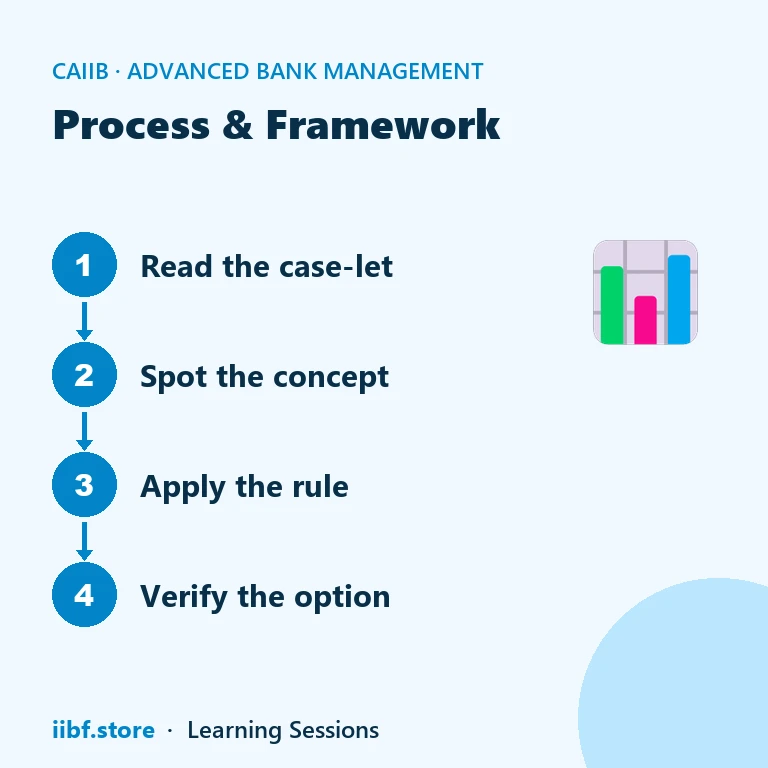
Part 3 of the mini marathon is where the ABM paper stops being about definitions and starts being about judgement. If you have worked through the earlier parts, you already know the rhythm: read a case-let, find the concept hiding in it, apply the rule. What makes CAIIB ABM previous year questions from Modules C and D different is that the answer is rarely a number you can compute — it is a decision you have to defend. This piece walks through how those two modules are examined, the traps that repeat, and how to use CAIIB ABM previous year questions as a diagnostic rather than a scorecard.
ABM CAIIB 2026 PYQ Mini Marathon Part 3 · Watch on YouTube
What the paper actually looks like
Before the content, the format, because it shapes how you should practise. Advanced Bank Management is one of the four compulsory CAIIB papers, alongside Bank Financial Management, Advanced Business and Financial Management, and Banking Regulations and Business Laws. On top of those you pick one elective from five.
The paper carries 100 objective questions for 100 marks, written online in two hours. There is no negative marking, which has a direct tactical consequence: never leave a question blank. Some CAIIB subjects also carry numerical questions where no options are provided at all and the answer has to be keyed in — a format that punishes rounding sloppiness in a way MCQs do not.
Passing is 50 out of 100 in the subject. There is a second route: 45 or more in every subject with an aggregate of 50% across all subjects in a single attempt also completes the exam. Credits for passed subjects are retained until your time limit expires.
On the time limit itself, do not rely on older notes. A candidate gets 5 attempts within a maximum of three years from first registration, whichever comes first, and attempts count whether or not you actually sit the exam. Miss that window and you re-enrol from scratch with no credit for subjects already passed. The current position is on the IIBF rules and syllabus page at iibf.org.in, and it is worth checking there rather than trusting a forum post.
Module C: Credit Management, where the case-lets live
Module C runs from the overview of credit management through appraisal, delivery of credit, monitoring, and the whole non-performing asset chain. This is the densest scoring block in the paper and also the one candidates under-practise, because reading it feels productive in a way that solving it does not.
The questions cluster around a handful of decision points. Given a borrower's figures, is the working capital assessment method appropriate? Given a repayment history, when exactly does the account slip from special mention into substandard? Given a security position, what provisioning applies? Each of these is a rule applied to a fact pattern, and the fact pattern is deliberately cluttered.
The discipline that helps most is stripping the case-let before you solve it. Underline only the figures and dates that the question asks about. Half the material in a well-written case-let exists to test whether you can ignore it. Candidates who read linearly and compute everything run out of clock at question sixty.
The second discipline is knowing which classification boundary is being probed. A large share of Module C questions turn on a single date or a single threshold, and once you spot which one, the arithmetic is trivial. Working through the Advanced Bank Management chapter notes module by module makes those boundaries automatic rather than something you re-derive under pressure.
Module D: Compliance and Corporate Governance
Module D covers the compliance function in banks and corporate governance. It reads like the easy module and examines like the treacherous one, because the questions are about who is responsible, to whom they report, and what the escalation path is — not about what compliance means.
Expect questions on the structure of the compliance function, the position and independence of the compliance officer, board-level committees and their composition, and the interaction between internal audit, risk, and compliance. The distinctions are fine. Two roles can both sound correct until you check which one reports where.
The most efficient way to hold this module is as an org chart rather than as prose. Draw the reporting lines once, mark which committee owns which mandate, and revise the diagram rather than the chapter. Governance questions are almost always testing a line on that chart.
Using previous year questions properly
Most candidates use past papers as a mock exam. That is the least valuable thing you can do with them. The exam is not going to repeat the questions; it is going to repeat the shapes. The point of a marathon session is to learn the shapes.
A practical loop looks like this.
| Stage | What you do | What it tells you |
|---|---|---|
| First pass | Solve untimed, no notes | Which concepts are genuinely absent |
| Review | Classify each error: concept, careless, or clock | Where the marks are actually leaking |
| Repair | Read only the chapters behind concept errors | Targeted revision instead of a re-read |
| Second pass | Re-solve the same set, timed at 70 seconds | Whether the repair held under pressure |
The classification step is the one people skip and the one that matters. A careless error and a concept error look identical on the answer sheet and need opposite responses. If you re-read a chapter because you misread a date, you have spent an evening fixing nothing.
Take a worked illustration of the clock arithmetic. One hundred questions in 120 minutes gives 72 seconds each, and case-lets eat more than that. If you budget 55 seconds for the roughly 60 direct questions, that is 55 minutes, leaving 65 minutes for 40 case-let questions — about 97 seconds each, plus a few minutes to review flagged items. Practising CAIIB ABM previous year questions without that budget in mind trains accuracy but not throughput, and the paper tests both.
Fitting it into the remaining weeks
If you are running the full marathon series, do not attempt all parts in one sitting and call it revision. Space them. One part per session, followed the same evening by the error classification, beats a six-hour binge whose lessons evaporate by morning.
Build the sequence into a written schedule rather than an intention. The study planner handles the spacing, and the mock test bank gives you fresh items so your second pass is not just memory of the first. For a wider view of what else is being examined this cycle, the CAIIB course hub collects the other three compulsory papers in the same place.
Two modules, a clean error log, and a clock you actually respect. That is the whole method, and CAIIB ABM previous year questions are simply the instrument you run it with.
Is there negative marking in the CAIIB ABM paper?
No. The examination carries no negative marking for wrong answers, so every question should be attempted. Leaving an item blank guarantees zero where a considered guess carries a real chance.
How many attempts do I get to complete CAIIB?
Five attempts within a maximum of three years from the date of registration for the first attempt, whichever comes first. Attempts count once you apply, whether or not you appear.
What are the four modules of Advanced Bank Management?
Module A is Statistics, Module B is Human Resource Management, Module C is Credit Management, and Module D is Compliance in Banks and Corporate Governance.
Can I pass with less than 50 in ABM?
Yes, by the aggregate route. Securing at least 45 marks in each subject with an aggregate of 50% across all subjects in a single attempt also completes the examination.
Prefer revising from a printed book?
Chapter-wise books with MCQs after every chapter — minimal pages, complete coverage, delivered anywhere in India. Every book has a free sample to read first.
148 pages · 478 MCQs
Learning Sessions · Ashish Sir
151 pages · 465 MCQs
Learning Sessions · Ashish Sir
148 pages · 375 MCQs
Learning Sessions · Ashish Sir
216 pages · 895 MCQs
Learning Sessions · Ashish Sir
109 pages · 300 MCQs
Learning Sessions · Ashish Sir
104 pages · 360 MCQs
Learning Sessions · Ashish Sir
82 pages · 297 MCQs
Learning Sessions · Ashish Sir
151 pages · 600 MCQs
Learning Sessions · Ashish Sir
98 pages · 282 MCQs
Learning Sessions · Ashish Sir
131 pages · 672 MCQs
Learning Sessions · Ashish Sir
221 pages · 831 MCQs
Learning Sessions · Ashish Sir
128 pages · 524 MCQs
Learning Sessions · Ashish Sir
107 pages · 445 MCQs
Learning Sessions · Ashish Sir
132 pages · 225 MCQs
Learning Sessions · Ashish Sir
188 pages · 435 MCQs
Learning Sessions · Ashish Sir
117 pages · 236 MCQs
Learning Sessions · Ashish Sir
Learning Sessions · Ashish Sir
118 pages · 299 MCQs
Learning Sessions · Ashish Sir
Learning Sessions · Ashish Sir
Learning Sessions · Ashish Sir
Learning Sessions · Ashish Sir
115 pages · 255 MCQs
Learning Sessions · Ashish Sir
Learning Sessions · Ashish Sir
334 pages · 936 MCQs
Learning Sessions · Ashish Sir
Learning Sessions · Ashish Sir
115 pages · 344 MCQs
Learning Sessions · Ashish Sir
107 pages · 240 MCQs
Learning Sessions · Ashish Sir
90 pages · 150 MCQs
Learning Sessions · Ashish Sir
Learning Sessions · Ashish Sir
Quick quiz on this topic
5 exam-style questions from our free test bank — check yourself before you move on.
Practice this topic
Take a free mock test, download chapter PDFs, or watch a video class — all included on iibf.store.