CAIIB BFM Previous Year Questions: Risk and Treasury Practice 2026
BFM is the paper that separates candidates who have read the book from candidates who can use it. Part 2 of the marathon leans into that gap, and it is why CAIIB BFM previous year questions deserve a different treatment from the rest of your revision. Where other papers reward recall, this one hands you a rate, a position and a maturity profile and expects a number back. This piece maps how Bank Financial Management is examined module by module, works through the arithmetic that repeats, and sets out a way to practise CAIIB BFM previous year questions that fixes throughput as well as accuracy.
BFM CAIIB 2026 PYQ Mini Marathon Part 2 · Watch on YouTube
The four modules and where the marks sit
Bank Financial Management is built on four modules: Module A is International Banking, Module B is Risk Management, Module C is Treasury Management, and Module D is Balance Sheet Management. The marathon's second part concentrates on the middle two, and that is a sensible allocation, because risk and treasury between them account for the bulk of the computational questions.
Module A gives you exchange rates and forex business — the mechanics of quotes, cross rates, and the products used to cover exposure. Module B moves into the risk framework proper: what risk is, how it is categorised, and how each category is measured and mitigated. Module C is treasury, from the concept and functions through the instruments and the integration of treasury with the rest of the bank. Module D closes on the balance sheet, its components, and how assets and liabilities are managed against each other.
Read that list and one thing should be obvious: Modules B, C and D overlap heavily. Interest rate risk shows up in the risk module as a category, in the treasury module as something you position against, and in the balance sheet module as a gap you manage. A question can be labelled any of the three. That overlap is an advantage if you study across it and a liability if you study module by module in isolation.
The format detail that changes how you practise
The paper is 100 objective questions for 100 marks, online, in two hours, with no negative marking. That much matches the other compulsory papers.
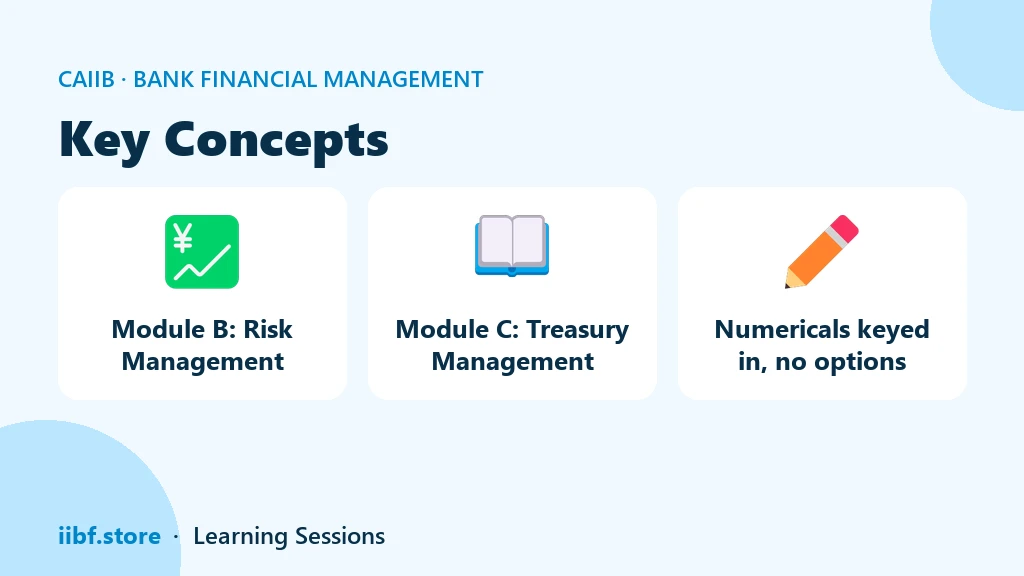
The clause that matters specifically here is this: some CAIIB subjects carry numerical questions where no options are provided and the candidate has to key in the answer. BFM is the paper where you should assume that applies to you.
The consequence is not subtle. In a four-option MCQ, a rounding slip often still lands you on the intended option, because the distractors are usually built around a conceptual error rather than a decimal. In a keyed-in numerical there is no such cushion. An answer that is right to two decimals and wrong to three is simply wrong.
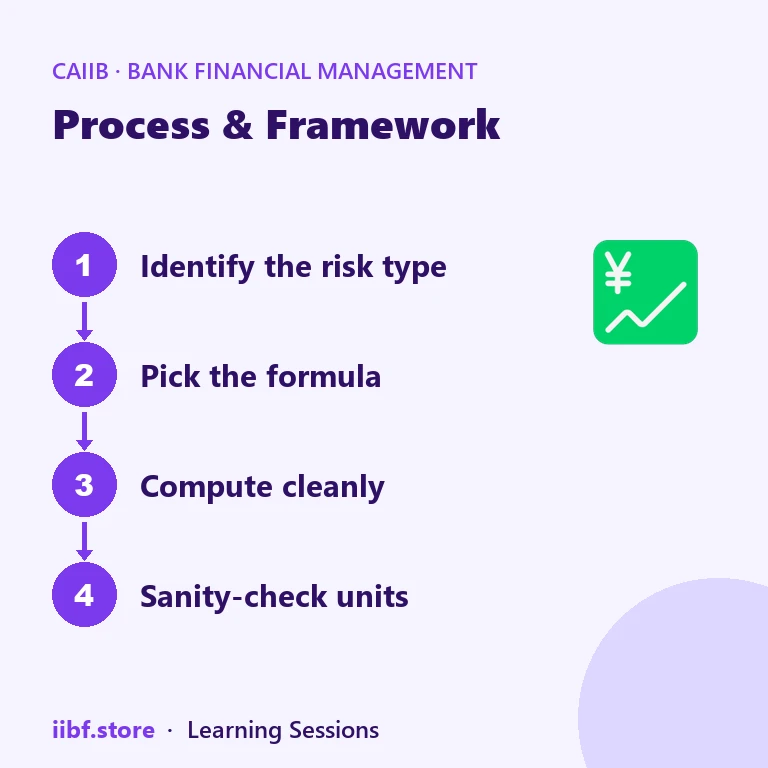
So practise the way you will be examined. Decide in advance how you will round, carry intermediate values at full precision rather than rounding as you go, and write the unit next to every figure. Most keyed-in errors are unit errors — a rate expressed as 0.0625 where the answer wanted 6.25, or a figure in lakhs keyed as a figure in crores.
A worked illustration of the clock
Throughput is examined here as surely as knowledge, and the arithmetic is worth doing once, explicitly.
| Question type | Rough count | Budget each | Total |
|---|---|---|---|
| Direct theory and definitions | 50 | 45 seconds | 37.5 minutes |
| Short numericals | 30 | 80 seconds | 40 minutes |
| Case-lets and multi-step | 20 | 100 seconds | 33 minutes |
| Review of flagged items | — | — | 9.5 minutes |
That totals 120 minutes with a thin review buffer, and it assumes you do not stall. The practical lesson is that a single stubborn numerical costing you six minutes does not cost one question — it costs the review buffer and about four other questions you now rush. Flag and move is not a counsel of despair, it is the only budget that closes.
Run a timed set from the marathon with a stopwatch on your desk and note the time at question 25, 50 and 75. Most candidates discover they are eight to ten minutes behind at the halfway mark and never recover. Knowing that about yourself in September is useful; discovering it in the exam hall is not.
Turning the marathon into a diagnostic
A marathon watched passively is entertainment. A marathon worked actively is a diagnostic, and the difference is whether you keep an error log.
Solve first, then watch the explanation — never the reverse. Watching first produces the warm feeling of understanding without any evidence that you could have produced the answer. Then classify every miss into one of three bins: you did not know the concept, you knew it and computed carelessly, or you knew it and ran out of time. Those three failures need a chapter, a checklist, and a stopwatch respectively, and treating all three with a re-read is the most common wasted evening in CAIIB preparation.
Weight your repair by module overlap. If an interest rate question defeated you, that single gap is costing you marks in Modules B, C and D simultaneously, which makes it worth a whole evening. A one-off definition from Module A is worth ten minutes. Grade your gaps by blast radius, not by how uncomfortable they felt.
For the underlying theory, the CAIIB course hub keeps the four compulsory papers together, and the mock test bank supplies fresh items so a second pass tests recall rather than memory of the marathon itself. Space the sessions using the study planner rather than trusting yourself to remember what you did last Tuesday. And confirm the current exam pattern and attempt rules directly at iibf.org.in — five attempts within three years of first registration, with 50 marks needed to pass a subject, or 45 in each with a 50% aggregate in a single attempt.
The short version
Study Modules B, C and D as one connected system rather than three chapters. Practise numericals the way they will be keyed in, at full precision with units written down. Budget the clock before you sit, not during. And use CAIIB BFM previous year questions to find out what you cannot do, which is the only thing a past paper can honestly tell you.
What are the four modules of CAIIB Bank Financial Management?
Module A is International Banking, Module B is Risk Management, Module C is Treasury Management, and Module D is Balance Sheet Management.
Are BFM numericals always multiple choice?
Not necessarily. Some CAIIB subjects include numerical questions where no options are provided and the answer must be keyed in by the candidate, so precision and units matter more than in a standard MCQ.
How long is the BFM paper and how many questions does it carry?
The paper carries 100 objective questions for 100 marks and runs for two hours, conducted in online mode. There is no negative marking for wrong answers.
Should I attempt every question even when unsure?
Yes. Because there is no negative marking, an unattempted question is a guaranteed zero while a reasoned guess carries a real chance of a mark. Flag it, move on, and return in the review buffer.
Prefer revising from a printed book?
Chapter-wise books with MCQs after every chapter — minimal pages, complete coverage, delivered anywhere in India. Every book has a free sample to read first.
151 pages · 465 MCQs
Learning Sessions · Ashish Sir
148 pages · 478 MCQs
Learning Sessions · Ashish Sir
148 pages · 375 MCQs
Learning Sessions · Ashish Sir
216 pages · 895 MCQs
Learning Sessions · Ashish Sir
109 pages · 300 MCQs
Learning Sessions · Ashish Sir
104 pages · 360 MCQs
Learning Sessions · Ashish Sir
82 pages · 297 MCQs
Learning Sessions · Ashish Sir
151 pages · 600 MCQs
Learning Sessions · Ashish Sir
98 pages · 282 MCQs
Learning Sessions · Ashish Sir
131 pages · 672 MCQs
Learning Sessions · Ashish Sir
221 pages · 831 MCQs
Learning Sessions · Ashish Sir
128 pages · 524 MCQs
Learning Sessions · Ashish Sir
107 pages · 445 MCQs
Learning Sessions · Ashish Sir
132 pages · 225 MCQs
Learning Sessions · Ashish Sir
188 pages · 435 MCQs
Learning Sessions · Ashish Sir
117 pages · 236 MCQs
Learning Sessions · Ashish Sir
Learning Sessions · Ashish Sir
118 pages · 299 MCQs
Learning Sessions · Ashish Sir
Learning Sessions · Ashish Sir
Learning Sessions · Ashish Sir
Learning Sessions · Ashish Sir
115 pages · 255 MCQs
Learning Sessions · Ashish Sir
Learning Sessions · Ashish Sir
334 pages · 936 MCQs
Learning Sessions · Ashish Sir
Learning Sessions · Ashish Sir
115 pages · 344 MCQs
Learning Sessions · Ashish Sir
107 pages · 240 MCQs
Learning Sessions · Ashish Sir
90 pages · 150 MCQs
Learning Sessions · Ashish Sir
Learning Sessions · Ashish Sir
Quick quiz on this topic
5 exam-style questions from our free test bank — check yourself before you move on.
Practice this topic
Take a free mock test, download chapter PDFs, or watch a video class — all included on iibf.store.