Soiled and Mutilated Notes: Exchange Rules at Any Bank Branch
If a shopkeeper has ever pushed a torn fifty back across the counter at you, the video above answers the question you asked next: can you really walk into any bank branch and swap it? The answer is yes. It is not a new concession either — the Reserve Bank has required every commercial bank branch to exchange soiled and mutilated notes for full or part value for years now. What trips people up is not the entitlement, it is the fine print: how many pieces you may tender across the counter, and how the payable value is decided. This guide covers soiled and mutilated notes end to end, with the exact limits and the adjudication table.
Katte fatte note kisi bhi branch mei change kro ab · Watch on YouTube
The entitlement, stated plainly
Two separate rules are doing the work here, and mixing them up is where most branch-level arguments start.
The first is exchange. All banks are authorised to accept soiled banknotes and pay full value for them, and they must extend that facility to non-customers as well. You do not need an account at that branch. You do not need an account at that bank.
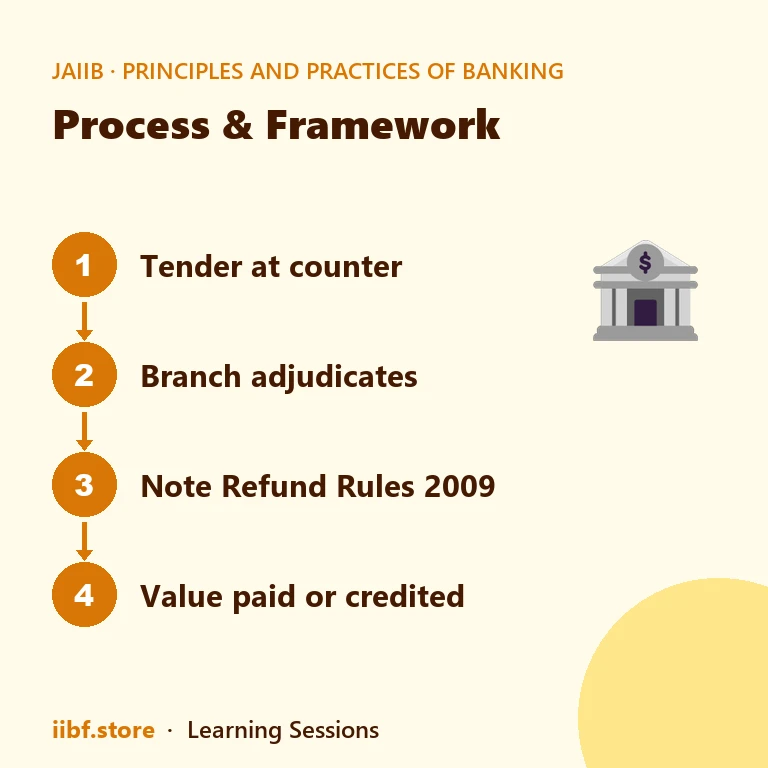
The second is adjudication. A mutilated note is not simply exchanged — somebody has to judge how much of the note survives and pay accordingly. Under the Reserve Bank of India (Note Refund) Rules, 2009, as amended in 2018, all branches of commercial banks are authorised to adjudicate mutilated banknotes and pay value for them. That is the line the video is built on. Adjudication used to be a currency-chest-and-Issue-Office affair in most people's memory; it is now an ordinary branch counter function.
Small Finance Banks and Payments Banks sit slightly outside this. They may offer the facility, but it is at their option rather than an obligation.
Soiled, mutilated, imperfect — three different buckets
The vocabulary matters because the treatment differs.
A soiled note is one that has simply become dirty and limp through normal use. A two-piece note where the cut passes through a spot that does not damage any essential feature, and the two halves are pasted back together, also counts as soiled. Soiled notes are exchanged at full value, full stop.
A mutilated note is one where a portion is missing, or which is made up of more than two pieces. These go to adjudication and may fetch full value, half value, or nothing at all.
An imperfect note is one that has become wholly or partially obliterated, shrunk, washed, altered or indecipherable — but is not mutilated. Think of a note that went through a wash cycle and came out unreadable in patches.
Note that a branch cannot refuse a tender merely because a serial number is missing or a particular feature is hard to make out. Refusal has to be grounded in the Note Refund Rules, not in the cashier's comfort level.
How the value is actually calculated
This is the part that decides whether you walk out with full money, half, or a rejection slip, and it turns on the surface area of the single largest undivided piece you tender. The threshold changes at the fifty-rupee mark.
| Denomination | Area of single largest piece | Value payable |
|---|---|---|
| Rs 1, 2, 5, 10, 20 | More than 50% | Full value |
| Rs 1, 2, 5, 10, 20 | 50% or less | Rejected — no value |
| Rs 50 and above | More than 80% | Full value |
| Rs 50 and above | 40% to 80% | Half value |
| Rs 50 and above | Less than 40% | Rejected — no value |
A worked example makes the asymmetry obvious. Suppose you tender a Rs 500 note of which roughly 60% survives as one piece. Sixty per cent falls in the 40-to-80 band, so you are paid half value — Rs 250. Now tender a Rs 20 note with the same 60% surviving. Twenty rupees sits in the lower slab, where anything above 50% is full value, so you get the whole Rs 20. The small denominations are treated more generously precisely because half of twenty rupees is not worth the paperwork.
Also worth remembering: for the lower denominations there is no half-value option at all. It is full value or nothing.
Counter limits, charges and the receipt route
The right to exchange is not a right to empty a sack of currency at a busy counter, and the limits are where people get turned away legitimately.
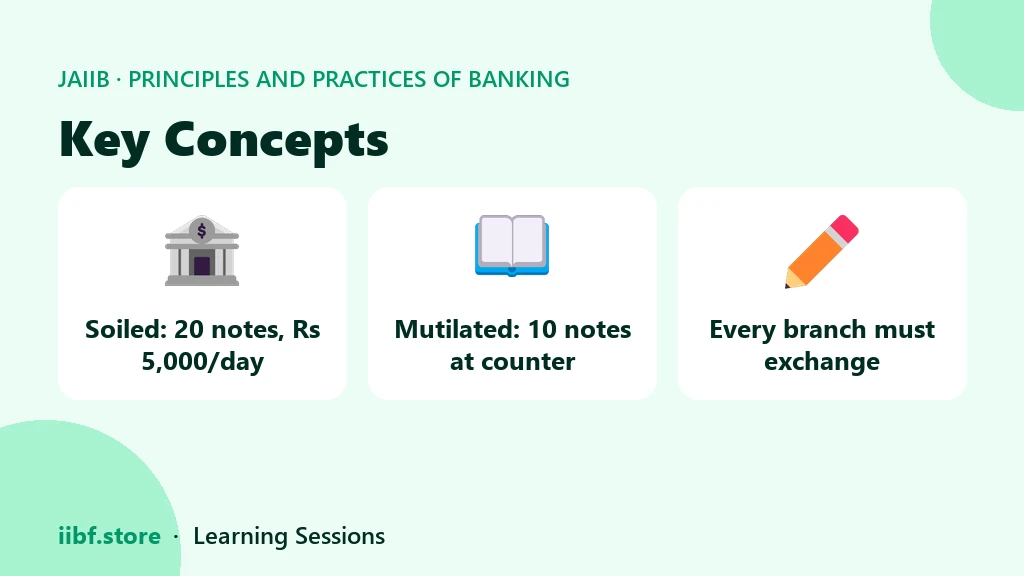
For soiled notes, up to 20 pieces with an aggregate value of up to Rs 5,000 can be exchanged across the counter, free of charge, per day. For mutilated notes, up to 10 pieces can be handled at the branch counter, again within the Rs 5,000 ceiling.
Cross either limit and you are not refused — you are shifted to a different track. The branch accepts the tender against a receipt and credits the value to your account, with the credit to be made within 30 days of tender. This is where having an account helps in practice, because electronic credit needs account details. Service charges may apply on above-limit tenders, and banks are expected to obtain bank account details from tenderers so the exchange value can be paid by electronic means.
If a branch declines outright, ask the officer to record the refusal and cite the rule. Refusing a legitimate tender of soiled and mutilated notes is a compliance failure, and it feeds directly into the customer service and grievance redress machinery — the same machinery covered in the Ombudsman scheme updates on our blog.
Why JAIIB PPB keeps asking this
This topic is a reliable source of one or two marks because it is rule-bound and unambiguous. Examiners like it for exactly the reason candidates dislike it: the numbers are arbitrary and must be memorised. Three things carry the weight — the 40% and 80% area thresholds for Rs 50 and above, the 50% threshold for Rs 20 and below, and the 20-piece and 10-piece counter limits with the common Rs 5,000 cap.
A common trap is the two-piece note. Candidates classify it as mutilated because it is torn in two. It is soiled if the halves are pasted and no essential feature is damaged, and that single distinction changes the answer from half value to full value. Another trap is assuming the customer must hold an account at the branch. They need not.
If you are preparing Principles and Practices of Banking, this sits in the customer service and currency management territory. Run it alongside the clean note policy and the grievance redress chain rather than as an isolated fact — that is how case-lets present it. Practise it with the JAIIB course material, then test recall under time pressure in the mock test bank. If you are also tracking rate-linked topics for the same paper, keep the RBI rates page open beside your notes. The authoritative text on soiled and mutilated notes is the Reserve Bank's own currency portal at rbi.org.in, and it is worth reading once in the original.
The practical takeaway
Walk in with fewer than ten damaged pieces and under Rs 5,000, and any commercial bank branch should settle it across the counter without charge, whether or not you bank there. Bring more than that, and expect a receipt and a credit within a month. Know the area bands before you argue, because the cashier is applying a table, not an opinion — and on soiled and mutilated notes, that table is the whole game.
Can a bank refuse to exchange my torn note because I do not have an account there?
No. Banks must extend the exchange facility to non-customers as well. An account is only practically necessary when the tender exceeds the counter limits and the value has to be credited electronically.
How much will I get for a Rs 500 note that is roughly half missing?
If the single largest surviving piece is between 40% and 80% of the note's area, you receive half value, so Rs 250. Below 40%, the claim is rejected. Above 80%, you get the full Rs 500.
Is there a charge for exchanging damaged notes?
Within the counter limits — 20 soiled pieces or 10 mutilated pieces, up to Rs 5,000 a day — the exchange is free. Tenders above those limits are accepted against receipt and may attract permissible service charges.
Which rules govern the value paid on a mutilated note?
The Reserve Bank of India (Note Refund) Rules, 2009, as amended by the Note Refund Amendment Rules, 2018. They set the area-based slabs that branch officials apply when adjudicating a claim.
Prefer revising from a printed book?
Chapter-wise books with MCQs after every chapter — minimal pages, complete coverage, delivered anywhere in India. Every book has a free sample to read first.
221 pages · 831 MCQs
Learning Sessions · Ashish Sir
131 pages · 672 MCQs
Learning Sessions · Ashish Sir
128 pages · 524 MCQs
Learning Sessions · Ashish Sir
107 pages · 445 MCQs
Learning Sessions · Ashish Sir
148 pages · 478 MCQs
Learning Sessions · Ashish Sir
151 pages · 465 MCQs
Learning Sessions · Ashish Sir
148 pages · 375 MCQs
Learning Sessions · Ashish Sir
216 pages · 895 MCQs
Learning Sessions · Ashish Sir
109 pages · 300 MCQs
Learning Sessions · Ashish Sir
104 pages · 360 MCQs
Learning Sessions · Ashish Sir
82 pages · 297 MCQs
Learning Sessions · Ashish Sir
151 pages · 600 MCQs
Learning Sessions · Ashish Sir
98 pages · 282 MCQs
Learning Sessions · Ashish Sir
132 pages · 225 MCQs
Learning Sessions · Ashish Sir
188 pages · 435 MCQs
Learning Sessions · Ashish Sir
117 pages · 236 MCQs
Learning Sessions · Ashish Sir
Learning Sessions · Ashish Sir
118 pages · 299 MCQs
Learning Sessions · Ashish Sir
Learning Sessions · Ashish Sir
Learning Sessions · Ashish Sir
Learning Sessions · Ashish Sir
115 pages · 255 MCQs
Learning Sessions · Ashish Sir
Learning Sessions · Ashish Sir
334 pages · 936 MCQs
Learning Sessions · Ashish Sir
Learning Sessions · Ashish Sir
115 pages · 344 MCQs
Learning Sessions · Ashish Sir
107 pages · 240 MCQs
Learning Sessions · Ashish Sir
90 pages · 150 MCQs
Learning Sessions · Ashish Sir
Learning Sessions · Ashish Sir
Quick quiz on this topic
5 exam-style questions from our free test bank — check yourself before you move on.
Practice this topic
Take a free mock test, download chapter PDFs, or watch a video class — all included on iibf.store.